Showing posts with label weapons. Show all posts

Sunday, June 14, 2015

Disarm Yourself?


'Disarm Yourself,' say the police.
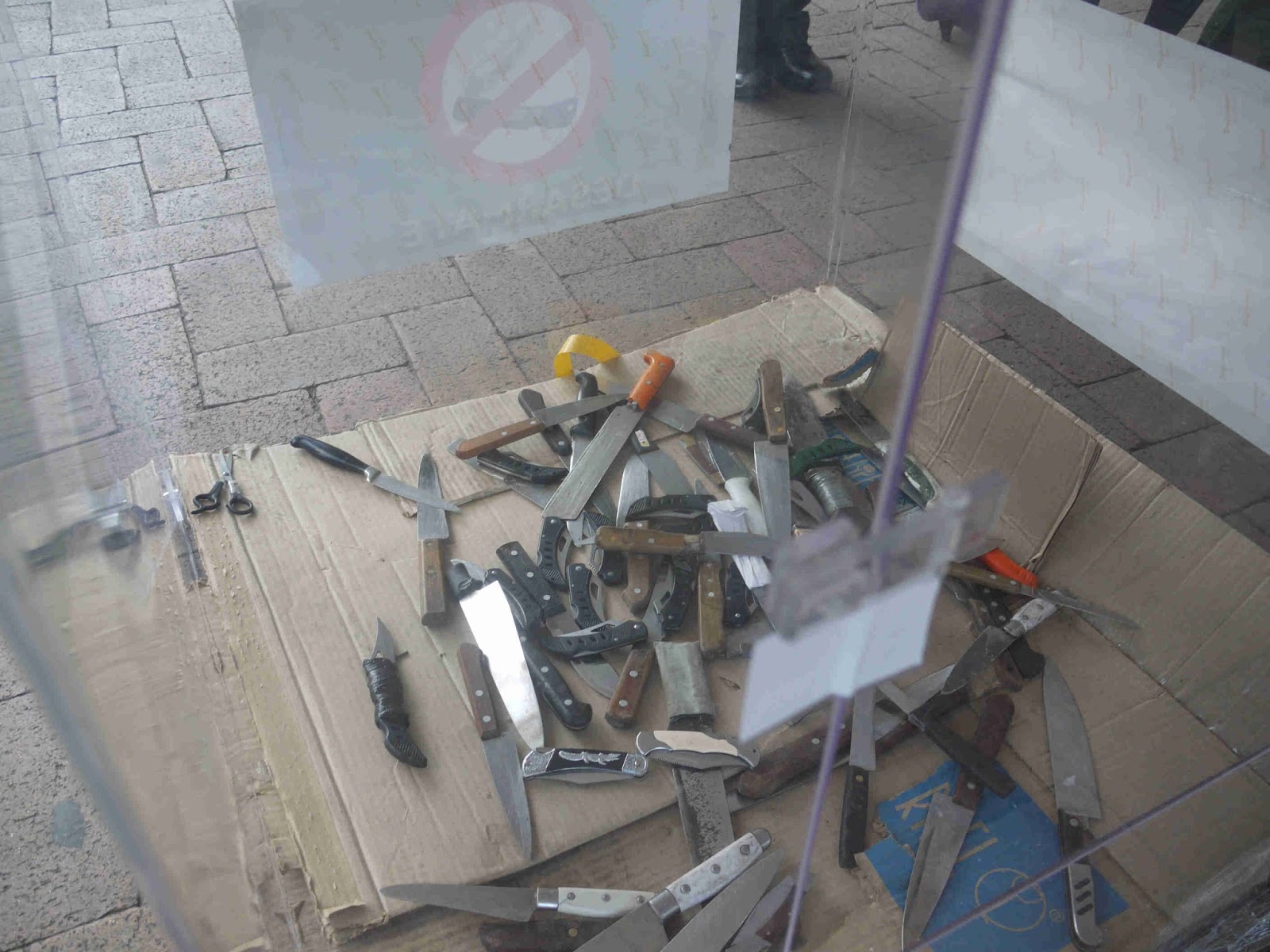
Confiscated knives on display.
The other evening, I was buying an electric shaver in one of the Sanandresitos along Calle 13, an area known for fencing stolen cellphones and money laundering. The shop also had a display of pocket knives - instruments not known for cutting bread and cheese.

As I was leaving, a tough-looking fellow crossed the dark street, purchased a knife and departed with it under his coat. He wasn't heading off to prepare his dinner.

Bogotá has just prohibited the carrying of 'armas blancas,' which include knives and other sharp weapons. It's potentially a positive move, since almost nobody carries knives to defend themselves, whereas criminals routinely do to threaten others.

A jackknife. Tool or weapon?
The trouble is enforcing the law, since knives, stilettos and other such weapons are easy to hide. And, how do you distinguish between someone carrying a knife to commit crime, and someone carrying one for work or carrying home new-bought knives to prepare dinner?

When I was a kid growing up in California, we carried jackknives or pocket knives to be cool and manly, but not to cut anybody.

Regulating the market is even more difficult, since there are legitimate uses for those weapon-like knives, such as camping, hunting and fishing. And, unlike a gun, you can make a knife at home.

All those grey areas leave the armas blancas law open to abuse. Still, for those of us who don't want to be mugged by a drugged out addict, as has happened to me, see the law's advantages.

On the other hand, a week ago I was going home late at night in La Candelaria when two cops stopped and searched me, even tho they had no reason to think I was up to any crime - which I wasn't. Perhaps frustrated by not finding any reefers in my pockets, they confiscated the pepper spray I usually carry, as I have been mugged on my way home at night.

"Where's your permit for carrying this," they asked me.

In fact, no permit is required for carrying a pepper spray.

Prohibited?
I've since talked to several police officers, who agree that what those two cops did was rob me. The cops did not deposit my pepper spray in the police station. Perhaps they threw it away or sold it.

For whatever reason, criminals don't use pepper spray to commit crimes, but the spray seems to have saved me from several muggings.

Do the police really want more crime victims?

Congress is now considering requiring a permit to carry such personal protection. That might be reasonable. But disarming law-abiding people of this non-deadly protection device would just make criminals' work easier.

On the other hand, prohibiting pepper spray and similar devices will compel some people to resort to guns, replacing a non-deadly, non-injuring weapon with a deadly one.

By Mike Ceaser, of Bogotá Bike Tours

Wednesday, March 4, 2015

No Chinese Spoken Here!


Capt. Wu Hong under arrest. (Photo: El Tiempo)
Colombia aspires to be a plugged-in, globalized nation, and arguably its most globalized city should be the port and tourist magnet of Cartagena.

So, why in the world, can't that regional capital of a million people find a Chinese-language translator?

A few days ago, Cartagena port officials discovered that a Chinese ship bound for Cuba carried not only the oil pipes declared on its manifest, but also had hidden 100 tons of gunpowder, ammunition for heavy artillery and more than two million detonators.

The captain, Wu Hong, was duly arrested - but authorities found they could not arraign him because they had no Chinese-Spanish interpreter. A search of Chinese restaurants and shops produced no volunteers, perhaps because the people feared involvement in an illegal enterprise. Finally, a student from China was located and presented himself in court. However, when officials asked him for his cedula, the young man "scratched his head and said that he'd left it at home," El Tiempo reports. The youth departed and has not been heard from since.

Crates of contraband arms. (Photo: El Tiempo
Cuba's trafficking of war material is bizarre, unethical and ugly. The island nation has no borders and nor apparent enemies, particularly now that it's making friends with the United States. (And if the U.S. did invade - in violation of treaty commitments - no amount of artillery would save Havana from the planet's only superpower, anyway.) The arms cache is particularly worrisome in light of the discovery in Panama last July of weapons hidden on a Cuban ship bound for North Korea, a totalitarian dictatorship which regularly threatens to attack South Korea.

Ironically, Cuba is hosting the peace negotiations between the Colombian government and the FARC guerrillas.

But back to Cartagena's embarrassing lack of a Chinese interpreter. I needn't observe that China is the world's most populous nation, the world's second-largest economy and a huge investor in Latin America. It's also a great potential source of tourists.

Are there no students who did semesters in Chinese high schools or universities? No businesspeople who travel to China? No Chinese immigrants who've learned Spanish? No Chinese language scholars?

Cartagena's lack of Chinese interpreters is handicapping prosecution of this ship captain. But it surely throws much more of a wrench into the region's economy.

By Mike Ceaser, of Bogotá Bike Tours

Saturday, March 30, 2013

The Axis of Killing

South American homicide rates:
The region has some of the
world's highest murder rates. 
At the risk of being associated with a United States president of limited intellectual and moral capacity, it's hard not to call the triumvirate of tyrranies which blocked the United Nations Arms Treaty yesterday evil, evil, evil.

North Korea, a totalitarian dictatorship which has millions of its own people in concentration camps and threatens nuclear war to get attention; Syria, who dictator is massacring his own people; and Iran, which has also threatened to annihilate at least one of its neighbors, have blocked an arms treaty which could cut the ongoing slaughter of civilians around the world.

The arms treaty would, finally, impose some common-sense rules on the international traffic in weapons ranging from handguns to surface-to-air missiles. The treaty would, among other things, try to keep weapons out of the hands of murderous dictatorships. Maybe that's why these three regimes oppose the treaty.

The question shouldn't be whether or not to approve this treaty, but why such common-sense rules weren't created many years, civil wars and massacres ago.

Homicides on headstones. (Photo from IPS news)
The treaty is strongly supported by both Mexico and Colombia - nations which have been scourged by firearms violence fed by the globe's unrestricted weapons trade.

Fortunately, the treaty could still become international law thru a vote by the General Assembly, where support appears to be overwhelming. Then, however, it will have to be signed by individual nations. Nations such as Russia and China, which have sold weapons to authoritarian regimes, will probably resist
Assault rifles and bullets: Subjects for free trade?
signing, as will nationsl like Pakistan, which wants to weapons to threaten India, at the expense of its own children's food and education. For its own part, the U.S.'s powerful and paranoid gun lobby opposes the treaty because, it says, it could restrict private ownership of guns - even tho both the treaty's authors and independent analysts say that won't happen.

Ironically, the treaty would actually benefit the wealthy arms exporters in North America and Western Europe which already apply strict controls to their arms sales. That certainly doesn't make it right to hawk weapons to nations which lack money for food and schoolbooks, but it's a little bit less evil.

Ironically, one of gun rights' fundamentalists' strongest arguments is the supposed need for citizens to protect themselves against a tyrranical government. So, it's ironic that gun rights defenders are allying themselves with and defending the interests of exactly such dictatorial regimes, which obviously are not worried by a free trade in arms.
By Mike Ceaser, of Bogotá Bike Tours

Tuesday, September 25, 2012

Montesinos' Web is Back in Court


In what seems like a blast from the past, one-time Peruvian svengali Vladimiro Montesinos and 57 others are on trial in Colombia for smuggling arms from Jordan to the FARC guerrillas in 1999.

The 57-year-old Montesinos is not likely to make an appearance at the trial, since he's already serving a 20-year sentence in Peru for the same scheme, which involved a sale of 10,000 assault rifles to the FARC guerrillas. Montesinos, also faces dozens of other charges in Peru, including for drug running and murder.

But the really extraordinary thing about this arms trafficking scheme was its complexity. On trial in -- besides Montesinos are a Spaniard, a Frenchman, a Lebanese, 14 Peruvians and 15 Russians, as well as 24 FARC leaders - some of whom are involved in the peace negotiations with the government, according to media reports. Montesinos, who was Peruvian strongman Alberto Fujimori's right-hand man, denies that he can be tried in Colombia because he's already been convicted in Peru for the same crimes.

Montesinos, incidentally, was for many years on the CIA's payroll.


By Mike Ceaser, of Bogotá Bike Tours

Monday, September 10, 2012

Fast and Furiously to Colombia II


Made in the USA? Weapons confisticated from the
murderous Oficina de Envigado. (Foto: El Espectador)
A cache of weapons sold to criminals in Texas in order to trace them to Mexican cartels has turned up in Medellin, El Tiempo reports.

It's the second time that weapons from the controversial Fast and Furious weapons tracing program have turned up in Colombia. And, undoubtedly, the news will provide more ammunition for Republican critics of the Obama administration.

But the criticism misses the forest for the trees.

Yes, this project went very wrong when U.S. officials lost control of the weapons. However, the goal was extremely important: to find out how drug cartels and other criminal networks illegal obtain weapons sold in the U.S. and then use them to wreak havoc south of the Rio Grande.

A Colombian policeman, allegedly murdered
by the Oficina de Envigado. (Foto: La Vanguardia)
This April, U.S. authorities reported that more than 68,000 guns recovered in Mexico during the past 5 years came from the United States - which is surely just a fraction of the U.S. guns being used by Mexican criminals. And then there are the guns from the U.S. wreaking violence in the rest of Central and South America, including Colombia and elsewhere. To its credit, the Fast and Furious plan has shown just how far those U.S. guns get smuggled. The weapons in Medellin were reportedly recovered from the 'Office of Envigado', a violent succesor organization to Pablo Escobar's cartel employing ex-paramilitaries killers.

The weapons found a month ago on the property of the Envigado's commander included 13 pistols, 9 submachine guns and 56 rifles, according to El Tiempo, altho the article doesn't make clear how many of those came from the States. But those are probably only a sample of the firepower smuggled here from the U.S.

Guns for sale without background checks
at a US gun show. 
Mexican government officials and common Mexican people whose relatives have been killed in their nation's mindless violence have implored the U.S. to take common sense measures to control gun sales. And it's only common sense that by controlling sales of automatic rifles and huge gun magazines useful only for mass murder (as a start), the U.S. would benefit as well. The recent massacres in a movie theatre and a Sikh temple are plain evidence of that.

A piece of graffiti in Bogotá plays a
tic tac toe game with rifles and
bulls-eyes and concludes that '
Nobody wins.'
But owners of gun stores in U.S. border states such as Texas, Arizona and New Mexico were so selfish that they sued to overturn an Obama administration rule requiring them to file reports when someone purchased several high-powered rifles within a five-day period. Just to make myself clear: the gunshops were still allowed to sell a person multiple high-powered firearms within a five-day period, but just had to report the sales. But the gun sellers' valued their profits so much more than they did lives of people in Mexico and Colombia that they objected even to that. At gun shows, meanwhile, firearms are bought and sold with virtually no control at all.

Everybody knows where most of these weapons go, and who uses them: vicious criminals like the Oficina de Envigado. But the U.S. political system is too intimidated by fanatical gun rights lobbies such as the National Rifle Association to do anything about it.

It's a continent-wide tragedy which appears to be expanding fast and furiously.


By Mike Ceaser, of Bogotá Bike Tours

Sunday, August 26, 2012

The World Trade in Weapons: The Google View

Arms flow from the United States to Colombia. 
Google has created a website displaying the world trade in small arms and ammunition which makes the trade lines appear positively artistic.

A bad trend for the hungry: Colombia's arms sales and
purchases are trending upward.
But the graphics' beauty disguises the fact that these small weapons are creating mayhem and slaughter in nations around the world, including Colombia.

While not as dramatic as tanks, warships and dive bombers, small arms cause a disproportionate number of murder and mayhem around the world, both in domestic and international conflicts and in criminal violence. According to Google's arms project, light weapons and small arms cause 60 percent of the world's violent deaths.

Colombia's arms
are primarily
military. 
In purely economic trade terms, Colombia's arms deals are bad for the country: its exports of small arms and ammunition constitute only a few percentage points of its exports. But that of course is unimportant compared to the human suffering these light machine guns, handguns, assault rifles and their ilk cause.

The Google graphics are not complete. They off course do not include illegal arms transfers. And, the most closed and authoritarian nations, such as North Korea, Belarus and Zimbabwe, are precisely the ones least likely to report arms sales and purchases. Venezuela also does not appear to be disclosing all of its arms trades.

Discouragingly for all but arms dealers, the South American nations I looked at appear to be trading more small arms. How's that news for the region's poor and hungry?

The various nations' graphs also illustrate geopolitical connections. Venezuela is tied to Russia; Brazil, which appears to be making money as an arms exporter, trades with much of the globe.

The United Nations is working on a global arms treaty to at least place guidelines on this trade - but has met furious opposition from U.S. gun fanatics.

An arms highway from Russia to Venezuela. 
Brazil has become a major arms exporter. 
Brazil's arms trading trends upward. 
'Nobody wins' this street art tic tac toe game using
bulls eyes and rifles.
By Mike Ceaser, of Bogotá Bike Tours

Monday, July 16, 2012

The UN's Vital Arms Control Treaty!

You probably haven't heard of it, but at the United Nations headquarters in New York they're discussing a treaty on arms traffic which could someday make Colombia a much safer place.

Unfortunately, a few confused fanatics in the United States make the treaty's passage unlikely anytime soon.

A Swedish-made AT4 anti-tank missle launcher
like those sold to Venezuela and then transferred to
the FARC guerrillas.
Incredibly, no international treaty exists on arms trade, despite the fact that small arms such as handguns and automatic rifles kill a half million people every year, while they together with heavy weapons can destabilize governments and carry out wholesale repression and massacres of civilians, as we've seen in places like Syria, Sub-Saharan Africa, Mexico and Colombia.

Regulating the trade in weapons, which cause so much havoc and killing, seems like a no-brainer. And it would help Colombia, not only by keeping weapons out of the hands of illegal groups, but also to reduce Colombia's extremely high homicide rate.

The treaty under discussion would, according to ArmsControl.org, prohibit international arms transfers when they would cause:

  • The undermining of global, regional, local, or internal peace and security;
  • Violations of international humanitarian law or human rights law;
  • Involvement in genocide, crimes against humanity, or war crimes;
  • Risk of diversion to organized criminals or terrorists;
  • Impairment of socio-economic development;
  • Risk of unauthorized re-export from the recipient state.


It's predictable that authoritarian governments which want weapons to repress and kill their own people would oppose this treaty, as would the governments which earn billions of dollars selling arms to human rights trampling dictatorships. (Recent sales and attempted sales of weapons by China to Zimbabwe and Russia to Syria come to mind.)

Illegal arms seized by Colombia's military. 
Colombia has helped write the new treaty. But neighbor Venezuela, which has made huge weapons purchases and is building an AK-47 factory, abstained from a vote on the issue, as did China and Russia, two big arms exporters. The U.S. voted against the proposed treaty, altho the Obama administration has expressed support for it.

Undoubtedly, the most powerful opponents of this treaty are the United States' fanatical domestic organizations - even tho they actually have nothing to fear from this treaty (altho I wish they would). The evidence, from both common sense and scientific research, is overwhelming that more guns in circulation usually mean more crime and violence, and the drop in homicides following Bogotá's recent ban on carrying weapons is even more evidence of that. U.S. organizations like the notorious NRA choose to ignore the evidence because of their paranoia that any sort of arms registration will end up taking away their handguns. That's ridiculous. Nevertheless, for the time being, they appear to have won their war in Washington. But the proposed treaty says explicitly that it wouldn't affect nations' domestic gun laws, but regulate only international transfers. In addition, the U.S.'s controls on weapons exports are already quite strong, meaning that treaty's impacts would be small. 


The U.S., as the world's largest arms exporter, is critical to this treaty. But ratification by the U.S. would require a two-thirds vote by the Senate, and far more than one third of the U.S. senators live in fear of the NRA.


Standing in the way of sane gun laws in the U.S. is bad enough. But gun-rights fanatics should be ashamed of themselves for blocking a treaty a treaty which could save millions of lives and stabilize nations around the world. By taking this position, the NRA and its allies make themselves passive accomplices to mass murder on a global scale. 

By Mike Ceaser, of Bogotá Bike Tours

Sunday, November 13, 2011

Arms, The Man and Uncle Sam

Bout: Locked up. 
In his United States prison cell, Viktor Bout probably doesn't want to hear anything about Colombia.

Bout, a Russian nicknamed 'The Merchant of Death,' had been the world's most successful smuggler of arms, altho he also traded in drugs and legal products, including even humanitarian supplies.

But Bout tried for one deal too far - an arms sale to Colombia's FARC rebels, for which Bout left the safety of Russia for Thailand to seal the deal. But the supposed FARC representatives were actually informants working for the U.S. Drug Enforcement Administration, who got Bout arested and eventually deported to the United States for trial.

And perhaps it was appropriate that Bout was tried and convicted in the U.S., even tho his weapons killed mostly Africans, because it was the U.S. which, in lots of ways, created Bout. 

A Soviet soldier uses a surface-to-
air missile. With the Soviet
Union's collapse, its weapons
flooded the world. 
Bout flourished in the free-wheeling, uncontrolled illicit arms market, shipping mostly small arms to different warring groups, primarily in Africa. Bout cared only about money. In some conflicts, he sold weapons to both dictators and insurgents fighting them, single-handedly creating arms races. But Bout also shipped humanitarian and other supplies, and was even hired by the U.S. government to supply U.S. forces in Iraq.

Bout's planes also reportedly carried Colombian cocaine north.

Bout's business was successful, in part, because of the U.S. government's traditionally strong opposition to an international treaty regulating the trade in small arms. Those are the weapons which kill about 2,000 people every day, including many Colombians, in insurrections, gang battles and street crimes. Colombians, for example, murder each other at a rate more than double that of war-torn Mexico. The U.S.'s position has shifted somewhat during the Obama administration, but not enough.

The Merchant of Death may be locked up, but, like the drug trade, where there's money to be made, other merchants will appear to make it. And, even more than illegal drugs, weapons should be regulated and controlled. 

FARC fighters carry
black-market weapons. 
Bout had offered the supposed FARC representatives an arsenal of weapons including 100 surface-to-air missiles, armor-piercing rockets and even helicopters. The U.S. indictment focuses on harm to the U.S. and its citizens. But, if the FARC had actually gotten ahold of those weapons, they would have caused lots of carnage against both Colombian soldiers and civilians, even downing passenger planes. 

After Bout's conviction, campaigners called for a U.N. treaty controlling the arms trade. But the U.S.'s National Rifle Association, a paranoid gun-rights lobby which seems to have U.S. presidents terrorized, says that "In most cases, agendas for the elimination of private ownership of firearms are disguised as calls for international arms control to stem the flow of illicit military weapons." I'd like to see how a treaty blocking an African dictator or a Colombian terrorist group from buying a surface-to-air missile is going to take away a rifle from a deer hunter in Montana, but the NRA has apparently convinced itself of it.

And that's fundamental, because Bout is a small fish in the pond. The United States is the world's biggest arms merchant. And a recent U.S. sting operation showed that guns smuggled across borders go directly into criminal hands - including Colombian hands.

And while weapons (along with drugs) remain unregulated, terrorist groups will continue arming themselves and conflicts in Africa, Colombia and elsewhere will drag murderously on.

By Mike Ceaser, of Bogotá Bike Tours

Monday, December 13, 2010

Venezuela's Worrisome Weapons

Chavez and toy. Who'll play with it next?

The news that Venezuela has purchased at least 1,800 shoulder-fired missiles from Russia has got to be frightening for Colombia - and the rest of the world.

Colombia and Venezuela aren't likely to get in a war, and if they did then it's a good bet that the battle-hardened, U.S.-equipped Colombians would defeat Venezuela's socialist 'socialist revolutionary forces'. After all, the last time that Venezuela ordered forces to the Colombian border, many of its military vehicles couldn't move.

Much more worrying is the fact that many of those Russian SA-24 missiles are likely to leak out of Venezuelan hands - whether due to government policy of supporting Colombia's outlaw leftist guerrillas or just plain corruption. There have already been several instances of Venezuelan weapons showing up in possession of Colombia's FARC guerrillas.

Take aim.
Like the leftover guns from Central America's civil wars, these small, mobile missiles will be floating around the Americas for decades, and will inevitably fall into the hands of guerrillas, terrorists, drug cartels and anybody else with enough cash to buy one. A terrorist or joker who posted a photo of himself with one of these missiles could easily paralyze an airport. After all, suddenly the threats are realistic.

Whatever Chavez's paranoid fantasies, the U.S. - already mired down in Iraq and Afghanistan - is not going to invade one of its primary oil sources. Why has Chavez bought these missiles and billions of dollars more in weapons? To make himself feel important, to snub the nose of Uncle Sam, to feed his own paranoias, to buy the support of his military...lots of reasons, and none of them good. The best we can hope for is that all of this armament rusts in peace on Venezuelan military bases. But even then, every bolivar or ruble spent on weapons is one stolen from hungry Venezuelan children, from the people in need of housing and education, from Venezuela's parks and hospitals. It's a real unconscionable tragedy.

More tragic still, Venezuela's weapons purchases place pressure on neighbors like Colombia to stock up on their own armament, stealing from the mouths of Colombian babes, as well. And Colombian ex-President Alvaro Uribe was worried enough about Chavez's war-mongering to push for the deal giving U.S. troops use of Colombian military bases for anti-drug flights. All this on a continent with no prospects of war or sources of ethnic, religious or territorial strife.

Unfortunately, like Chavez's 100,000 AK-47s, his tanks, boats and other toys, these missile launchers are not going to be returned to sender. 

By Mike Ceaser, of Bogotá Bike Tours