Showing posts with label urban policy. Show all posts

Wednesday, November 29, 2017

Memories of El Bronx

Chiri, left, and Juan Carlos point to a detail of their model of El Bronx.

Looking out of the window of
a Bronx rented room.
For most Bogotanos, the name 'El Bronx' represents misery, addiction, depravement and addiction. But, for three young men who lived years there as criminals and addicts, the place also represents joys, friendship and pleasure.

The three young men recounted their experiences recently in Bogotá's Museo Nacional, where they also displayed a scale reproduction of the three streets which for nearly 15 years were home for thousands of thieves, drug dealers, crack addicts, prostitutes and myriad other criminals, just a few blocks from City Hall and the Presidential Palace.
Drugs for sale.
The model was complete with a stabbing, lots of bags of drugs and the streets' many other criminal activities, but also normal activities such as a woman preparing food and children playing with a dog.

Juan Carlos, 19, who lived in the Bronx for six years and Chiri, 22, who lived there for a decade, were both addicted to basuco, a cheap, dirty form of crack cocaine, and supported themselves by robbery. Chiri recounted how he belonged to a gang which stole car parts on the neighboring Carrera 10.

"I'd ask the driver for a handout," he said, "and then bang! the rear-view mirror's gone!" He made a motion of ripping the mirror off of the car.

But El Bronx, which was ruled by several criminal kingpins, each of whom controlled a sector of the
A Bronx corner.
streets, had its own organization and rules. For example, thievery was prohibited inside - except when the prize was big and one had permission from one of the kingpins.

"You could come and go safely," one of the young men told me. "Fresco."

"Nobody stole just a few hundred thousand pesos. It had to be millions."

The neighboring small businesses, which sell bedwear and hardware were safe, the men explained, because they paid protection money. In fact, El Bronx's bosses prohibited stealing within a several block radius, as Chiri learned when he stole a bicycle on the neighboring Los Martires Plaza. The bike's owner chased him into El Bronx, where one of the bosses learned of Chiri's misdeed and sentenced him to being hit 25 times with a wooden board. Chiri took it in stride.

A stabbing in the street.
"I just said 'let's get it over with,' Chiri recalled. "I wanted someone who would do it fast."

But he'd gotten off easy. When Mayor Enrique Peñalosa sent in thousands of police to clear out El Bronx a bit more than a year ago, they found cemeteries and torture chambers, used to punish those who didn't pay their drug debts. I asked the young men about the stories that the penalty for failing to pay was death and they shrugged their shoulders.

"Isn't it that way everywhere?" they asked me. "How about your country?"

I told them that this was beyond my personal experience.

Another unpardonable sin in El Bronx was spying - or even giving the appearance of doing so. For
example, outsiders came in to buy drugs or stolen items, but couldn't dilly dally. If they didn't come, buy and leave, they were suspect and could be punished.

"The Bronx wasn't a shopping mall," Juan Carlos said.

Both boys entered El Bronx because of their drug habits. "It's just a short step from (doing drugs on) the corner, to living in the street," they said, and added, "There are no social classes in El Bronx. Everybody's the same, everybody's an addict."

In contrast, young girls and women addicts ended up trading sex for drugs in El Bronx - and many became prisoners. After months of witnessing the Bronx's crimes, the kingpins would not let them leave for fear they'd rat on them.

Children play with a dog, lower left, near scavenged materials to be sold.
Bazuco, or crack, was the ubiquitous drug there, but marijuana, heroin, psychedelics and alchohol were also popular. Juan Carlos recalled multi-day alchohol and heroin binges. "Boy, I was flying," he said.

The entrance to the old Bronx.
Not all the Bronx residents were criminals and addicts. There were also working families, they said, who lived there because it was cheap: a room cost as little as $5,000 pesos per night, and you could pay in cash by the night.

But, amidst the horrors, the boys also experienced solidarity, when other Bronx residents shared food and loaned money to each other.
Quiet and empty: El Bronx today.


Now, they are living in a rehabilitation center, working with other addicts, and have started a hip hop band called 'Free Soul.'

El Bronx replaced the nearby El Cartucho neighborhood, which was bulldozed and replaced by the Tercel Milenio Park in the early 2000s. The ex-Bronx residents agreed that the problems of addiction and crime won't go away, but urged more support for addicts. That wasn't the case with the thousands who had inhabited El Bronx, many of whom ended up on the street. Juan Carlos and Chiri said there are about 150 recovering addicts in their rehabilitation residence.

The young men made one other point: To its residents, their home was not 'El Bronx,' but 'La L,' named for the L shape made by the two original streets invaded by addicts and criminals driven out of El Cartucho. "El Bronx is a place in New York," they pointed out.

Evidently, they think the original Bronx's reputation reflects badly on them. (Little do they know that New York's Bronx is being gentrified.)

As for Bogotá's Bronx, the city has plans to turn the neighborhood into an arts and education district. We'll see whether that ever happens. So far, it's still vacant.

I asked Juan Carlos whether he regretted his years living in El Bronx.

"No," he replied, "if I hadn't been there, then I wouldn't be here today."

This was the last week the event and exhibition were to be held in the Museo Nacional, but it will move on to the Centro de Memoria and IDArtes.

It's worth seeing, even if your Spanish is less than perfect, like mine. I probably understood less than half of what was said, but I comprehended enough to appreciate the tragedy, suffering and humanity of El Bronx, and why it's a good thing that it's gone - until another one appears.

Related:

Battle in El Bronx


By Mike Ceaser, of Bogotá Bike Tours

Saturday, November 18, 2017

Plaza San Victorino UInder Guard

A police line on Plaza San Victorino today.
Plaza San Victorino, known for the nearby stores selling inexpensive toys, clothing, housewares and
Barricades on the plaza's west side.
other things, is sealed off these days. The city fears, reasonably, that, given the chance, street vendors will invade and occupy the plaza, as they have done many years before as Christmas neared. 

Some years, police invaded, the vendors rioted, and the police used tear gas. This year, they want to avoid those crises before they happen.


By Mike Ceaser, of Bogotá Bike Tours

Saturday, October 28, 2017

A New Life Growing in San Juan de Dios Hospital

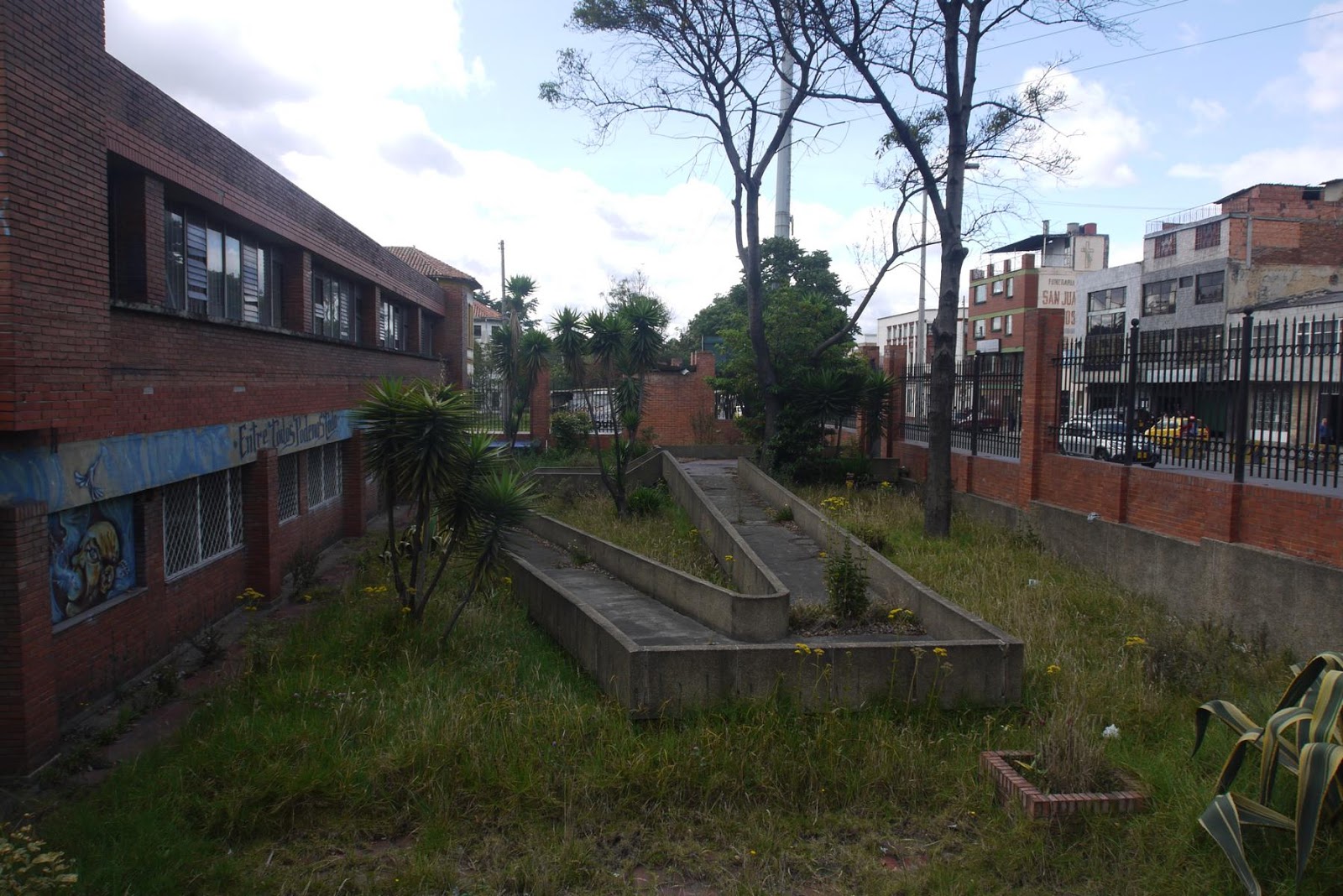
A hospital building, behind growing trees.
The hospital's church.
San Juan de Dios Hospital, on Calle 1 and Carrera 10 in south-central Bogotá, holds a legendary status in Colombia's medical history. Its roots reach back to the 16th century, and some of the country's most accomplished doctors did their internships there.

But, amid financial problems, the hospital was shut down in 2001. Since then, it has been the center of controversy, as citizens groups and some politicians called for its reopening, laid-off employees lived in its buildings, demanding back pay, and its structures deteriorated.

Mayor Gustavo Petro supported the hospital's renovation and reopening - despite the huge cost - but did nothing. Under Mayor Peñalosa, two small sections of the hospital have been turned into emergency medical centers for ambulatory patients.

Meanwhile, the rest of the buildings continue deteriorating, and the trees keep growing, turning the hospital grounds into a kind of urban forest interspersed with decaying buildings, very possibly haunted.

San Juan de Dios's long limbo is nothing but a tragedy for Bogotá: for sick patients who suffer thru long waits for treatments, and for the hospital's neighbors, for whom its campus could provide much-needed green space - if only visitors were allowed in.

An urban forest.
A wheelchair access ramp for patients who never come.
The front of the building, a small part of which is in use.

Wouldn't this make a nice park, or medical museum?

By Mike Ceaser, of Bogotá Bike Tours

Wednesday, November 2, 2016

Our Pigeon Problem

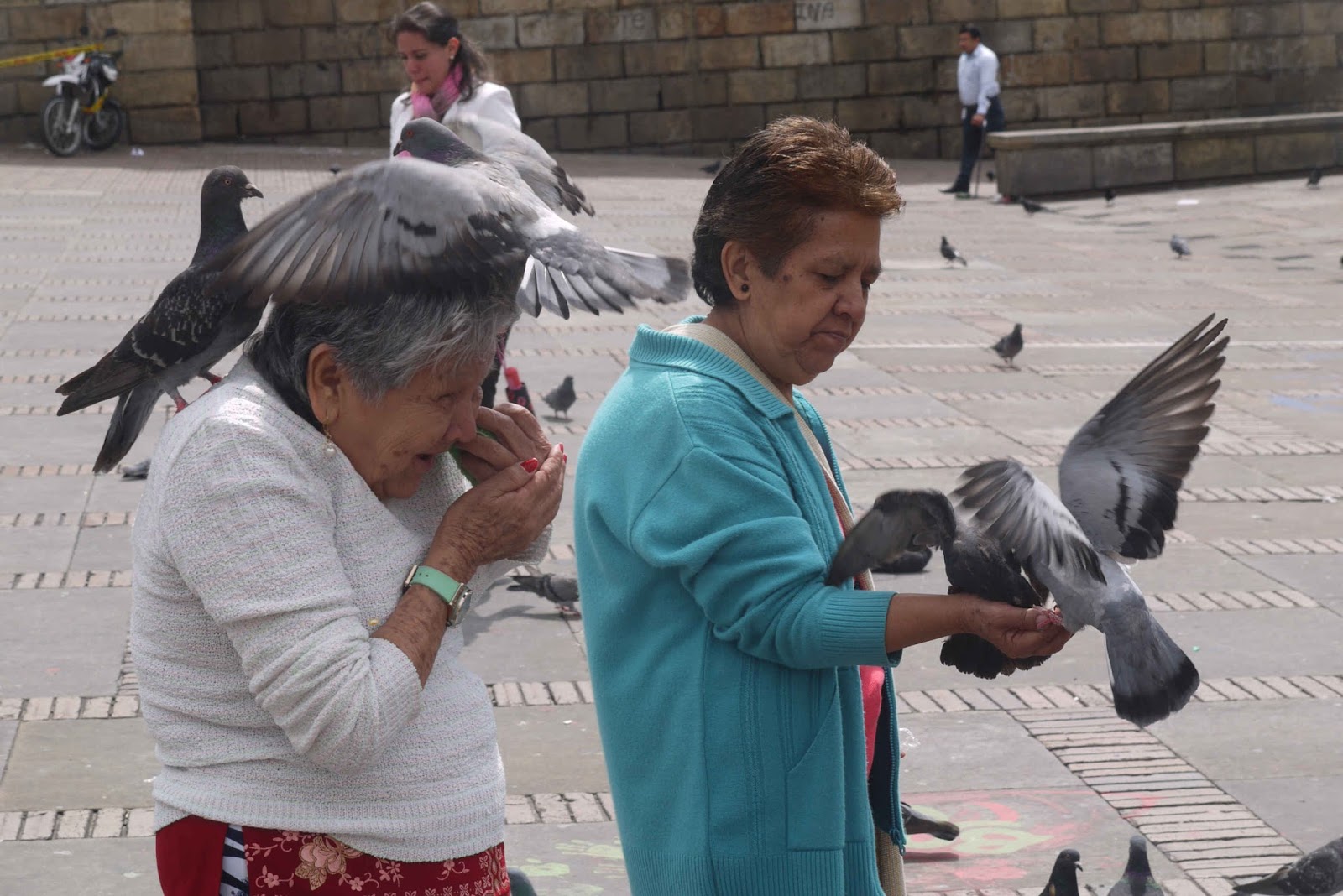
Young fun! An older woman gets a thrill from a headful of pigeons on Plaza Bolivar.

Feathered friends or rats with wings, Bogotá's got plenty of pigeons. Too many, says City Hall: the animals roost on statues, churches and historic buildings, damaging and discoloring them with their feces. A few years ago, the Cathedral placed spikes on its front to repel the animals. But, pigeons not being the brightest creatures, they impaled themselves, creating a gruesome version of crucifixion. The church removed the spikes.

Now, the city's considering more humane methods of population control, such as lacing their foods with contraceptives or building a pigeon roost, where their eggs would be taken away.

My bet is that the hated and beloved pigeons will be with us for a long time.

A pígeon in hand is worth two on the pavement.


The pigeons make the picture on Plaza Bolivar.

By Mike Ceaser, of Bogotá Bike Tours

Indigentes All Over

Homeless drug addicts pass the hours away on the median of Carrera 10 south of San Victorino.
When thousands of police invaded El Bronx this May, they discovered a place of horrors. Crack addicts, child crack addicts, prostitutes of all ages, torture chambers, and even murder victims, buried and forgotten beneath the buildings.

However, what might have been a new life for the addicts and criminals in the bronx, who are also
Residents of El Bronx. (Photo: Semana)
victims, has not come to pass. According to news reports and people who work with addicts, many Bronx residents were bussed to neighboring towns, where they were just dumped on the street, or dropped off on the banks of the Rio Bogotá.

Of course, many addicts reject assistance, so social workers' jobs aren't easy. But now, complain residents of neighborhoods like San Bernardino, located just south of Tercer Milenio Park, the drug addicts camp on their doorsteps. Businesspeople complain about addicts sleeping and defecating in front of their doorways and have marched in protest to Plaza Bolivar.

Permitting a criminal district in the city's center, just a few blocks from City Hall and the presidential palace was intolerable. But now things may be worse, both for the Bronx residents, who lost their homes and community, and neighbors, who now feel as tho they're living in El Bronx.

The 'good' news? Just as before the Bronx there was El Cartucho, sooner or later the same population will settle someplace new and establish a new 'Bronx.'

By Mike Ceaser, of Bogotá Bike Tours

Wednesday, October 26, 2016

A Minor Example of Municipal Malfunction


Parque la Concordia today, and tomorrow, and the day after...
El Parque de La Concordia is a small public park located above the La Candelaria neighborhood, furnished with some swings, exercise bars and a futsal/basketball court. It's popular with neighborhood sports teams and dog walkers, as well as hippies and pot smokers. It's about the only substantial green area nearby.

At least, that's the way it was, until the city improvement folks got their hands on it.

In March, city workers blocked off the park and began renovation work due to be finished by July 1. July came and went, as did, Sept. 1, the next completion date. Since then, the city appears to have given up on publicly announcing such dates. I'd bet money that the park won't be completed until 2017.

Is this just incompetence? Bad planning? Or, is someone stretching this project out to milk all the money they can from it? After all, besides myself, nobody else seems to be paying attention to this project, even tho this was the neighborhood's only usable court for sports. (The only other one, a few blocks away, is disabled by a separate public construction project.)

Meanwhile, on hill hillside above, the Externado University is racing ahead with its construction of two towers, for which it deforested a large area, and which will block residents' views of the hillside.

The most infuriating part of all this? It was a perfectly good park before they started on it.

Will this history be repeated in the construction of Bogotá's metro system? Many prospective contractors and public officials are undoubtely salivating already. On the other hand, the metro project will recieve lots of media scrutiny, something which doesn't happen with small projects like this one.

And here's the topper: The electricity company clearly did their work, trusting, I suppose, that the contractors would actually finish by July. So, now we have and unused and useless park lighted up all night by two dozen super-bright bulbs, for the benefit of one security guard. This is a nation with blackouts and, until the recent rains, an impending electricity crisis.


By Mike Ceaser, of Bogotá Bike Tours

Thursday, March 19, 2015

Good Riddance Mayor Petro - But Not Yet

Bogotá Mayor Gustavo Petro. (Photo: El Universal)
Petro's enemies have made a sport of trying to oust him from office. In April 2013 they filed the more than 630,000 voter signatures required to hold a recall election. However, before that election could be held, the procurador ousted Petro in early 2014 for mishandling garbage collection. Nevertheless, only a month later, in the face of myriad legal maneuvers, his ouster was suspended and Petro returned to office. To the anti-Petristas' frustration, the short suspension appeared to kill the possibility of a recall vote.

However, to the surprise of all, this week the Constitutional Court revived the recall vote.

Perhaps the high court - which, incidentally, is engulfed in a corruption scandal - didn't have a calendar. If the magistrates had looked, they'd have seen that the next mayoral election is in October and that Petro's term ends Dec. 31. A recall vote would take at least three months to carry out, placing it only two months before the scheduled mayoral election. And, if Petro lost, they'd have to select a placeholder mayor and schedule an election to select the person to serve the last few months of his term. That would mean two or three expensive elections within a few months, conflict and extreme instability in municipal government.

El Tiempo analyst Yesid Lancheros points out that the noise generated by the pointless Petro recall vote would drown out the policy debates before the vote for the next mayor. Lancheros also observes that the recall vote would almost surely lose - of the 34 such votes held since 1994, not a single recall has succeeded. But the recall vote alone would cost 40 billion pesos. Isn't there a better use for all that money?

Even ex-Congressman Miguel Gómez Martínez, who started the recall effort, told Blu Radio that the court's latest decision was "a joke and the result of not having justice."

None of which changes the fact that Petro has been, if not a bad mayor, a huge disappointment for those of us who hoped the ex-M19 guerrilla leader would bring truly innovative ideas to Bogotá.

Instead, Petro's Bogotá Humana has meant many failed, half-hearted and pointless policies:

Sacks of trash on a sidewalk along Jimenez Ave.
Petro's brief ouster was for allegedly mishandling the city's garbage collection service, so you'd think he'd have taken real steps to resolve this problem. But rather than taking real steps to reduce garbage - such as taxing plastic bags, applying a deposit system to containers or creating a meaningful recycling program - the mayor is expanding the city's solid waste dump.

A huge - and daily - traffic jam in central Bogotá.
One of Bogotá residents' constant complaints is the traffic congestion. And, upon being elected, Petro promised to replace Bogotá's failed Pico y Placa law with something dramatically different: a London-style congestion charge. Altho the mayor presented the congestion charge to the City Council twice, it didn't back the idea, which died. Instead, Petro just twiddled with the failed Pico y Placa.

Cyclists on Carrera Septima's bike lane.
Bogotá was once seen as a regional cycling leader, and Petro set himself up as a great advocate of bicycling and other clean transport. He has created several bike lanes and financed a short pro-bike PR campaign. But the bidding processes for a public bikes scheme repeatedly failed to attract responsible companies, leaving Bogotá lagging behind neighboring capitals which set up public bikes years ago.

The Santamaria Bullfighting Plaza with a sit-in by bullfighters in front.
 Perhaps surprisingly for a man who helped lead a violent guerrilla group, one of Petro's headline efforts was to end bullfighting in Bogotá. He promised to convert the 'Plaza de Toros' into a 'Plaza de Todos.' Petro used a serious of stratagems, including setting up an ice skating rink in the plaza during the bullfighting season, to block bullfights there. The mayor lost a long legal battle to prohibit bullfighting, so he decided that the plaza needed to be shut for renovation. But the bidding process for the renovation contract keeps getting suspended. Meanwhile, for no discernible reason, the plaza's administration banned tourist visits. Instead of being the Plaza de Todos, Petro has turned the historic building into the Plaza de Nadie - Nobody's Plaza.

The bullfighting plaza will be vacant for the foreseeable future.
A TransMilenio bus belches smoke in La Candelaria.
And a severe problem which has barely even registered on Petro's Bogotá Humana program - the air pollution which causes thousands of premature deaths every year. Of course, Petro's done nothing substantial about this.

A scene in El Bronx.
Petro has repeatedly promised to improve the lives of the denizens of central Bogotá's notorious Bronx street, with its addicts, thieves and prostitutes. But initiative after initiative has gone exactly nowhere.

Good bye and good-riddance Mayor Petro - but not until the end of the year.

By Mike Ceaser, of Bogotá Bike Tours

Tuesday, March 17, 2015

Flying Above Problems

The Torre Colfondos, on Calle 67 and Carrera 8 in Chapinero, will not have a commuters heliport - for now.
(Photo: Panoramio)
Imagine the convenience of flying quickly and smoothly high above the noise and congestion of central Bogotá between Bogotá's business center and El Dorado Airport.

Such a service would come, naturally, at a high price for the commuter - but perhaps a much higher one for the city.

High above Bogotá, a commuter helicopter takes off.
(Photo: Aviatur)
Aviatur has been proposing using the commercial heliport on top of the Torre Colfondos, on Calle 67 and Carrera 8, for commuter flights from the surrounding business district to the airport. In the face of neighbors' protests about noise pollution, the company announced today the suspension of the plan, but that they would seek another location.

Helicopter commuting is already established in many big, traffic-choked cities. Liberty Helicopter, of New York, for example, offers eight-minute flights between New Jersey and Manhattan for $200.00 per day, replacing a one-hour ferry boat commute.

For elite bankers, stockbrokers, politicians and others, an hour may be worth $100.00. By the same token, the wealthy live in isolated, protected communities, send their kids to private schools and vacation on private tropical islands, far away from the problems which afflict the rest of us.

Congested streets? Why, we just fly over them!

Crime in the streets? That's why we live behind walls in a private community!

Pollution? Poverty? Dirt and hunger? We don't even have to see those things!

All of this might be well and good (besides the tremendous environmental impact), except that it insulates the wealthy and powerful - often society's decision makers - from society's real problems.

Once Bogotá's elite fly over the city's noise, pollution and traffic jams, they'll care less about working to solve those problems.

As a result, those problems become less likely to be solved.

By Mike Ceaser, of Bogotá Bike Tours

Sunday, January 25, 2015

Bogotá's Public Bikes - Stuck in Park

A delivery cyclist rides beside traffic in the Santa Fe neighborhood. Is Bogotá ready for public bikes?
On Friday, Bogotá suspended for at least the third time bidding for a public bicycles program.

Bicyclist fill the street during the Sunday Ciclovia.
Cycling isn't so popular the rest of the week.
The program's non-start is not only a failure of the public bikes program, but another decline in Bogotá's status as a cycling leader.

Creating a public bikes program has been a long-time dream for sustainable transport advocates here. A few years ago, they even tried out a pilot programs, which revealed interest in the service. Since then, there have been repeated plans and predictions.

However, despite repeated promises, no public bikes have hit the streets. (The District Institute for Sports and Recreation, the IDRD, does lend bikes in a few spots in the city, but their program is limited and not designed for transport. Go figger.)

Public bikes on Jimenez Ave. They are to be used only on specific
streets and are not intended for transport. (Go figger.)
Over the past few weeks, Bogotá put a planned public bicycles system, consisting of some 1,500
bikes, out for bid. However, only two consortia made offers: One of them has little apparent experience in anything; the second's experience is principally in garbage collection, and its owner has a history of corruption problems and recently supplied defective garbage trucks to Bogotá.

To City Hall's credit, it did not sign a contract with either company. But why can't Bogotá, a big city with a growing economy, manage to set up an economically-sustainable public bikes program? After all, metropolises including Buenos Aires, Argentina; Santiago, Chile; Mexico City and even archrival Medellin all have public bicycles.

A cyclist wearing a pollution mask. Dirty air makes
cycling unpleasant - and even bad for you.
Is it because Mayor Petro, a one-time leftist guerrilla leader, suffers particular challenges in working with private businesses? Or do potential bidders, particularly operators of public bike programs in other cities, feel that Bogotá's crime, weather or vehicular chaos doom such a program to failure here?

Once upon a time, more than a decade ago, Bogotá was seen as a leader in the developing world in the promotion of bicycling. But in the last dozen years cities, Bogotá's bike lane network has been neglected, public bikes have not materialized and other cities around the region have made strides in cycling.

Sadly, the Colombian capital's inability to get its act together and make public bikes a reality may be symptomatic of a loss of drive and ingenuity from the days when Bogotá was celebrated as a leader in urban renewal.

'Latin America's best cycle paths network.' But other cities are building.
By Mike Ceaser, of Bogotá Bike Tours

Friday, January 9, 2015

Early Return of the Traffic Jams


One of the daily traffic jams in La Candelaria.
Millions of Bogotanos are still far away, on their Christmas vacations, but the city's traffic jams already back.

Waiting and waiting,,. 
And things will only get worse. Last year, Colombians bought a record 326,000 new cars, about hoalf of which will clog Bogotá's streets...unless the government takes real measures - which doesn't mean more twiddling with the failed Pico y Placa law. Instead, drivers should pay for their impacts on the city, in noise, congestion, space used and pollution, thru a London-style congestion charge, charging for parking and raising the price of gasoline.

'Fear of the dollar provokes record car sales,' reports El Tiempo.
By Mike Ceaser, of Bogotá Bike Tours