Showing posts with label mayor Gustavo Petro. Show all posts

Monday, August 21, 2017

Corruption Accomplishes Something


Jumpin' Jack Flash
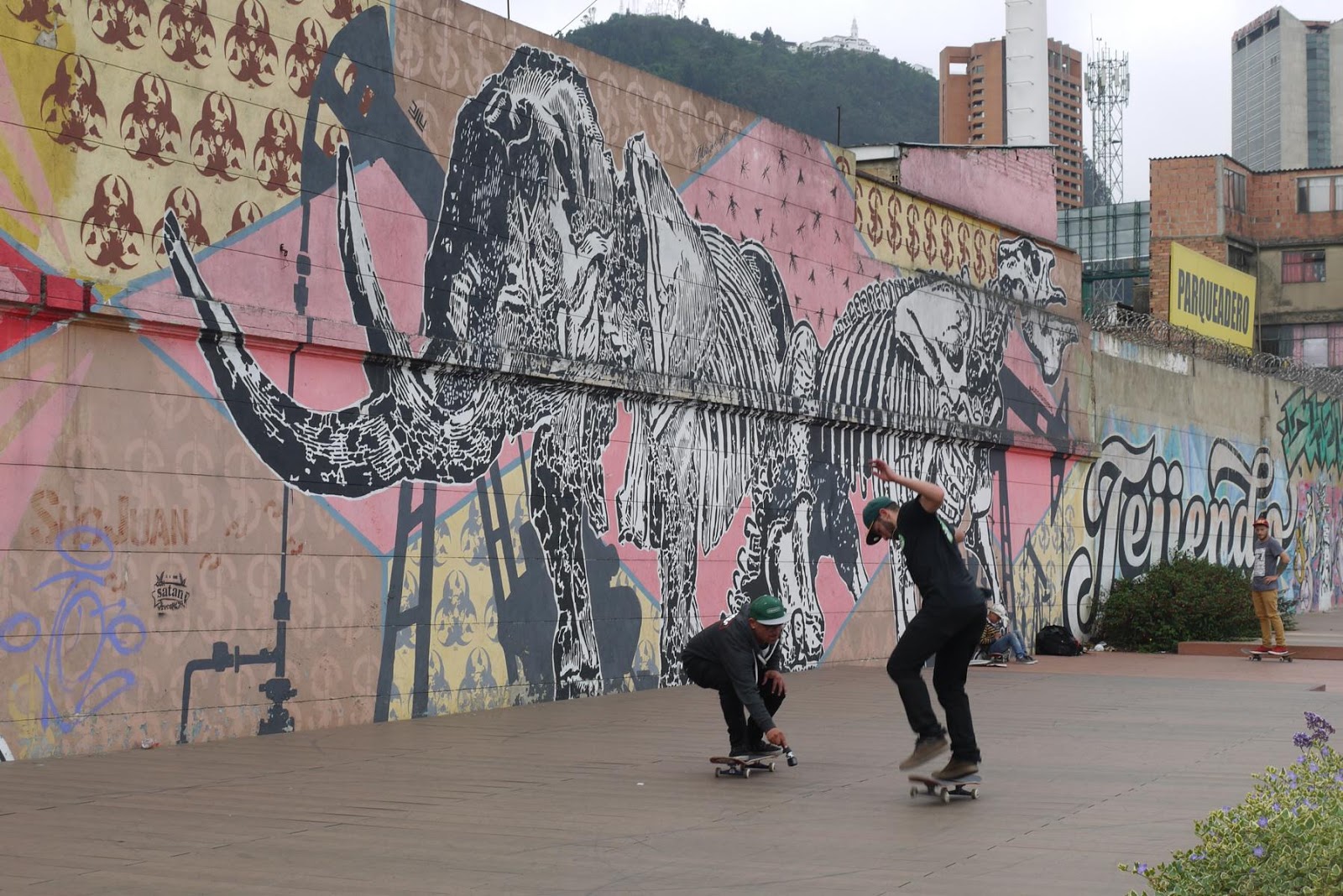
During his last year as mayhor, Gustavo Petron built this nice wooden platform along Calle 26 across from the Central Cemetery and furnished it with tables and chairs for folks to sit around or enjoy lunch. Despite the noise and pollution from the adjoining avenue, the area was actually used - for about a month, until the tables and chairs all disappeared.

Further west along Calle 26, the city build similar platforms, but these were never even furnished.


The whole project stank badly of an administration ladeling out public money to friendly contractors - no matter the usefullness of the work- which is a long-winded way to say 'corruption'. (They also installed bike racks in a place where nobody would want to park a bike -which racks were promptly stolen.)

But the public expense has not been completely useless. The wooden platforms have become popular skateboard parks, as these photos attest. And the huge city-funded murals don't harm the visuals at all.


The below scenes, further west along Calle 26, with backdrops of murals by Toxicomano y DJLU, are in a stretch where the Petro administration built wooden platforms, but never did anything at all with them. Is that corruption compounded by mismanagement?

Happy skateboarding!


By Mike Ceaser, of Bogotá Bike Tours

Thursday, September 22, 2016

The Parks Which Might Have Been

Prohibido entrar: Pedestrians walk past an off-limits green space.
A few years ago, when the city built the TransMilenio line to the airport along Calle 26, they demolished houses and businesses on both sides along the blocks west of the Central Cemetery.

Since then, the areas have remained vacant, unused, abandoned, in a neighborhood in dire need of green space to walk dogs, play football or throw frisbees.

Now, to add insult to injury, the city has walled off the lots with barbed wire and hired security guards with vicious dogs to keep neighbors out of green space which they should be welcomed into. More than one passerby has observed the resemblance to a prison camp.


A dog doing his duty.
The barbed wire adds an ugly element to the colorful city-sponsored murals.

Nearby, during its last months, the Petro administration made a poorly-thought out effort to turn parts of the land into a seating area, by building wooden floors. But the few tables and chairs the city supplied quickly disappeared, apparently stolen. Today, skateboarders make use of the city investment, whose only other beneficiaries were likely Petro's business acquaintances.


By Mike Ceaser, of Bogotá Bike Tours

Thursday, September 24, 2015

The Latest Bullfighting Round


Posters announce the 'Anti-bullfighting referendum.'
A performer dressed as a bull at an
anti-bullfighting demonstration.
Mayor Petro's anti-bullfighting crusade may have received a fatal stabbing from the Concejo de Estado, which ruled today that Petro's planned referendum on the issue was illegal, because the city doesn't have the authority to decide on such a traditional practice.

Petro hasn't allowed bullfighting in the historic Plaza Santamaria since Feb. 2012, and with or without a referendum fights aren't likely to return soon, since Petro has scheduled renovation work there.


Young bullfighters practice in the Santamaria Stadium.
By Mike Ceaser, of Bogotá Bike Tours

Wednesday, November 12, 2014

Bringing Bullfighting Back to Bogotá?


Bullfighters Cesar Rincon, El Juli and others on stage today in front of the Santamaria Plaza.
Will Bogotá see bullfighting again?
No idea why someone was
waving a United States flag.

A group of active and retired bullfighters, including Colombia's Cesar Rincon and the Spaniard Julián López Escobar, known as 'El Juli,' led a rally today outside the Santamaria bullfighting stadium demanding that the historic plaza be reopened to bullfights.

Mayor Gustavo Petro has not allowed bullfighting in the plaza for the past two years.

A group of young bullfighters, called novilleros, have been staging a sit-in for the last 100 days in front of the plaza. Meanwhile, bullfighting supporters have also been battling the mayor in court, and achieved a victory several months ago, when a court ruled that the mayor didn't have the authority to prohibit bullfighting. The mayor has appealed that ruling.

The Petro administration has not only banned bullfighting, but recently also prohibited tourist visits to the stadium, because of scheduled renovation work - even tho no work is actually going on. Upon becoming mayor, Petro said he'd convert the Plaza de Toros into a Plaza de Todos - a 'Place for Everybody.' Instead, it's become a Place for Nobody.

In related news, the novilleros carrying out the sit-in say that a ghost appeared in a photo they took of themselves in a bullfighting stadium passageway.

Strangely, no anti-bullfighting protesters appeared today.

Ghost in the bullfighting plaza? Looks more like a shirt hung up to dry.
Bullfighting advocates have been sitting in for more than 100 days in front of the Santamaria Stadium.
Bullfighting supporters play a board game.
By Mike Ceaser, of Bogotá Bike Tours

Wednesday, October 22, 2014

'A Place for Nobody': The Closing of the Plaza de Toros


When Gustavo Petro became mayor three years ago, he vowed to end bullfighting and convert the historic Plaza de Toros Santamaria into a center for arts and culture, as well as a tourist attraction.

The Plaza de Toros would be transformed into a Plaza de Todos, a 'stadium for everyone.'
A threat? Bullfighters staging a sit-in in front of the plaza.

For a while, Petro seemed to keep his word. He allowed no more bullfights after Feb. 2012 and for a while the plaza was used for sports events, concerts and even, most memorably, ice skating.

However, about a year ago, the sports and cultural events stopped. The only activities which continued there were morning bullfighting practices and visits by tourists, including Bogotá Bike Tours. We'd visited the stadium for years, thousands of time, and never experienced a single problem. Foreign and Colombian tourists enjoyed exploring the handsome old Moorish-style building and learning about la fiesta brava, as well as the building's dramatic political history.

About three months ago, a group of young bullfighters began a (pseudo) hunger strike in front of the stadium, and their morning practices inside ended.

Tourists by a statue of famed Colombian bullfighter Cesar Rincon.
Then, about three weeks ago, the District Institute for Sports and Recreation (IDRD), which administers the city-owned building, changed the building's administrator. The new administrator shut the historical monument to visitors. When I talked to her, she cited the hunger strikers camped out in front of the building.

"When the tension subsides, we'll reconsider," she said.

We had never noticed any tension, with the bullfighters, who are quiet and friendly - or anybody else. Days passed, and the imaginary tension didn't disappear. The stadium remained shut.
Tourists on the plaza's arena.

We sent a letter and called the IDRD. An IDRD official also mentioned the hunger strikers to justify the closure. I pointed out that the strikers are very friendly people, and, in any case, are on the sidewalk outside the stadium - so what possible relevance do they have to what goes on inside the stadium? No reply.

The IDRD did, however, reply to our letter., They justified the closure on the "ongoing process of structural reinforcement for the stadium." Mayor Petro has argued that the old building needs repair work. Many suspect that's an excuse he invented to not allow bullfights. But, whatever the truth, the fact is that no work of any kind has started there - and may never. The handsome old building sits empty and used by nobody.

The Petro administration, rather than turning the old plaza into 'a place for everyone,' has transformed it into 'a place for nobody.' A brilliant move for a city which aspires to make itself into a tourist destination

It's really absurd that one of Bogotá's historical monuments is closed to the public - and even the bureaucrats who made the decision don't seem to know why.

The Moorish-style building was designed by a Spanish architect.
Ride that bull!

The stadium's backside.
By Mike Ceaser, of Bogotá Bike Tours

Sunday, September 28, 2014

Why the SITP is Failing, in 12 Photos


Anybody in there?
In the quiet Teusaquillo neighborhood this afternoon I came upon this long line of blue SITP buses. What was this army of buses doing on a slow Sunday afternoon in this drowsy neighborhood?

As the photos below show, the buses weren't doing much that was useful. Most were completely empty, while a few carried a couple of lonely passengers. This long row, I suspect, contained more buses than passengers.

Another empty bus.
What makes a company send out a fleet of buses even where there are no passengers? The bus owners aren't stupid, so it must be distorted rules and incentives. Are the SITP operators paid for each kilometer their buses travel, rather than the number of passengers they carry? Or, do their contracts require them to cover certain routes, no matter whether or not anybody actually wants to go there?

The SITP is the brainchild of Mayor Petro, and Bogotá badly needs a rationally-designed bus system with clean, efficient vehicles and respectful drivers. But it also needs to be rational and economically sustainable, and the SITP clearly is not that. Petro seems to believe that propaganda and wishful thinking can make things work. But we live in a world of profits and losses, and unless the SITP has the former, it won't last long.

And another empty bus.
Rather than rationalizing the SITP, Petro plans to apply the Pico y Placa rule to the traditonal buses, keeping them off of the road some days every week, thus driving more passengers to the SITP buses. That might work, but making the SITP system more attractive would be a better solution. More sensible, even, would be to take the highly-polluting buses, whether traditional buses, SITPs or TransMillenio vehicles, off of the road. Then, the city would be reducing congestion and also saving our lungs.
Yet another empty bus.

I think I see passengers in this one. Hallelujah!


A single traditional bus does have a few passengers.

By Mike Ceaser, of Bogotá Bike Tours

Thursday, September 4, 2014

Bullfighting Back in Bogotá?

The empty Santamaria bullring might see corridas again soon.
Bullfighting's coming back? Altho a court has ruled that Mayor Petro did not have the authority to break the city's contract to put on bullfighting, you can bet that Petro will do his best to defend one of his few - and perhaps his most signature - accomplishment.

Christ-as-bullfighter.
The court ruled that bullfighting enjoys legal protection because it is a piece of cultural tradition. Petro has not permitted bullfights in the stadium for the last two years, and recently said he'd retire before allowing bulls to return there. But after the court ruled, the mayor said he'd respect the decision. At the same time, Petro also claims that sections of the 83-year-old plaza are in danger of collapse and that the building needs a major remodeling.

The bullfighters suspect the mayor of inventing that supposed danger as an excuse to not allow bullfights, and that in remodeling the stadium the city would make it unusable for bullfighting. Whatever the truth, Petro may now insist that holding major events in the plaza would be hazardous and that the building needs an expensive multi-year workover.

The court also seemed to give Petro a way out by allowing him six months to allow bullfighting in the plaza. Six months from now is early March 2015, and Bogotá's annual bullfighting season is in January and February. So Petro could possibly delay bullfighting until at least 2016 without violating the court ruling.

The Moorish-style Santamaria stadium was built in 1931.
It's understandable that Petro will do all he can to block bullfighting for reasons besides his concerns about animal welfare and the celebration of violence. The anti-bullfighting activists have been a small but vociferous part of Petro's coalition.

And Petro has few other accomplishments to point to. Courts have ruled against two of his other signature accomplishments: his city-wide land-use plan and his reorganization of the city's garbage collection scheme. Meanwhile, hopes that Petro would boost the city's recycling rate and find a new formula to reduce traffic jams have been disappointed.

Bullfighting advocates certainly continue to be dubious about Petro's intentions. A group of young bullfighters called novilleros have been hunger striking in front of the plaza for more than a month demanding the return of bullfights. After the court's ruling, they vowed to continue until a bullfight is actually held in the stadium.
Young bullfighters have been hunger striking in front of the stadium for more than a month. They now vow to continue until the first bullfight is held there.
Bullfighters train in front of the Santamaria Plaza.
By Mike Ceaser, of Bogotá Bike Tours