Showing posts with label kidnapping. Show all posts

Monday, February 2, 2015

Colombia's Lesson for the Middle East

A FARC guerrilla and kidnappees behind barbed wire.
In 1983, ELN guerrillas kidnapped four executives of the German oil company Mannesmann. The company didn't forget about its employees. It sent representatives who purchased the freedom of the four for a reported $8 million, half in cash and the other half to be paid in social investments in the region (which the company never fulfilled). The quadruple kidnapping may have saved the ELN, which at the time was down to just a few hundred fighters, but survives today with some 3,000.

Annual kidnappings in Colombia declined until
recently, when numbers leveled off.
(Image from Paise Libre)
That crime was far from Colombia's first kidnapping - or its last. Armed guerrilla groups began kidnapping as a business practice soon after their appearance in the 1960s. When the crime proved profitable economically and politically, the guerrillas and common criminal groups accelerated the practice thru the '90s and into the early 2000's. Numbers soared to several thousand kidnappings each year (and many kidnappings are never reported to authorities). Only in the last few years, with government military successes and the FARC guerrillas' promise to stop kidnapping, have the numbers declined.

Still, in 2014 outlaw groups kidnapped 245 during just the first eight months of the year, and probably many more unreported ones. Even if the FARC and ELN guerrillas sign peace agreements with the government and give up kidnappings forever, undoubtedly other criminal groups will kidnap more.

Repeating a pattern? A Japanese man kidnapped
by the Islamic State.
In Iraq and Syria today, the Islamic State is using kidnapping to finance itself and gain a horrific kind of attention. It works for them because many European nations pay millions of euros or dollars for their citizens' freedom. (The major exceptions are Great Britain and the United States.) But that's a devil's bargain: The ransom money only serves to strengthen the terrorists, enabling them to kidnap more Westerners and strengthen themselves further.

The nations paying terrorists for their citizens' freedom should look toward Colombia, where the practice reaped only more kidnappings, and decades of violence.


By Mike Ceaser, of Bogotá Bike Tours

Wednesday, November 19, 2014

Best Frenemies?


'There's already a path to resolve the crisis and renew the peace process,' announces today's El Tiempo.
A victory for the peace process?

'The people have the key to peace,' says a sign at a
demonstration today against the suspension of the peace talks.
Judging from today's press headlines, that's what this Sunday's kidnapping of a general by the FARC amounted to.

El Tiempo, Colombia's leading newspaper, headlined 'Advances in moves to achieve general's liberation.'

Remember that the FARC, who had promised to stop kidnapping, grabbed a general and his assistants while he traveled in civilian clothes without bodyguards no apparent hostile intent.

The FARC want find a fast
solution to the crisis they
caused themselves, they say.
But Colombia's  El Tiempo, historically owned by the family of Pres. Santos and an active backer of the peace talks, is not denouncing the guerrillas for breaking their promise or violating human rights abuses, but rather interprets the FARC's actions as an advance, as its subheadline today announced: 'The solution to the crisis could allow a deescalation of the conflict.' Perhaps the guerrillas should kidnap more military officials to advance the peace talks even further?

The contrast with the episode a few weeks ago when the guerrillas murdered several NASA indigenous guards for removing a banner which the guerrillas had hung on indigenous territory could hardly be greater.

That time, government officials denounced the killings, but continued talking peace with the FARC. This time, the government suspended negotiations, but seems to be trying to put a positive spin on the guerrillas' crime. Prosecutor General Eduardo Montealegre termed the kidnapping an 'improper retention' - using what is traditionally the guerrillas' own euphemism for kidnapping.

Pres. Santos won reelection primarily thanks to support for the peace talks, and he's determined not to let anything, even murder or kidnapping, derail them.

For their part, FARC leaders in Havana said they wanted to resolve the situation as quickly as possible and find "a fast, tranquil and just solution to this problem." Strange comments coming from the organization which caused the crisis in the first place and presumably could end it at any moment by freeing the general and other kidnappees.

Students on the National University campus in Bogotá
walk past a mural celebrating the FARC guerrillas.
But the contradiction between the guerrillas' actions and statements also suggests that the FARC leadership cannot control some of its 'fronts'. That's a worrisome reality for any post-peace treaty situation, in which some guerrilla units might defy their leaders and turn into straight-out narcotrafficking groups, as some ex-paramilitary groups have done.

This evening, the FARC promised to free the general, his two assistants and two other soldiers held by the guerrillas.

By Mike Ceaser, of Bogotá Bike Tours

Thursday, October 10, 2013

Kevin Scott's Great Adventure

Kevin Scott, in the Colombian Amazon,
shortly before wandering off into FARC's hands.
(Photo: El Tiempo)
Kevin Scott, apparently, does not read Wikipedia. If he had, he might have learned that San José del Guaviare, a town deep in Colombia's Amazon, is the historical base of the FARC Guerrillas and not a reccomended tourist destination - particularly for an ex- military man from the United States.

But Scott, a 27-year-old ex-Marine, got it into his head to walk from San José del Guaviare across the Amazon jungle to Brazil, armed only with a machete. It promised to be a great adventure, and turned into an even greater one when the FARC seized Scott on June 18 and began providing him free food and lodging (as well as Marxist ideology) for the duration.

When they initially kidnapped him, the guerrillas accused Scott of being a 'mercenary.' But they seem to have warmed up to him. Recently on their web page the guerrillas called Scott "a good gringo, naive and a daydreamer." That's probably not the way an ex-Marine likes to be described. But his family must be comforted to hear that Scott is alive, and apparently well, if a bit confused.

The guerrillas also described Scott as a hippy, who seems to have added a new dimension to couch surfing. After finishing his tour in Afghanistan, the FARC say, Scott "turned into a folkloric gringo, a gum chewer and marijuana smoker, who with a pack on his back, bluejeans and a few dollars in his pocket, set out to travel and get to know the world, with a very unique conception of life."

The FARC seem to have found in Scott an opportunity to wax poetic. They also hope he will get them some of the attention and legitimacy they perpetually craave. When U.S. civil rights leader Jesse Jackson visited Colombia recently, the FARC seemed willing to release Scott - as long as Jackson showed up for a photo opp at the release.

The Colombian government refused to cooperate. Now, Scott may have to wait until the next media star visits.

Scott, however, may not be impatient to live the jungle and guerrilla hospitality. On their website, the FARC quote Scott as saying that, before he leaves the jungle, he wants to see a tiger.

By Mike Ceaser, of Bogotá Bike Tours

Monday, June 24, 2013

A Nation Kidnapped

FARC kidnappees held behind barbed wire in a jungle prison.
No other crime, perhaps, has scarred Colombia's recent history and psychology as deeply as has kidnapping.

Unlike massacres and assassinations - which at least end quickly - kidnappings stretch on for months, years or more than a decade, creating long, painful dramas.

And kidnapping even created its own culture in Colombia - as it's now doing in Mexico - with novels and non-fiction books and even radio programs for kidnapping victims.

Now, two human rights organizations have attempted to place numbers on this scourge. And their report, altho terrible enough, is almost surely a huge underestimate.

The report, A truth Kidnapped (Kidnapping from 1970-2010), is the result of five years' research by Cifras and Conceptos and the Center for Historical Memory, counted more than 39,000 kidnappings over the past four decades. Of those crimes, they said, only some 7,800 kidnappers have been arrested, meaning a 92 percent rate of impunity.

Over these past decades, kidnapping has become a source of chronic anguish in Colombia. For years, foreign journalists made sure to note how wealthy Colombians kept anti-kidnapping hot lines at their fingertips, lived behind barbed wire and traveled with bodyguardss. Colombia's fabled plastic surgery industry got its start from reconstruction for wealthy kidnap victims of the Pablo Escobar era, whose ears and fingertips had been sliced off to horrify family members. And then there was the literature - from Gabriel Garcia Marquez's News of a Kidnapping, to the recent slew of books by Ingrid Betancourt, the American contractors and others rescued from the FARC after years of jungle captivity. Kidnapping even gave birth to what must be one of the world's most unique media forms: Radio stations which transmit messages from anguished family members who hope that their captive loved ones in the jungles or mountains have access to a transistor radio.

But as terrible as the kidnapping study's numbers are, they are surely a gross underestimation. Most kidnappings - 75%, according to the anti-kidnapping NGO Pais Libre - are not reported at all. That may be because the victims are too scared or unsophisticated, unimportant or remote, or because they prefer to reach 'a friendly agreement' by paying the kidnappers instead of involving authorities.

During my journalistic days I interviewed many kidnapping victims, including one famous one: Clara Rojas. She was presidential candidate Ingrid Betancourt's running mate, who while in captivity had a baby with a guerrilla. I also spoke to a young woman who'd been kidnapped by the FARC guerrillas when she was 15 and held in the jungle for three years along with her father, until her family finally scraped together enough money for their ransom. The guerrillas didn't physically abuse their victims, but the woman recalled the terrible boredom of spending her teenage years captive in a jungle tent with no idea of if or when she'd be free.

I also talked to a man who'd administered a ranch near the Venezuelan border. Guerrillas kidnapped him mistakenly believing that he was the ranch's owner, and therefore a valuable prize. They subjected him to a kind of torture by forcing him to endlessly tread water in a river until they became convinced he was only an employee and released him.

I met a man from a rural town who repaired radios and electrical equipment. Guerrillas kidnapped him and forced him to repair their communications equipment. After this happened several times, the man and his family fled to Ecuador, where they were refugees.

Also in Ecuador I talked to a woman who had owned a small town restaurant in a Colombian border area. A group of strangers came and ate for several days without paying. When she finally presented them with the bill, the men informed her they were FARC guerrillas: 'We're not paying,' they said. 'And we're also taking away your business and your sons,' whom they turned into unwilling rebel fighters and permanent kidnap victims.

Stories like those often never make it into the statistics.

Then there have been the guerrillas' spectacular mass kidnappings, including the ELN's 1999 kidnapping of 285 parishioners from a Cali church and the 46 passengers and crew of an Avianca flight the same year. In 2002, the FARC invaded the regional Assembly building in Cali and kidnapped 12 regional deputies, whoom they held for five years before murdering 11 of them.

The most recent high profile kidnapping was of a Spanish couple in La Guajira, apparently by common criminals. Police rescued them last week.

Kidnapping peaked between about 1996 and 2005 and has since declined steeply. This year, officials recorded an average of 5.8 kidnappings per week in Colombia, down from 8 per week last year, according to Pais Libre. That's still a lot, reflecting weak rule of law and the continued activty of outlaw organizations throughout the country.

The FARC guerrillas have said they've given up kidnapping, and hopefully they'll hold to their word. If the ongoing peace negotiations succeed, Colombia's kidnapping nightmare will finally conclude, if not end completely.

By Mike Ceaser, of Bogotá Bike Tours

Sunday, October 14, 2012

Those Still Missing

This couple suspect their nephew, who disappeared on leave one year ago, was kidnapped by the FARC. 
Pais Libre (Free Country), an anti-kidnapping organization, organized a protest by alleged victims of the FARC guerrillas on Plaza Bolivar today called 'Los que Faltan' (Those Still Missing).

With the start of government-FARC peace negotiations just a few days away, the demonstration was intended to pressure the guerrillas to free hostages whom Pais Libre believes the guerrillas still hold. The FARC claim to have released all of their hostages.

It certainly seems possible that the guerrillas continue holding kidnappees. After all, kidnapping became an integral part of the FARC's struggles: it enabled them to intimidate, extort and terrify civilians, as well as to force civilians to work for them. However, the guerrillas may be telling the truth for a very grim reason: the hostages may have died in captivity. But in that case the guerrillas should reveal the truth and hand over the remains.

But, some relatives most likely sincerely, but mistakenly, blame the guerrillas for their missing relatives. One time, I heard a man from the Middle East telephone a Colombian radio program which sent messages to guerrilla hostages. This man's son had gone swimming years before on a beach on Colombia's Caribbean coast and never returned. It seemed most likely that the young man had simply drowned, but his father held onto the faint hope that his son had been kidnapped and survived in captivity.

Similarly, the couple in the photo above said that their nephew, a soldier, had disapppeared a year ago while returning home for leave. But they mentioned no concrete reason to believe that the guerrillas had been kidnapped him.

By Mike Ceaser, of Bogotá Bike Tours

Saturday, June 2, 2012

Out of Captivity and into Controversy

Romeo Langlois, surrounded by FARC fighters,
films his own liberation. (Photo from AFP)
French journalist Romeo Langlois was released this Wednesday by FARC guerrillas who'd helm him for more than a month - and immediately started talking nice about his former captors.

It's not the first time that a just-released kidnappee has praised the guerrillas, in what could be intepreted as a sort of Stockholm Syndrome. But in Langlois' case it's particularly understable, if not justifiable. After all, Langlois voluntarily entered the arena of Colombia's conflict as part of his work, and spending a month on close terms with the guerrillas in a non-journalistic relationship relationhsip is many a reporter's dream. And this month-long kidnapping, Langlois has transformed Langlois from being one of many correspondents working away in developing nations into an internationally-known figure. It's sure to open doors to juicy job offers, make him an authority about Colombia's armed conflict and land a juicy contract for a book or a movie. (If you hear hints of jealousy from me, a former journalist, you're probably  not far off.)

And the guerrillas had every motive to be nice to Langlois, who, they knew, would become a sort of spokesman for them. In return, Langlois said the guerrillas had "treated me like a guest" and that the guerrillas should take into account the guerrillas' points of view.

In response, Ex-President Alvaro Uribe called Langlois a guerrilla sympathizer, which Langlois denied.

Caged FARC kidnappees who
didn't have it so great in captivity.
Langlois has perhaps overlooked the fact that the guerrillas would not have been in a position to be nice to him at all if they hadn't attacked the military unit he accompanied, killing several soldiers, and then held him for more than a month in the jungle. If Langlois had been one of the businessmen, soldiers or politicians whom the guerrillas have often kidnapped, he wouldn't have been treated so kindly nor received so much attention.

When Langlois reports on his experience, he should balance his accounts of the FARC as gracious hosts with information about how the same guerrilla gang also plants land mines, recruits children (including a group of 13 kids during Langlois' own captivity), forces women guerrillas to have abortions, traffic drugs and has kidnapped many other civilians, who don't have quite as good a time as Langlois did while torn for years from their friends and family.

By Mike Ceaser, of Bogotá Bike Tours

Tuesday, May 29, 2012

Trust Chavez? Syria Says No!

If Chavez supports this, in Syria, why wouldn't he support the FARC?
Relatives of kidnapping victims protest
against the guerrillas today on Plaza Bolivar.
Colombians and others have long had doubts about the Venezuelan government's sincerity in the battle against Colombia's guerrillas and narcotraffickers.

Yet, the Colombian government keeps hoping...and hoping that the Venezuelans will really combat guerrillas on their territory. Venezuela once again promised to do so after last week's massacre of 12 Colombian soldiers by FARC, who then fled across the Venezuelan border.

A recent FARC bombing in the mostly
AfroColombian town of Tumaco.
We've had plenty of reasons to doubt the sincerity of the Venezuelans in the war against the FARC's terror: there have been repeated Venezuelan officials' statements and intelligence reports sympathizing with the guerrillas and even providing them material support in weapons. There were the Swedish-made rocket launchers which the Colombian military found in a FARC camp in 2009, and which the Swedes had sold to the Venezuelan military. Colombian officials have also found messages in guerrilla leaders' computers showing links between the FARC and Venezuelan government officials all the way up to Minister of Defense Henry Rangel Silva.

I could go on and on...including things people on both sides of the Colombian-Venezuelan border told me when I traveled thru there some years ago.

But the most damning proof that the Venezuelan government has no qualms about embracing vicious entities, just as long as they spout the right anti-U.S. rhetoric, are the recent barbarities in Houla, Syria. The Venezuelan government has insisted on its right to supply gasoline to the Syrian regime - an anti-U.S. ally - thus fueling the machines which massacred the men, women and children of Houla, Syria.

A protest today on Plaza Bolivar against
kidnapping by the FARC and ELN 
In the wake of that horror, while the rest of the world has denounced the Syrian government, Venezuela's leaders have kept silent - and evidently continued fueling the machines which are massacring civilians.

By Mike Ceaser, of Bogotá Bike Tours

Sunday, May 27, 2012

If This Isn't Kidnapping, Then What Is It?

Romeo Langlois in better times. Where is he now?
Today, French journalist Romeo Langlois completed one month in the hands of the FARC guerrillas - but finally with prospects of being released soon. Today, the guerrillas announced they'll free Langlois on Wednesday. Let's hope they're true to their word.

On April 28, Langlois was embedded with Colombian troops searching for cocaine labs, when hundreds of guerrillas dressed in civilian clothing attacked them, according to the military.

Wounded in one arm, Langlois pulled off his helmet and bulletproof vest and ran toward the guerrillas in an apparent effort to show that he was a civilian.

The FARC argue that holding Langlois didn't violent their recent promise not to kidnap civilians, because he was accompanying the military and his dress could have been mistaken for a military uniform.

That ignores that the FARC, according to the military, were dressed as civilians themselves (in violation of the rules of war and principles of human rights), and that they could have released Langlois as soon as the fighting ended.

Instead, the guerrillas have held the Frenchman incomunicado for a whole month. We don't know where he is, how badly he's injured and the FARC's assurances are the only evidence that he's even alive.

Even if one accepts the guerrillas' very dubious justification for holding Langlois initially, his prolonged captivity has unquestionably turned into a kidnapping.

Why have the guerrillas held Langlois for so long? Perhaps they want to stage a big media show for his release and portray themselves as his saviour. Or, perhaps they saw in him, like French-Colombian presidential candidate Ingrid Betancourt whom they held for seven years, as a way to keep themselves relevant and in the news.

Cross your fingers that the FARC stay true to their word and release Langlois in three days. If they do, he'll undoubtedly have many stories to tell - and very likely a book about his month in the guerrillas' hands.

It's also worth observing that the FARC's violations of civilians' rights don't end with Langlois' detention. Recent bombings and bombing attempts appear likely to be the FARC's work. And the horrifying 'recruitment' of 13 schoolchildren from a rural schoolhouse was a kidnapping by another name.


By Mike Ceaser, of Bogotá Bike Tours By Mike Ceaser, of Bogotá Bike Tours

Tuesday, May 22, 2012

Sigifredo Lopez in his Labyrinth


Back to captivity: Lopez being escorted to prison.

It's a saga which Gabriel Garcia Marquez might have invented - but if he had, critics would have called it too outlandish even for the creator of flying toasters and mass insomnia.

In 2002, Cali regional deputy Sigifredo Lopez was one of twelve victims, when he and eleven other deputies were kidnapped by the FARC and carried off to a jungle camp. The guerrillas held the eleven men for five years. One day, believing that a rescue effort was underway, the guerrillas murdered the other 11 deputies. In fact, the guerrillas had unexpectedly run into another group of guerrillas in the jungle. Lopez was the sole survivor. The guerrillas explained that he had by good fortune been in a separate location when the tragic encounter took place.

Two years later, the guerrillas released Lopez, making him a free man again.

But not for long.

Happier times: Lopez being
released by the guerrillas in 2009.
Even as Lopez tried to restart his political career, evidence accumulated that he might have been more than just a victim. An ex-guerrilla had already accused Lopez of collaborating with the FARC. Later, the ex-girlfriend of a FARC leader told investigators that Lopez had, strangely, enjoyed certain privileges while in captivity. But the most powerful proof, according to news reports, came from a siezed FARC computer: a video in which a voice describes the layout of the deputies' offices and their security arrangements. Forensic analysts say the voice matches Lopez's, and that a fleeting glimpse of the hidden speaker's profile also matches Lopez's face.

The ex-deputy and kidnappee is now in prison pending further investigations into whether or not he collaborated with the mass-kidnapping and murder.

But why would Lopez have collaborated with his colleagues' kidnapping - and much less his own? He was a leftist as a youth, but seems to have grown out of that. Might the guerrillas have blackmailed Lopez? Or, perhaps they tricked him into collaborating, without telling him their real kidnapping plan. But all of the 'evidence' against Lopez might be no more than misidentifications and misunderstandings.

Yet, if any of these collaborative hypothesis are true, why didn't Lopez just stay away from the office the day of the kidnapping, as many other deputies did for other reasons? Or, why didn't the guerrillas arrange an 'escape' for him shortly after the kidnapping? After all, other guerrilla hostages have escaped.

In addition, since his release in 2009, Lopez has harshly criticized the guerrillas. In his book about his ordeal, 'The Triumph of Hope,' Lopez described the guerrillas recruiting of children - and their executing some of those children for violating guerrilla codes. That, of course, would make sense in any case: Whether they had stolen seven years or his life, or if they had used and then betrayed him.

Hopefully, the truth about Lopez's role will come out.

One thing seems certain, tho: If Lopez did collaborate with the guerrillas, he's paid a huge price for it.


By Mike Ceaser, of Bogotá Bike Tours

Thursday, May 17, 2012

The Risks of Reporting


Londoño's bombed car - it's amazing more people weren't killed.

Theirs were very different histories, styles and viewpoints - but both show why it's still risky to be a journalist in Colombia.

Romeo Langlois is a youngish French journalist held by the FARC guerrillas, who siezed him after he fled during a firefight while accompanying Colombian soldiers.

Fernando Londoño and ex-Pres. Alvaro Uribe
Fernando Londoño was interior minister for Pres. Alvaro Uribe and continues being a fervent defender of all things Uribista - as well as of the military, Catholicism, business interests and everything conservative. I've sometimes listened to his morning radio show, which is egoistically named 'The Hour of Truth,' and read his newspaper columns, and I disagree with most of what he says, including most of his political opinions as well as his addiction to automobiles and love for golf - an elitist, environmentally-destructive excuse for a sport. Nevertheless, Londoño has every right to express his opinions, and those undoubtedly were part of the reason that a would-be assassin jumped from a motorcycle and attached a bomb to Londoño's car the other day. The bomb killed two of Londoño's bodyguards and injured dozens of people on the street, but only lightly wounded Londoño himself.

Romeo Langlois at work. 
Agree with him or not, Londoño had every right to express his views, which contributed to public debate.

Colombia is much less dangerous for journalists than someplace like Mexico, where drug violence is raging. And, Colombia has become much safer than it was in decades past, when Pablo Escobar and other narcos intimidated and murdered journalists who didn't write what they were told to.

Langlois' and Londoño's travails are reminders of why we should be grateful to the people take risks to provide us with news, analyze it and opinionate on it, in newspapers, radio, television and on the 'net.


By Mike Ceaser, of Bogotá Bike Tours

Monday, May 14, 2012

Romeo Langlois - Bargaining Chip


Romeo Langlois - FARC captive.

And so the FARC are going to release French journalist Romeo Langlois...soon. Sure they will - just as soon as the governments of Colombia and France obey their demands.

The guerrillas' unjustifiable holding of the injured, unarmed reporter has been condemned by journalists' and human rights organization. And the guerrillas could release him at any moment, just by letting him go on a road and pointing him toward the nearest town, or calling the local priest to come out to fetch him.

FARC guerrillas, and kidnappers. 
But the FARC, who fear above all else becoming irrelevant, will milk this incident to make headlines about something else besides the terrorism and drug dealing they specialize in. Also, the FARC must see an opening in France's recent election of socialist Pres. Hollande. The FARC's perpetual hope is to obtain legitimacy by getting foreign governments to send emissaries to meet with the guerrillas. Hopefully, Hollande will be clear-eyed enough to recognize that the FARC are a criminal band, not some sort of idealistic socialists, and tell them to release Langlois or be condemned as the human rights violators that they are.


By Mike Ceaser, of Bogotá Bike Tours

Thursday, May 10, 2012

Romeo: Still Captive


This is the back page of May's edition of The City Paper, Bogotá's English-language monthly.

French journalist Romeo Langlois was taken captive by the FARC guerrillas April 28, while he was accompanying Colombian soldiers on an anti-drug expedition.

Langlois may have been wearing military dress, including a bulletproof vest and helmet for his own safety, but he was unarmed and cannot be considered a combatant.

The FARC recently pledged to cease kidnapping civilians. But if holding a journalist against his will is not kidnapping, then what is this?

By Mike Ceaser, of Bogotá Bike Tours

Tuesday, April 3, 2012

Free At Last? Not So Fast!


Bogotá newspapers report the freeing of the FARC's hostages. 

The wonderful news that ten soldiers and policemen are free after 13 and 14 years held captive by the FARC guerrillas is cause for celebration by their families and the nation. 

But freedom is only the beginning of new difficulties for the ex-captives, some of whom suffer physical and psychological ailments from their years of captivity and the abuses and hopelessness they've suffered. After the initial euphoria passes, these men will be faced with stresses in their marriages, work and the rest of their lives. We may see divorces and chemical dependencies.

Colombia has not escaped the kidnapping plague, either. Pais Libre says that the FARC continue holding more than 400 people. El Tiempo reports that more than 600 kidnappees are unaccounted for. And most likely other kidnappings go unreported. Narcotraffickers and other outlaw groups have also committed kidnappings.

Only time will tell whether the FARC will fulfill their promise of ending kidnappings of civilians, but I wouldn't bet on it. Kidnapping has been too fundamental a part of the guerrillas' extortion system and their tactics for intimidating and controlling civilian populations.

But let's hope. Let's hope that this liberation is the beginning of a road to negotiations which will end Colombia's long conflict. 


By Mike Ceaser, of Bogotá Bike Tours

Monday, February 20, 2012

A Message Marathon for the Kidnapped

A young police officer stands before a banner paying homage to a kidnapping victim. 
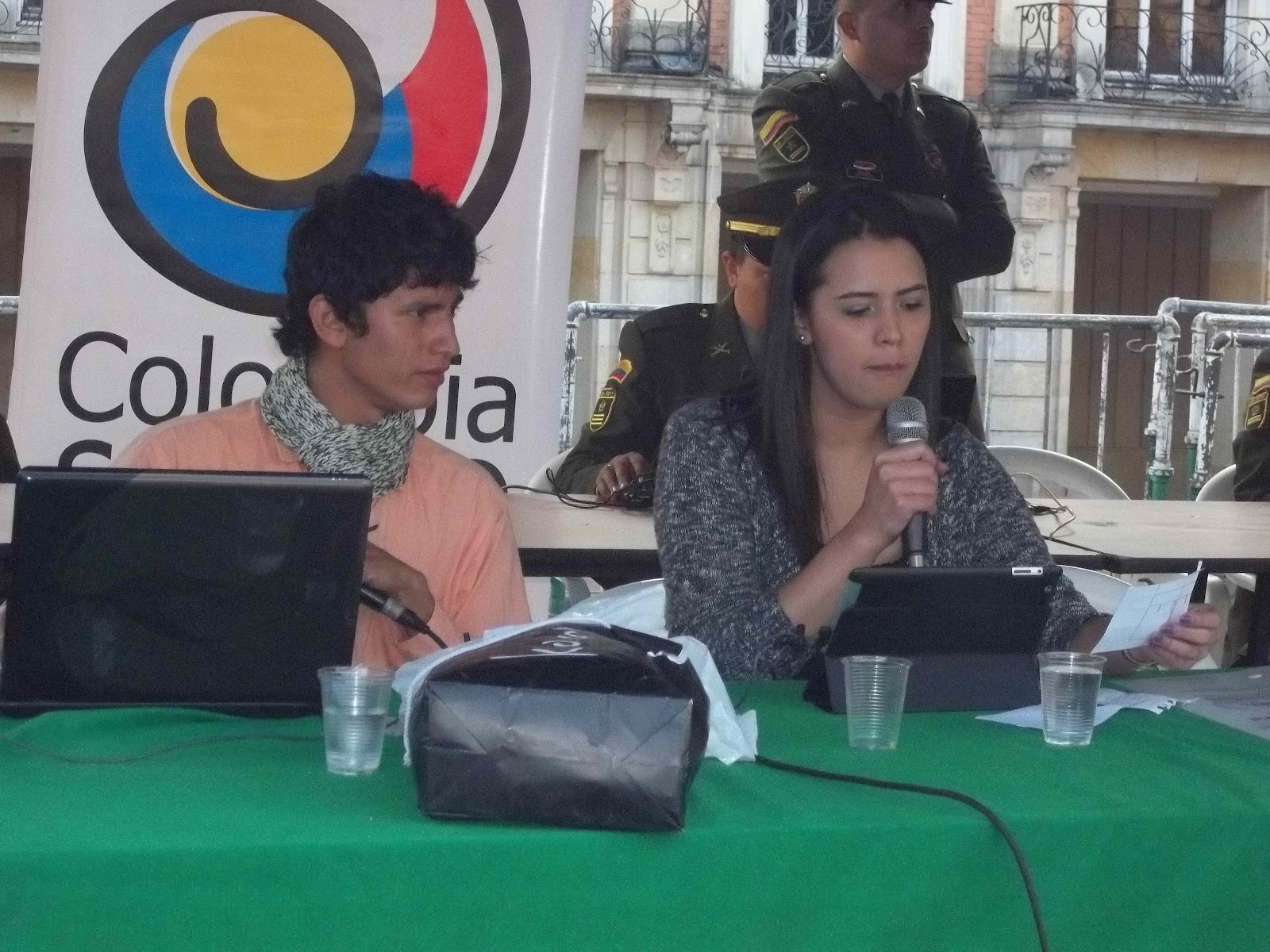
Since Saturday, on Plaza Bolivar, they've been reading messages for kidnapping victims who may or may not be able to hear them in captivity in Colombia's jungles and mountains.

Tables set up in front of the
Catedral Mayor de Bogotá.
The 110-hour marathon, which ends Thursday, was organized by Colombian police and military, the Voces del Secuestro (Voices of Kidnapping) radio show and the Colombia Soy Yo NGO.

Kidnapping is a grim part of Colombia's long-running armed conflict. Historically, the nation's leftist guerrilla groups have carried out most of the kidnappings, for both economic and political reasons. Apolitical criminal organizations also kidnap, just to win ransoms.

Reading messages sent in
from all over the world. 
Thankfully, kidnapping has decreased in recent years, and many of the FARC's most prominent hostages have either escaped or been freed by the military. But Colombians were reminded of kidnapping's tragedy last year when the FARC guerrillas murdered three policemen and a soldier whom they'd kidnapped and held in the jungle for as long as 14 years.

The government demands that the guerrillas release their hostages immediately and without preconditions. Some left-leaning organizations - which seem to me to be guerrilla sympathizers - support the guerrillas' proposal that the government exchange kidnappees for imprisoned guerrillas. But the government argues that that would only free the guerrillas to return to violence and encourage more kidnapping.


During the message marathon, they've been reading thousands of messages sent in from countries across Latin America and Europe. You can listen live on Colombia Soy Yo's website.

Voces del Secuestro and other radio programs regularly transmit friends' and relatives' messages to kidnappees in the jungle.

Find information about kidnapping on Pais Libre's Website.

Related posts: Lest They Be Forgotten


The FARC's Countless Unseen Crimes


By Mike Ceaser, of Bogotá Bike Tours

Tuesday, December 6, 2011

No More FARC!

Marchers on Seventh Ave. carry a sign reading 'No More.'
Thousands of Colombians marched today in protest against the FARC guerrillas and their practice of kidnapping. The FARC have been around for almost a half-century, but these protests were triggered by the guerrillas' recent murder of three policeman and a soldier whom the guerrillas had kidnapped and held in the jungle for more than a decade.

A dove hangs before City Hall. 
The FARC aren't likely to lay down their arms in response to the protests. After their cold blooded murders of the four kidnappees, the FARC said cynically that they 'regretted' the deaths. And the guerrillas' civilian support has dwindled to only a few percent of the population, mostly among leftist university students and peasants in coca leaf growing regions.

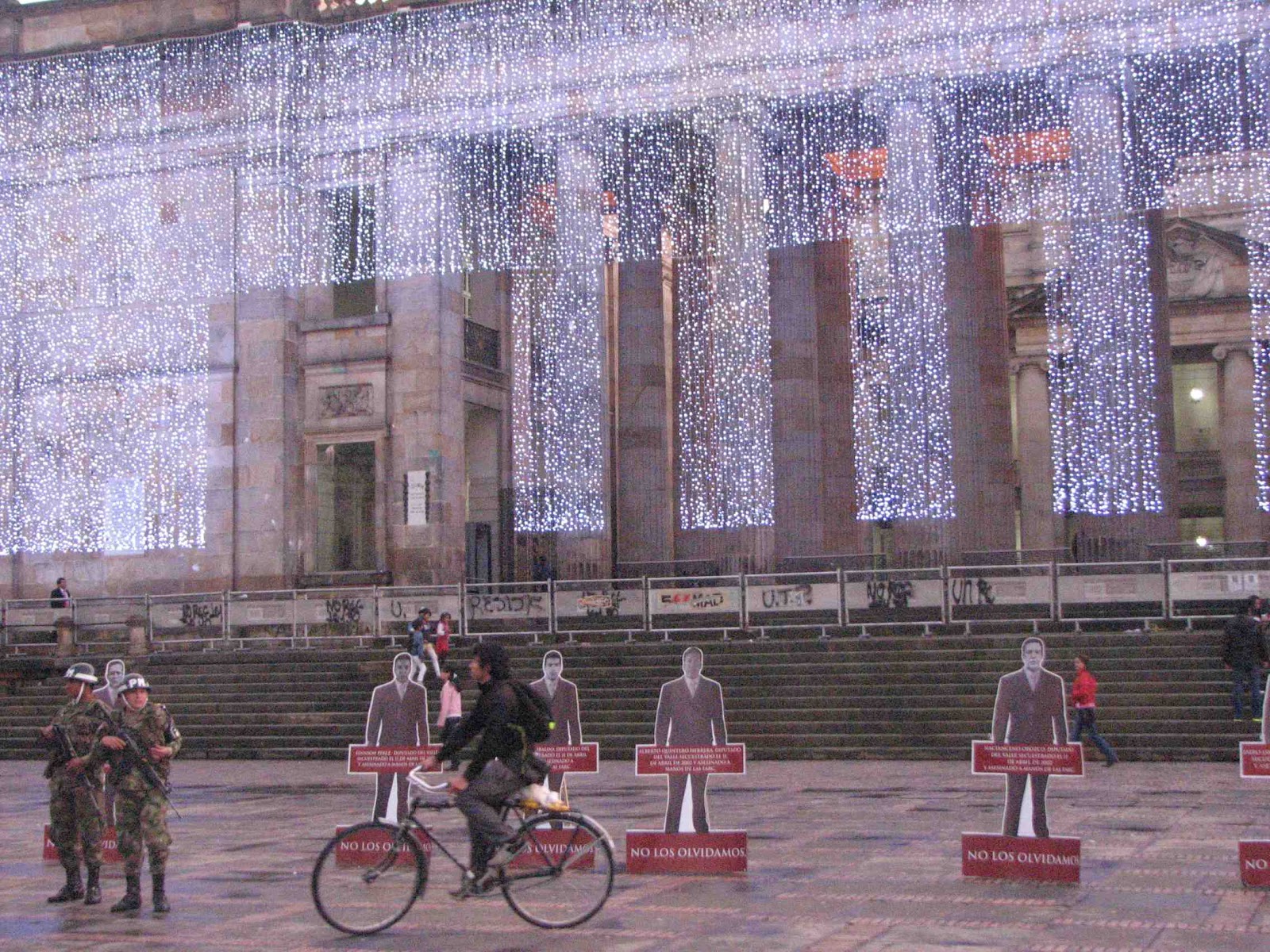
Mounted police stand in the Justice Palace above a sign referring to the military's successful 2008 rescue of guerrilla hostages, called Operation Checkmate. The graffiti and paintball marks are from recent protests by public university students.  
Photographs represent 11 deputies from the Cali area
 whom the guerrillas kidnapped in 2002 and murdered
 in the jungle in 2008.
The guerrillas began in the 1950s as peasant armies fighting for the landless, but long ago lost their way. They now commit monstrous human rights violations, including kidnapping, recruiting children, driving peasants from their homes, planting land mines and forcing women guerrillas to have abortions. Colombia's government and military have also violated human rights - but at least a legal system exists to enforce some accounting on their part. You can't say the same about the guerrillas, for whom violating rights is standard operating procedure. Colombia's is also a very unequal society, with a small, wealthy elite and about half the population living in poverty.

But the FARC are no solution to these problems, and in fact make them worse. I shudder to think what would happen if a vicious organization like the FARC did somehow achieve power.

Displaced people, invisible victims of Colombia's
conflict, demand assistance from the government.
Many are victims of the guerrillas.
But even if one did swallow the idealistic rhetoric on the FARC's websites about revolution and social justice, it's more than obvious that the guerrillas are further than ever from taking over the state, and that they'll never achieve it. So, why not lay down their arms and end this almost half-century of suffering?

And the recent election of Gustavo Petro, one-time leader of the M-19 guerrillas, as mayor of Bogotá shows once again that legal, democratic routes to power exist, even for revolutionary leftists.

47 years of destruction and lies against the
Colombian people - No More FARC!
Refreshingly, this march was not monolithic in viewpoints. I saw demonstrators advocating the Humanitarian Accord, in which the government would exchange imprisoned guerrillas for hostages held by the guerrillas. The guerrillas also advocate the Accord, but Pres. Santos today repeated the government's opposition. The government says an exchange would only encourage more kidnapping and free guerrillas to continue killing and kidnapping. Other demonstrators urged us to find the solution in Christ. But Colombia is a highly-Catholic nation, so it's unclear why Christ hasn't already helped it.

Despite being weaker than ever, the FARC have shown few signs of openness to negotiations. But, with a huge income from the illegal cocaine trade, the government will have a hard time defeating them militarily. The strongest blow Colombia and the world could deal Colombia's guerrillas (and the Taliban and many other violent groups) would be to legalize and regulate illegal drugs.

A group carries a Virgin Mary statue across Plaza Bolivar. 

Christ is the real solution, says this banner. 


The El Tiempo newspaper building dressed in white. 


A man shows off a T-shirt with FARV written on it, a reference to evidence that Venezuela has supported the FARC guerrillas. 

A homeless man stands in front of figures of deputies from Cali murdered by the FARC in 2008.


This man's sign called for the government to agree to a prisoner exchange with the FARC guerrillas. 


This couple displayed photos of their disappeared son.

People sit watching on the edge of the Justice Palace. 


Police pay tribute to fallen comrades. 

Repent and convert - Jesus Christ is coming soon. 

Mounted police, called carabineros, stand above a sign calling for the Humanitarian Accord, which the national government opposes. When I returned to the plaza in the evening this sign had been taken down, altho by whom I don't know.

Demonstrators call for a prisoner exchange between the guerrillas and the government.
A telescope, trained on Monserrate, appears to be aimed at a dove. 


A snack vendor tries to interest the bored anti-riot police. 

By Mike Ceaser, of Bogotá Bike Tours