|
| La Rebecca reaches futiley for water on a dry island amidst trash. |
It was supposed to be an avenue of art, welcoming visitors on their way from the airport to central Bogotá in style.

But neglect, time and weather and the mistakes of city workers, have turned Bogotá's 'art avenue' into a sad spectacle.
The concept was created in 1991, entitled el Museo Vial,
according to El Tiempo, altho several of the works were created before that.
 |
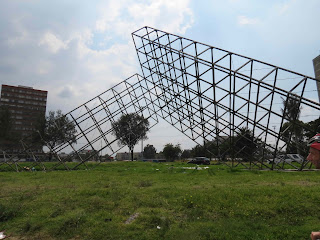
The Ala Solar, donated by Venezuela,
is now a skeleton against the sky. |
Perhaps the most pathetic piece is the Ala Solar, or Solar Wing, located on 26th St. near the National Prisons Institute, INPEC. The sculpture, created in 1975 by Venezuelan artist Alejandro Otero and donated to Colombia by the Venezuelan government, was part of a series including other works located in Venezuela, Washington D.C. and Italy. The original sculpture included many pieces of metal, which have since been stolen and sold to scrap dealers. Today, the sculpture could be mistaken for a framework for a construction project, or perhaps a support for a lost billboard.
Across 26th from the Central Cemetery is a bust of Jorge Eliecer Gaitan, the leftist, populist politician assassinated in 1948. The bust, by sculptor Bernardo Vieco Ortiz, is in good shape. However, it was removed and replaced during the work on the 26th St. Transmilenio line. El Tiempo reports that the bust had originally been placed with its back to the Central Cemetery, symbolizing the fact that, for political reasons, Gaitan was not buried. When the bust was returned, it was placed facing the cemetery.
 |
This cement platform a kilometer west of the
Ala Solar looks like it ONCE carried a sculpture. |
Near the Central Cemetery, however, stands perhaps Bogotá's most best-known piece of outdoor art - the huge 'fat man on a fat horse' by sculptor Fernando Botero, outside of the Parque del Renacimiento. And the huge, empty mausoleums in the block just west of the Central Cemetery are decorated with images of people carrying stretchers - a haunting memorial to the victims of Colombia's armed conflict.

Finally, somewhat hidden in a concrete plaza at Carrera 13 and 26th is La Rebecca, a nude woman kneeling to collect water. The artist is unknown, according to Wikipedia, but the sculpture has suffered a lot. The sculpture was installed in 1926 in what was then the Parque Centenario, created for the centennial of Simon Bolivar's birth. But during the following decades the park lost sections as avenues were sliced thru around it. The park's other sculptures were moved to the Parque Nacional, but La Rebecca remains, pathetically reaching out toward a pool of dirty, trash-strewb water. City officials are considering moving La Rebecca to the nearby Parque de la Independencia,
El Tiempo reports.
Bogotá has nearly 500 pieces of public art, many of which are deteriorating.
The city's partimony department says that during 2013 it will concentrate on restoring the 50 or so pieces located in Bogotá's historical center.
 |
| This bust of Jorge Eliecer Gaitan across from the Central Cemetery was removed for TransMilenio construction and then put back. Gaitan, a fiery communist, may feel unformfortable beside a marketing billboard. |
 |
| When Gaitan was put back he was set facing the Central Cemetery - even tho the sculptor wanted Gaitan with his back to the cemetery, where he could not be buried. |
 |
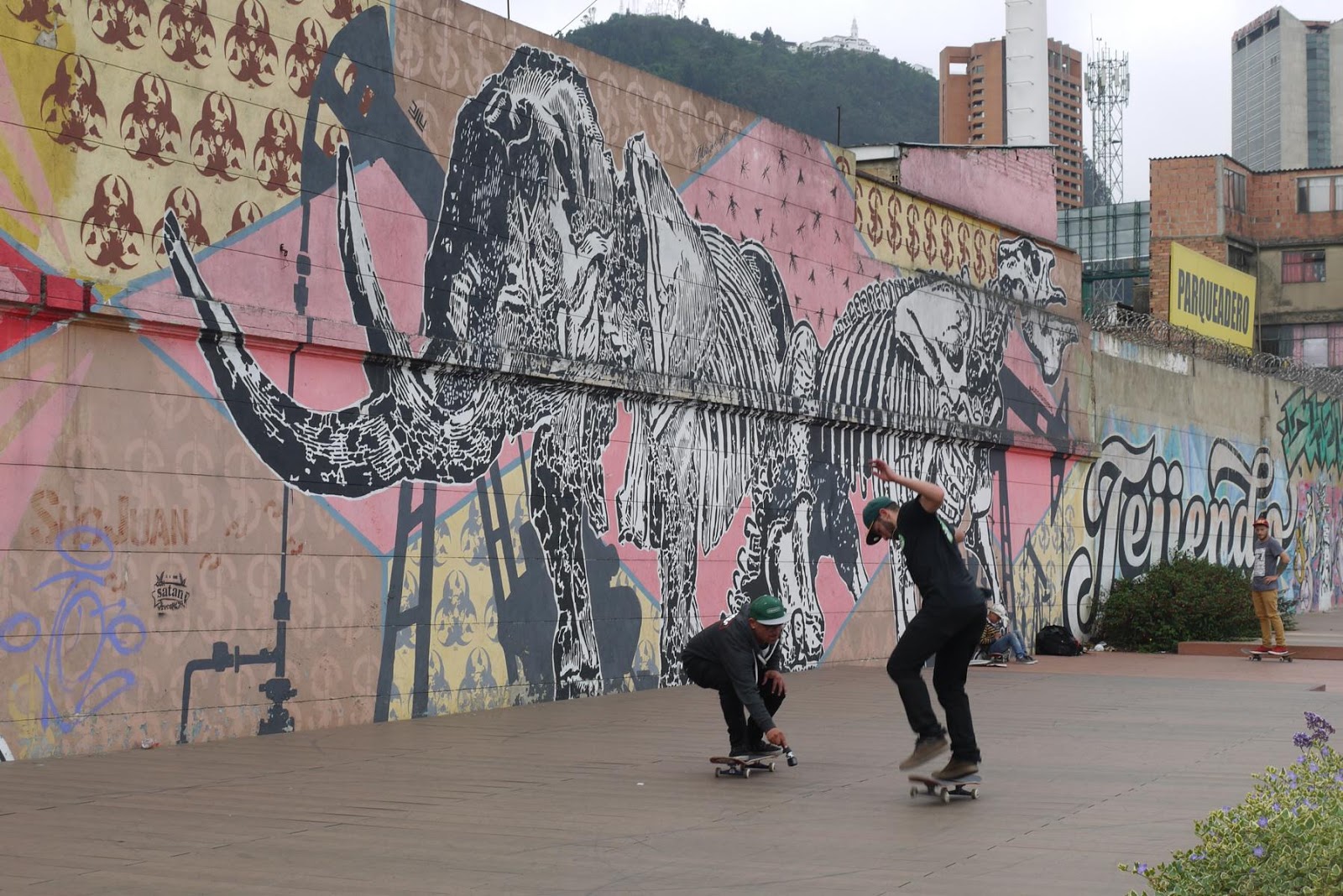
| Some real, new art on 26th St. - great street murals near Ave. Septima. |
 |
| Stencils on these empty mausoleums along 26th St. represent victims of Colombia's conflict. |
 |
| 'Life is sacred.' |
 |
| Near the Central Cemetery stands Bogotá's only Botero sculpture in a public space. |
By Mike Ceaser, of
Bogotá Bike Tours




 Posts
Posts