Showing posts with label media. Show all posts

Wednesday, June 14, 2017

Development by Rural Radio

Popular Cultural Action.
'You should buy a
NEW battery radio.
In the age of the internet and smart phones, old fashioned radio often gets overlooked. That's not yet true, however, in the countryside, where in some areas radio is the only source of local news.

During the 1940s, '50s and '60s, the Colombian government tried to use radio to promote land redistribution and health care, teach literacy and even promote family planning - and got embroiled in polemics with religous conservatives and anti-Communists.

Today, radio is still important in rural areas, in some of which it is the only
The BLAA exhibition.
 local news source. However, in some places that radio station belongs to the military or police, making one question how objective and inclusive the news is.

There's an exhibition about Colombia's rural radio on now in the BLAA library on Calle 11 in La Candelaria.


A priest reads to the radio.

'How to reach a man's mind.'


A young, apparently VP Nixon, talks radio.

Agrarian reform.


'The great communist threat.'


Services for the campesino.


'It's no sin to talk about that' (family planning).

Mother and Child.


'Land Distribution Plan.'

'Agrarian social reform is Christian and not communist.'


By Mike Ceaser, of Bogotá Bike Tours

Saturday, June 13, 2015

The Spokesman Who Wasn't There


Venezuela's state-run and state-controlled media needed someone high up in the United States to take their side. So, they invented him.

Jim Luers is a White House spokesman, and also an FBI agent. Or, he might be, if he only existed.

Luers achieved public prominence recently when 'White House spokesman Jim Luers' was quoted in pro-government Venezuelan media saying that reports that National Assembly President Diosdado Cabello was under investigation in the U.S. on drug-smuggling allegations were "totally false." That raised eyebrows, since multiple media have reported that Cabello is in fact under investigation for narcotrafficking.

Soon after, skeptical journalists discovered that Luers apparently did not exist. A real White House spokesman denied that any Jim Luers had ever worked there.

Nevertheless, the man who was never there in the flesh, does exist in cyberspace. He had a Twitter account, since suspended, and a satirical Wordpress site, on which he boasts of his 'enormous experience in interamerican relations,' and says he is 'currently in charge of a secret White House project to improve bilateral relations with the sister republic of Bolivarian Venezuela'.

Somebody, clearly, is getting some fun out of this episode.

But the serious, and disturbing side of this episode is how enthusiastically Venezuela's Chavista media, much of which has been intimidated into echoing government declarations or outright purchased by pro-government businessmen, eagerly and unquestioningly swallowed the Jim Luers fantasy.

If that's their standard of journalism, then it's understandable why they swallow and regurgitate absurd Venezuelan government statements so easily.

By Mike Ceaser, of Bogotá Bike Tours

Friday, February 27, 2015

Venezuela Vs. Colombia's Media

http://www.semana.com/caricaturas/vladdo/articulo/vladdomania-edicion-1708/415619-3
Disparaging - but a coup? (From Semana magazine)
Maduro says that paramilitaries
infiltrate from Colombia.
His popularity at 20%, his nation's economy in collapse, and his democratic credentials increasingly questioned, Venezuelan Pres. Nicolas Maduro is fighting back - against the Colombian media.

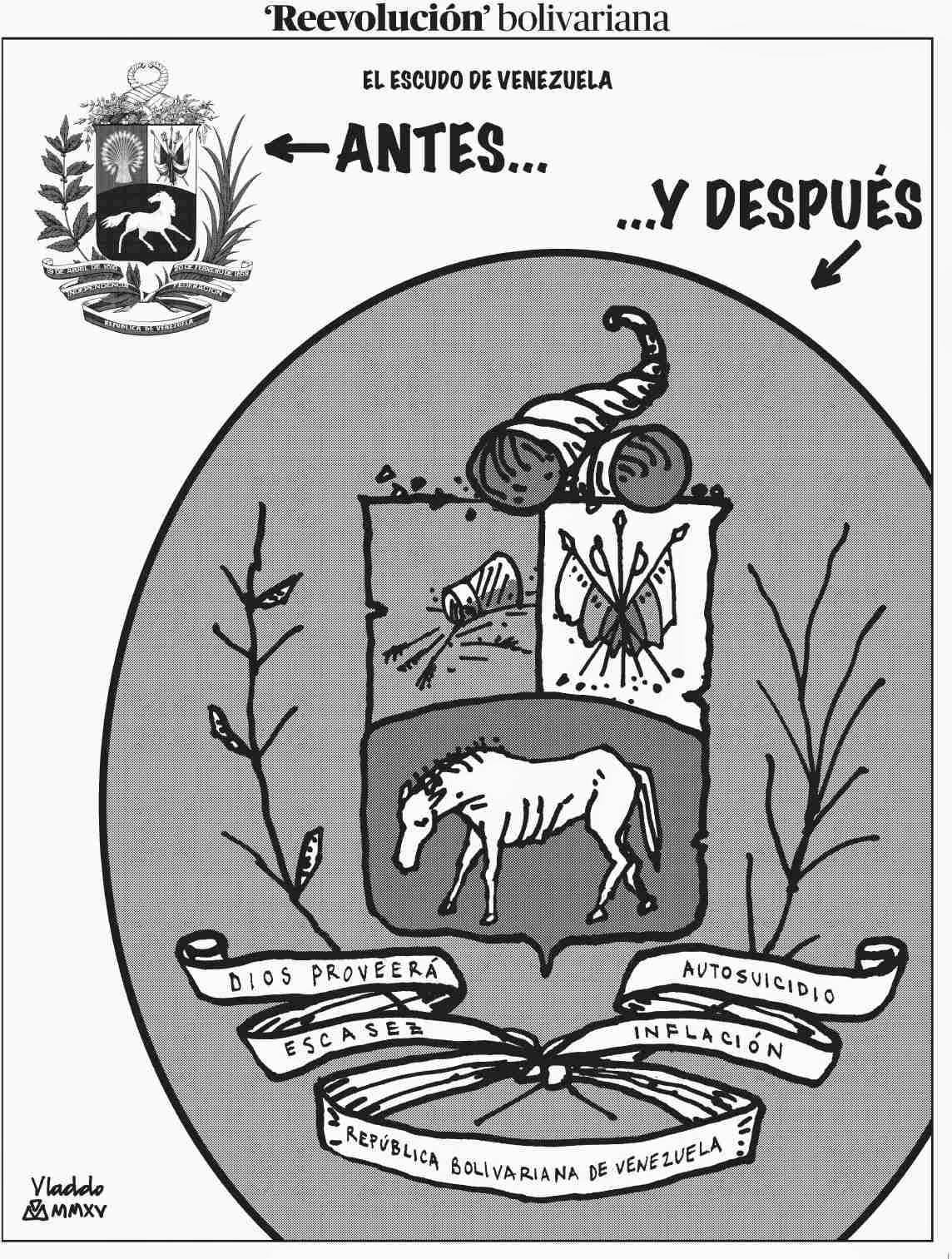
When Semana magazine cartoonist Vladdo published a cartoon portraying Venezuela's coat of arms with a sickly horse, empty cornucopia and empty branches, Maduro was ready.

"I reject the campaign of manipulation, lies and hate in Colombia against Venezuela, Nicolas Maduro, against Hugo Chavez and the Bolivarian Revolution," Maduro thundered over a national 'cadena' (chain), when all Venezuelan radio and television stations are required to carry his speeches.

Madura offensive against
the Colombian press.
Whether Vladdo's portrayal is accurate or not - and it sure seems true that Venezuelan shelves are empty and its people discouraged - the context is revealing. Maduro attacked Colombian media by enslaving (literally 'chaining) a Venezuelan media which has already been tamed by official threats, intimidation and lawsuits.

Over the past several years, the Venezuelan government has progressively taken away broadcasting licenses and bought out critical broadcasters and newspapers. Surviving independent papers struggle to obtain paper to print on. And the famed opposition opinion paper Tal Cual, run by old leftist Teodoro Petkoff, it switching from being a daily to a weekly under the burden of government lawsuits, lack of advertising and lack of newsprint.

So it's not surprising that Maduro, used to a pliant and passive media back home, would object to a critical one next door.

At the same time, of course, everything Colombian provides Maduro with a convenient target to attack. In that respect, Maduro's use of the term 'Santanderean oligarchy' is also telling. Maduro was referring to Colombian revolutionary hero and president Francisco de Paula Santander, who broke with Simon Bolivar after independence and is famous for telling Colombians that 'Weapons have given you independence, but laws will give you liberty.' In contrast to Santander, after independence Bolivar wanted to discard the Constitution and make himself lifetime president - much as the Chavez-Maduro dynasty, whch has ruled for 16 years, has done in Venezuela.

By Mike Ceaser, of Bogotá Bike Tours

Thursday, January 8, 2015

Colombia's Own Charlie Hebdo Moment


On the morning of Aug. 13, 1999, journalist and satirist Jaime Garzón was driving to work when gunmen murdered him. Right-wing paramilitaries are believed to have been behind the assassination, which is still under investigation 16 years later.

Today's newspapers reported the Paris massacre. El Tiempo
printed its front page in black and white.
Whoever was behind it, Garzón's murder shook Colombia, which had become tragically accustomed to the killing of politicians, but not to that of popular commentators. And, inevitably, Garzón's killing, like that of many Colombian journalists before and after him, inevitably sent fear thru every Colombian journalist and commentator, who wondered whether his or her next observation would bring a bullet.

Sound familiar?

Today, journalists the world over have become very aware how just a few armed fanatics can destroy lives and a newspaper.

I'm not defending Charlie Hebdo, which I've never read and wouldn't understand if I did. A Financial Times columnist called Charlie Hebdo's ridiculing of Islam "stupid," altho the commentary has since been revised. And it sounds as tho the magazine was very offensive not only to Islam, but to many groups and religions. But it was a group of Islamist extremists trapped in a medieval mentality who apparently stormed the newspaper's office yesterday and massacred 12 people.

'We are all Charlie.' El Espectador published a
French-language cartoon on its front page..
Today, journalists all over the world, including Colombia, feel a bit more scared about what they
right and where they go. Journalists, more than other professionals, are vulnerable because they must constantly venture out into unfamiliar places, amongst strangers, to get the story. Probably there'll be less of that now, which will mean a loss for society. It will also mean suffering for Muslims and other immigrants across Europe, since right-wing, xenophobic protests like those last week in Germany will undoubtedly intensify.

Those offended by Charlie Hebdo, like those who hated satirist Garzón, had lots of reasonable alternatives, including filing a lawsuit, marching in protest or just closing the magazine and tossing it into the trash.

The Committee to Protect Journalists lists 45 Colombian journalists murdered since 1992. Those murders have inevitably had a muting effect on media investigation and reporting. Freedom House ranks Colombia's press as only 'partly free.'

During recent years, Colombia has had many scandals, including the parapolitica, government spying and the horrific falsos positivos murders. We can only speculate about how much wrongdoing would have been reduced or even prevented had Colombia had a more vigorous press.

By Mike Ceaser, of Bogotá Bike Tours

Wednesday, December 31, 2014

What's it take to be Colombian of the Year?


El Tiempo: 'James, the personality of 2014.'
Colombian media has anointed football star James Rodriguez as 'Colombian of the year.' And Rodriguez sure is good at kicking round objects between upright sticks.

However, it is a sad commentary on human priorities that Rodriguez is now probably the second-
El Espectador: 'James, fortune and God.'
most-famous Colombian, behind only cocaine king Pablo Escobar. My Google search for "James Rodriguez" Real Madrid produced 16.4 million hits, while "Juan Manuel Santos" presidente Colombia produced 7.8 million hits and "Gabriel Garcia Marquez" only a pathetic 1.2 million. (For whatever it's worth, I bet that 100 years from now they'll rank in reverse order fame-wise.)

I'm waiting for someone to explain to me why running behind a ball - across the ocean in Spain, no less - is more important than, say, well - almost anything else.

What does the media's deification of a sports star say about its respect for science, politics, business, teaching, medicine and all those other human endeavors which produce so much to benefit us, but receive little attention or reward?

Gloria Barreto defends riot police from rioters.
(Photo: El Tiempo)
And, even among prominent athletes, Rodriguez doesn't stand out in much besides athletic ability. He hasn't excelled in philanthropy, even tho he probably leaves enough loose euros behind in his dry cleaning to solve the child malnourishment problem in a lot of Colombian towns, or buy schoolbooks for schools in Ciudad Bolivar.

Rodriguez could employ his fame and the huge admiration he commands (justifiably or not) from Colombians of all kinds - to bring his people together to find peace, stop violence, study harder, or embrace any number of causes, but he hasn't bothered to. Instead, Rodriguez serves unintentionally as an unfortunate role model: How many boys and young men have slackened their studies and focused on futbol because they expect to become the next James Rodriguez?


Rather than Rodriguez, how about someone like Gloria Barreto? She's the humble woman who had come to downtown Bogotá (albeit in August 2013) to complain about her water bill when she found herself in the midst of a riot in which youths hurled chairs, tables and rocks at police, who cowered behind their shields. Barreto, a short, apparently frail woman, placed herself between the police and attackers, her arms spread protectively. The rioters paused their attack only long enough to pull her away. A few moments later, an anti-riot tank arrived firing tear gas canisters, and the youths fled.

But when it comes to the 'most important Colombian of 2014', love him or hate him, it's hard not to name Pres. Juan Manuel Santos. He got reelected and carried forward the peace talks with the FARC guerrillas, which appear likely to end Colombia's half-century of armed conflict. In fact, the FARC ended the year with the announcement of their first-ever unilateral cease fire - a milestone in Colombian history, even if it doesn't last.

By Mike Ceaser, of Bogotá Bike Tours

Thursday, September 25, 2014

What El Tiempo Forgot to Mention

'Successful debut for Aval on the New York Stock Exchange.' Aval's owner, it just so happens, also owns El Tiempo.
If you read yesterday's El Tiempo you learned that Grupo Aval, the huge Colombian banking group, made a successful initial offering on Wall Street - altho it didn't make quite as big a splash as did Alibaba.

'Wall Street welcomes
Grupo Aval's Shares
.'
But Colombia's leading newspaper neglected to mention that Aval and El Tiempo share the same owner, billionaire Luis Carlos Sarmiento. The news wasn't necessarily distorted - Reuters and Fox business news also described the offering as successful. But you could question the huge spread Sarmiento's newspaper gave his bank. Other Colombian media also reported the offering, but made it their second or third story. 
The website La Silla Vacia also pointed out that El Tiempo has given much less coverage to other stock offerings, including even that of EcoPetrol, Colombia's national oil company, in 2008. La Silla Vacia also observed that El Tiempo gave flattering attention to a highway project in which Sarmientos has interests.

El Tiempo has the right to splash whatever it wants across its pages, and readers have the right to judge the paper's credibility. But in the United States and other nations it's basic journalistic ethics to mention possible conflicts of interest in reporting. Take, for example, the Washington Post's coverage of Amazon Corp. and its owner Jeff Bezos, who bought the newspaper last year.

When Sarmiento, Colombia's richest man with a fortune of $17 billion, purchased El Tiempo in 2012 he probably saw it mostly as a trophy. But when he did so, he promised that the paper's coverage would not be biased by his business interests. Now, the more that he uses it to blow his own horn, the less respect it'll bring him. 

For its part, El Tiempo's smaller but older rival El Espectador has belonged since 1997 to Colombia's second-richest family, the Santo Domingos. A glance at El Espectador's coverage of one of the family's other prominent properties, La Cerveceria Bavaria, finds a lot of flattering coverage, including the information that Colombia's beer consumption is still relatively low. 

I'll wait with bated breath for El Tiempo to do an exposé on Grupo Aval or one of its banks, or for El Espectador to uncover corruption inside Bavaria.

Latin American journalism, unfortunately, is known for corruption and favoring special interests. The ownership of Colombia's two most important newspapers by its two richest families is a test for whether journalistic ethics can stand up to economic interests, and the results don't look so encouraging.

By Mike Ceaser, of Bogotá Bike Tours

Tuesday, April 8, 2014

Can an English-Language Paper Survive?


It's not easy starting a newspaper these days, especially when it's a real one - printed on dead trees.

As a veteran of several newspapers - several of them sadly deceased - I'm a real believer in the printed word, as well as the role newspapers play in uncovering graft, telling truth to power, bringing new perspectives on old topics. Other media, such as video, just can't do the job with the same agility and detail.

But, as everybody knows, the traditional newspaper industry is in crisis, mostly due to the Internet, which places limitless information at our fingertips, instantly. Several big papers in the U.S. have folded, others slashed their staff (including stringers like myself). It's not so much because people are reading less, but because the advertising, which is historically the media's main income, has shifted to the Internet. At the same time, the Internet has filled with parasitical publications (read: Huffington Post), which take information generated by others, rework it and republish it as their own.

So, it's admirable to see someone launch The Bogotá Post, a new newspaper that's actually printed on paper.

I've got to hand it to this group. The Post contains real news and real stories by real writers. They evidently interviewed an Irish deputy minister visiting Colombia about Colombia's peace process. (He's optimistic, altho the two countries' conflicts have fundamental differences. And, was the IRA as corrupted as are Colombia's guerrillas by drug trafficking and human rights violations?) Jenny Boyle (it'd be nice to know who she is and how long she's lived in Bogotá and how she commutes) writes an opinion column criticizing the women-only cars in TransMilenio, which for her represent the city's resignation to an ugly element of human nature - men's sexual predation. (Unfortunately, human nature - and particularly male nature - is often ugly, and Bogotá can't easily change that.) The inaugural edition also includes a nice opinion piece by Briton Oli Pritchard about the wonders of bicycling in Bogotá. I'm afraid that Pritchard forgot to mention Bogotá's aggressive drivers and clouds of pollution, but it's still nice to see urban cycling praised - especially in an article that's not surrounded by auto ads.

Then there are some somewhat dated news articles about Gustavo Petro and a few predictable features about Usaquen and the monuments of San Agustin. (I couldn't tell whether the Post is meant to be a weekly, bi-weekly or monthly publication.)

What the Post's inaugural issue conspicuously lacks is much advertising - its only income, since the paper is free. Hopefully, that will come in future editions. But it'll be a challenge in the Internet age.

Sadly, my journalistic career is a trail of deceased and agonizing publications. I started out journalistically with the Florida Flambeau, a spirited, independent daily paper covering Tallahassee, Florida's universities. We published exposés and hard news, as well as sports. But the Flambeau died - beaten by a more commercial paper catering to the sororities and fraternities, according to this Wikipedia article. Several years and newpaper jobs later, I worked for the Bolivian Times, a weekly published in La Paz, Bolivia. The BT struggled along with a colorful and hard-working, but sometimes incompetent and occassionally drugged-out staff, an owner often more interested in flattering his elite friends than doing serious reporting, and Bolivia's dysfunctional economy. Nevertheless, we managed to do some interesting reporting. The BT finally died - perhaps deservedly - after many of us were stiffed of our salaries.

Recent years have not been easy for English language publications across Latin America, as English-language papers have folded not only in Bolivia, but also in Caracas and Mexico City, where the surviving Mexico City News saw its staff slashed a few years ago. Besides the Internet, such newspapers have also fallen victim to changing hiring policies. Foreign companies used to bring down foreign staff, but now tend to hire locals.

The Bogotá Post joins the Colombian capital's only other English-language print publication, The City Paper. I'm not sure how The City Paper, a monthly, has managed to survive the tough times for newspapers despite little advertising. I've enjoyed The City Paper's talented, sometimes magazine-quality photographs and features (detracted, unfortunately, by irregular editing). Both are in competition with the Internet-only, Medellin-based Colombia Reports, which publishes interesting articles, many of which however are recycled from the Spanish-language press.

Good luck to the Post. A new voice is always important. Let's hope this one lasts. 

By Mike Ceaser, of Bogotá Bike Tours

Sunday, October 27, 2013

The Fall of an Idol?

Raul Cuero. (Photo; El Espectador)
It was a wonderful, inspiring life story: An AfroColombian child of Buenaventura, one of Colombia's poorest cities, overcame innumerable obstacles to become a star researcher and inventor in the United States, even working for NASA.

Unfortunately, the story seems to be untrue, or at least inflated.

Raul Cuero was the son of illiterate parents. From an early age he showed an interest in research, and his botany work moved a foreign visitor to help Cuero travel overseas to study. Today, at age 65, he teaches in a small United States agricultural university, works on inventions and does contract research. He's published research papers and has several U.S. patents to his name.

Cuero's life story is unquestionably impressive. But being good was evidently not good enough for him: he wanted to be great. And the Colombian media played along. Colombian newspapers, magazines and television celebrated Cuero as a great inventor and award-winning NASA researcher.

El Tiempo columnist Maria Isabel Rueda recently even asked Cuero whether he dreamed of winning the Nobel Prize. (To his credit, Cuero said that awards weren't important.)

But Rodrigo Bernal, an ex-professor of agricultural engineering of the National University, decided to dig deeper into Cuero's story. It turned out, as Bernal wrote in a cover story in El Espectador, that Cuero's dozens of 'scientific papers' were mostly news reports about himself, that the NASA awards were rather routine recognitions and that Bernal had only two minor patents to his name. Bernal added many other details which Cuero appeared to have exaggerated or distorted to add to his own legend. Cuero has worked for NASA, for example, but only as a contractor.

One of Cuero's recent books even describes him as 'One of the world's most important scientists.'

In his response, Cuero did not directly deny Bernal's affirmations. 'I'm not an orthodox scientist," he wrote. "In essence, I'm an inventor...I'm an inventor and my purpose is to create things which serve humanity and create economic impact.'

Give Cuero credit for accepting the criticisms gracefully. In fact, Cuero is a very impressive guy. How many of us have even one invention or scientific article to our names? How many of us overcame a dirt-poor background and racial discrimination to become university professors and do work for NASA?

Cuero is rightly an inspiration for many poor youth. But he inflated his impressive life history into a legend, and paid the price when the exaggerations were inevitably uncovered. Sadly, those distortions will leave a lasting stain on his exceptional accomplishments.

By Mike Ceaser, of Bogotá Bike Tours

Thursday, October 17, 2013

Racism in El Tiempo?

AfroColombians can be journalists and student activists,
but are rarely portrayed as such by the media.
A few key phrases from El Tiempo's recent article about Bogotá's AfroColombian neighborhoods:

"I don't enter the (city) blocks full of blacks ever since I saw how they planned to mug a girl who'd just gotten off of a bus..." said a man who requested anonymity.

'Fear and frustration rule in the the 10 neighborhoods where most Afros are concentrated.'

In the black neighborhoods "One has to walk carefully because they (Afros) will force you against
the wall and attack you; they'll steal all you have."

Residents of black neighbhorhoods are also generally dishonest, adds a taxi driver: "They like to fight; they don't pay for the ride, and even end up breaking the (car) windows or pulling out a knife."

Those are just some of the quotes and commentaries from an article the other day in El Tiempo, which
Afro-Colombian girls on their way to or from school.
in the past has seemed to have a sensitive attitude toward the situations of ethnic minorities. But this article consisted primarily of voices describing black neighborhoods - and their residents - as violent criminals who should best be avoided. The article included little balance and few voices examining the history of poverty and social discrimination which have contributed to making those Afro neighborhoods poor and socially troubled.

The story also neglected to mention that, of the many poor and dangerous Bogotá neighborhoods, only a few are predominantly Afro. For example, the dangerous and violent central Bogotá neighborhoods like Egipto, Las Cruces y San Bernardino are overwhelmingly by white and mestizo.

An AfroColombian univesity student
doing a presentation about a Bogotá business.
I know some young AfroColombians who live in an impoverished area called Altos de Cazuca, in the far south of Bogotá, where many residents are displaced people driven from their land and into the city by Colombia's armed conflict. Altos de Cazuca IS dangerous - residents fear returning home after dark. And criminal groups force local businesses, including street vendors, to make extortion payments - on the threat of death. But most of the victims here are the neighborhood's own AfroColombian residents. The residents also suffer severe types of discrimination: Because different illegal groups dominate neighborhoods, and different neighborhoods are predominantly black, white or mestizo, my friends tell me that if they cross into non-Afro neighborhoods they run the risk of being labeled as members of a hostile gang and attacked. These AfroColombians are victims of violence and discrimination, not generators of it, as the El Tiempo story portrays.

El Tiempo's story also perpetuates stereotypes by portraying AfroColombians as examples of poverty and crime. Even when the media portray black Colombians positively, it often still means stereotypes: as dancers, musicians or athletes. But AfroColombians also study, start businesses and hold down 'normal' jobs. But because such images don't play into established stereotypes, they're more difficult to portray.

By Mike Ceaser, of Bogotá Bike Tours

Thursday, February 28, 2013

Enough Already About Colmenares!


Enough already! The neverending parade of stories describing in minutiae the progress (and lack of same) in the legal procedures in the case of the death of Luis Colmenares have got me sick. His body was discovered --ñ years ago below a bridge in el Parque Virrey in north Bogotá. Did he just fall, or was he pushed? Probably, the public will never know for sure. Bogotá suffers thousands of homicides every year, as well as lots more fatal accidents, and most are simply forgotten.

But the death of Colmenares, a popular student at the elite Los Andes University, has fascinated the public, and the media, who have probably noticed that Colmenares case headlines sell newspapers.

Colmenares' death was a tragedy for his family and friends, as is every death. But it's beyond me why this one case has become a real-life reality show, with every new witness, each new arrest, each new lab test result, becoming 'news.' Sure, all of this probably does have some educational value, and it is arguably more important than another futbol game. But there's also a negative side to it. Maybe it produces a false public perception that all deaths are really taken seriously and investigated, when that's far from true. How about the people, especially the children, who get run over regularly by drunk drivers? Each of those killings generates a day or two of public anger, and then gets forgotten. As far as I've heard, the driver gets usually sentenced to a period of home detention, which he may or may not carry out, and then keeps on driving. But those victims, and many others, are important, too. But they get forgotten because whatever Colmenares' latest ex-girlfriend told investigators the other day makes headlines.

Sure, Colmenares' death was a tragedy, but only one of many. It's time to move on.


By Mike Ceaser, of Bogotá Bike Tours

Sunday, January 20, 2013

Press Freedom Gets More Defenders

The Inter-American Press Association at a meeting in Venezuela, whose president has not signed the declaration protecting press freedom.
Tomorrow, Colombian mayors and governors are to sign the Declaration of Chapultepec, which commits them to respect and defend freedom of the press.

Pres. Santos signed the declaration last year. It's no mystery why this rush to sign
Passers-by look at a newsstand in central Bogota.
this 1994 declaration, has only happened recently. After all, previous Colombian Pres. Alvaro Uribe had a sort of paranoia about the press, which he apparently often suspected of collaborating with guerrilla groups.

The declaration includes high principles of protection for the press, including bans on censorship, and a prohibition against punishment of journalists for publishing news, restrictions on press circulation and others.
If only freeing the press were so simple as signing a non-binding declaration. Dangers to journalists continue in Colombia - Jineth Bedoya, who in the year 2000 was kidnapped, beaten and raped while investigating the murders of prison inmates, continues receiving threats. But governments and big business also have more subtle weapons for controlling media coverage, such as providing or withholding advertising or access to news sources.

I haven't seen strong evidence of such pressures here in Colombia, but they may very well be taking place. (Laudatory news coverage of certain fossil fuel corporations, for example, makes one wonder whether the journalists are receiving more than their salaries for their efforts.) But several leftist government in the region, including Ecuador, Nicaragua, Venezuela and Argentina, have used lawsuits, legalisms and bureaucratic mechanisms to intimidate and shut down the media.

Coincidently, these nations' presidents don't appear to have signed the declaration.

In a way, that's encouraging, since it suggests that the declaration does mean something.

By Mike Ceaser, of Bogotá Bike Tours

Wednesday, November 21, 2012

How Much is a Life Worth?

That apparently depends on who you are and how interesting your death is.
University student Luis Andres
Colmenares, whose death has become
a national obsession.
Take the death of Luis Andres Colmenares, a popular student at the Universidad de los Andes whose body was discovered under a bridge in a north Bogotá park two years ago. Since then, we've seen an unending drama of news stories, court appearances, arrests and releases of suspects and tales of romance and betrayal. Colmenares, who was just another student, even has a Wikipedia entry and El Tiempo lists nearly 2,000 stories about his case. Most recently, a journalist even published a book about the case - in which he concludes that Colmenares' death was an accident.

Certainly, Colmenares' death was a tragedy for him, his family and friends, no matter what caused it. But does it really rate all of this attention in a country in which many people die violently every single day?

The grieving family of six-year-old Isaac, killed by a bus.
(Photo: El Tiempo
In contrast, take the case of six-year-old Isaac, who was hit and killed the other day by a bus, which also severely injured his friend. Even tho the bus driver, who witnesses said had run a red light and tried to flee the scene, had tens of millions of unpaid traffic fines, the last I heard he was resting comfortably at home. He hadn't even lost his driver's license. And how about his victims? A bus company lawyer claimed the company had done nothing wrong by hiring an evidently dangerous driver. He did mention something about insurance benefits for the victims, but didn't sound very sure.

In fact, now that the few days of attention to Isaac's death have passed, the bus company will likely give a token payment to Isaac's family, who are very humble people, and then continue with deadly business as usual.

Luis Colmenares was just another partying
student until his death made him interesting.
A dealth like Colmenares', which might have been a murder, accident or even a suicide, is no easy thing to prevent, and the resources and attention spent on it don't seem to have gotten us any closer to preventing a repeat. But in Isaac's case we know who killed him and how it happened. And prevention, if anybody has the will to do it, seems clear enough: make sure that bus companies and drivers pay for the consequences of their actions. (which is why one of those miserable, ambulance-chasing liability lawyers could do great things right now.) The city also needs to take measures to end the murderous 'War over the penny,' in which buses race each other to pick up passengers.

But the Caso Colmenares will continue monopolizing the public's attention, while little anonymous Isaac seems to have already been forgotten by all but his family - and traffic goes on as deadly as usual.

By Mike Ceaser, of Bogotá Bike Tours

Sunday, August 5, 2012

Colombian History on Paper


The Candelaria's Luis Angel Arango Library, or BLAA, is holding this exhibit about Colombian newspapers' history, which the creators number at the good round number of 223 years.

Colombia, of course, has had a very eventful history, which has been reflected in its newspapers. And the newspapers themselves have been part of that history, for example with the assassination of El Espectador publisher Guillermo Cano (as well as killings and attacks on many others) and the car bombing of the newspaper's printing plant, both planned by Pablo Escobar. For their part, the media-savvy M-19 'invaded' sympathetic newspapers, to give them a justification for publishing the guerrillas' propaganda. Less dramatically, many journalists from all types of media have been forced into silence or exile by threats. 
The Avianca building in flames in 1973.
Perhaps paradoxically, and in contrast to the newspaper industry in developed nations, Colombia's dailies are healthy. Despite Bogotá's high poverty rate and illiteracy problem, the city has a half dozen dailies, ranging from El Tiempo and El Espectador, to sports sheets and sensationalist tabloids given to featuring gruesome crimes and naked women. Newspapers continue to thrive here thanks in part to the nation's strong economy and to low Internet penetration - altho that will inevitably change - and to the fact that the country's two richest families now own the capital's two leading papers.

For all of their weaknesses and errors, newspapers have played a vital role in informing the public and exposing corruption and misdeeds, and lets hope that they can continue doing, whether on paper or in cyberspace.

Crowds pay homage to politician Jorge Eliecer Gaitan after his 1948 assassination. 


A sharp commentary: Uncle Sam stabs
Colombia in the back by stealing Panama. 


Novelist Gabriel Garcia Marquez's Nobel Prize award in 1982.


One of Bogotá's first papers, circulated after the 1785 earthquake. 

To Arms! War with Peru in 1932! (Colombia's one and only foreign war, not counting independence.

Crusading El Espectador publisher Guillermo Cano is assassinated by Pablo Escobar.


A paper reports on the M-19's 1980 takeover of the Dominican Republic's embassy. 

A photo of Bogotá mayor and ex-M-19 guerrilla leader Gustavo Petro. In the background is the old Justice Palace, which the M-19 attacked, disastrously, in 1985.


By Mike Ceaser, of Bogotá Bike Tours