Showing posts with label law. Show all posts

Sunday, January 7, 2018

Who Owns the Sidewalks?

A cop watches as vendors gather up their goods on a side street off of Carrera 7.
One of Mayor Peñalosa's most prominent and polemical policies, clearing public spaces of illegal vendors, may have hit a roadblock.

Courts ruled recently that vendors who sell on a particular spot for a considerable time acquire rights
A car occupies a sidewalk in the Los Martires neighborhood.
If you park your car on a sidewalk long enough,
does that make you the sidewalk's owner?
of possession for that piece of pavement, something like eminent domain, and can't be driven off without a sort of due process. By the same token, the court ruled, by permitting vendors to use sidewalks as their retail space for years, it is implicitly saying that they have a right to be there, and authorities can't suddenly change the rules.

This is an age-old battle in Bogotá, and one which the city won't ever win. As long as there are poor people here and the sidewalks offer access to many potential customers, vendors will occupy them, even if they are forced to play hide-and-seek with the police.

A cop escorts a vendor off of Carrera 7.
It is true that many street vendors are a nuisance: They clutter and block sidewalks, compete with tax-paying formal businesses and contribute to an atmosphere of anarchy and disorder. But they also serve many functions, providing a livelihood to poor people and easy access to products for the rest of us. I've bought headphones, books, socks, fruit and shoes on the street (or sidewalk).

If only authorities could distinguish between 'good' vendors who don't block pedestrians and
don't compete with neighboring shops, and those who do do damage to urban living. Unfortunately, making such a distinction is nearly impossible, and therefore

By Mike Ceaser, of Bogotá Bike Tours

Sunday, December 17, 2017

One Gender Equity Word Too Far

The girls and women of Bogotá have lots of concerns: crime, sexual harassment, employment
The new official Bogotá uniform?
discrimination, and others. But I've never heard a Bogotana say she suffered from oppression by grammatical discrimination.

But this is what Bogotá's legal system, in all of its wisdom and blindness, is now charging ahead with.

A judge just ordered Mayor Peñalosa to modify his city slogan from 'Bogotá Mejor Para Todos' to 'Bogotá Mejor Para Todos y Todas.' In other words, he's to add the words 'y todas' so that nobody gets the idea that the city's goal is to make life better only for its male residents.

Aventureros hostal: Only male adventurers allowed here?
Sensibly, Peñalosa is appealing the decision, which would require the modification of innumerable city signs, uniforms, websites and literature, not to mention making the city's slogan sound wordy and awkward. The slogan was changed when Peñalosa became mayor a year ago, and will be changed again if the current recall effort against Peñalosa succeeds.

In protesting the ruling, Peñalosa pointed out that 'every high school teacher knows that in Spanish the masculine words include both male and female individuals'. That's why when schools refer to their 'alumnos' nobody thinks they mean boys but not girls. And when presidents refer to 'ciudadanos' they mean both male and female citizens. 'Abogados' includes lawyers of both genders. And so on.
Welcome to La Candelaria: But only for males,
unless your an Engish-speaker.

Specify the female gender in everything and you not only state the obvious and treat your audience ciudadanos y ciudadanas' and 'candidatos y candidatas' and 'senadoras y senadores.' I'll never forget a mind-numbing talk I suffered thru one evening in Bolivia as the speaker went on about 'campesinos y campesinas,' 'maestros y maestras' and 'profesoras y profesores.' Perhaps he also specified that the people owned both 'perros y perras.'
like idiots, but you generate documents like Venezuela's Constitution or Colombia's peace agreement with the FARC, which drone on repetitively about '

If not for the time and effort wasted by this habit isn't enough to ban it, the trees needlessly killed and the gigabytes of computer memory needlessly filled should do it.
'A better Bogotá for all' - but only if you're a male?

But if always specifying the female gender really is required, then Bogotá is in big trouble:


The Down Town converntion center says its closer to male Bogotanos.
The Procudaria warns males not to be corrupt.
Unquestionably, Spanish is sexist - as are most languages. But Bogotá won't change it, and will make a fool of itself. A more practical solution would be to convince the ultra-conservative Real Academia de la Lengua in Madrid to accept use of the @ symbol to include both genders, as in 'Hola chic@s'.

By Mike Ceaser, of Bogotá Bike Tours

Thursday, November 17, 2016

The Law is Blind - and Tasteless

An environmental menace? The San Isidro Restaurante,
in a 60-year-old building on Monserrate.
For almost four decades, the Restaurante San Isidro has served food and drinks on the summit of Monserrate, an area of asphalt where thousands of tourists wander around some days, eating, drinking and taking pictures. Before it, another restaurant functioned for two decades. The area, which used to be a quarry, is also the scene of a church and occasional fireworks displays, as well as a cable car station.

But the summit of Monserrate, one of Bogotá's most popular tourist destinations, is pristine forest, a court just ruled, and the San Isidro, as well as other restaurants and handicraft shops located there, will have to close.

The businesses' closing will throw hundreds of people out of work, and deprive visitors of a meal
Dining with a view.
(Photo from Trip Advisor)
with Bogotá's best view.

The San Isidro, which is fighting this absurd ruling, is ranked 11th among Bogotá restaurants on Trip Advisor and says it employs almost 50 people, who would lose their jobs if the ruling is carried out. More importantly, one  of Bogotá's most important icons will lose part of its attraction.

This French dish Chateaubriand Portobelo - whatever it is -
will disappear from Monserrate's summit
if the restaurants close.
This is all despite the fact that the San Isidro, at least, says it respects environmental regulations and disposes correctly of its wastewater.

Pristine natural territory? The summit of Monserrate, with the church. 
However, the law being blind, it has a remarkable ability to ignore the reality that, even tho these businesses are surrounded by forest, they are actually located on cement, in an area that has been cement for decades.

The Externado University cut down forest to
build these towers, which block residents' view
of the hills. That apparently does not count
as environmental damage.
Meanwhile, the city turns a blind eye while the powerful Universidad Externado has deforested a large area to build two huge towers which block the view of the hills from the La Candelaria neighborhood.

While they're worrying about Monserrate, the city might also consider reopening the hiking trail to the summit. The trail was closed for a long time for reconstruction, then reopened briefly, only to be closed again early this year because of supposed damage from forest fires. The trail provided exercise, good family recreation - and free access to the summit for many Bogotanos.

Prohibited! The popular hiking trail has been closed most of this year, and shows no sign of reopening.
By Mike Ceaser, of Bogotá Bike Tours

Monday, March 9, 2015

Friends in High Places

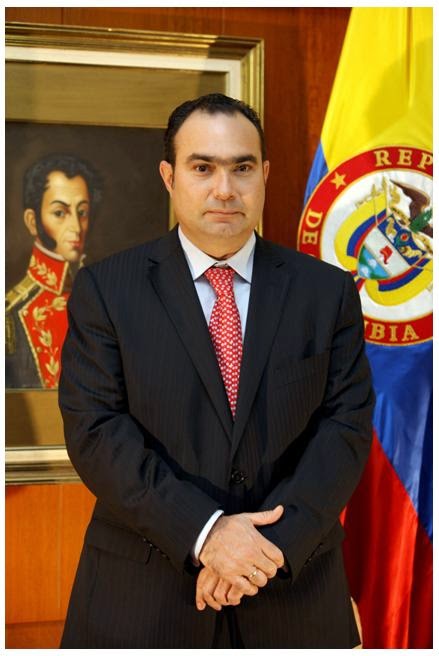
Judge Pretelt: In the middle of the storm.
When El Tiempo columnist Maria Isabel Rueda recently interviewed Constitutional Court Pres. Jorge Pretelt, she was impressed that Pretelt brought along the court's ex-president, Rodrigo Escobar Gil.

Because magistrate Pretelt is embroiled in allegations that he demanded a 500 million peso bribe in order to reverse a ruling against the Fiduciaria Petrolera S.A. oil company, Rueda asked Escobar Gil whether he was working for that company, known as Fidupetrol.

Escobar told her he was not.

But a few days later, Rueda writes, she learned that Escobar Gil had in fact signed a contract to help Fidupetrol in its battle to reverse a 22 billion peso ruling by the Supreme Court against the company. Fidupetrol's case was in Escobar Gil's old stomping ground, the Constitutional Court.

The episode is in the news because Pretelt, the Constitutional Court's current president, stands accused of asking for a 500,000,000 peso bribe in order to produce a court ruling favoring Fidupetrol. As it turned out, the court ruled against the company. Its attorney Víctor Pacheco then accused Pretelt of demanding a bribe to ensure that Fidupetrol's tutela succeeded and then failing to fulfill his promise. Pretelt denies the bribery accusation, but acknowledges that Pacheco visited him at home. Pretelt has taken a leave of absence.

Victor Pacheco, the man who started it all.
Update: El Tiempo reports that Pacheco, apparently contradicting himself, told prosecutors that Pretelt had in fact instructed Pacheco to give money to another court judge, Mauricio Gonzalez. Pacheco later informed Gonzalez, who made the affair public.

El Tiempo examined Pretelt's finances and found that he has acquired a large amount of property over recent years. Pretelt denied any wrongdoing and pointed out that he comes from a wealthy family.

Whatever the truth about the alleged bribe, the mere fact of an ex-court president representing a company with a case before the court calls the high court's version of 'justice' into question.

'La Ley Para Los de Ruana' - A common saying meaning
that only the poor have to obey the law.
After all, who can doubt that a an ex-court high court magistrate - much less its president - still has powerful influences on the court, whose inner workings he knows intimately and on which he must still have friends and political allies?

In this case, Fidupetrol's machinations failed them. But how many powerful people and companies have bent courts to their interests thru bribery and undue influence? And if that's the case on Colombia's top courts, how much corruption is happening in local courts? I now that I've heard multiple stories about people slipping judges money to get convicted relatives off with light sentences. And, the repeated spectacle of drunken drivers responsible for fatal accidents receiving home detention also undermines faith in the courts.

To rebuild respect for its courts, Colombia needs to take a few basic steps, including requiring more transparency about court officials' property and income and prohibiting retired judges and other court officials from working on cases before the institutions they recently belonged to.


By Mike Ceaser, of Bogotá Bike Tours

Monday, September 8, 2014

Don't Like the Law? Then Leave!

Ex-Controlora Sandra Morelli, now in Italy, is the most
recent Colombian high official to flee to escape
legal charges.
As the controlora, her job was to investigate and evaluate the performance of other government entities, including whether they were obeying the law.

As minister of agriculture, his job included implementing a law providing subsidies to small landowners.

As director of the DAS, Colombia's FBI, her job was to investigate and expose lawbreakers.

As peace commissioner, his job included negotiating the demobilization of outlaw guerrilla fighters and bringing them within the law.

However, when each of these high officials faced legal charges themselves, they decided that Colombian law shouldn't apply to them, and fled the country.

Ex-agriculture minister Andres Felipe Arias is
seeking asylum in the U.S.
Controlora Sandra Morelli won respect for exposing corrupt contracts while in office. However, soon after finishing her term, she faced accusations herself, including alleged fraud involving the purchase of a government building. But Morelli alleged that Colombia's Attorney General Eduardo Montealegre was biased against her, and declared that she would not receive a fair trial here, and fled to Italy, where she also has citizenship.

María del Pilar Hurtado, director of the Administrative Security Department (DAS) under Pres.
Alvaro Uribe, allegedly helped Uribe spy on his political opponents, including Supreme Court magistrates and reporters. After the scandal, which many compared to Watergate, the DAS was liquidated and replaced. Hurtado fled to Panama, where she is fighting extradition. And Uribe was recently elected to Congress.

Ex-peace commissioner Luis Carlos Restrepo fled to
Canada, where he recently obtained asylum.
Andrés Felipe Arias, minister of agriculture under Pres. Uribe, was popularly seen as Uribe's heir and a potential presidential candidate. But Arias allegedly used a government subsidy program called Agro Ingreso Seguro (Secure Agricultural Income) to reward wealthy political supporters. Arias apparently did not enrich himself personally using the program, but nevertheless was sentenced to 17 years in prison. Arias fled with his family to the United States, where he is seeking political asylum. Arias claims that his 17-year sentence was disproportionate to any wrongdoing.

Ex-DAS director Maria del Pilar Hurtado fled to Panama,
where she is fighting extradition.
A respected author and conservative political leader, Luis Carlos Restrepo was the Uribe administration's peace commissioner. In 2006, he oversaw the demobilization of 62 supposed guerrillas members of the Cacica la Gaitana Front. However, it later became known that most of the supposed guerrillas were homeless and unemployed men who had been paid 500,000 pesos each to pose as guerrilla fighters and 'demobilize' for the media. Even tho at least one ex-guerrilla testified that he had tricked Restrepo into believing that the men were guerrillas, courts ordered Restrepo arrested for the false demobilization. In January 2012, Restrepo fled to the U.S. and then to Canada, where he recently received asylum.

All four officials claim that Colombia's justice system is unfair or biased. That may be true - but
which nation's system is not to some degree. And, by living in a nation, and particularly by serving in government, a person implicitly agrees to play by their nation's rules. Picking and choosing when to respect the legal system is fundamentally unfair, since this option is not open to poor people.

You can't - or shouldn't be able - to pick and choose your laws.

The pattern of Colombian high officials fleeing the country to escape prosecution is also extremely damaging to Colombian society, since it creates a privileged class above the law and then everybody else, who have to submit themselves to an inefficient, often corrupt legal system. It thus degrades respect for the law and makes a mockery of the legal system which these once high officials once were supposed to uphold.

By Mike Ceaser, of Bogotá Bike Tours

Sunday, August 24, 2014

A Plaza Gets its Name Back

Plaza Las Nieves -  or Plaza Eduardo Umaña Mendoza
The patch of cement across Ave. Septima from Iglesia Las Nieves is commonly known as Plaza Las Nieves, after the church. 

But the official name of this haunt of pigeons, alcoholics and skateboarders is Plaza Eduardo Umaña Mendoza, named after a radical leftist attorney assassinated by right-wing killers in April 1998.

Today, several posters celebrating Umaña appeared on the wall of the ETB building. Why today? I have no idea, since it's not the anniversary of his birth or death.

Born in 1946, Umaña Mendoza defended victims of the Union Patriotica assassinations, fought against privatization of the ETB phone company and other state-owned enterprises (the plaza adjoins ETB's building, which is probably why the plaza was given his name), and even Abimael Guzmán Reinoso, leader of the notorious Peruvian terrorist group Sendero Luminoso. Umaña traveled across Rurope denouncing human rights abuses in Colombia. 

'It's a lie that Colombia has a general impunity.
(Rather), there is impunity for those on top and
repression for those on the bottom.'
Umaña also studied the 1948 assassination of populist leader Jorge Eliecer Gaitán, and argued that the United States' Central Intelligence Agency was behind the crime - despite the lack of any evidence I know of. Umaña's own assassination has been tied to right-wing paramilitaries.

For a man who was likely an atheist, it would be tough knowing that his plaza is popularly associated with a Catholic Church. And, a man dedicated to defending society's humblest would certainly feel saddened seeing some of those people wandering drunk about his plaza.
A group of alcoholics sits on the the plaza below Umaña's posters.

'The rights of peoples and human rights are two separate battles which meet each other.'
Feeding pigeons on the plaza.

The plaza's centerpiece is this long-suffering statue of Francisco Jose de Caldas.
By Mike Ceaser, of Bogotá Bike Tours

Thursday, February 28, 2013

Enough Already About Colmenares!


Enough already! The neverending parade of stories describing in minutiae the progress (and lack of same) in the legal procedures in the case of the death of Luis Colmenares have got me sick. His body was discovered --ñ years ago below a bridge in el Parque Virrey in north Bogotá. Did he just fall, or was he pushed? Probably, the public will never know for sure. Bogotá suffers thousands of homicides every year, as well as lots more fatal accidents, and most are simply forgotten.

But the death of Colmenares, a popular student at the elite Los Andes University, has fascinated the public, and the media, who have probably noticed that Colmenares case headlines sell newspapers.

Colmenares' death was a tragedy for his family and friends, as is every death. But it's beyond me why this one case has become a real-life reality show, with every new witness, each new arrest, each new lab test result, becoming 'news.' Sure, all of this probably does have some educational value, and it is arguably more important than another futbol game. But there's also a negative side to it. Maybe it produces a false public perception that all deaths are really taken seriously and investigated, when that's far from true. How about the people, especially the children, who get run over regularly by drunk drivers? Each of those killings generates a day or two of public anger, and then gets forgotten. As far as I've heard, the driver gets usually sentenced to a period of home detention, which he may or may not carry out, and then keeps on driving. But those victims, and many others, are important, too. But they get forgotten because whatever Colmenares' latest ex-girlfriend told investigators the other day makes headlines.

Sure, Colmenares' death was a tragedy, but only one of many. It's time to move on.


By Mike Ceaser, of Bogotá Bike Tours

Wednesday, November 21, 2012

How Much is a Life Worth?

That apparently depends on who you are and how interesting your death is.
University student Luis Andres
Colmenares, whose death has become
a national obsession.
Take the death of Luis Andres Colmenares, a popular student at the Universidad de los Andes whose body was discovered under a bridge in a north Bogotá park two years ago. Since then, we've seen an unending drama of news stories, court appearances, arrests and releases of suspects and tales of romance and betrayal. Colmenares, who was just another student, even has a Wikipedia entry and El Tiempo lists nearly 2,000 stories about his case. Most recently, a journalist even published a book about the case - in which he concludes that Colmenares' death was an accident.

Certainly, Colmenares' death was a tragedy for him, his family and friends, no matter what caused it. But does it really rate all of this attention in a country in which many people die violently every single day?

The grieving family of six-year-old Isaac, killed by a bus.
(Photo: El Tiempo
In contrast, take the case of six-year-old Isaac, who was hit and killed the other day by a bus, which also severely injured his friend. Even tho the bus driver, who witnesses said had run a red light and tried to flee the scene, had tens of millions of unpaid traffic fines, the last I heard he was resting comfortably at home. He hadn't even lost his driver's license. And how about his victims? A bus company lawyer claimed the company had done nothing wrong by hiring an evidently dangerous driver. He did mention something about insurance benefits for the victims, but didn't sound very sure.

In fact, now that the few days of attention to Isaac's death have passed, the bus company will likely give a token payment to Isaac's family, who are very humble people, and then continue with deadly business as usual.

Luis Colmenares was just another partying
student until his death made him interesting.
A dealth like Colmenares', which might have been a murder, accident or even a suicide, is no easy thing to prevent, and the resources and attention spent on it don't seem to have gotten us any closer to preventing a repeat. But in Isaac's case we know who killed him and how it happened. And prevention, if anybody has the will to do it, seems clear enough: make sure that bus companies and drivers pay for the consequences of their actions. (which is why one of those miserable, ambulance-chasing liability lawyers could do great things right now.) The city also needs to take measures to end the murderous 'War over the penny,' in which buses race each other to pick up passengers.

But the Caso Colmenares will continue monopolizing the public's attention, while little anonymous Isaac seems to have already been forgotten by all but his family - and traffic goes on as deadly as usual.

By Mike Ceaser, of Bogotá Bike Tours

Wednesday, June 27, 2012

Nailing the Reform's Coffin

'Justice Yes, Reform No,' says this banner hanging on the Justice Palace on Plaza Bolivar. 
A small crowd of demonstrators turned out on Plaza Bolivar this afternoon in protest against a a justice system reform law passed by Congress last week. The law was already controversial, and was approved in a rapid and strange congressional manuever. Several officials claimed that changes had been incorporated behind their backs.

Critics say the new law would permit impunity for some human rights violators. The law generated an impressive protest mobilization - I've seen people collecting signatures on streets and in neighborhood stores. Now, even President Santos has vowed to trash the new law. 

'Alvaro Uribe...killed my son,' says this sign on Plaza Bolivar, 'and with the reform he'd have impunity.' 


Collecting signatures to reverse the legal reform on Seventh Ave. in front of the Justice Palace.

Speaking against the reform. I'm not sure what the bananas represent.


By Mike Ceaser, of Bogotá Bike Tours