Showing posts with label literature. Show all posts

Friday, July 7, 2017

Maria, a Sesquicentennial Celebration


Perhaps it's appropriate that Jorge Isaacs was recently removed from the 50,000-peso bill and replaced with fellow novelist Gabriel García Márquez.

A scene from Isaacs' novel 'Maria.'
After all, Isaacs' signature novel, Maria, represents a past era and a past mindset. It's a romantic, sentimental novel, set near Cali on a plantation ironically named El Paraiso worked by slaves, and resembling his family's own hacienda.

Altho Maria, published in 1867, the story of a love affair between two cousins, was produced repeatedly on the theatre stage, television and in movies, it seems that few people read it anymore, perhaps because its sentimental romanticism is so 19th-century. Today, it's all about magical realism.

Nevertheless, this being the novel's 150th anniversary, it's receiving a bit of attention, including an exhibition in the Biblioteca Nacional in Bogotá, which calls the novel:

'the foundational novel of Colombian literature for its representation of relations between different
A plantation scene on the El Paraiso plantation.
social classes, the protagonism of the landscape, the reflections about the transformation of the colonial and plantation world, the ideas of a 'nation', and the era's political tensions.'


But appreciating those aspects requires a familiarity with 19-century Colombian society, which few have today.

Isaacs himself, who lived from 1837 to 1895, was an extraordinary character who lived a life which might have come from a Garcia Marquez novel: The son of a Colombian mother and a Jewish-Jamaican immigrant, Isaacs' failures in business caused him to turn to politics, literature and the military. He was at times a soldier, politician, road engineer, explorer, educational planner, and would-be coup leader in Antioquia Department. And, despite his idealized portrait of plantation life, Isaacs campaigned to end slavery, which he called 'a cancer.'

He left behind a book of poems and his novel Maria, a bestseller in its day translated into 31 languages.

Reading a modern version of Isaacs' 'Nueva Era' newspaper.


The art deco National Library, in Bogotá.               


A character in Maria is attacked by a crocodile.

A portrait of Maria.

A modern version of Isaacs' newspaper, the Nueva Era.
By Mike Ceaser, of Bogotá Bike Tours

Friday, June 20, 2014

Gabriel Garcia Marquez's Bogotá Years

Gabriel Garcia Marquez's portrait in the exhibition in the National University's library.
In 1942, the teenage Gabriel Garcia Marquez arrived in Bogotá, and found the city dark, rainy and generally depressing. Nevertheless, it would be the place where he would find his leftist ideological formation, enroll in university, publish his first poems and short stories and get his start in journalism.

Publications by and about Marquez
in the Nacho's library.
Unfortunately, however, you won't learn much of that from the sparse exhibition about Marquez on now in the lobby of the National University's main library, which was renamed after the Nobel Prize-winning author after his recent death.

Paradoxically, a lot more information about Marquez was on display recently in an interesting and detailed exhibition that was up only during a brief book fair on the university's Ché Plaza.

The exhibition in the library will interest Marquez fans: there's his university inscription document, as well as editions of books by and about the novelist. But it's embarrassingly sparse for a man of such accomplishment and the university's most famous ex-student.

I wish I knew where the book fair exhibition is stored away. Perhaps somewhere in the university's
Marquez's Universidad Nacional registration paper.
literature department. It's worth seeking out for anyone wanting a fuller picture of Marquez's life.

That exhibition included Marquez's famous (or infamous) description of the Bogotá he encountered in 1942  on arriving from the warm and sunny coast.

"Bogotá was then a remote and sad city, where a drizzle had been falling since the beginning of the century."

But Marquez grew to like - or at least appreciate - the Colombian capital's quirks and characters, including its spark-throwing streetcars and dignified funerals. He also became an habitué of the cafés in the city center, where he debated literature with other intellectuals.

Marquez enrolled in a high school in Zipaquira, north of Bogotá. The school was incorrigibly leftist,
and Marquez later recalled that even his physics professors graded students more on their ideology than their learning.

"I dare to think that most of my professors graded me more on my personality than my tests," Marquez wrote.

But, he added, a professor named Calderon saw talent in one of Marquez's short stories and urged him to continue writing, despite classmates' teasing, "if only for my mental health."

Marquez's first published
story 'The third resignation.'
In 1947, Marquez enrolled in the National University to study law, primarily to please his parents. But his university career cut short by the April 1948 Bogotazo riots, which sent the budding author to Cartagena. His memories of the University are less pleasant: He describes law school as "an alley with not exit" and didn't understand the subject - despite having Alfonso López Michelson, son of a president and later president of Colombia himself, as a professor. Marquez's best memories of university life were his long walks and talks with other leftist intellectuals, including priest Camilo Torres, the university's chaplain, who two decades later would claim his own place in Colombian history by joining the ELN guerrillas and finding martrydom in his first battle.

It was in Bogotá that Marquez read a version of Franz Kafka's 'Metamorphosis' rewritten by Argentine writer Jorge Luis Borges, which revolutionized Marquez's literary mindset. In 1947 and '48 he published his first three stories in El Espectador: 'The third resignation,' 'Eva is inside her cat,' and 'Tubal-Cain forges a star.' The three displayed the influence of Kafka and of the Bible.

 Marquez later recalled how he'd been told to climb to the second floor and hand his manuscript to the
Marquez admired populist politician Jorge Eliecer Gaitan,
whose 1948 assassination sent Marquez to Cartagena.
paper's literary editor. However, terrified, Marquez simply left the pages in reception and ran away. Nevertheless, two weeks later the story was featured with its title in grand letters.

Four years earlier, Marquez's first published work, a poem called 'Song,' (Canción), appeared in El Tiempo's literary supplement.

Marquez later became a reporter for El Espectador. In 1955, the paper's editor asked Marquez whether he had plans for the following Friday. Marquez did not, and the editor assigned him to a two-week trip to cover a political meeting in Geneva, Switzerland. Marquez's reporting trip to Europe would extend to five years, during which, while living in Paris, he wrote his first novels.

In 1955, El Espectador sent Marquez to Europe to
cover a political meeting. He stayed for five years.
Marquez eventually would warm up to the cold city of Bogotá. He later said that he had "5,000 anecdotes about Bogotá, the city where I was formed."

And he even reconciled the Andean city with his coastal roots. Bogotá, he would later write, "is a green and endless beach at 2,600 meters above sea level."

'Insomnia' by Marquez.
Marquez with friends in Bogotá.
Related entries:

Thursday, April 17, 2014

Gabriel Garcia Marquez: A Complicated Character

Gabriel García Márquez: 1927-2014
Gabriel García Márquez, Nobel Prize Winner, Colombia's most famous author, leftist icon and a writer whose work captured Colombian history and culture, died today at age 87.

I'll leave evaluating his fiction to others with better literary taste, except to say that I've enjoyed his autobiography and journalistic reporting more than his fiction, and his lesser-known works - particularly the historically-based ones - more than his master work, One Hundred Years of Solitude.

It's sad that Márquez, Colombia's only Nobel Prize winner and a pioneer of a style of fiction known as magical realism, died as the second-most-famous-Colombian, behind the monstrous Pablo Escobar. 

Márquez will be remembered as a great artist and great Colombian - both of which are true. But, unfortunately, he'll also be remembered as a kind of saint and patriot - which is less true.

Márquez was a leftist, and perhaps something of a leftist of convenience during his later decades. During its early years, when it was still politically palatable, Márquez associated himself with the M-19 guerrillas. Threats resulting from that relationship drove him out of the country, and Márquez lived for the last half century in Mexico City, even tho Colombia's political climate had improved enough to permit him to safely return home.

Márquez's leftist rhetoric and ideas earned him the friendship of Fidel Castro, whom Márquez visited repeatedly in Havana, where Márquez had a home. Márquez, who got his start in writing as a journalist, also created a foundation to teach journalism and purchased and then sold a weekly newsmagazine, Cambio. Yet, I almost never heard anybody call Márquez on the contradiction between promoting free speech and befriending - and thus supporting - the hemisphere's last dictator and greatest repressor of free speech.

Márquez was sometimes criticized for not being more philanthropic. The comparison to singer Shakira, of Hips Don't Lie fame, is not flattering. Shakira's art may be more superficial than Márquez's, but with her Pies Descalzos children's foundation she's given a lot more to her country.

In 1972, after winning the Venezuelan Romulo Vallegos literary prize, Márquez gave the $100,000 award to a Venezuelan political party: the Movement Toward Socialism. Couldn't Marquez have found a worthy cause at home? his critics asked.

Where Márquez rested on his leftist laurels, his sometimes-friend, sometimes-enemy, fellow Peruvian Nobel Prize winner Mario Vargas Llosa, remains politically active and opinionated (Vargas Llosa is also a decade younger).

Márquez was certainly a great artist. But whether his character made him a great man is a different matter, and the two shouldn't be confused.

Addendum: Maria Fernanda Cabal, recently elected to Congress with the conservative Centro Democratico Party, made waves by tweeting a photograph of Márquez and Fidel Castro with the phrase 'Soon they'll be together in hell.' A few hours later, she erased the tweet. She later tweeted that she didn't question Márquez's literary greatness, but did question his 'indifference toward Colombia.'

By Mike Ceaser, of Bogotá Bike Tours

Friday, July 26, 2013

Short Stories From (But Not About) Chapinero

Authors from Authors, a short story collection.
I'll start this post by discrediting my taste in literature. I do read - a lot - but with little appreciation for quality literature - or even much ability to recognize it. For example, I've tried and failed three times to make it thru 'One Hundred Years of Solitude.' The Nobel-prize-winning novel confuses me and the significance of all of those strange episodes goes right past me. And I just read 'El Ruido de las Cosas al Caer,' a recent Colombian novel which has won important literary awards in Spain and Italy. Its author, Juan Gabriel Vasquez, is probably the most admired of Colombia's youngish generation of writers. I enjoyed the book, mostly because of its descriptions of the Bogotá of the Pablo Escobar era. But parts bored me and left me wondering why they were in the story at all.

And don't even ask me about tackling literary giants like Thomas Mann...

On the other hand, I just read and loved a book of pirate adventure stories.

So, I'm no judge of literature.

The creative writing group at Authors bookstore. 
With that in mind, here's my appraisal of Authors from Authors, a slim book containing 12 short stories by a group of Colombians and foreigners participants in a creative writing workshop that meets at Authors English-language bookstore in Chapinero. I greatly respect them, as I do anybody with the guts, discipline and willpower to create fiction - which is more than I've ever done.

That said, I thot this collection could have been better. In the first place, only a few of the stories are set in Colombia. That's not relevant to the stories' quality, but Colombian content would have made them more interesting and immediate to a local audience. And, as we Colombian residents know, this country is boiling over with interesting and exciting raw material for fiction and for non-fiction).

Of the stories I read (I skipped the science fiction and fantasy), three are set in Colombia. These are interesting, but lack some basic plot elements, it seems to me.

The unsubtly titled 'False Positives', by Clara Irene Reyes, tells the story a killings by the same sort. (The False Positives was a Pres. Uribe-era scandal in which military units kidnapped and murdered thousands of young men and disguised them as guerrillas in order to receive bonuses and vacation time.) Reyes's fictional story is a heartfelt (and maybe overwrought: 'Rosalia, I have just realized what they're going to do to us. I'm scared, so scared.') account of such a killing told from the perspectives of the victim, his lover and his killer - who also happens to be one of his lover's exes. But for me the story lacked a tension to carry the reader to the not-very-subtle ending: 'As blood seeped from the wound, I understood: The government always lies.'

Routine Glances, by Juan Manuel Rodríguez, set in Bogotá, is one of the few to aim for that good, ol' fashioned excitement, including sex, violence and betrayal. In order not to spoil it, I'll say only that it involves a young man who falls for a murderess who beguiles him on a bus. So far, so good. But the trouble is that what happens next is precisely what the characters predict and the reader expects to happen. A piece of irony, a plot twist would have made this story fun rather than flat. Also, several of the story's details struck me as unrealistic, including when the police arrest the protagonist and tell him 'If you can't afford an attorney, one will be provided for you.' Do Bogotá police really say that? (Perhaps only when they arrest gringos?)

Also, I might have felt more sympathy for the protagonist if he had displayed a bit more originality, instead of issuing lines like: 'Damn, somebody is in need of a little love! I will happily be the provider.' Certainly, it can't be easy creating characters, developing a plot and wrapping up a story in eight pages. But this particular character might sill have had some interests above his waistline.

A third Colombia story 'Life from a different point of view,' by Lucia Cristina Loazana, about a woman with a physical deformity, offers the lesson 'Accept people just the way they are.' That's nice, but doesn't make for a story for me.

The only story which really drew me in and left me caring for the characters was 'Pristine,' by Peter Dale. It's apparently set in Britain and describes, with interesting psychological dynamics, the consequences of a family which stmbles    discovery of someone's sexual escapade. The style is understated, embedded with small, realistic details, and the author allowed himself to suggest things and let the reader draw conclusions. The story isn't exciting, but is natural and believable, and made me relate to the characters' moral and psychological quandries. The atmosphere of sport, suburbia, sexual yearnings and family suspicions added ealism.

I also have some general suggestions for the book. Its last few pages contain photos and a paragraph or two about each writer, mostly their interests and what lively, enthusiastic people they are. But only a few included the writer's nationality or their experience - important background it seems to me to put their work into context.

Another detail: I'm sure that lots of time and dedication went into this book. However, the 35,000 peso price for a 144-page softcover might limit the readership to housemates and close relatives. (On the other hand, while in Authors I registered for a raffle for one of the sample books the store receives but isn't allowed to sell - and I won, providing me with a good value after all.)

All that said, more power to this group for their work. It's a wonderful endeavor. And since Colombia contains so much rich material for fiction,let's hope that more writers, whether Colombians or foreigners, bring it to life.

But my views are completely subjective and I'm unqualified to judge, anyway. So, support creativity made in Colombia, buy Authors from Authors and judge for yourself.

By Mike Ceaser, of Bogotá Bike Tours

Monday, October 1, 2012

Author Tomas Carrasquilla in the Archivo de Bogotá


Tomas Carrasquilla, altho little-remembered today, is one of Colombia's major writers. An exhibition on now in the Archivo de Bogotá (in the Belen neighborhood just south of La Candelaria) focuses on the best-known aspect of this custombrista writer - his descriptions of the lives and habits of common Colombians.

Carrasquilla's Wikipedia entry argues that the writer is little-remembered because during his long life  (1858 - 1940) spent mostly in rural areas and the city of Medellin, the costumbrismo style fell out of favor and was replaced by modernismo, leaving Carrasquilla appearing out of date.


"One thing has charmed me greatly, and those are the bicycles. What a pleasure seeing these people balanced on those wheels, with that smoothness, that delicacy, that speed and that grace! I can't help be feel a certain envy when I see one of these guys rolling down these streets and passages." 


"Bogotanos drink chicha, a fermented corn drink which Carasquillo called 'scorpions liquor.' "I still haven't accustomed by guts to this infamous liquor which distills into a demented jerkiness and toad's stomach bile."


"And this business of bumping up against the multitude of unknown people is a charm." Carrasquilla went on to say that this isn't a city only for great men.

"No, they worry about any silly person and any gossip or commentary and the details of the most insignificant subject."


The view of Bogotá from the Archivo de Bogotá's second floor. 


A market scene from way back. 

Plaza Bolivar back in Carrasquilla's day. The writer observed that everybody dressed in black. 

The entrance hall of the Archivo de Bogotá.

By Mike Ceaser, of Bogotá Bike Tours

Friday, May 11, 2012

Rafael Pombo - Not Just Kids' Stuff

Children play on a wooden iguana in Pombo's childhood home. 
One hundred years (and a few odd days) ago, Colombian poet, translator and diplomat Rafael Pombo died at age 79.

Pombo is remembered as a children's writer - which he certainly was - and you can visit his childhood home, now the Rafael Pombo Foundation on 10th St. in La Candelaria, beside the Teatro Colon. The house, built in 1833, does workshops for groups of schoolchildren and is full of colorful characters from Pombo's stories, which include Rinrin el Renecuajo (Rinrin the Tadpole), La Pobre Viejecita (The Poor Old Woman) and Simon el Bobito (Simon the Fool)

Pombo is less remembered for his work as diplomat in New York, where he lived for 17 years and translated and adapted Anglo Saxon stories into Spanish, or that back in Bogotá he founded two newspapers and even wrote opera.

Pombo's home, in the foreground,
and the Teatro Colon beyond it. 
Rinrin the Tadpole tells the story of a tadpole - actually a frog - who goes partying with his friend the mouse. But, because they didn't listen to momma frog's admonitions, they end up being eaten by a cat and a duck. So, let that be a lesson to you, young people! (But it's a lesson lost, judging by young Colombians' partying habits.)

Characters from Pombo's stories now populate his home. 
A doorway and garden in Pombo's home. 
The Poor Old Woman 'who had nothing to eat, except for meats, fruits, sweets, cakes, bread, eggs and fish' and had noplace to live 'except for a big house with garden and garden.' And so it goes, ending with a plea to God to 'let us enjoy the poverty of this poor woman and die from the same afflliction.'

Witty and entertaining, The Poor Old Woman could also be seen as a lesson for Colombia - a suffering, afflicted nation with tremendous riches.

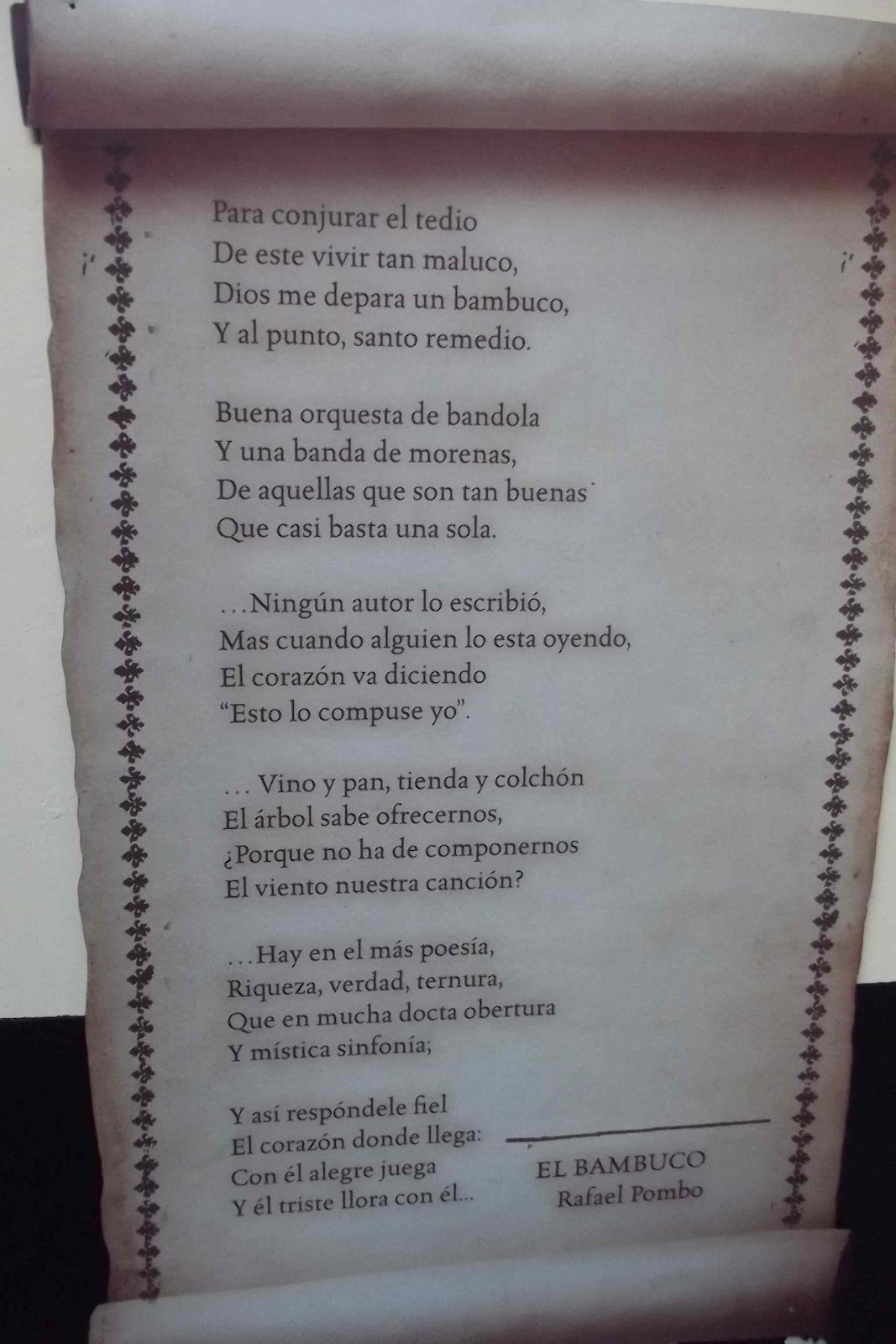
But it is Pombo's darker and even anguished passages which I find more interesting. He gives a hint of existential despair in El Bambuco, which begins with an appeal to 'excorcise the tedium of this miserable life' which God responded by 'providing a bambuco', or traditional Colombian dance related to the European waltz. Pombo ends the poem by saying that his greatest ambition would be to have composed el bambuco.

That poem's happy ending contrasts with his most famous existentialist piece, La Hora de Tinieblas (The Hour of Darkness), in which life is worse than a burden: 'Why was I born? Who forces me to suffer? Who created this terrible law of being and suffering?'

Predictably, that loss of faith got Pombo in trouble with the church. But it doesn't appear to have cast a shadow over the children having fun in his old home in La Candelaria.

Find 18 of Pombo's most famous poems here.


Rafael Pombo's portrait in the National Museum in Bogotá.


El Bambuco


Calle 10 is one of La Candelaria's most historic and best-preserved streets. 


Playing with a giraffe. 


By Mike Ceaser, of Bogotá Bike Tourswhich also has La Candelaria's largest collection of used books in English, French, German, Dutch and other languages for sale and exchange.

Friday, September 9, 2011

25 Years of the Casa de Poesia Silva


The Poetry House's entrance hall. 

The Casa de Poesía Silva, named in honor of Poet José Asuncion Silva, is celebrating its 25th birthday this year.

A young man plays a flute
on the house's front steps.
The house, located on Calle 14, No. 3-41, in the heart of La Candelaria, was founded in honor of Silva, who died there, an apparent suicide, in 1896. Silva, whose portrait graces Colombia's 5,000 peso bill, had a sad, even tragic, life, but did manage to write some of Colombia's most memorable poems.

The room where Silva died
of a gunshot to his heart. 
The Casa de Poesia, which was Silva's family home and where he shot himself after years of tragedy, including business failures, the deaths of his siblings and the loss of much of his work in the sinking of a ship, now hosts poetry readings, talks about literature and musical events. It also has a small library and seems to be a hangout for the city's literati. The house itself was built in 1715, but has been renovated in a republican (post-independence) style. Despite its illustrious past, the house had become a cheap rooming house for decades until Pres. Belisario Betancur turned it into a cultural center in 1986.

Silva died at 31, after seeing the deaths of four siblings, including his sister Elvira, with whom some say he was in love. He also suffered business failures and was heavily in debt. The Colombian government had sent him to work in its embassy in Caracas, Venezuela. But during Silva's sea voyage home, the ship sank and he lost much of his work. Silva's surviving work totals 150 poems and one novel.

Not suprisingly, most of Silva's work is sad and sentimental, a lot of it about death and night.

The house's central patio, with Monserrate visible beyond it. 
The Casa de Poesia also pays tribute to many other Colombian poets and novelists.


Gonzalo Arango, 1931-76, was a leader of the Colombian philisophical movement called nadaism (nothingness), related to dadaism and nihilism.

"Life is a succession of happenstances and nothing is real. Only death."


Isaacs poses as a character from his novel 'Maria.'
Jorge Isaacs, 1837-95, (on the 50,000 peso bill), wrote the romantic novel Maria. The son of an Englishman from Jamaica, Isaacs was also a poet, soldier and businessman, had an eventful life, fighting in two of Colombia's civil wars. He was also a great advocate for free public education for working class people.


Jose Joaquin Casa, 1866-1951, was a politician, writer and educator. He's best known for his poem 'Cristobal Colon.' He founded Colombia's 'Academia de Historia' and headed the 'Academia de la Lengua.'


A caricature of Miguel Rash-Isla, born in 1889, who wrote lots of romantic poems - in both senses. The Secret: "I hold in my sad, restless heart a hidden love. Nobody has seen it, nor will ever see it...."


Poet Leon de Greiff, 1895-1976, and poet/journalist Carlos Castro Saavedra,1924-89.


Eduardo Carranza, 1913-85, was a poet and diplomat. He also directed several literary publications and headed the National Library. Lots of his poetry was about love, death and his nation.


By Mike Ceaser, of Bogotá Bike Tours