Showing posts with label police. Show all posts

Monday, October 1, 2018

Duque Kills the Minimum Dose

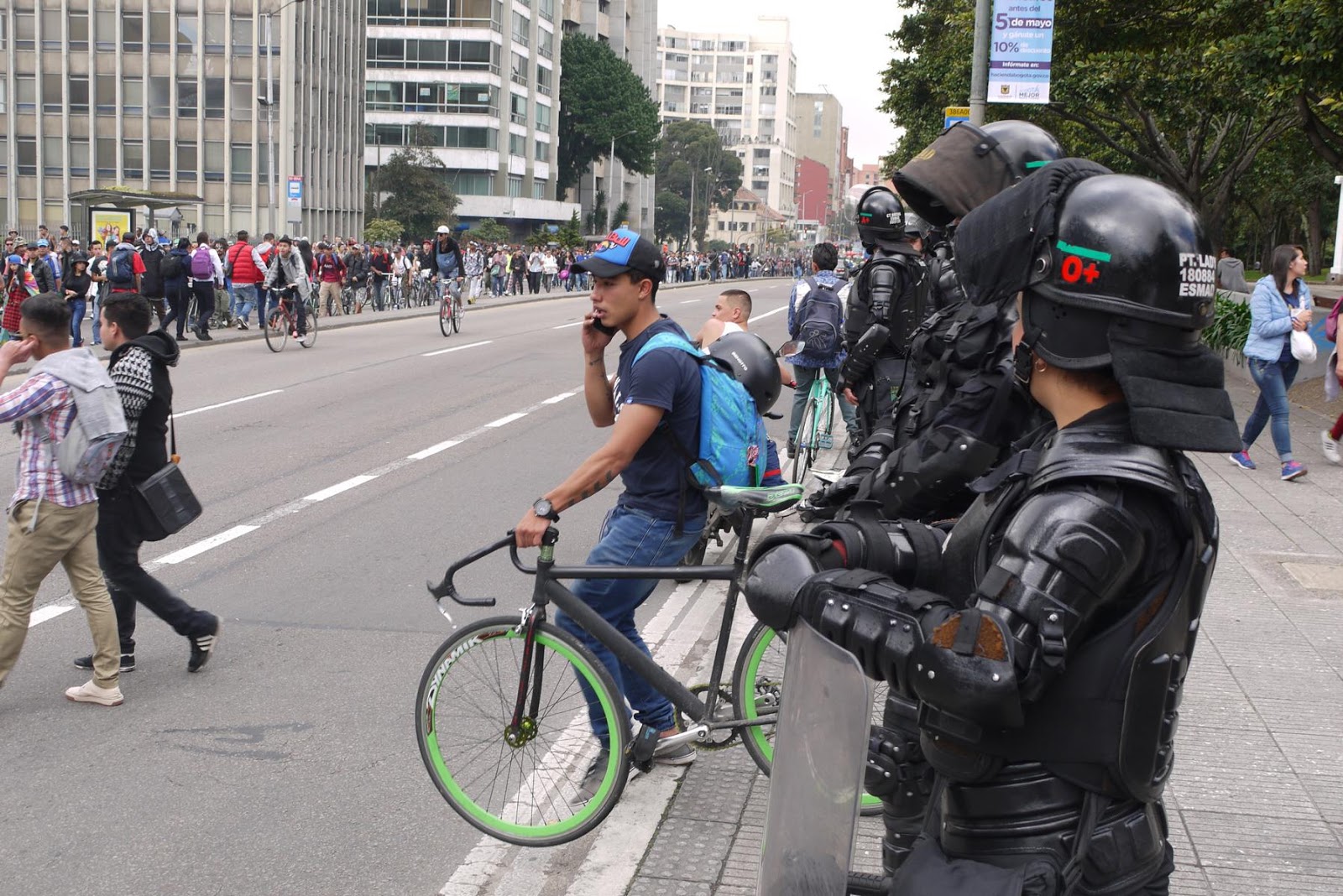
Got any weed on you? Police search young men in Bogotá's historical center. 
The 'minimum dose' of drugs - supposedly the amount a user needed for his own consumption - was the object of many jokes and much derision, as well as criticism from police and conservative politicians as get-out-of-jail-free card for drug dealers. And cops didn't often respect this 'right' to carry drugs in the first place.

But the minimum dose rule did keep a lot of otherwise law-abiding people out of jail, saving them
lots of grief and society lots of money.

Authorities' hopes that prohibiting the minimum dose will reduce crime or drug consumption aren't borne out by experience. Instead, the prohibition will open more opportunities for police corruption and ruin the lives of many young people, especially poor ones, because they have a dependancy or just prefer getting high by smoking rather than drinking.

And, police will waste lots of time and effort pursuing people for a lifestyle choice while real criminals go free.

By Mike Ceaser, of Bogotá Bike Tours

Wednesday, November 15, 2017

When Institutions Don't Work

Are they real, or just virtual?
Case One: For months, our building's sewage system regular crisis. During hard rains, the
wastewater would back up and come flowing up out of the bathroom drain, obliging all of us to grab mops and buckets and clean the mess up.

The landladies, who live upstairs, didn't care - until it happened to them. Then, they hired laborers to clean and rebuild the house's pipes. Then, the only step left was for the city's Acueducto, or Water, department, to hook the house's pipes up to the city sewer line.

That was months ago, and we're still waiting.

One of the landladies, who has physical and psychological problems, has visited Acueducto at least a half dozen times, and come back with promises that they would do the work 'in a few days', 'in a week', 'in a month', etc. They even wrote 'Emergencia!' in big letters on one of the work orders. They've broken all their promises.

To compound the situation's absurdity, the last time the landlady visited Acueducto, they told her she needed to first go get permits from the city's Transit and Public Space departments. And then come back to acueducto.

Shouldn't the water department, rather than the homeowner, have the responsibility of coordinating with the transit department about planned street work? And if they do want the homeowner to do the city employees' job, shouldn't they have told her this the first time she visited, months ago?

Or is all this delay and run-around their way of saying 'You need to grease my palm to get anything done'?
'God and Fatherland.'
And where does the
public service come in?

Case Two: More than two months ago, a foreigner who has lived in Colombia for years was walking down a Candelaria street when a youth stabbed him several times in the back.

The foreigner almost died of blood loss, spent more than a month in the hospital, underwent a half dozen surgeries, lost a piece of one kidney, and is now at home recuperating.

Meanwhile, what have the police done about this attempted murder? The police 'investigador' only interviewed the victim more than two weeks after the attack - and only after we complained to his superiors - and more than two months after the crime he has not talked to the witness. The street has many video cameras which might have captured the attack, but the investigador hasn't looked at the videos. Instead, he gave the victim's teenage son a letter authorizing him to obtain the videos.

"He wants me to do his job," the son says.

A Colombian acquaintance who works in a La Candelaria hotel had a similar experience after being stabbed in an attempted mugging. He went down to the police station and placed the denuncia, but hasn't heard from the cops since.

How many people have these criminals robbed, attacked or even murdered since? But identifying and catching them seems to carry a much lower priority with the cops than, say, shaking down kids for smoking pot or stopping tour guides for working without the benefit of a Sena certification.

And if the public institutions are this apathetic and abusive here, in central Bogotá, in one of the city's more important neighborhoods, the heart of its tourism industry, then what happens when someone needs help in Usme, Kennedy, Ciudad Bolivar or some other barrio popular?

Yet, the really remarkable thing is that Colombian institutions actually work WELL compared to those in many neighboring countries, such as Venezuela and Bolivia. Hundreds of thousands of Venezuelans have sought refuge in Colombia because of the astronomical levels of corruption and criminal violence there (as well as the collapsing economy and hyuperinflation).

In Bolivia, where I lived some 15 years ago, the public institutions seemed designed primarily to squeeze money out of the people they were supposed to serve. There, my landlady's telephone would get cut off periodically, and she'd have to go down to the phone company and pay someone a bribe to get it turned back on. And the police seemed to make a practice of arresting people in order to force them to pay a bribe to be released - a form of institutionalized state kidnapping for ransom.


By Mike Ceaser, of Bogotá Bike Tours

Wednesday, August 9, 2017

A (Police) Code for Corruption

Don't talk back! If this kid being arrested talks back
to the junior cops, it could cost him.
You can insult the president, your grandma or even a priest - but disrespect a cop and you'll pay for it: 657,000 pesos, according to the new Codigo de Policia.

Keep you mouth shut and cooperate! Police evict
booksellers from a downtown sidewalk.
No matter that 'disrespect' is a vague term, inevitably left up to the cop's own judgement - and that speaking one's mind about the police seems like a basic civil right.

And don't urinate in public, either, because that means a 736,000 peso fine.

And if you're brutish and prejudiced enough to insult a member of the LGBT community, you might have to shell out 657,000 pesos. But insulting anybody is bad, so why should LGBT people be singled out, when insulting someone for being fat, female, black or Armenian seems just as wrong?

The new Police Code, which went into effect on Monday, may be well-intentioned. But its fines seem arbitrary, out of proportion and destined to increase police corruption.

Had too much fun at the local bar, and cop spotted you pissing against a tree on the way home? Maybe that's a bad thing, except for the nitrogen-starved tree - but what's the likelihood that you'll be willing to pay close to a million pesos for your transgression? Instead, you'll reach in your pocket for a 20,000 peso bill and hand it to the notoriously malleable police officer.

And is urinating in public really twice as bad as publishing someone's intimate photos on the Internet without their consent, which means only a 325,000 peso fine? Publishing such a photo can ruin someon's career, while urinating just makes a doorway stink.

Practicing the oldest profession on a central Bogotá plaza
outside of the designated red light district.
And then there is the odd 'crime' of 'obstructing expressions of affection' (not including sexual ones), which I suppose is intended to protect LGBT people's rights to display public affection. But don't conclude that the new police code is about free love, because having sex in public and practicing prostitution outside of designated areas are also subject to fines.

Not that the new codigo is all bad -.if it were only enforceable. For exampole, selling cigarrettes to minors now carries a fine. But that's been illegal for years - as is selling loose cigarrettes - yet every corner seems to host a street vendor eager to sell a smoke to anybody with a few coins in their hand.

Colombia is not Singapore, and unless penalties are realistic, they'll only feed corruption and disrespect for the law, rather than a more ordered country.

By Mike Ceaser, of Bogotá Bike Tours

Saturday, May 6, 2017

Marijuana Marchers vs. the Police

Riot police on Carrera Septima, by the Parque Nacional, with marijuana marchers in the background.
The marijuana march was massive. 
Today's marijuana legalization march brought out thousands of people, mostly young, who marched down Carrera Septima and ended up on the Plaza del Periodista - until the cops swept in and drove them out.

It was a bit of a surreal scene. An anti-riot police tank arrived and proceeded to make a long speech - in English - advertising the speaker system's capacities. Then, they gave the marijuaneros ten minutes to clear out.

'This march has been carried out without incident so far,' said the loudspeaker.

One group held a 'Yes to the personal dosis' banner in front of the tank, to no avail. Afew protesters threw bottles at the tank, and one spray painted something illegible on its side. But soon, the cops started tossing acoustic bombs and the plaza quickly emptied out.

What was the point? Why didn't they just let them stay and smoke?


The marijuana march ended in La Plaza del Periodista, in La Candelaria, which was packed.


About 6:30 p.m. the police arrived, on foot, motorcycles and in tanks.

A pot protester writes graffiti on a anti-riot tank.

A 'Yes to the Personal Dose' banner confronts a tank.

A photo opportunity for foreigners.

The plaza cleared out quickly. I didn't smell tear gas, but the cops apparently threw sonic bombs.


A line of riot police on Plaza del Periodista.

The empty plaza, crowded just a few minutes before.

Yet more cops come motoring in.

By Mike Ceaser, of Bogotá Bike Tours

Thursday, June 18, 2015

Police State?


Police watch a demonstration by displaced people on Plaza Bolivar.
One of the first things which foreigners remark about when visiting Bogotá is how many police and soldiers they see on the streets. There is a reason for this, of course - Colombia's terribly
 high rates of street crimes such as muggings, even murder.

Police detain a man on Carrera Septima.
However, the ever-present police could become scarier. Even tho they are frequently accused of abuses against the public, a new Police Code now in Congress would enable police to enter private homes without a judge's order when the officer feels it's case of 'hot pursuit'; the code would also enable police to detain someone 'for their own protection' or that of the public. And the code authorizes police to use polemical electric stun guns, known as tasers. Public protests would be illegal without previous authorization.

Altho some say that the police already have some of these powers, the code has generated protests from opposition politicians and civil rights groups, who say that it opens the door to more police abuses.

The reform bill is still under consideration in Congress. Expect protests if it advances.

Posters protest police abuse.
Anti-riot police along Carrera Septima.
Police at night in La Candelaria.


By Mike Ceaser, of Bogotá Bike Tours

Sunday, June 14, 2015

Disarm Yourself?


'Disarm Yourself,' say the police.
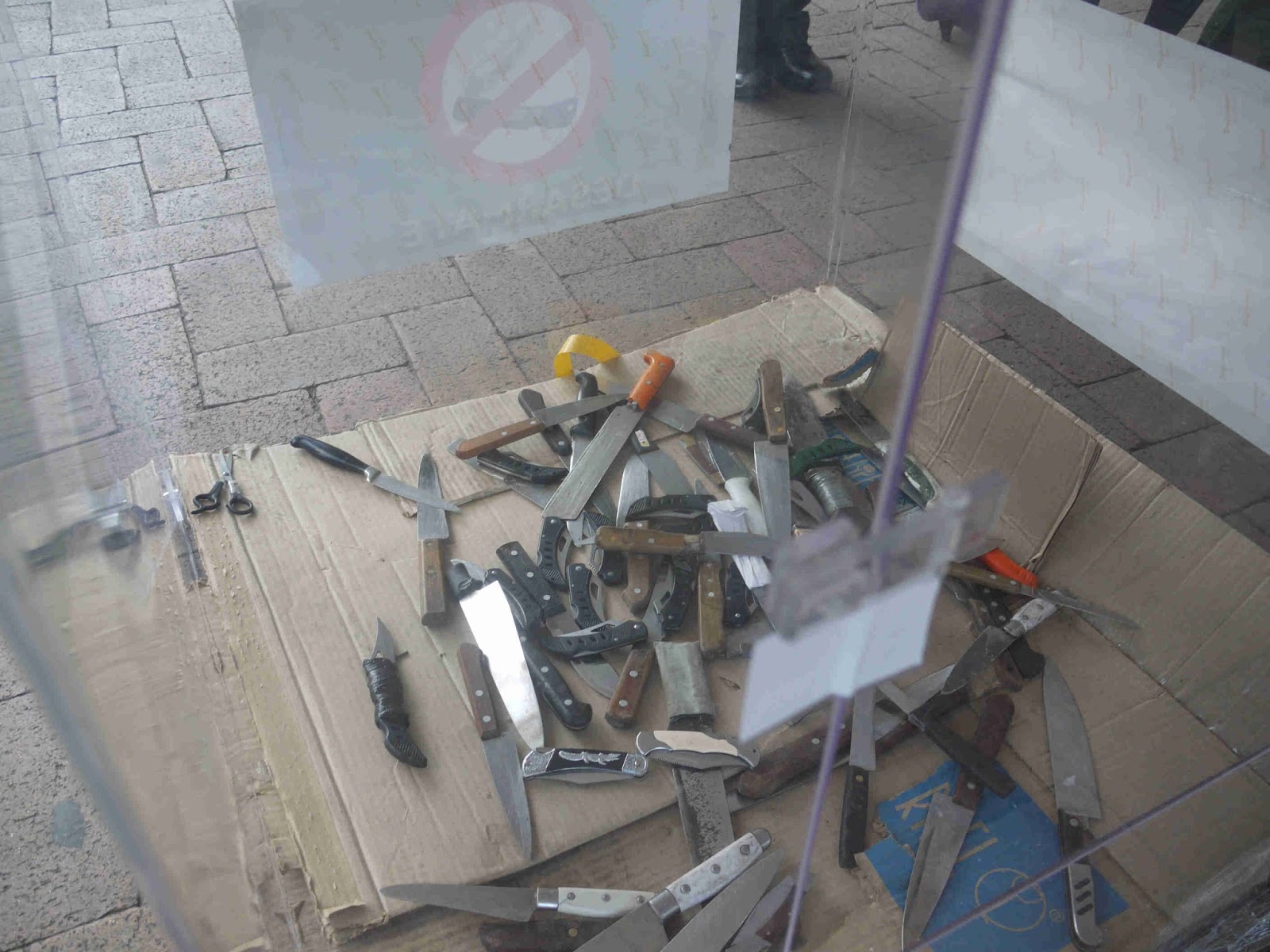
Confiscated knives on display.
The other evening, I was buying an electric shaver in one of the Sanandresitos along Calle 13, an area known for fencing stolen cellphones and money laundering. The shop also had a display of pocket knives - instruments not known for cutting bread and cheese.

As I was leaving, a tough-looking fellow crossed the dark street, purchased a knife and departed with it under his coat. He wasn't heading off to prepare his dinner.

Bogotá has just prohibited the carrying of 'armas blancas,' which include knives and other sharp weapons. It's potentially a positive move, since almost nobody carries knives to defend themselves, whereas criminals routinely do to threaten others.

A jackknife. Tool or weapon?
The trouble is enforcing the law, since knives, stilettos and other such weapons are easy to hide. And, how do you distinguish between someone carrying a knife to commit crime, and someone carrying one for work or carrying home new-bought knives to prepare dinner?

When I was a kid growing up in California, we carried jackknives or pocket knives to be cool and manly, but not to cut anybody.

Regulating the market is even more difficult, since there are legitimate uses for those weapon-like knives, such as camping, hunting and fishing. And, unlike a gun, you can make a knife at home.

All those grey areas leave the armas blancas law open to abuse. Still, for those of us who don't want to be mugged by a drugged out addict, as has happened to me, see the law's advantages.

On the other hand, a week ago I was going home late at night in La Candelaria when two cops stopped and searched me, even tho they had no reason to think I was up to any crime - which I wasn't. Perhaps frustrated by not finding any reefers in my pockets, they confiscated the pepper spray I usually carry, as I have been mugged on my way home at night.

"Where's your permit for carrying this," they asked me.

In fact, no permit is required for carrying a pepper spray.

Prohibited?
I've since talked to several police officers, who agree that what those two cops did was rob me. The cops did not deposit my pepper spray in the police station. Perhaps they threw it away or sold it.

For whatever reason, criminals don't use pepper spray to commit crimes, but the spray seems to have saved me from several muggings.

Do the police really want more crime victims?

Congress is now considering requiring a permit to carry such personal protection. That might be reasonable. But disarming law-abiding people of this non-deadly protection device would just make criminals' work easier.

On the other hand, prohibiting pepper spray and similar devices will compel some people to resort to guns, replacing a non-deadly, non-injuring weapon with a deadly one.

By Mike Ceaser, of Bogotá Bike Tours

Thursday, January 22, 2015

Crime and Punishment


Ignoring the police, pedestrians attack a supposed thief today on Calle 13 and Ave. Caracas.
When a criminal gets caught red handed on Bogotá's streets, he doesn't have only the police to fear: Passers-by also take the law - or, rather, street justice, into their own hands.

The guy WAS guilty. After a few more
kicks, he produced a gold-colored
chain he'd grabbed.
Without justifying lynching, one can still try to understand people's attitude. Reports of many crimes, including muggings and robberies and even homicide, rose last year, El Tiempo reported here and here. That's paradoxical with a growing economy, which presumably would have more people working legitimate jobs. The police suggest that crimes did not rise, but that reporting did. Or, the three-month judicial strike, which left many accused criminals on the street, may also have influenced things.

What is certain is a general anxiety about crime, and a common belief that even when criminals are arrested, they're freed the next day. So, some people try to apply punishment with their own hands. Literally.

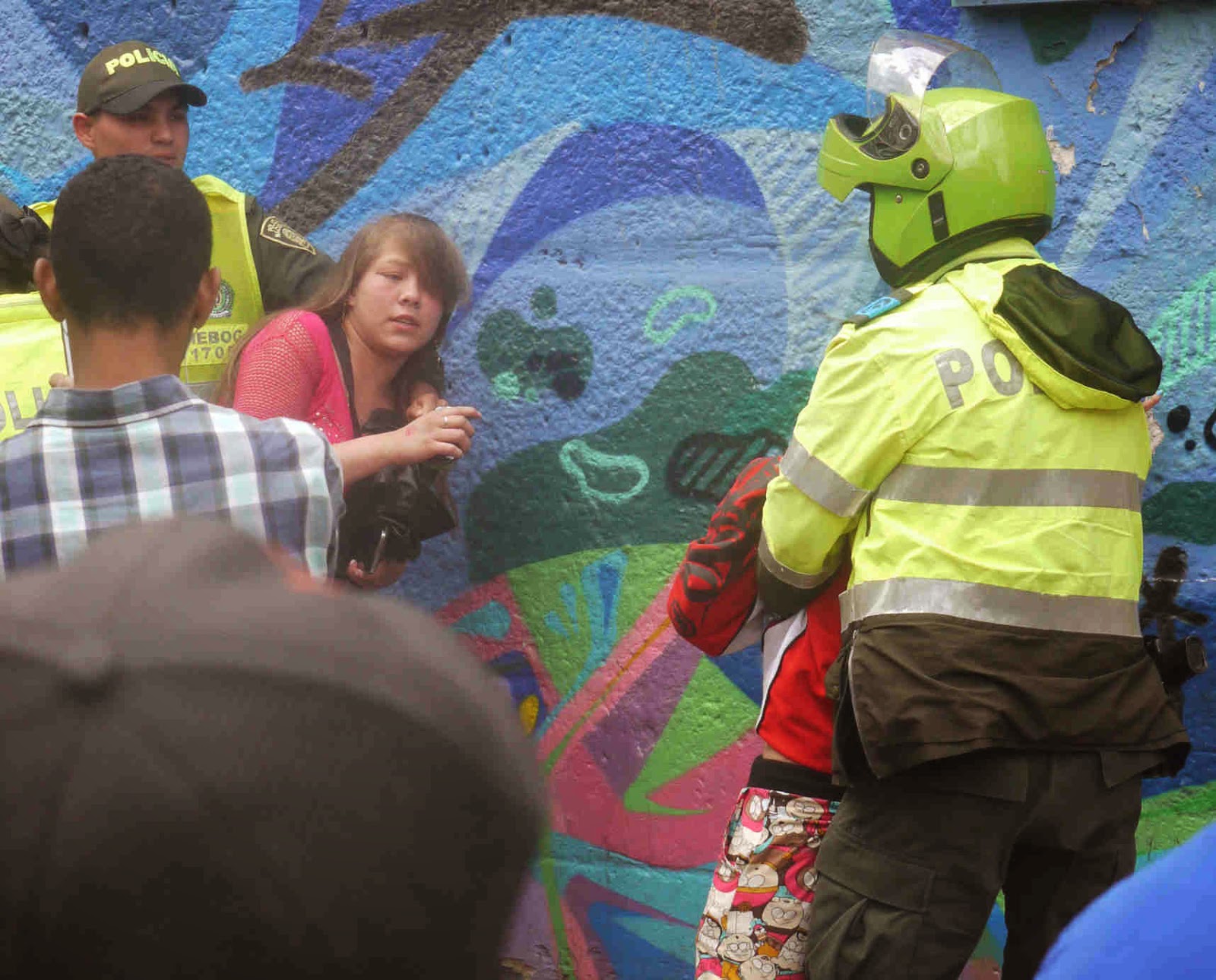
This happened on Carrera Septima the other day. But the police's motives for grabbing the youth weren't clear. One observer thot he'd stolen a bike that was nearby. Others speculated that one or both of the young women present had accused him of attacking her, and then repented.


'Let my man go!'
'He's my man, too!'
But these cops had no intention of freeing the youth.

By Mike Ceaser, of Bogotá Bike Tours

Tuesday, July 29, 2014

A Shocking Proposal: Tasers for Colombian Cops


Cops on patrol today on San Victorino Plaza in Bogotá. They appeared to be carrying regular pistols.
Colombian media are asking whether the 'electric pistols', commonly known as tasers, are dangerous. Colombian police use some of the devices and may buy more of them.
Israel Hernandez, a Colombian-American
who died last August after being
tasered by police in Miami Beach.

The answer obviously is 'yes,' but that's the wrong question. Nothing is perfectly safe, particularly a device designed to incapacitate violent criminals by causing them pain.

And police will use some dangerous device, whether billy clubs, tasers or regular guns. The right question to ask is whether tasers are better than the alternative.

Tasers have a bad image here, and perhaps rightly so, because last August Israel Hernandez, an 18 year-old Colombian-American graffiti artist was killed in Miami Beach by a police taser charge.

A taser.
Hernandez's death was a tragedy. However, in August 2011 another young Colombian grafitero, Diego Felipe Becerra, died in Bogotá after police chased and shot him with a real gun. Becerra would probably be alive today if those cops had been using a taser.

According to Amnesty International since 2001 500 people in the United States have been killed by electric stun guns. Every one of those deaths is a tragedy. But every year tens of thousands of people in the U.S. are killed by firearms. If those were replaced by tasers, almost all of those people would have survived.

Bogotá graffiti artist Diego Felipe Becerra, 
shot to death in 2011 by police firearms. 
Any weapon can be deadly. I'm sure that many people have been killed with billy clubs. But tasers will more likely be used in place of real guns. For all the dangers of tasers, real guns are much more dangerous, not only to the suspect, but also to bystanders. A bullet can kill or injure someone hundreds of meters away. Miss with a taser charge and nothing happens.

According to a police study cited by Wikipedia, taser use reduced police deaths by 75%. The Taser company's website claims that their products have saved 128,000 lives and counting. I wonder how they came up with that number. However, if I were a youth being chased, rightly or wrongly, by police, I'd much prefer they carried electric pistols than ones with bullets in them.

Bogotá cops: better off with firearms,
electric pistols, or both?
And, if I were a cop, I'm sure I'd prefer an electric pistol to a real gun except in extreme situations. Say you're called to a tavern where a drunk construction worker is throwing chairs at the walls. You can't get close enough to club or tackle him. You could try to shooting him in the arm, but you might miss and kill him or another patron. And shooting a suspect would surely mean an investigation and newspaper headlines. So, you pull out your electric pistol and immobilize the guy, at minimal risk to other bar patrons.

Another danger of real guns was highlighted by the ongoing scandal over the importation of thousands of Sig Sauer pistols, apparently in violation of German law. Some of those pistols were stolen before police even received them - meaning that criminals are likely using them today to rape, robbery or even murder. I'd much rather that those criminals get their hands on tasers - which fire only one to three times and which the bad guys probably wouldn't even know how to use - than real guns.

It's amazing to me, too, how the potentially illegal purchase of tens of thousands of deadly real guns and the theft of some of them, produced little news, while the purchase of a few hundred electric stun guns has generated a firestorm. It's a testament to how blasé society has become about the proliferation of firearms.

By Mike Ceaser, of Bogotá Bike Tours

Tuesday, August 13, 2013

A Fatal Passion for Street Art

Graffiti artist Diego Becerra, left, shot by Bogotá police in 2008, and Israel Hernandez, right, killed two weeks ago by police in Miami Beach, Florida. (Photo: El Tiempo)
The killing of a young Colombian-American graffiti artist by Miami Beach, Florida police last week recalls the killing five years ago of a yong grafitero in north Bogotá.

Both Diego Becerra,17, and Israel Hernandez, 18, were talented graffiti artists. Both were surprised by police while painting walls and killed soon after. Unfortunately, their art is looked upon negatively by many people, and often associated with crime.

Becerra's case has become something of a cause celebre in Bogotá. Initially, police charged that the youth had committed a robbery before they pursued him. But it soon became clear that police had framed Becerra in order to cover up the killing. Since then, three police officers have been charged in the killing and cover up, and two police colonels put under investigation.

For his part, Israel Hernandez was allegedly killed by a Miami Beach taser, a weapon which emits a supposedly paralyzing but non-harmful electric shock. Hernandez's father, who is also named Israel, told W Radio that his son had also been hit on the head. The elder Hernandez vows to see his son's death will be investigated and the guilty punished.

Ironically, the Hernandez family moved to Miami from the sometimes violent La Guajira region because the elder Hernandez had experienced threats, he said. Somewhat ironically, in the radio interview, Hernandez called Miami a city 'where rights are respected.' It will be interesting to see whether Hernandez's case is pursued as thoroughly as Becerra's has been.

Also this week, in the state of Virginia a Colombian woman was also allegedly strangled to death by her American husband, who is now in prison.

The United States was once the land of opportunity for many Colombians: a place where Colombians went to escape their own nation's violence. Today, as Colombia's rates of violence drop and its economy grows, that historic relationship may be shifting.

It's time to change the traditional view of graffiti artists as probable delinquents and criminals. Some people who paint walls are just gang members vandalizing public space. But Hernandez had won awards for his artwork and exhibited in Miami art galleries. While not everything painted onto walls is attractive, or even art, good street art contributes a lot to a city. Putting them into the same category is like
And, I'm certain, many more people get to enjoy a piece of street art than do a painting hidden away in a museum.

By Mike Ceaser, of Bogotá Bike Tours

Monday, July 15, 2013

The Vice Hasn't Left El Bronx

Police frisk people entering and exiting El Bronx this afternoon. 
A few months ago, police invaded El Bronx, the notorious drug-filled street near Los Martires Plaza. They,  cleared out the hundreds of shacks which residents had set up to live and do business. 
Today, the buildings are still gone, the open air drug market and shooting gallery remain. 

This afternoon, police had the street's western entrance blockaded and were searching those who entered and exited. A few meters away, seated on the opposite sidewalk, a half dozen apparently homeless people were smoking bazuco, a cheap form of crack. 
The authorities evidently are fine with drug consumption insid El Bronx, but want the vices contained there. 

It can't be any fun looking inside drug addicts' shoes and under their shirts all day long.