Showing posts with label museum of modern art. Show all posts

Wednesday, February 7, 2018

Museum for Rent!

'For Rent.' Bogotá's Museum of Modern Art seen from its parking lot.
No, Bogotá's Museum of Modern Art, off of Carrera Septima just south of Calle 26, is not for sale.

The 'Se Arrienda' signs hung on its walls are a sort of performance art, publicizing the museum administrators' argument that the museum is short of dough. The measure worked: The museum's situation received lots of coverage in all sorts of media - attention which would have cost the museum an arm and a leg.

Strikingly, while the modern art museum - and undoubtedly others - scramble for funds to continue operating, the city has just financed a series of huge murals on Calle 26 - which ALREADY HAD huge murals.

It would be sad to see the museum close down, as it's housed powerful exhibitions like this one.

By Mike Ceaser, of Bogotá Bike Tours

Saturday, November 11, 2017

The War We Have Not Seen

Massacre victims.
A paramilitary commander kidnaps a woman on suspicion of guerrilla sympathies, holds and rapes her, and then murders her to keep her quiet.

A teenage FARC guerrilla, eight months pregnant, wants to have her baby. But the guerrilla leaders
Massacring civilians.
force a doctor to abort her pregnancy. When the doctor and the baby's father both object, the guerrilla leaders order them murdered, too.

A child soldier flees a paramilitary unit, but is recaptured. The paramilitary commander gathers together the students from the local school to watch the execution, as a warning.

A guerrilla unit commander, ordered to blow up a military vehicle, becomes bored with waiting, and decides to bomb a car carrying a civilian family instead.

FARC guerrillas, suspicous that a local schoolteacher is reporting on them when she leaves town, capture and hang her.

A funeral.
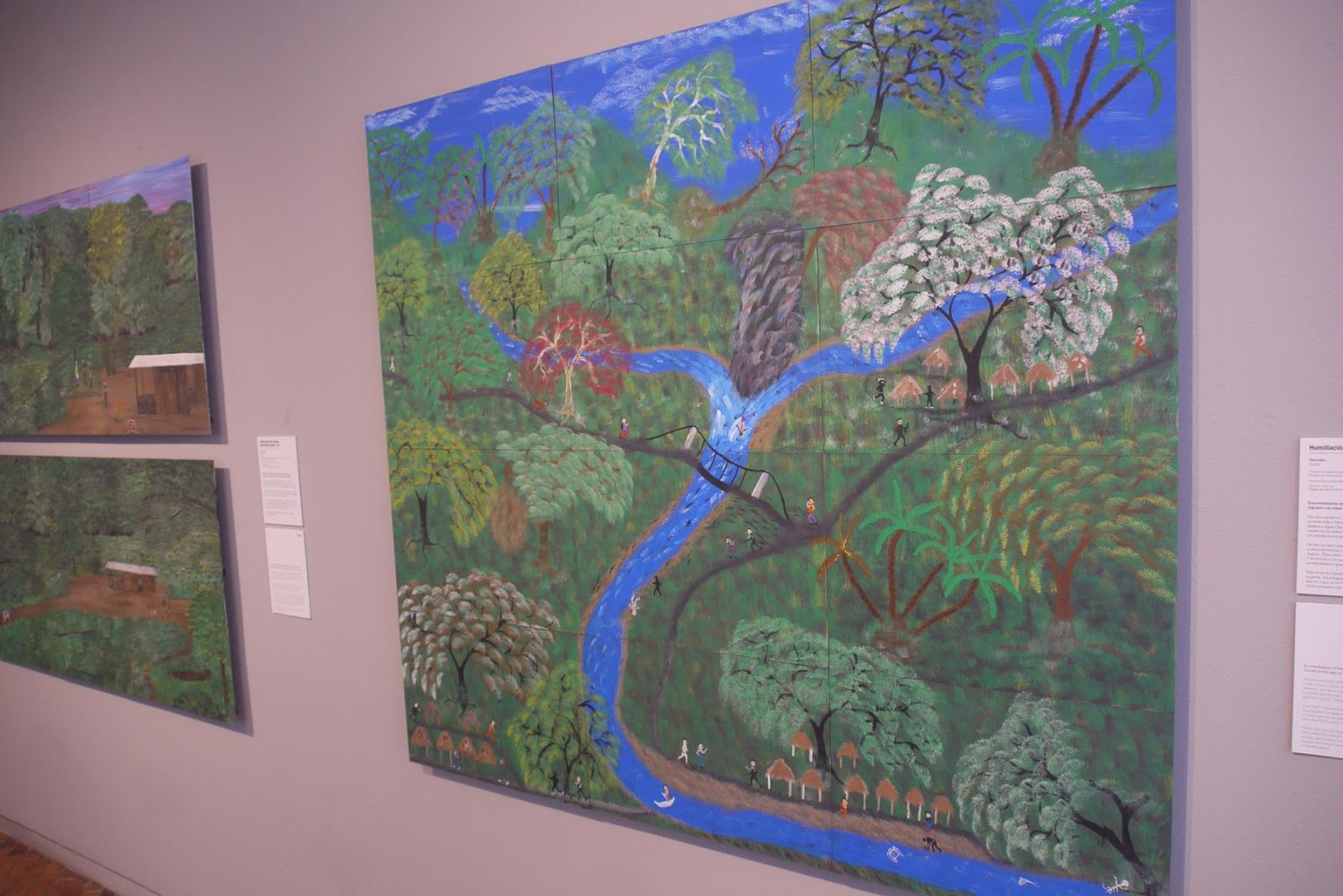
Such horrors became almost routine during Colombia's long and senseless conflict. And such accounts, told by ex-combatants, many of them only children when they joined up, are on display now in Bogotá's Museum of Modern Art, illustrated by childlike paintings.

The project is called 'The War We Have Not Seen', by the Points of Encounter Foundation, and captures a few of the conflict's innumerable horrors, horrors which would have made headlines in any normal country, but, if not for this project, would have gone unnoticed here.

The museum has, incidentally, done a good job of becoming bilingual.
A hanging.


A river of death.


Killing a woman.


Kidnap victims.

A massacre.

A paramilitary officer. In the background, a woman he raped and then murdered.


By Mike Ceaser, of Bogotá Bike Tours

Boards of Memory

When Juan Manuel Echavarría traveled thru the Montes de Maria region in 2010, in a community depopulated by Colombia's conflict, he came upon a schoolhouse abandoned by the fleeing residents. Inside, he entered a classroom - and found the teacher's final lesson still on the blackboard.

That haunting experience started Echavarría  and a friend on an oddysey across the remote region, where they visited more than 100 abandoned schoolhouses, photographing more than 200 classrooms as memorials to disappeared schoolchildren, families and whole communities.

According to Verdad Abierta, from the late 1980s to the early 2000s, nearly 50 massacres took place in this bucolic hill country just a few hours outside of Cartagena, mostly committed by right-wing paramilitary groups against landless campesinos.

Echavarría's work, named Rios y Silencio, preserving a history Colombia hopes not to repeat, is on now  thru Jan. 7 at Bogotá's Museum of Modern Art.

The museum has, incidentally, done a good job of becoming bilingual.

A mule outside of a school, apparently waiting for a child who long ago went away.
An abandoned chalkboard in a deserted school conserves its final lesson.

Photos of abandoned schools in the Museum of Modern Art.


By Mike Ceaser, of Bogotá Bike Tours

Sunday, November 9, 2014

The Last, Past Generation, in the MOMA

Visitors by a sculpture by Ana Mercedes Hoyos.
The dozen years between 2003 and 2014 saw the deaths of at least 21 Colombian artists of note. Bogotá's Museum of Modern Art, located across Ave. Septima from the Torre Colpartria, is holding an exhibition. called In Memoriam, of works by those 21, among the best known of whom are Enrique Grau, Bernard Salcedo, Hernan Diaz and Ana Mercedes Hoyos.

The museum's website calls this generation of soldiers 'innovative' and says that they "consolidated modernity" "broke with traditional forms" and "used non-traditional materials."

An abstract mess, by Armando Villegas.
Art by no other name. Cuentas, by Bernardo Salcedo. 

Delirium of the Dead Nuns, by Juan Rodas.
Visitors walk past paintings by Gustavo Zalamea.
Enrique Grau, by Hernan Diaz.

Paintings by Juan Antonio Rodas.
Scenes by Maria Helena Bernal.


There are no condors, nor abundance, nor liberty, nor canal.


Squares by Ana Mercedes Hoyos.

Eggs exhibit by Bernard Salcedo.
By Mike Ceaser, of Bogotá Bike Tours

Saturday, November 8, 2014

Colombian Double-Takes

The Peñol de Guatape in Cordoba Dept., by Henry Price, in 1852.
Between 1850 and 1859 the Comision Geografica, led by the Italian-born Agustín Codazzi, criss-crossed Colombia studying its people, geography and natural resources. The goal was to catalog and unlock the nation's natural resources, making Colombia a rich country. The wealth did not materialize, but the expedition gathered valuable information about the young nation's far-flung regions. The paintings, most by British-born Henry Price, immortalize a formalized, somewhat romanticized view of Colombia.

Recently, Santiago Harker traveled thru many of the same areas, capturing modern versions of the people and places. His photography also captures the contrasts of Colombian society: rich and poor, urban and rural, humble and glamorous.

Harker's work, on exhibit thru tomorrow in Bogotá's Museum of Modern Art, invites reflection on how things have changed and whether they're better or worse today. Certainly, people appear less formal and pretentious - altho that probably also a result of the old-timers' artistic style. Things move faster today, with less physical toil, but are they actually better?

In the case of the Peñol de Guatape, pictured here, the giant graffiti, the houses at its base and the strange building on top don't much improve the natural landmark.

The final day for the exhibit in the Museo de Arte Moderno, is tomorrow, Nov. 9.
 A nicer view? The Peñol de Guatape today.
The 1850s expedition on the left and Harker's travels on the right.
Couples then and now. 

Gold mining then...
Artesanal, mostly illegal gold mines, haven't become much more sophisticated, but they have become much more destructive for the environment and the miners, who expose themselves to toxic mercury.

...and gold mining now.
Nuns haven't changed, but girls' dress has.

Affection is much more open and intimate.
Zipaquira, location of the Salt Cathedral, back in the 1850s...
...and Zipaquira today.
Diversions are no more sophisticated.
Blue jeans and an old bicycle will make you glamorous.

Rural workers today.
Fishing has changed little.
Kids amongst soldiers. 


Pack right when you travel.


Prostitutes await customers in Antioquia.


I want to be glamorous, too.
Well-dressed youths.
By Mike Ceaser, of Bogotá Bike Tours