Showing posts with label urban planning. Show all posts

Tuesday, April 25, 2017

A White Elephant Towering Over Bogotá?

Is anybody working up there?
The two-tower BD Bacata
looks quiet these days.
The BD Bacata skyscraper started out in the year 2013 with great promise - or at least promises. Colombia's new tallest building - and the second tallest in South America - would be the world's first crowdfunded high-rise and produce returns for investors at double the bank rate. The two-tower complex - to include a shopping mall, hotel, luxury apartments and offices - wouldn't even worsen traffic jams in the already-congested area.

The promoters' promises sounded too good to be true, and so far they have been. Construction is now years behind schedule, and investors who each poured tens of millions of pesos into the trillion peso project, are complaining. The Bacata's builders say the project will operate this year, and the mall section looks close to completion. However, during the past weeks I haven't seen anybody working on the unfinished towers. The project'¿s backers explain that they ran into legal and other delays, including a huge rock underground.

The mall looks near completiion.
The skyscraper was never a great idea by urban design standards. It's on a busy, chaotic avenue, with only a narrow access to its parking garage. And the building has little public space, and no green space at all nearby.

Now, I wonder whether it'll get finished, and I feel sorry for those who counted on it for a life-long 'guaranteed' income.

A century ago, the Edificio Peraza on Calle 13 across from the Estación de la Sabana was Colombia's tallest building.
Today, however, it appears vacant and decrepit.
By Mike Ceaser, of Bogotá Bike Tours

Tuesday, April 28, 2015

Reaching for the Sky, Forgetting the Ground?

Trouble on the ground? The unfinished BD Bacata just became the tallest tower in Colombia.
According to news reports, the BD Bacata Tower, being built by the intersection of Carrera 7 and Calle 19, just became the tallest skyscraper in Colombia, surpassing the 48-story, 196-meter Torre Colpatria, on Carrera 7 and Calle 26.

Reaching for the sky: An artist's
rendering of the BD Bacata tower.
I suppose that this is something to be proud of - despite some development researchers' observations that the construction of arrogantly tall buildings often anticipates economic swoons. 

The Bacata's website boasts about the project's urbanistic positives - mostly the fact that its central location won't contribute to sprawl and will reduce travel times to reach it. Those certainly are pluses, as is the potential to use public transit in the area. 

But none of that obviates the need for planning and investment to keep the surroundings livable and transit in the area functioning - things that aren't often the case now, even without this immensity. 

The 66-story BD Bacata will contain a parking lot, shopping mall, offices, apartments and a 364-room hotel. None of those are designed for poor people. Sadly, even with the area's wealth of bus service, most of the complex's users will likely arrive by car, snarling the chaotic traffic on Calle 19 and the narrow secondary streets. (Carrera 7 is currently pedestrian-only during the day.) 

Central Bogotá's skyline, with the Bacatá on the left.
While the Bacata's construction is advancing rapidly, I've seen exactly no, (zippo, 0, nada) transit improvements nearby to prepare for the onslaught of vehicles which this city-in-a-building will generate. In a rational city, of course, the Bacata's builders would be required to contribute to TransMilenio and-or light rail lines to expand the capacity of the adjoining avenues.

I won't even speculate about the capacity of nearby water, sewer and electricity service, nor mention the lack of nearby green space. And, how about urban renewal of the adjoining blocks, which are quite seedy? Will the Bacata's residents and users dare to walk a block outside the building, or immediately take refuge in a private vehicle - compounding perpetual traffic jams?

In an interesting aside, the Bacatá claims to be the world's first crowd-funded skyscraper.

By Mike Ceaser, of Bogotá Bike Tours

Tuesday, March 24, 2015

Skyscraper City?

High and higher? Central Bogotá's skyline, with the Cerros Orientales behind.
Quietly, last December, Mayor Petro issued Decree 562, permitting the construction of skyscrapers across much of Bogotá, as long as certain restrictions are observed.

If you didn't hear about the decree at the time, you weren't alone. It received little attention, despite its potentially fundamental impacts on Colombia's capital. Now, however, the decree IS receiving attention - almost all of it negative.

High rises along Carrera Septima.
"I don't know any urbanist, architect or civic leader...who believes (the decree) will produce a better Bogotá," wrote ex-Bogotá mayor and urban sustainability expert Enrique Peñalosa. "The citizens, who will suffer the most, haven't begun to understand how this decree will destroy the character and quality of their neighborhoods."

Journalist and novelist Enrique Santos Molano, who describes himself as usually an opponent of Peñalosa, instead agrees in this case. High-rises, Santos Molano writes, "produce visual contamination...and overcrowding...A city planted with skyscrapers resembles a hell."

Peñalosa and Santos may be overreacting. The decree's goal is to make the city more dense, and as they themselves admit, that's a valuable goal, since it makes transport and providing public services much cheaper. And, are Chicago, New York, Singapore and other skyscraper cities really 'hells' on Earth?

The Torre Bacatá being constructed on Calle 19
is to be Colombia's tallest building.
The decree does exclude high-rises from some neighborhoods, such as Bogotá's historical center, and
directs city officials to take into account the surrounding neighborhood, amount of open space and other factors when issuing building permits. However, such considerations, naturally, turn out to be extremely malleable when construction companies' huge profits come into play.

This decree will be very destructive if it permits the growth of urban jungles, in which residents feeling trapped, and neighborhoods become impersonal, anonymous places with little green space, where streets feel like dark chasms deep in urban canyons.

High-rise construction can be positive for cities, but it should be planned carefully, considering factors such as public space, transport and sunlight. Unfortunately, that isn't true in Bogotá now, and won't likely be under Decree 562.

By Mike Ceaser, of Bogotá Bike Tours

Sunday, March 15, 2015

The 'Miracle' Metro

A jammed Bogotá road. Is a subway the solution?
It will reduce commute times, traffic congestion, pollution - and even crime and health problems, while saving Bogotá millions of dollars.

Those are some of the claims made by backers of a 15 trillion peso Bogotá subway line in a recent study by the company Teknidata, hired by the city's Urban Development Institute, the IDU.
A Bogotá bus belches smoke. Has anybody
thot of enforcing emissions laws?

But many of those claims look dubious from a glance at Latin American capitals such as Mexico City, Santiago, Chile and Caracas, Venezuela, all of which have much more extensive subway systems than Bogotá could have for decades - and still suffer from horrific pollution and traffic jams.

The reason is simple: Induced traffic demand. Opening up road space, by either building more roads or taking cars off of the roads using mass transit, will reduce traffic jams....for a while. But new drivers, seeing that wonderful open asphalt, will decide to make more trips. So, traffic ends up just as bad, or even worse.

This is not to say that a subway's a bad thing. In fact, it's an excellent thing for the many thousands of people who use it every day to get where they're going quickly underneath the traffic jams.

Will Bogotá's metro look this good?
But the question for a cash-strapped city isn't whether a metro would be a good thing (a space port, after all, would also be a good thing), but whether it's the most cost-efficient way to accomplish the city's goals. And a subway looks rather like the most expensive way to maybe achieve its goals:

Reduce traffic congestion? Rather than spending trillions of pesos digging up the city for a subway, Bogotá could reduce congestion AND make money by creating a London-style congestion charge. Such a charge would raise the cost of and thus disincentivize driving. More people car-pool, take buses, ride bikes or simply don't make that unnecessary trip, and traffic jams are reduced (and so is pollution).

Reduce pollution? This one's almost too obvious to be worth explaining. Bogotá has a bad air pollution problem. Bogotá also doesn't bother to enforce emission laws. Wouldn't enforcing the law be a good first step toward reducing pollution, rather than pretending a subway will do it a decade from now - by which time the city will be inundated with many thousands more polluting vehicles?

As for reducing crime, the newspaper article doesn't bother to explain this, and I won't try.

Bogotá's leadership is fixated on building not only any metro but the most expensive kind; a subway. And not because it's the best transit option, but - it seems to me - because other big cities have subways, and Bogotá wants to feel important. Incidentally, subway construction will also mean huge, juicy contracts for infrastructure companies.

By Mike Ceaser, of Bogotá Bike Tours

Friday, February 14, 2014

Fighting for the Trees

People walk thru the tree-filled Parkway in the Teusaquillo neighborhood.
Urban trees block noise, soak up pollutants, provide shade and make a city feel more liveable - but they also generate controversy.

Councilman Saenz points to a photograph of deforested
land in the Bosque Izquierdo neighborhood.
That's happened in Bogotá, where the city plants trees - but also cuts them down. And the sometimes over-zealous efforts of tree  cutting companies, as well as construction companies which deforest areas others many consider to be public patrimony.

City Councilman Roberto Saenz, who calls himself 'the environmentalist councillor' has held a series of public hearings about urban deforestation, focusing particularly on several cases of construction on or near Bogotá's iconic Eastern Hills, its Cerros Orientales. These include apartment towers in north Bogotá and in the historic Bosque Izquierdo neighborhood, and two towers which the Universidad Externado is building above the La Candelaria neighborhood.

"I'm not impartial on this," Saenz said. "I'm for the trees."

Colombia's Consejo de Estado recently ruled that the hills' Forestry Reserve should be sacrosanct.
A map shows the area where the Externado University
is building towers above La Candelaria. 
Strangely, however, construction on the hills continues unimpeded. Bogotá's Eastern Hills could be a great resource for the capital's residents, particularly for the poor, who can't afford to escape the city to find nature. But the hills' reputation for crime keeps many out, and if private interests manage to pave over the hills, their potential will be lost forever.

While there are questions about the these projects' documents and licenses, what is clear is that many contradict the city's declared philosophy of protecting public space and promoting sustainable transit not based on the private car.

"When all the evidence shows that we are going against nature, how can they tell us that all the (projects') documents are in order?" said Fernando Cortés, a leader in the Bosque Izquierdo neighborhood.

A woman walks past a sawed-off sidewalk
tree in Teusaquillo. 
"Externado University, as a law school, should be the first to conserve the forest," councilman Saenz said. "They should buy and protect the forest."

The Externado's project includes the removal of thousands of trees, altho some are supposedly being replanted elsewhere and the university is supposed to plant trees in other places. But that will still mean the loss of forest and green space for the people, many of them poor, who live in nearby neighborhoods. And, the university's project, which includes almost 500 parking spaces, will produce impacts including pollution and traffic jams along La Circuvular Avenue and in the historic center, La Candelaria.

Juan Melgare, a resident of the tree-filled Teusaquillo neighborhood and urban tree advocate, attended a recent meeting to
Nothing green here: A treeless street in the
Puente Aranda neighborhood.
denounce city plans to cut hundreds of trees in the grey and polluted Puente Aranda neighborhood. I was surprised to hear that that industrial neighborhood, which is pure cement, even HAS that many trees.

"They want to cut down trees in one of the most polluted parts of Bogotá," Melgare said.

Melgare points out that there are huge economic incentives for deforestation. The companies hired to do the work can earn from hundreds of thousands to millions of pesos for for cutting down a tree. And the wood is sold to barbecue restaurants.

Melgare even defends non-native trees, such as pines, urapanes and eucalyptus. He recalled one promoter of native trees who wanted a huge eucalyptus tree cut down.

"I asked him his age," Melgare recalled. "He was 50. I told him 'That tree is 75 years old. It's got more citizenship than you do."

Juan Melgare stands under a tree in Teusaquillo.
A metal tree on a sidewalk in Puente Aranda.

A bus belching smoke passes a lonely and mutilated tree on a street in Puente Aranda.
See also:

Another Bite Out of Bogotá's Hills


By Mike Ceaser, of Bogotá Bike Tours

Saturday, October 5, 2013

Is Bogota a Smart City?


Bogotá tomorrow? A futuristic urban vision at the Smart Cities Conference.
The Smart Cities Conference in Corferias ended yesterday with talks about water management.

But Smart Cities are still, with isolated exceptions, a fantasy. And Bogotá is not one of those exceptions. A decade ago, the city was seen as a pioneer, with its bike lane network and TransMilenio express bus system. Today, TransMilenio is in a perpetual crisis, many bike lanes are neglected, and the city has not adopted new methods for managing waste, traffic, energy and other urban issues.

A smart city has intelligent traffic lights which give priority to mass transit. (Not in Bogotá.) A smart city has a flexible electricity grid, which charges different rates depending on demand. (Not Bogotá.) A smart city has permeable street and other surfaces to let rainwater sink into the soil instead of filling waterways with pollutants. (But not Bogotá.)

For its part, the Smart Cities Conference exhibited some cutting edge concepts which aren't likely to be adopted here soon. And, lamentably, for an event supposed to protect the environment, many exhibitors seemed to believe that the best route to reducing one's impact on the world is thru more consumerism.

Samsung natural gas-powered washer and dryer on display. I asked the young woman what the most energy efficient method was for drying clothing. 'With natural gas,' she replied. I guess she's never heard of a technology called 'the clothesline'.
An electric car on display. Unfortunately, most of the taxi drivers who were recently issued electric cars quickly returned them. Meanwhile, more than 100,000 conventional, polluting, traffic congesting private cars enter Bogotá every year.

A taxi blocks a TransMilenio bus in central Bogotá. Smart cities enforce laws against stopping in intersections and have systems to give priority to mass transit. 
A display shows the environmental and economic benefits of natural gas driven vehicles. Unfortunately, the Colombian government recently gave in to public pressure to cut gasoline prices.
Collecting huge sacks of trash in front of a McDonald's in downtown Bogotá. A smart city would impose economic penalties on big trash porducers.  
Trash overflows from a bin labeled 'Environmental Management System.' Smart cities have banned or taxed packaging such as plastic bags and styrofoam, but Bogotá has not.  
WOMA, a Medellin design company, invented this system for bus stops in which passengers are supposed to pedal while waiting. But if you're willing to sit and pedal, then why not ride a bike there in the first place?
Jane Martin, an architect from San Francisco, California, described a program in which residents can break thru sidewalks and parking lots and plant urban gardens or ornamental plants. The policy, called Plant SF, not only adds green spaces, but also makes the ground permeable, allows rainwater to enter the soil, reducing flooding and pollution.
A San Francisco sidewalk transformed by urban planters.
A photo Jane Martin took in La Candelaria during a recent rainstorm, when waters backed up sewage into the streets.
The interior of Corferias. Why didn't they build it with transparent roof panels to let in sunlight and cut the electricity bill. 
By Mike Ceaser, of Bogotá Bike Tours

Monday, September 2, 2013

A Handsome White Elephant for Ave. Septima?

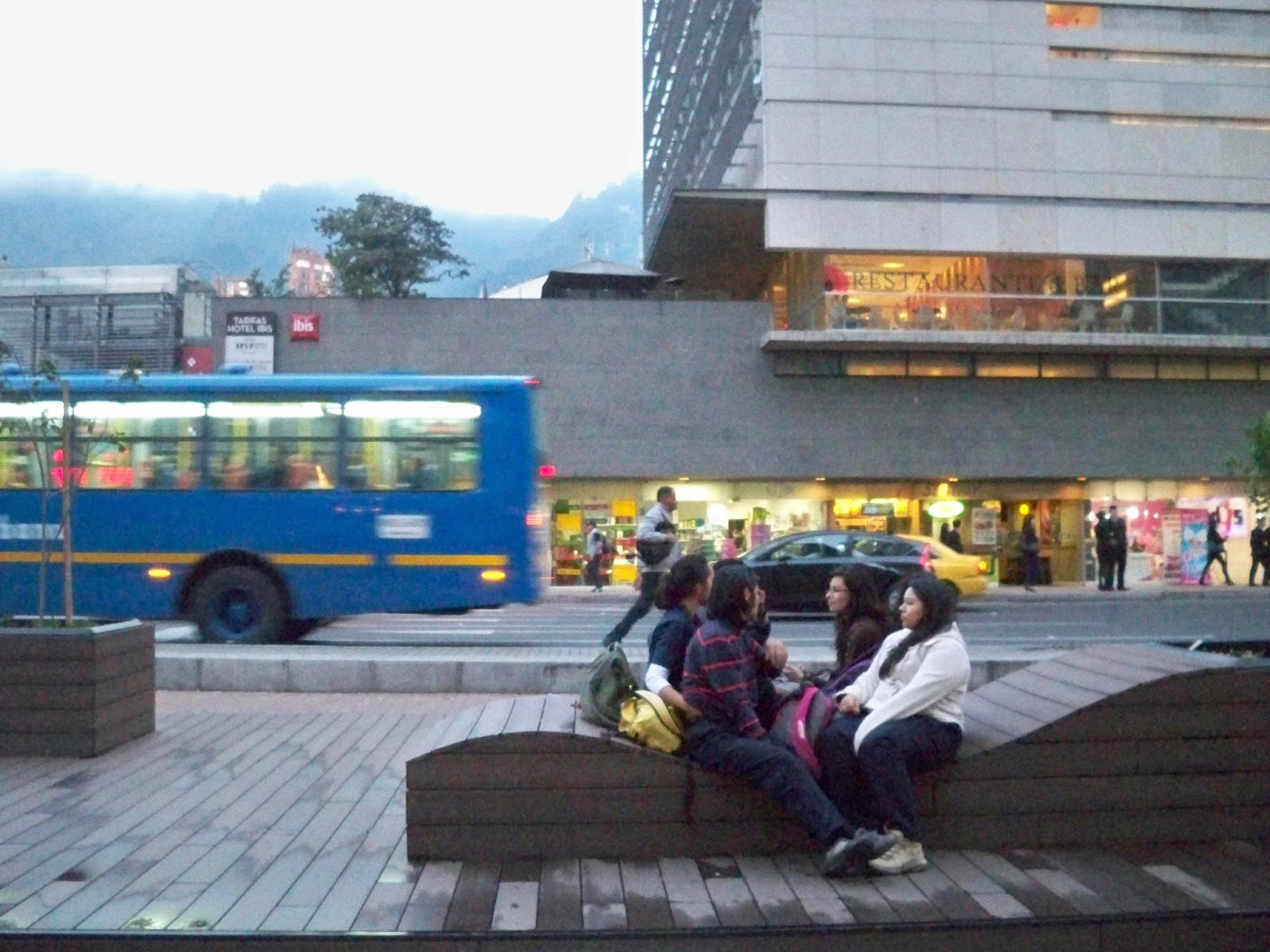
The new Museo Nacional TransMilenio station, which includes a nice - but short - bike lane. 
Entrance to the Museo Nacional TransMilenio Station. 
TransMilenio's Museo Nacional station is finally taking form above ground - only about three years behind schedule and 50% over budget. The station's above ground sections provide an elegant addition to the Centro International/
Bavaria district, with benches, green space, bicycle lanes and parking and futuristic glass entrances. The station adds a pleasant island between the chaotic Avenidas Septima and Decima.

The station is expected to handle some 14,000 passengers per hour during rush hours, according to El Tiempo, altho many may feel stranded at the end of the TransMilenio line.

But the new station, located between the National Museum and the Centro Bavaria, will not provide what it was supposed to: Relief from the pollution, congestion and chaos of La Septima. In fact, it could even make things worse.

Cyclists pass by thru
Museo Nacional station.
Over the past several years, City Hall administrations have succesively proposed building TransMilenio 'light', a subway line and then a light rail line along La septima, as well as turning La septima into something called a 'green corridor.' None of those plans have advanced, while the avenue's troubles have worsened.

Traffic congestion on Ave. Septima will only get worse.
The new station will receive TransMilenio buses from the south on the Ave. Decima/Ave. Trece. But, instead of proceeding north on La Septima, those buses will turn around and head back south. To the north will proceed new hybrid fuel buses with entrances on both sides. But these buses won't have their own exclusive lanes - the key ingredient of Rapid Bus Transit systems like TransMilenio. Rather than easing transit along La Septima, by adding 200 new congestion will only worsen. Things would be different, of course, if the city actually had the will to remove excess, unneeded buses from the streets - but the Petro administration clearly does not.

A group of young people enjoy the new station's public space.
Trees planted in the new TransMilenio station, which adds public space and green to the area. 

The new station includes good public space. 

The ramp heading north from the station won't carry TransMilenio buses as once planned.

By Mike Ceaser, of Bogotá Bike Tours

Tuesday, August 6, 2013

Downtown Bogotá's Nowhere Plans

'A project with value.' This area between the San Victorino retail area and Parque Tercer Milenio is supposed to be turned into an 'international wholesale center.' Years after the existing buildings were demolished, we're still waiting. 

As owners of small businesses near the Palacio de Nariño protest plans to force them move out to make way for government ministries, it's worth taking a look at other government renovation plans for parts of the city center which have gone absolutely nowhere.
'Coming soon!' says the sign. But exactly what,and when?

These include a supposed wholesale commercial center near San Victorino - which, years after the signs went up is still an empty lot. And the old Cundinamarca Provincial government building on Jimenez Ave, which has sat vacant for years. And the property on Jimenez Ave. which was first supposed to be the site of a Spanish-Colombian cultural center, until Spain's economy sank and it yanked funding. The city of Bogotá now has plans to build housing and other stuff on the property. But, years after the existing buildings were demolished, it's still - you guessed it - an empty lot.

Would they do any better with the sector

'International center of wholesale commerce.' Except that it's a parking lot. 


The old Cundinamarca government building on Jimenez Ave. has sat vacant for years. Last I heard it was supposed to be turned into an arts center. We're still waiting.
'The center of Bogotá is being renovated here.' This valuable property on Jimenez Ave. near Los Andes University was supposed to become a Spanish-Colombian Cultural Center - until Spain's economy collapsed. Now, the city has plans to build housing and other things here. But, so far, it's just an empty lot.
For years, someone's planned a shopping center for this empty lot on Carrera Septima and Calle 19. It's a sad scene, but the city could find much better uses for the area, such as a park and mass transit center. 


By Mike Ceaser, of Bogotá Bike Tours

Renovation or Expulsion?

Leidy Garzon and Gonzalo Bonilla Fuentes, owners of military supply stores who fear being forced to sell and move out. 
'The center is not for sale! Defend the Center!'
A woman walks past a military supply store. 
For more than 40 years, Gonzalo Bonillo Fuentes has sold military gear in this neighborhood between the Plaza Bolivar, Palacio de Nariño and Carrera Decima. Around the corner, Leidy Garzon's family has manufactured and sold boots for two decades. Now they, along with other military supplies vendors, typographers and pawnshops, are facing eviction by the government, supposedly to make room for ministries. 

"More than 5,000 people work in this neighborhood, and we're going to be thrown into the street!" protests Garzon, who is president of the neighborhood's association, 'The Committee in Defense of the Center'. "They want to finish off the small businesses. How will we survive?"

Military supply store owner Leidy Garzon shows
the letter business owners recieved telling them they
have to sell  their properties. The letter declares that
they have no recourse to oppose the changes. 
The business owners says that the government has offered them only a pittance of their properties' market value. And, if their businesses were relocated, customers would not know how to find them in a new neighborhood. And they doubt that the area would be used for ministries, suspecting instead that the government will bulldoze the buildings, sell to other businesses and make a big profit. 

Locals learned of the government's plans thru a letter in May, which adds a sense of fultility to injury by specifying that 'no legal measures may be taken against this announcement'. If property owners do not sell at the government's prices, they say, they've been told their properties will be expropriated.

The neighborhood is run-down, with sagging balconies and walls missing patches of paint. (Business owners complain thatthey aren't allowed to repair their properties because of historic landmark designations.) 

The threat to their livelihoods seems to have generated a new political and class consciousness among the business owners, who are mostly people of modest means. They brand the government's plans 'communism' and 'Chavism', like anti-business policies imposed by the government of Venezuela. And they're full of resentment against hight government officials, who earn generous salaries and benefits, such as free transport. 


In fact, it doesn't seem clear to me why the government would want to relocate ministries here. several already located just blocks away, where they function well (or poorly) enough, depending on your point of view. 
And central Bogotá abounds with empty lots and vacant buildings which badly need occupation, including the grand, old and vacant Cundinamarca government building on Jimenez Ave. just below La Septima. 

Government officials, particularly city leaders, have said they want to reinject life into the city center. Government districts, which become ghost towns after 6 p.m., are not the answer to that. 

And, how likely is it that the locals will be forced out only to see the renovation plans stall? That's happened to at least two nearby projects.
A map showing the blocks to be 'renovated.'


Gonzalo Bonilla Fuentes in his shop. He's been here for 25 years and in the neighorhood for 46, and says the government's offered to pay him only a fraction of his property's value.
This parking lot and adjoining vacant building might make a good spot for a ministry. 

Pawnshops on Carrera 10 would also have to sell. 


A 60-year-old printing machine, still at work in a neighborhood typography shop.

Activists post signs declaring 'The center is not for sale.'
A sexy soldier. The military supply stores sell to military high schools, security firms and the occasional soldier or police officer. 
'Wake up! Respond! This neighborhood is worth gold!'


Peeling paint. With grand old buildings, the neighborhood has seen better days. 


By Mike Ceaser, of Bogotá Bike Tours