|
| A group of transvestites get ready to perform on Plaza Bolivar. |
Transsexuals were out in force this afternoon on La Plaza del Chorro, participating in a consciousness-raising program about HIV/AIDS.
 |
A poster of a transvestite says:
'I live my life, and if you don't
like it that's your problem.' |
Colombia's
AIDS infection rate is, fortunately, much lower than many other nations - less than one percent of adults - and has actually declined over the last several years. The epidemic here is also still a mostly-male, mostly-gay phenomenon, altho that's no comfort for infected people.
Colombia's armed conflict has, however,
worsened the AIDS problem, both because fighters can be AIDS vectors (violence against women is a continuing phenomenon in Colombia's conflict) and because victims of the conflict are more vulnerable to AIDS and other diseases.
As for transsexuals - they seem surprisingly common in Bogota, both in their own 'separate-but-equal' part of the city's central
red light district, as well as in the city's parks and neighborhoods. And, of course, in
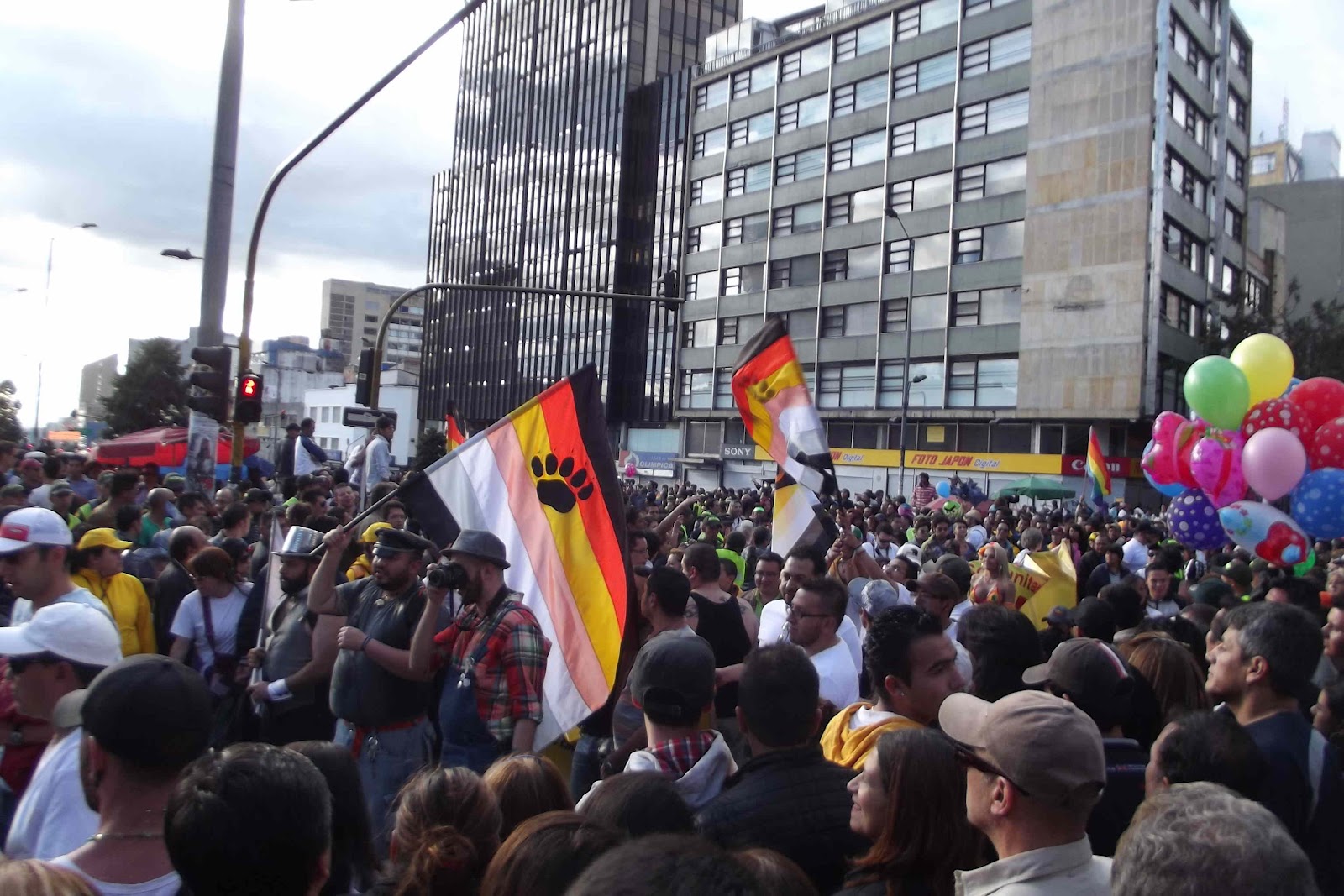
Chapinero, Bogotá's gay neighborhood. Sure, many other people treat them as a spectacle, which is probably inevitable. But, at least, I haven't seen them abused or ridiculed. And, they sometimes seem to want to be a spectacle, with their often flamboyant dress and behavior, particularly during the annual
Gay Rights Parade.
 |
| A group of transvestites walk down Bogotá's Sunday Ciclovia. |
I won't pretend that I feel comfortable with transvestisism. But, to each his or her own. Still, I can't help but
wonder about a few things: Why are almost all transsexuals men turned into women, rather than the reverse? What sort of person goes to a transsexual prostitute, when real women prostitutes are working the streets just a few blocks away? Do almost all transsexuals want to convert themselves into a person of the opposite sex, or are they satisfied just acting like it?
 |
| Back on La Plaza del Chorro, a transsexual gives a pep talk. |
Finally, I can't resist recalling the
only conversation I've ever had with a transsexual, which took place in a women's prison in La Paz, Bolivia.
I was working as a journalist then, and I was interviewing a young South African transsexual who had wanted to have sex-change surgery. But how would she pay for it? She decided to travel to Bolivia, buy cocaine, and smuggle it to Europe, where the profits would pay for the surgery.
But she got searched in the La Paz airport and they found the cocaine, as well as something else which showed she was not born a woman. In court, the South African pleaded guilty: 'Judge, I confess it, I did it, I'll do the time - but please don't put me in the men's prison because God only knows what they'd do to me!'
The judge felt sorry for her and put her in the women's prison, where she was living happily with 300 women. She had decided, however, not to become a woman.
 |
| A high-risk population: Transsexual prostitutes in Bogotá's central red light district, in the Santa Fe neighborhood. |
Colombia's
National Plan to Combat HIV/AIDS
Colombian League Against HIV/AIDS
By Mike Ceaser, of
Bogotá Bike Tours




 Posts
Posts