Colombia's Federation of Jewish Communities is demanding that Attorney General Alejandro Ordoñez come clean on whether he believes the Nazi Holocaust happened.
For the record, it's hard to think of another historical even that's better documented than the Holocaust: there are the survivors' statements, the Nuremberg and other trials, confessions by Nazi perpetrators, voluminous Nazi records, the concentration camps - which are there to be visited, and, of course, the fact that the large Jewish populations which existed across Europe disappeared during World War II.
According to historical investigators, the Nazis massacred some 6 million Jews and hundreds of thousands of gays, Gypsies, communists and disabled people.
A lie? Piled corpses of victims of the Nazi Holocaust.
Ordoñez, a hard line conservative and traditionalist Catholic, got himself into this situation during an April 8Blu Radio. Ordóñez has said that he feels like he's 'on trial at Nuremberg' because of criticisms of his views opposing abortion, gay rights and a law banning discrimination.
interview by writer Héctor Abad Faciolince on
Abad asked Ordóñez "Do you believe that the Jewish Holocaust, by the government of Hitler, was an exaggeration?"
Armando Valenzuela Ruiz, Colombian neo Nazi. (Photo from a Neo Nazi site, where he shares the page with Hitler, Mussolini and Goebbels.)
Abad's didn't come out of the blue, as Daniel Coronell, a newspaper columnist, leader of Colombia's tiny Jewish community and executive of Univision in Miami, pointed out in a column in Semana magazine. After all, Ordóñez is a follower of conservative Catholic Bishop Marcel Lefebvre, some of whose other followers have denied the Holocaust. Even more incriminating are Ordoñez's associations with Armando Valenzuela Ruiz, a founder of Colombia's paramilitaries and life-long Holocaust denier who is venerated by Colombia's neo-Nazis.
In 1975, Ordoñez, Valenzuela and others signed a letter congratulating Ecuador's dictator for escaping a coup attempt. The letter, from 'Colombian nationalists' was published in Valenzuela's openly anti-semitic newspaper, according to Coronell. (The letter congratulated the dictator for triumphing over 'International Masonry,' but the bizarre conspiracy theories about Freemasons deserve their own blogpost.)
The letter was written 38 years ago, which gives Ordoñez plenty of time to
The February issue of Semana
magazine calls Ordoñez 'all powerful.'
have changed his ideas and associations. And Abad gave Ordoñez his opportunity to make clear that he believes that the Holocaust, like other historical events, really happened. Instead, Ordoñez thanked Abad and ended the interview.
Does Ordoñez deny the Holocaust? He made it easy to believe that he does. Colombia's Federation of Jewish Communities called on Ordoñez to state his position on the Holocaust. He hasn't responded.
People who seize onto the bizarre idea of Holocaust denial usually don't do it based on historical research, but motivated by anti-semitism.
A sign at Bogotá's May Day parade says
'Hitler killed 6 million Jews.
Ordoñez killed Colombia's democracy.'
As bad as religious prejudice is, especially for someone responsible for enforcing the law evenhandedly, even worse might be what it suggests about how Ordoñez's reasoning. Colombia is supposed to be a secular nation with no official religion, where policy decisions are made based on evidence. If Ordoñez really doesn't believe in the Holocaust, despite all the evidence, then what does he think about global warming, evolution, the basis of human sexuality and so many other subjects? Should anybody who bases his positions on ideology - whether prejudices or religion - be making decisions in a secular nation?
Today, for the first time, during a bike tour we were able to enter Bogotá's Cementerio Alemán, the German Cemetery.
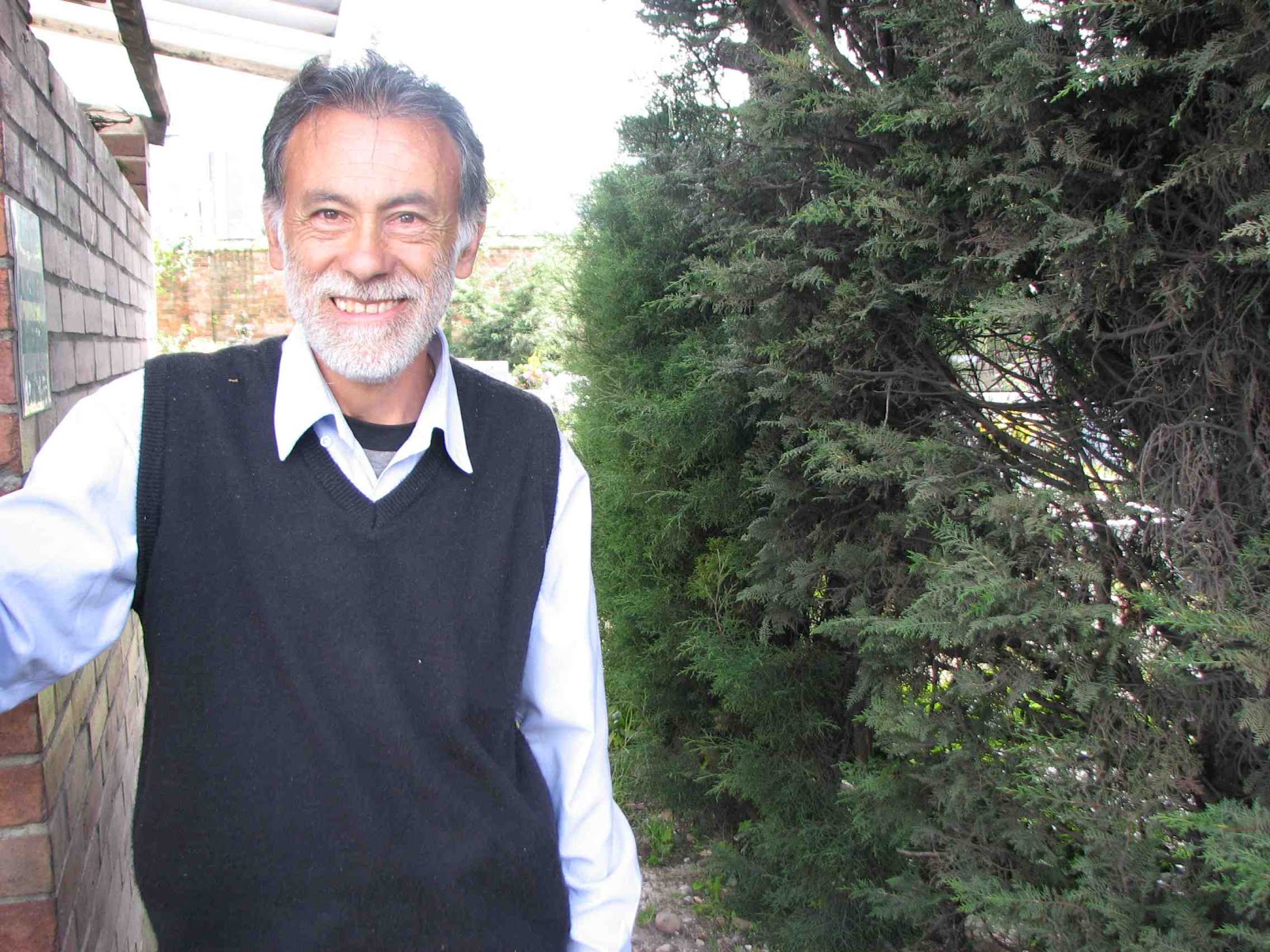
Cemetery administrator Gonzalo.
The German Cemetery is located on the south side of Calle 16, just west of Parque Renacimiento (once the Children's Cemetery) and two blocks west of the Central Cemeteryand the British Cemetery.
Gonzalo, who administers the German Cemetery, told us that it opened in 1912 and is still active. It contains about 500 tombs and has capacity for another 500.
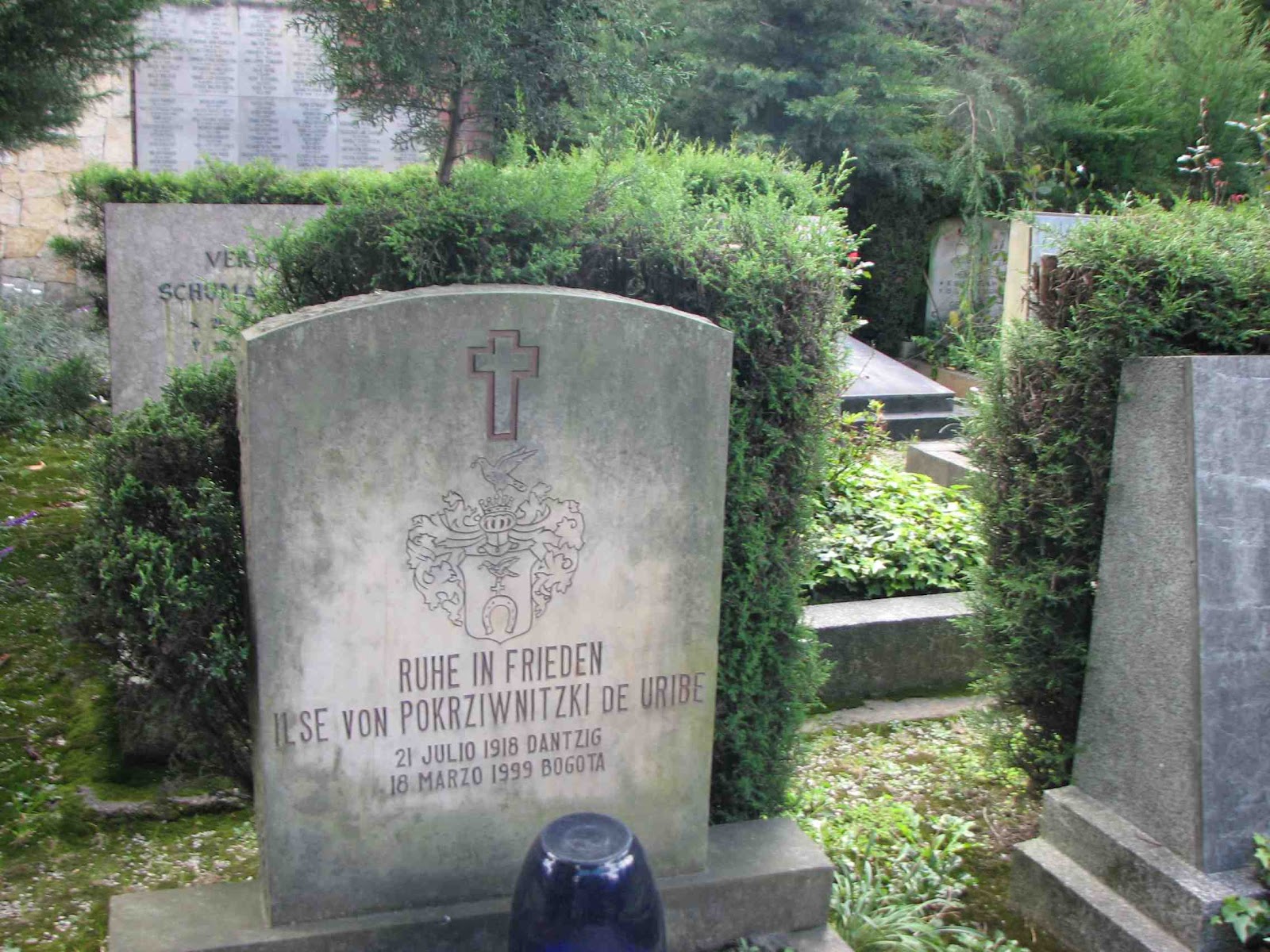
'Rest in Peace'
Asian and European immigrants did not flood into Colombia as they did into more southern South American nations with more temperate climates. But immigrants, including German ones, have contributed a lot to Colombia's history and economy.
German immigrants played important roles in exploration, aviation, jewelry, manufacturing and business, amongst other areas, administrator Gonzalo said. In fact, Colombia's first airline - and one of the first in the world - was the Colombian-German Air Transport Society, founded in 1919. The company eventually evolved into Avianca, today Colombia's largest airline.
Leon de Greiff, poet
Germans also were prominent in Colombian science, the most famous of them being Alexander Von Humboldt, who traveled up the Magdalena River in 1800. Another was anthropologist Gerardo Reichel-Dolmatoff, who fled Hitler's fascism and did pioneering research on Colombia's indigenous peoples and founded the Department of Anthropology of the University of the Andes, the first such department in Colombia.
Antonio Navarro Wolff, ex-guerrilla, and now a
top official of Bogotá.
Other prominent Colombians of at least partially German descent include Leon de Greiff, a Colombian modernist poet of the early 1900s, as well as his son Boris, a chess champion, who died just two months ago. Antonio Navarro Wolff, a leader of the M-19 guerrillas is now governor of Nariño Department.
German immigrants have also played important roles in the fabrics, coffee and banking businesses.
Colombia's most famous German immigrant is probably Leo Siegfried Kopp, a German Jew who founded the Bavaria Beer Company and has become a popular saint in Bogotá's Central Cemetery.
But Carlos Lehder, an associate of Pablo Escobar in the Medellin Cartel, was also of German descent.
Asking for a favor
at the tomb of
Leo Kopp in the
Central Cemetery.
Colombia was also affected by the dark side of German history - fascism and the Holocaust. Colombia backed the Allies during the Second World War, when some German nationals lost their properties and were either deported or sequestered in a hotel in the tropics. A small number of Jews fleeing Naziism settled in Colombia, and a few Nazi war criminals came here. But their numbers were tiny compared to those who emigrated to nations like Argentina, Chile and Brazil.
This headstone carries a cross,
but the name sounds Jewish.
Returning to the cemetery, like the British Cemetery, the German Cemetery is a peaceful, green oasis in the heart of the city. Not all those buried there are from Germany, or even of German descent. We saw headstones with Polish surnames and at least one apparently Jewish-German name. (On the other hand, the Central Cemetery contains many German surnames.) Perhaps those buried in the German cemetery are Protestants, since the tombs' style is much more plain and austere. Or, maybe those buried there simply felt more affinity for their German heritage.
It was probably best for my ability to sleep that I arrived late at a talk today by five Colombian survivors of the Holocaust.
By the time I entered the standing-room-only event at the Bogotá Museum of Modern Art , the accounts of horrific experiences had passed and the survivors were describing the war's end, their migrations to Colombia and whether they could ever forgive, a point they disagreed on.
Faces of many who did not survive.
The four women and one man, speaking still imperfect Spanish with European accents, displayed vigor, spirit and strong memories, a testament to their vitality despite what they suffered: discriminatory laws, being driven from their homes, from their countries, packed in rail cars and seeing friends and relatives taken away to be slaughtered by a civilized nation converted into a machine of mass murderer.
The museum's Shoa exhibition, which fills some three levels, is sophisticated and detailed, with personal experiences, photos, recordings and examinations of Spain's mixed role in the Holocaust (a fascist nation friendly to Hitler, some Spanish diplomats individually risked their lives to save Jews and others). The exhibition also looks at South America's involvement in World War II and Jewish refugees' efforts to flee to Latin America. The information is powerful and moving, as the account of history's most terrible and calculated slaughter must be.
A rally of Nazi fanatics in Barranquilla during WWII
Some other Latin American nations, or their officials, did play either tragic or heroic roles during the war. Cuba notoriously turned the S.S. St. Louis, a ship packed with Jewish refugees, back to Europe, where many were murdered by the Nazis. In contrast, the Dominican Republic agreed to accept 100,000 Jewish refugees, although escaping Europe became so difficult that only 645 people actually made it.George Mantello, an El Salvadoran diplomat stationed in Switzerland distributed El Salvadoran citizenship papers, which saved the lives of thousands of Eastern European Jews and later helped pressure Hungary to resist the Nazis' deportations of Jews to Auschwitz.
After the war, many Jewish survivors, German refugees and Nazi persecutors took refuge in South America, but relatively few came to Colombia, which at the time was suffering a period known as 'La Violencia,' a politically-driven fratricide which at times rivalled Naziism in barbarity.
Five of those Jews who did come to Colombia, mostly because they had relatives already here, spoke on Tuesday at the Modern Art Museum. Now octogenarians, they heard with difficulty, but spoke strongly, with no lack of passion or strong beliefs. A woman whose family managed to send her to England to wait out the war recalled how after Germany's surrender the refugee children received lists of the dead from the Red Cross - "where they found their parents' names."
Max Kirschberg shows the number tattooed on
his arm in Auschwitz.
After telling their stories, the octogenarians reflected on how to prevent another genocide.
"Memory is the best shield so that it doesn't happen again," said one woman. Others spoke out against neonaziism, or the importance of living one's own life in a good way.
The survivors have handled their experiences differently. One decided to forgive. Another said she could not, until she had the permission of "my aunts, uncles, cousins and other relatives" slaughtered by naziism. A woman from Holland has vowed never to step on German soil.
Yet, despite the world's collective memory, genocide has happen multiple times since World War II, in Africa, Serbia, Cambodia, and likely other places - while the rest of the world did little.
Still, the Colombian survivors managed to draw positiveness from tragedy. "There is one God for all of us," said one survivor, to a strong applause from the packed room.
Inge Chaskel hasn't let her WWII experiences ruin her life.
The Holocaust revertebrates particularly strongly in Colombia, because some of the crimes by the country's lefitst guerrilla groups and right-wing paramilitaries almost rival the Nazis' crimes for cruelty and barbarity, although certainly not in scale.
Sadly, at least one Israeli is accused by Colombia of helping train Colombian paramilitaries to commit such crimes.
Like many nations, Colombia also has its own skinheads and neo-Nazis - a bizarre phenomenon in a nation where the great majority of people are of Spanish, Indian or African descent, or of mixed background.
On the other hand, having lived throughout South America, I've seen and heard less racism, anti-Semitism and homophobia here than in other Latin American nations.
There have been at least two famous Jewish Colombians: Actress Fanny Mikey, who organized theatre festivals and founded the National Theatre, and Leo Siegfried Kopp, who founded the Bavaria Beer Company and who has become a kind of saint in Bogotá's Central Cemetery.
The Shoa exhibition ends March 31. The museum is also showing films about the Holocaust.




 Posts
Posts