Showing posts with label colombia. Show all posts

Tuesday, October 11, 2016

Trumping Latin Democracies

Donald Trump, would-be strongman.
U.S. Republican presidential candidate Donald Trump and Venezuelan Pres. Nicolas Maduro may
seem like polar opposites. One is a wealthy conservative, the other a leftist who started out as a bus driver.

The two, however, do have at least one characteristic in common: Authoritarianism.

At the last U.S. presidential debate, Trump told Democrat Hillary Clinton that if he were president, she'd "be in jail," because of her mishandling of government e-mails. Evidently, Trump had forgotten that imprisoning people is the job of judges and prosecutors, not of presidents - at least in a democracy.

Nicolas Maduro, Venezuela's
authoritarian president.
But Trump might find a model in Maduro, whose government has imprisoned numerous opponents, most prominently Leopoldo Lopez, an ex-mayor and potential presidential candidate, whose trial was called a farce by many human rights organizations. Lopez is serving a 14 year prison term for supposedly inciting protests using subliminal signals.

Not satisfied with jailing opponents, the deeply unpopular Maduro has also used his puppet Supreme Court to declare Parliament, where the opposition has a majority, 'unconstitutional' and unable to issue legislation. Maduro also announced that he will instruct the Supreme Court to approve the national budget, even tho the Constitution explicits gives this job to Parliament.

Among Maduro's long list of authoritan, anti-constitutional actions is also using his puppet Electoral Council to put obstacle after obstacle in the way of a recall referendum the opposition wants to organize against him - another right provided in Venezuela's Constitution. And Maduro's government recently said that it won't hold governor and regional legislative elections this year because it can't afford to - this in an oil-soaked nation which throws billions of dollars away each year on corruption and giving away gasoline.

"The priority isn't to hold elections," Maduro said. "What is the country's priority? Fulfill the whim of the oligarchy or recover the economy?"

Leopold Lopez,
Maduro's political prisoner.
Under Maduro's incompetent mishandling, Venezuela's economy is sinking, it has the world's highest inflation rate and shortages of basic goods like sugar, flour, toilet paper and medicines. It also has one of the world's highest homicide rates.

What Venezuela needs most are elections, to throw out Maduro and his allies and restore sanity. understandably, Maduro doesn't want to permit votes he knows he'd lose.

Sadly, the story is not so different in nations like Bolivia, Ecuador and Nicaragua, where leftist leaders have entrenched themselves and are trying to become presidents-for-life.

In that sense, Brazil and Guatemala, both embroiled in corruption scandals, should be admired. There, at least, the democratic institutions have had the resiliency to remove flawed presidents and investigate their alleged misdeeds.

Would the U.S.'s own institutions be strong enough to withstand a President Trump?

Hopefully, we'll never have to find out.

Check out the excellent NY Times story about this.

By Mike Ceaser, of Bogotá Bike Tours

Tuesday, January 21, 2014

The Helvetic Expedition and the Swiss in Colombia

Otto Fuhrmann and Eugene Mayor on expedition. 
In 1910, two Swiss scientists set off into what must to them have seemed one of the wildest and remote corners of the globe: the hinterland of Colombia.

From the expedition, sketches of a
Colombian fungus. 
The expedition lasted only five months, and the organisms the men studied - primarily fungus and other parasites - weren't particularly glamorous. But the expedition helped map out Colombia's tremendous biological diversity and created links between two very distand and different nations.

The Biblioteca Luis Angel Arango (BLAA) has an exhibition about the expedition as well as the Swiss presence in Colombia until the end of January.

'Voyage of Scientific Exploration in Colombia' by Fuhrmann and Mayor, published in 1914. Their trip also produced more than 30 scientific papers.
The two scientists, Otto Fuhrmann and Eugene Mayor, who hailed from the same university in the city of Neuchâtel, might have aborted their expedition before
they started when they discovered the ship they had boarded from Europe also carried 900 boxes of dynamite for Colombian gold mines. Fortunately, it was too late to abandon the ship, and the pair continued on to Colombia, where they landed at Barranquilla and proceeded up the Magdalen River and then proceeded on horse and mule back and by foot. Their work identified 1,279 species of plants and 647 animal species, more than 300 of which were new to science.
Scientist and expeditionist Eugene Mayor at work. 

Other prominent Swiss-Colombians include Ernst Röthlisberger, a history and philosophy professor who worked for the National University from 1881 to 1885 and would later write letters of recommendation for the expeditioners. If I understand correctly, Röthlisberger was the first person to climb one of the peaks of the Cocuy range.

But the first recorded Swiss citizen in what's now Colombia was the priest Jean Magnia, who came here in the 1720s on an evangelical mission.

The Colegio Helvetia, designed by
Swiss-Colombian architect
Viktor Schmid.
Probably the most famous Swiss-born person to play a role in Colombian history was the Swiss born architect Le Corbusier, altho he is more associated with France, where he lived and worked most of his life. Le Corbusier visited Bogotá in 1947 and drew up grand plans which would have meant flattening much of central Bogotá and replacing it with districts for residences, industry, recreation and others, but which fortunately were never carried out. Le Corbusier's ideas were incorporated into Ave. Caracas, which he envisioned as a shady, tree-lined avenue for families to stroll along. It hasn't turned out that way, altho the trees are still there. Rogelio Salmona, who emigrated from France to Colombia, where he became Colombia's most famous architect, studied with Le Corbusier after World War II.
Ernst Röthlisberger in old age. 

Another Swiss-Colombian architect was Viktor Schmid, who emigrated to Colombia in 1939 and settled in Bogotá, where he designed more than 100 buildings, including the Colegio Helvetia. Schmid is apparently the same Victor Smith, described in this El Tiempo article, who studied in Germany and fled the Nazis. Today, his son Urs is trying to preserve his father's works, many of which are falling into ruin.

Today, the 'Swiss community' in Colombia consists of more than 2,400 people, most of whom live in Bogotá. The Colegio Helvetia, which teaches in Spanish, French and German, is the world's largest Swiss high school outside of Switzerland, according to the BLAA's exhibition.

The La Candelaria building on Calle 11 in the
neighborhood of the same name, designed by Viktor Schmid.
"How small and montonous our own forests appear in relation to these immense, virgin jungles which cover the whole Magdalena Valley and which die at the river's edge!" Mayor and Fuhrman.

The Expedition might be almost forgotten today, but for the work of Alberto Gómez Gutiérrez, a graduate of the Colegio Helvetia, and Michel Schlup, a one-time teacher there, who located the Swiss expeditionaries' Memoires in a library in Neuchâtel and translated and published the work.

Inauguration of the clock in the Parque Nacional
donated by Bogotá's Swiss community in 1938.
The Swiss-donated clock in the Parque Nacional today.
Despite a restoration and repair in 1908, it doesn't work. 

In 1922, the Swiss helped Colombia and Venezuela resolve a border dispute. 
Ave. Caracas's design was inspired by Le Corbusier. But is isn't the pedestrian way which the Swiss-French architect envisioned.

The Swiss-Colombia Friendship Treaty, signed in 1908. In 2011, the two nations signed a free trade agreement. 
'The Golden On.' On the right, a long-ago view of the Plaza del Chorro de Quevedo.
Preserved fern leaves. 
A Swiss engineer designed both the funicular and
the cable car to Monserrate. 
A cable car climbs up toward Monserrate church.
Joseph Eberhard (which one is he?), who visited Colombia's indigenous people and collected plant samples and indigenous remedies for study back home. 
The route of Otto Fuhrmann and Eugene Mayor thru Colombia. 
On the road between Medellin and Igaguí.

In Antioquia. 
By Mike Ceaser, of Bogotá Bike Tours

Monday, September 16, 2013

Bogotá's Rolling Junkyards


The old bus failed on Calle 26 and its driver got out and tried pushing it.
In theory, Bogotá has a program, called chatarrizacion, or junking, to remove those old, junky, highly-polluting buses and other vehicles from city streets. Unfortunately, Mayor Gustavo Petro's administration has apparently forgotten about it.

I thot about that while observing this vehicle trying to make its way along Calle 26 the other day.

His effort was futile.

So, the passengers got out and pushed.

With a blast of toxic pollution, the bus gets going. Celebration!

The bus rolls on, to pollute another day.
Drivers of old buses carry a sign demanding more compensation for junking their vehicles. 

The woman's shirt says 'Chatarrizacion with dignity.'
By Mike Ceaser, of Bogotá Bike Tours

Friday, August 17, 2012

Colombia Scores a 'C' on Coastal Health


Colombia's Coast: Not so well managed.
An index of nations' coastal health just released by Conservation International and the National Geographic Society ranks Colombia 94th out of 171 coastal regions, with a score of 52 out of a possible 100.

The study ranked countries and coastal regions on 10 measures including 'Clean Waters,' 'Tourism and Recreation,' 'Biodiversity,' 'Coastal Protection,' and 'Food Provision,' as well as the less clear 'Sense of Place.'

Doing pretty well: An artesanal
fisherman on Colombia's coast.
Colombia did best on 'Artisanal Fishing Opportunities,' with a score of 85, and 'Coastal Livelihoods and Economies,' where it scored 69. Both are indications of the still strong artisinal fishing communities on Colombia's coasts. It also did alright, with a 68, on 'Biodiversity,' 'Coastal Protection,' at 66, and 'Clean Waters' at 67, but got a poor 47 score on 'Natural Products,' which can mean either that Colombia is not exploiting marine resources sustainably as much as it could, or that it is exploiting them unsustainably. judging by the state of world marine resources, it seems most likely that they are being overexploited. Another discouraging number, related to the previous one, was Colombia's score of 51 on 'Carbon Storage.' That rating measures trends in the amount of carbon stored by Colombia's coastal ecosystems, such as marshes and mangrove forests. As environmental destruction degrades coastal ecosystems, biodiversity is lost and carbon gets released, accelerating global warming.

Doing very badly: Finned sharks. 
Overall, Colombia's scores are a reflection of its relatively low population and level of industrialization, which have given some protection to marine resources, or at least delayed some human impacts. But, increasingly industrialization, coal and other shipping, port construction and the expansion of urban areas both on the coast and inland, will increase impacts unless the country takes strong protective measures. And, no matter what Colombia does, its marine resources will still be under siege from fishing boats exploiting nearby international waters, since fish are no respectors of political boundaries - and marine resources are collapsing all over the globe, under pressure from trawlers and things like the Chinese hunger for shark fin soup.

Colombia took steps forward recently in marine protection with decisions not to expand the port of Buenaventura and to ban petroleum exploitation around the San Andres Archipelago. It also made an agreement with Costa Rica to work against shark massacres like one which took place last year in Colombian protected waters. Colombia's score of 0 (yes, that's a zero) on 'Tourism and Recreation' suggests that there's lots of room for Colombia to expand this sector sustainably, which would make Colombia's biodiversity more visible and increase motivation for protecting its resources.

A world-wide marine crisis is taking place. But it's happening mostly out of sight. And as long as seafood shelves remain stocked, few people but fishing families take notice.

Regionally, Colombia did better than neighbors Venezuela, Ecuador and Panama, but the South American leader was Brazil, with its huge Atlantic coastline.

For the complete report, see: http://www.oceanhealthindex.org/

By Mike Ceaser, of Bogotá Bike Tours

Friday, August 10, 2012

Ecuador on the Eje Ambiental


These photos are from the exhibit 'Fotografias al Cielo Abierto,' or something like 'Open Air Photography,' financed by the Ecuadorean Embassy and now on display on the Eje Ambiental in La Candelaria. 

They contain scenes from Quito, Ecuador, some of them quite unexpected, including a woman in what looks to me like a Palestinian headress, and some men resembling country and western musicians from the U.S. 


By Mike Ceaser, of Bogotá Bike Tours

Saturday, May 19, 2012

AfroColombians' Week in La Candelaria

Traditional AfroColombian dishes, which include lots of seafood.

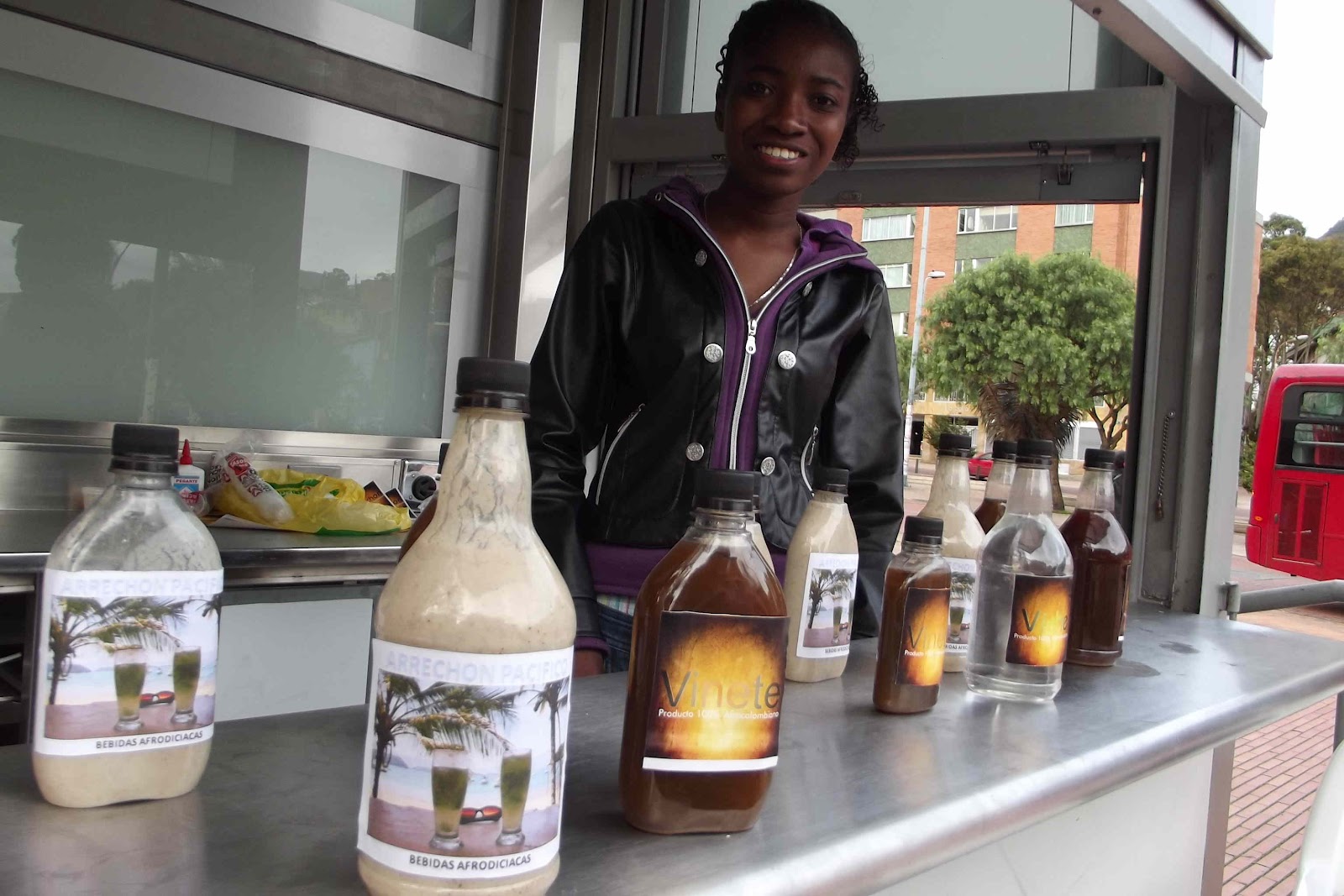
'100% AfroColombian drinks.'
This past seven days were Afro-Colombian Week, with food, culture and music showed off in the plaza near the Las Aguas TransMilenio Station.
Girls in traditional AfroColombian
festival dresses.
People of African descent make up about 20% of Colombia's population, but are disproportionately poor and victimized by the nation's violence. El Chocó, a mostly Afro region, has become almost synonimous for poverty, malnutrition and other social ills. Colombia's population of African descent lives mostly near the Pacific and Caribbean coasts. 
Attitudes toward El Choco were highlighted recently when Rodrigo Mesa, a regional deputy from the much wealthier province of Antioquia used insulting language to say that investing in El Chocó was a waste. Mesa is now under investigation for his comments and apparent fabrications in his academic history. 

Listen to their lively music. 


Neither Bogotá nor the La Candelaria neighborhood are particularly Afro areas. But the Afrodisiaco's seafood restaurant (on Carrera 5, just south of Calle 12B), owned by a black Colombian man who lived many years in the U.S., has become something of an Afro gathering spot. Perhaps that's due in part to the wall decorations, of Malcolm X, Marcus Garvey and Afro-Colombian leaders. (He shifted the Obama poster to his adjoining nightclub.)


Afro leaders of Colombia, on Afrodisiaco's wall. 

AfroColombian music in the Jorge Eliecer Gaitan Theatre. 


Handicrafts. 


AfroColombian children. 

Feel the AfroColombian musical beat. 

By Mike Ceaser, of Bogotá Bike Tours