Showing posts with label Hugo Chavez. Show all posts

Friday, September 5, 2014

Venezuela Goes Off the Deep End

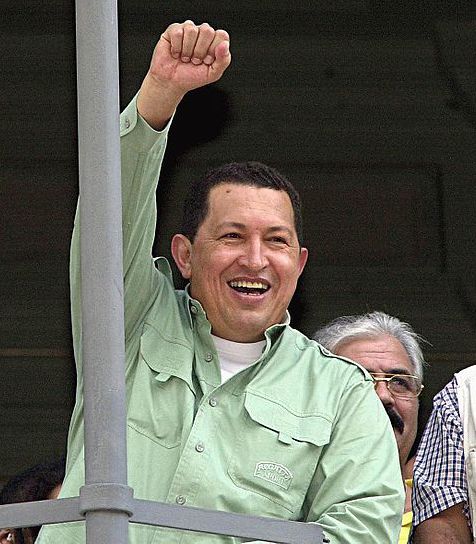
Hugo Chávez reaches for godliness.
Can a man be God?

Are the victims the aggressors?

Are economic laws really suspended by the Bolivarian Revolution?

Commenting on the progressive disaster in Colombia's neighbor Venezuela means struggling between pathos and laughter. And last week brought laughter.

Venezuela's socialists have long regarded their deceased ex-president Hugo Chavez with a near-religious reverence. And, Venezuela's chavistas have had a long-running clash with the Catholic Church. But Venezuela remains a deeply Catholic nation.

So, how to shift the people's allegiance to the 'socialist revolution'?

Well, how about making the deceased Chávez god? A group of Venezuelan revolutionaries took the first step toward that this week by replacing the traditional Padre Nuestro (Our Father) with Chávez Nuestro (Our Chávez). The Catholic Church, naturally, criticized the replacement of Christianity's founder and greatest prophet with a failed coup leader and authoritarian president.

Venezuelan Pres. Nicolas Maduro told the 'inquisition' to mind its own business. But, with its sagging economy and soaring inflation and crime rates, Venezuela had better pray to somebody.

With a huge government deficit, the Bolivarian Revolutión has to turn somewhere to fill its fiscal gap. And what better source of financing than a fellow authoritarian petrostate like Russia? And how to stay in Russia's good graces? Try reinterpreting the conflict in eastern Ukraine, which almost all the rest of the world sees as a calculated, violent territorial grab by Russia against its smaller neighbor.

According to the Venezuelanalysis website: Maduro criticized the "threats" made by the United States and Europe, insisting that "Russia defends itself, and is then accused of employing aggressive politics against the West." 

"We in Venezuela demand in a clear voice … that those who accuse and accost Russia desist the attack, desist from seeking war with Russia. Peace!"

Yes, why won't those darn war-mongering Westerners quit provoking those peaceful Russian soldiers, tanks and missiles now invading eastern Ukraine?

And Venezuela's Bolivarian Revolution long ago declared normal economic laws, such as supply and demand, suspended in revolutionary territory. That's produced the world's highest inflation rate, widespread shortages and huge smuggling economies along the Venezuelan-Colombian border.

Recently, however, the government hinted that it would actually reduce its disastrous gasoline subsidy, which costs Venezuela billions of dollars per year and enriches smugglers. But this week Pes. Maduro seemed to make clear that his government is too afraid of protests to actually charge for gasoline. Instead, it'll continue blaming 'conspirators and coup mongers' for the fact that the country's an economic basket case.

By Mike Ceaser, of Bogotá Bike Tours

Thursday, March 6, 2014

A Year Without Hugo Chávez


A year without Hugo Chavez, who died a year ago yesterday...has brought Venezuela closer to social and economic breakdown. That's bad for Venezuela, and also for Colombia, especially if Venezuela's chaos spills across the border.

A year without Hugo Chavez...has brought further decline in Venezuela's economy. Inflation is over 50%, basic products like toilet paper are hard to find and the budget deficit keeps growing.

A year without Hugo Chavez...has seen increased government repression and further restrictions on the media - a predictable result of an uncharismatic president struggling to hold on to power amidst a disintegrating economy.

Yesterday, a young Venezuelan guy did the bike tour. He's in Colombia on his way back to his homeland - if they'll let him in. His family fled Venezuela more than six years ago because his father, an opposition politician, feared persecution if he stayed. They now live in another Latin American nation, which I won't name just in case the family could be identified. The young man wants to visit Venezuela because a grandmother recently died. But he fears what the government might do to him because some of his relatives were and are active opponents of the government: They might not let him in; they might let him in and seize his passport; they might let him enter and not let him leave again. It all sounds a bit like the old Soviet Union or even North Korea, where children are punished for their parents' 'sins.'

That's the story of just more victim of Chavez's revolution.

While Chavez lived and ruled, Venezuela was, at least, pretty stable. Under Nicolas Maduro, who lacks Chavez's charisma and political acumen, the country appears to be unraveling.

Venezuela, it seems, could go one of several ways: It might continue with its ongoing instability, with the government exercising periodic repression to maintain control. Or, Venezuela's economy and government might really collapse if the government fails to pay its debts and the military and poor neighborhoods align with the opposition. That scenario could bring anything from genuinely democratic elections, a military government or a full-on dictatorship. More likely, however, is that Maduro or a successor will manage to hold on to power by becoming more and more authoritarian.

The most positive outcome, for both Colombia and Venezuelans, also happens to be the least likely: That Maduro will recognize that his policies have driven the economy into the ground and repressed normal civil society and agree to step aside and allow free elections.


By Mike Ceaser, of Bogotá Bike Tours

Wednesday, August 21, 2013

Leftism Done Right

Hugo Chávez: A real leftist?

In 1999, Hugo Chavez became president of Venezuela. Soon after, he declared that he was leading his oil-rich country toward a 'socialist revolution' based on something called 'Bolivarianism.'

In the name of leftism, Chavez and his succesor Nicolas Maduro have expropriated property, organized worker collectives and recruited Cuban medics - and sent corruption out of control skyrocketed the homicide rate.

But at the same time, the so-called chavista revolution has failed glaringly to behave revolutionarily on social issues.

Across the globe, pot is becoming legal, abortion rights are expanding and same sex couples are winning legal recognition - but not in the supposedly revolutionary Venezuela, or its allegedly leftist allies Bolivia, Ecuador and Nicaragua.

Two cuddly guys. Mujica and Brazilian
ex-Pres.Luiz Inácio Lula da Silva.
Contrast Venezuela with Uruguay, governed by Pres. José Mujica, an ex-guerrilla with true leftist/revolutionary credentials. (Chavez, in contrast, achieved fame by leading a failed military coup attempt.) In little more than three years, Mujica's government has legalized abortion and gay marriage and is working on legalizing marijuana. But Mujica doesn't call his policies a 'revolution' - just practical policy. He wants marijuana legal in order to take the business away from outlaw gangs which have become inceasingly violent. During a recent interview with Colombia's W Radio, Mujica, in his steady, houghtful way, explained that uruguay's 'drug problem' isn't overdoses, but violence by gangs fighting over the illegal drug business. And drug legalization isn't populist policy in Uruguay - most Uruguayans actually oppose the idea, according to polls.

Even countries ruled by conservative governments, such as Colombia and Great Britain have moved forward on these issues (which should call into question the left-right labels). Guatemala's Pres. Otto Pérez Molina, an ex-military general, in an outspoken advocate of drug legalization - altho he has not changed laws at home.

In the company of gay leaders, Venezuelan
Pres. Nicolas Maduro declares that the
revolution isn't homophobic.
The contrast couldn't be greater with 'revolutionary Venezuela,' where a chavista congressman recently accused opposition politiciansof running a gay/transsexual prostitution ring and said to opposition presidential candidate Henrique Capriles: “Respond, homosexual, accept the challenge, maricón."

Venezuela's supposedly leftist allies Bolivia, Ecuador and Nicaragua haven't done any better. In fact, in a monumentally cynical move, Nicaragua's then presidential candidate Daniel Ortega, bought the support of the Catholic Church by promising to prohibit all abortions. So much for a moral compass.

Perhaps the contrast between Mujica and Chavez reflects a deeper difference in character. As president, Mujica lives modestly, drives his old car and lives at home on the outskirts of the capital. Chavez, in contrast, spent Venezuela's wealthy lavishly on himself - and by importing military weapons.

What's that all say? Maybe one man has character and the other did not.

By Mike Ceaser, of Bogotá Bike Tours

Tuesday, April 16, 2013

Venezuela's Un-President

Maduro is dwarfed by his predecessor, Hugo Chavez.
50.5% to 49% is a mathematical victory for Venezuelan President Nicolas Maduro.

But it's a huge defeat relative to the double-digit victories racked up by ex-President Hugo Chavez, who died six weeks ago.

It's also a defeat compared to the ten-point margin which many polls predicted for Maduro.

It's also defeat when the Chavez sympathy vote is figured in. And it's a defeat when you consider that all of the government was converted into a Maduro election machine.

And it's a defeat in light of the many substantive charges of corruption.

The razor-thin victory of Maduro, Chavez's chosen heir, leaves Venezuela with a weak new president.
1989 Caracazo rights in Caracas. Coming back?
Maduro compounded his own troubles by first promising a recount and then backtracking, as the National Electoral Council announced a rushed inauguration.

Assuming that public protests or a restless military do not oust Maduro, he'll be a president without manuevering room and facing huge challenges, in particular a disfunctional economy inherited from Chavez.
Venezuela has a soaring homicide rate and the highest inflation rate in the region. Stores lack basic foodstuffs. Corruption is rampant. Those are problems which a nation swimming in oil that's at $100 per barrel should be able to deal with - but Chavez's populist policies left Venezuela with huge deficits and expensive subsidies, such as almost-free gasoline. As a weak president with little charisma whose legitimacy is under question, Maduro will not risk generating public discontent by reducing those subsidies - until he's forced to. Once the deficits become overwhelming and the Russians and Chinese refuse more loans, the Venezuelan government will be forced to make huge economic corrections, and deadly riots like the 1989 Caracazo may repeat themselves.

Ironically, El Caracazo is often seen as the origin of Chavismo. Now, the populism-and-bust pattern carries a warning for chavismo.

Already, Maduro's vow to block an opposition protest march suggests that his strategy for holding onto power is to become more authoritarian - like Venezuelan allies Cuba, China, Belarus and Russia.


For Colombia, Venezuela's continued instability is bad news. But it's also a lesson about the great dangers of populism.


By Mike Ceaser, of Bogotá Bike Tours

Friday, March 8, 2013

An Escuálido March for Chávez


Two supporters of Venezuelan Pres. Hugo Chavez, who just died, hold a banner celebrating him today in central Bogotá.
'Forward commander! We will live and triumph.'
Chavistas march past Bogotá's cathedral.
Their numbers may be few, but their spirit is strong. 
Colombian Chavistas marched down Ave. Septima today to pay homage to the Venezuelan president, who died this week. Chavez often called his opponents esquálidos, which means something like 'the pathetic ones,' or 'the scarce ones' or 'weak ones.' Sadly for Chávez, his march in Bogotá was pretty weak.

Chávez was buried today in Caracas.

The marchers called on people to attend a mass for Chavez to be held today in the Barrio Hugo Chavez, a poor neighborhood in northwest Bogotá which adopted the Venezuelan leader's name.


The man in the center of Plaza Bolivar facing his monument is Orlando, who carries on a lone campaign in favor of Cuba. 


'Chavez is not a man. He is a people which advances.' The slogan echoes the words of martyred Colombian politician Jorge Eliecer Gaitan, whose photo is also on the banner. 

The current edition of Voz, Bogotá's communist newspaper, headlines '¡Until forever, Commander Chavez.' But was Chávez a communist?
At a march yesterday by employees of ETB, Bogotá's public telephone company, carried a portrait of Hugo Chavez. 


By Mike Ceaser, of Bogotá Bike Tours

Tuesday, March 5, 2013

Hugo Chavez and Me

The death of Venezuelan Pres. Hugo Chavez likely ends an era of firebrand populist leftism in Latin America, creates new questions for Colombia and gives me reason to be nostalgic about some of the most memorable journalism I ever did - or am likely to.

Still, the way he died was a pathetic episode fitting for a man whose rule was both dynamic and destructive for his country.

Caught Up in a Coup

I moved to Venezuela just weeks before the April 2002 quasi coup, which swept him from power for 48 hours before he came roaring back on the shoulders of loyal military men. That was great journalism, and sort of makes me wonder whether this man, who overcame his enemies time and again and became such a presence over Latin America, could now just return from the dead like the messiah he seemed to believe himself to be.

Covering the coup and counter-coup in an unfamiliar city full of paranoia and confusion was naturally an unforgettable experience. I had just moved to Caracas, knew almost nobody, had no home Internet connection, and had only an old laptop whose floppy drive was broken - fatal in those pre-USB. When the turmoil began I was at the mercy of taxi drivers whose priority was not to find me an open internet cafe, but to maximize their fare by driving me across town and back.

Read All About It! Selling El Tiempo's
special edition about Chavez's death.
Still, frantic and confused, I managed to work. I participated in the huge marches which culminated with Chavez's kidnapping by coup leaders, who spirited him off to a Carribean island. But the coup quickly turned tyrranical, as its leaders - who included businessmen and Catholic Church officials - suspended the Constitution and civil rights. Even people who had wanted Chavez out agreed they didn't want this, and popular opinion and loyal military brigades brought him back.

One evening, amidst it all, I was in a taxi headed towards Miraflores, the presidential palace. Frantic crowds were milling around in the streets. On the tops of high-rises were sillhoueted figures. Were they snipers? Both sides were charging that their supporters had been shot by snipers. Suddenly, the taxi driver stopped, still blocks from the palace. He was too scared to continue.

I got out, into the crowd, and an editor called from a U.S. newspaper.

"Who's in control there?" he asked.

"How can I possibly know?" I replied.

I went home, wrote frantically, and then raced to an Internet cafe, where I retyped the stories from my laptop's screen and sent them in. Often, I did this while surrounded by teenagers chatting and playing video games, oblivious and uncaring about their nation's fate.

One evening near the end of this drama I was in an Internet cafe frantically writing a story, when an employee approached me.

"Would you mind changing machines sir?" he asked. "Then you can continue chateando."

"Chateando??!!!" For the love of god, I protested, I was not chatting, but documenting their nation's drama for the world. But the young kid didn't care. I had to change machines, losing valuable minutes. But, a few minutes later, he was back again.

"Sir, the boss has asked for you to leave."

"What! Why?" I almost screamed. "I'm very busy."

The employee was unmoved. "The other customers are complaining," he told me.

My further protests didn't help, and so, furious and panicked, I saved my work and ran out the door.

Miraculously, there was another open Internet cafe across the street. Here, however, several people were sitting waiting for computers. The minutes until deadline counting down in my head, I sat down beside another foreigner and proceeded to tell him my story, hoping for sympathy and assistance. He nodded with understanding.

"You don't smell too good," he observed.

Of course. I hadn't showered or probably even changed clothes for three days.

But the man was helpful and let me move ahead of him in line. This Internet cafe was less olfactorily sensitive and I was able to finish and file my stories just in time.

Later, I did a memorable investigative story about links between the opposition groups involved in the coup and U.S. 'pro-democracy' financing, which won me points with Chavistas.

A Hollow Revolution

I had moved to Venezuela with real hope that Chavez's 'revolution' offered real answers for the poor of Latin America, a region where tremendous poverty coexists with wealth and abundant natural resources. But, as time went on, Chavez's 'revolution' seemed to me like more and more of a fraud, designed more to buy power and votes than to help his country. I visited a literacy program in which the readings consisted of propaganda about the wonders of Chavez and the evils of the opposition. A few years later, the government boasted that illiteracy had been eliminated. That would have been news to many of my neighbors if they could only have read enough to understand it.

I visited public hospitals where the elevators and air conditioning didn't work, the intercom system had been stolen and basic supplies such as gauze and alchohol simply didn't exist. Chavez did import Cuban doctors to work in poor barrios. that program undoubtedly did some good, but I had doubts after interviewing leaders of pro-Chavez medical organization whose policy was supposed to be prevention. They were all obese, and I had to ask them to please put out their cigarrettes, as the office's air was stifling with smoke.


A Killing on the Border

And then there was the crime. During my last several months in Caracas, three or four people were murdered in the lower-middle-class street where I lived. And the galloping inflation, about which my neighbors, many of whom were poor, struggling people, complained constantly. All sort of corruption also spun out of control in Chavez's Venezuela. It seemed as tho nearly every cop and border official was looking for a bribe.

One time, I was returning to Venezuela from Colombia, crossing the border in the semi-desert La Guajira region. There, I passed the Colombian border post, crossed a forested no man's land where money changers hung out with wads of bills, and then came to the Venezuelan border post. At the Venezuelan post, the guards proceeded to search my few bags until they discovered my old laptop.

"Look, he's got a laptop," they announced, as tho it were a bomb. "What's the meaning of this? We must report this to our chief."

I knew that there was nothing wrong with having an old, used laptop, especially when you're a journalist. But I also knew that if these officials wanted to mess with me, they could, and they would, until I forked over a bribe. While I pondered we to do, we suddenly heard gunshots come from the no-man's-land. Robbers had run out of the forest, shot and robbed one of the money changers and disappeared back into the trees.

The border agents, ashamed to be trying to extort a petty bribe while people were being murdered in their area of responsibility, told me to take my laptop and go. I did, feeling very bad.


A Revolution Run on Free Gasoline

But to an environmentalist like myself, probably the most infuriating and hypocritical of Chavez's policies was his gasoline subsidy, which pushed the price of a gallon of gas down to just a few cents a gallon - and had it constantly dropping.

The results are obvious: waste, pollution, endless traffic jams - and all for a subsidy which took money which could have funded schools, police and hospitals and gave most of it to the rich (and to Colombians, who buy smuggled gasoline). Of course, Chavez didn't let his own policies stop him from warning the world about environmental destruction and climate change, and denounce the United States for burning oil irresponsibly.
Meanwhile, by tilting the electoral playing field, eliminating government checks and balances and getting rid of term limits, Chavez was turning himself into an elected autocrat.

while living all of this, I recieved a steady stream of hostile e-mails from idealistic young Chavistas celebrating La Revolucion - from far away in the U.S.


A Yanqui-Caused Cancer?

Now that Chavez has died - soon after getting himself reelected by assuring his people that he was cured of cancer - there will probably be elections, and Chavez's hand-picked succesor Nicolas Maduro will probably win. (Maduro showed his stripes tonight with a long tirade about how the opposition had certainly caused Chavez's cancer. The proof? That Israel supposedly poisoned PLO leader Yasser Arafat.
Anyway...)

It was only the latest evidence-less assassination charge against dark powers. Much more likely, Chavez's cancer came from the cigarettes he smoked, or the air polluted by his populist policies.
Vice President Maduro, altho uncharismatic, will likely win an election thanks to sympathy for Chavez and the fact that the state has been transformed into a Chavista electoral machine.

Maduro will inherit lots of problems from El Comandante Chavez, including huge budget deficits, the region's highest inflation and soaring crime rates, particularly homicide.

Chavez's death removes a charismatic leader and deep-pocketed financier for the region's leftist regimes in Bolivia, Argentina, Ecuador, Cuba and Nicaragua.

As for Colombia, Chavez's death raises lots of questions. He evidently was supporting the government-FARC peace negotiations in Havana. Will his succesor have the desire or the stature to do the same? During Chavez's 14 years in power, Colombia and Venezuela had many confrontations, altho relations have recently improved. Who knows what Chavez's succesor might do. Will he be more ideological? A guerrilla sympathizer? Will he blame Colombia for all of Venezuela's ills?

Time will tell.


By Mike Ceaser, of Bogotá Bike Tours

Thursday, January 10, 2013

Re-Inaugurating an Un-President

All for the invisible leader! (Photos from the Agencia Venezolana de Noticias.)
Venezuela's supposed President Hugo Chavez missed his own re-re-reinauguration today. The trouble is, as he begins yet another presidential term, that he's lying in Havana, Cuba hospital bed, apparently near death from cancer. But don't you worry, Chavez is still president.

These things don't happen in a normal country, where the laws apply and the Constitution matters.

Ordinarily, Chavez can't keep quiet, but he hasn't been heard from for a month, since traveling
'Now, more than ever, with Hugo Chavez.'
to Havana for his fourth cancer surgery. Venezuela's Constitution says the president is to be sworn in on Jan. 10, but Chavez's yes-men and women in the National Assembly and on the Supreme Court used technicalities and loopholes to conclude that Chavez can continue being president even tho out of commission and outside the country, and that he can take the oath whenever he wants before the Supreme Court.

And, since the Chavez government has eliminated all checks and balances, they decide.

Even if this un-presidency doesn't violate the letter of the law, it sure does violate its spirit. The Venezuelan people have no more evidence than the word of a few top officials who've visited Havana that their president is even alive, much less that he'll someday recover. And, isn't a president supposed to be in his nation's capital, not on an island ruled by a dictatorship? The word 'president' comes from 'to preside', which is difficult to do from an overseas hospital bed.

But that's Venezuela, a land which Gabriel Garcia Marquez's magical realism could have created if it didn't already exist.

This travesty is yet more proof that Venezuela isn't ruled by a normal government of institutions, but by a personality cult. Venezuela's top officials seem very aware that their 'revolution's' main appeal lies not in any accomplishments, but in the charismatic personality of the comandante presidente, who's held power for about 14 years. Without him as figurehead, the public's loyalty would waver and the opposition might win any elections. Trials of the Chavez administration for corruption and human rights violations would likely follow. So, the Chavistas believe, it's better to hold out the possibility of Chavez's return, even if everybody knows it's a fantasy.

Behind the scenes, a power struggle's likely already going on amongst Venezuela's top officials in preparation for the inevitable end of this charade. Will Chavez's succesor be able to consolidate power and maintain at least a semblance of democracy? Will a desperate strongman emerge who'll rip away Venezuela's weak institutions and rule thru the military? Or, will the chavista leadership permit fair elections and hand power if the opposition wins?

Chavez lastyear, showing the effects of chemotherapy.
In any case, Chavez seems to have chosen a convenient time to bow out of the political scene for the sake of his legacy. During Chavez's three presidential terms, Venezuela's poverty rate has dropped, literacy has improved (tho much less than the government boasts) and they've done things like expand the capital's subway system.

But they've accomplished that thanks to high prices for oil, on which the economy increasingly depends, as well as huge deficit spending. A hard economic landing looms. The government will be forced to devalue the bolivar currency and reduce or remove destructive but popular subsidies such as the almost-free gasoline. That belt tightening could trigger violence similar to the 1989 Caracazo riots, which helped create Chavismo in the first place.


A sea of red for Chavez.

But if Chavez departs the scene before that, all of that pain will be blamed on his succesors. Chavez the legend will rest peacefully, probably alongside his idol Simon Bolivar in the gigantic mausoleum which Chavez built for El Libertador in the center of Caracas.

Once again, for all of Colombia's defects, the contrast in terms of rule of law couldn't be stronger. In 2010, Pres. Alvaro Uribe wanted to run for a third consecutive term. He was very much alive, healthy and popular. But the Constitutional Court nixed the idea as unconstitutional. Grudgingly, Uribe accepted the verdict, and is now a private citizen tweeting criticisms at the Santos administration.


By Mike Ceaser, of Bogotá Bike Tours

Monday, December 31, 2012

Goodbye to 2012 - and to Hugo Chávez?


Hugo Chávez, right, with Cuban Pres. Raul Castro back in October, when Chávez announced himself cured of cancer.
The ending of 2012 also looks like the departing of Venezuelan Pres. Hugo Chavez, who is in a Cuban hospital suffering from complications from cancer.

The long-winded Chavez hasn't been heard from publicly for more than two weeks, and his vice president says his condition is 'complicated.' The Venezuelan people don't know the details, however, since the Chavez administration has kept the details of Chavez's condition secret. That's also why he's had his treatments in Cuba, where he's safe from a nosey free press (and it's no gesture of confidence for Venezuela's much-vaunted health care system).

Chavez's suddenly critical condition has also revealed a bait and switch of historic proportions. During the recent presidential campaign, Chavez acted as tho he was recovering - even tho he undoubtely knew his prognosis was poor. Venezuelans reelected Chavez, who has already held power for a dozen years, to yet another six-year term. Now, it looks obvious that even if El Comandante survives, he'll be no more than an invalid and a figurehead.

Chavez's illness is sending his country into unknown political territory. It's not clear what will happen if, for example, Chavez cannot make it to his Jan. 10 inauguration. Chavez designated his vice president Nicolas Maduro to succeed him. Maduro has been a loyal chavista, but lacks Chavez's charisma. Will Chavistas support him, or more ideologically figures such as Diosdado Cabello, or Chavez's older brother Adan? It seems likely that no other Chavista politician could win an election against the opposition.

For Colombia, too, Chavez's illness means more uncertainty.

Chavez had seemed to be assisting with the government-FARC peace negotiations also being held in Cuba. Will a Chavez sucessor help?

Other possibilities are scarier. What if a weak Chavez succesor tries to consolidate his power using nationalism by confronting historical rival Colombia?

It also strikes me as ironic that Chavez, a larger-than-life figure who often announced supposed conspiracies to assassinate him, is in the end being felled by a mundane illness which respects no status or power.

One time, back when I was a journalist living in Caracas, Chavez announced that someone had tried to shoot down his airplane with a surface-to-air missile. I visited the beach under Chavez's landing path and talked to residents, whose accounts made it clear that no attack had happened - and that an attack probably wasn't even realistic.

By the same token, Chavez's 'socialist revolution', while denouncing politically incorrect dangers, ignored inconvenient, mundane ones. For example, it was only several years into his presidency that the Chavez government finally eliminated leaded vehicle fuel, which harms children's development. Neither has his government flouridated the drinking water, a proven way to prevent children's tooth decay. Nor does it enforce air pollution laws, but it does spend billions of dollars subsidizing gasoline down to a few cents a gallon (which keeps old smog-belching clunkers on the road).

I once attended one of la revolucion's many long-winded leftie conferences, held in concrete a tower in central Caracas. I remember looking over the event's program, which included speeches denouncing genetically modified food crops, even tho not a single study that I know of has shown GMO's to harm human health. I looked out the tower's window at one of the slums crawling up the hills bordering Caracas and saw plumes of carcinogenic smoke rising from burning garbage, a proven carcinogen. So, Chavez's revolution prioritizes populist measures such as its gasoline subsidy over measures which would save lives.
Maybe it's in bad taste to suggest that a sick man contributed to his own disease, but in this case it seems to be true.

Of course, these policies are important not only for Chavez, but for the millions of Venezuelans whose health suffers because the Chavez government chooses populist measures over healthy ones.


By Mike Ceaser, of Bogotá Bike Tours

Monday, October 8, 2012

Chavéz's Latest Re-Re-Re-Reelection


Chavez's re-re-reelection victory in Venezuela is no surprise.

Chavez is undoubtedly popular, even after 14 years in power. But it's still an open question whether he would have won reelection yet again if not for his ability to convert the whole mechanism of government into a Chavez campaign machine.

I lived in Venezuela during several years of Chavez's presidency, and I left convinced that he wasn't doing much that was constructive in the long term for his country. Another six years of Chavez, which would total 20 years of Chavez presidency, will be disastrous for Venezuela's economy and democratic institutions. Chavez already dominates the judiciary, bureaucracy and legislature. The independent media has been severely weakened. And the state has expanded its control over more and more of the economy. All of these damaging trends will likely only increase.

But Chavez may very well not complete this latest six-year term, since there are persistent questions about his health. And if Chavez dies or is unable to rule, no clear succesor exists to govern the country.

In the meantime, however, Chavez's victory means continuity, if not perhaps stability, in Colombian-Venezuelan relations. It also improves prospects for Colombia's negotiations now just beginning with the FARC guerrillas, where Chavez can be a key mediator.

But all of this depends on Chavez's health holding up, and that's the great unknown.

Incidentally, Chavez idolizes revolutionary leader Simón Bolívar, who famously said this:


"...nothing is so dangerous as allowing the same person to remain in power a long time. The people become accustomed to obeying him, and he becomes accustomed to commanding them, from which comes usurpation and tyranny."

"The perpetuation of authority in the same individual has frequently been the end of democratic governments."


Chavez loves to quote Bolívar, but I've never heard him repeat those lines, for some reason.

By Mike Ceaser, of Bogotá Bike Tours

Sunday, September 9, 2012

Hugo Chavez for Colombia?

Chavez works a crowd.
With just under a month to go before the presidential election in Venezuela, socialist Pres. Hugo Chavez is ahead, but his conservative challenger Henrique Capriles appears to be closing the gap.

Colombia's predictable preference is Capriles. After all, during Chavez's 13 years in power, Colombia and Venezuela have had several confrontations and even talked of war. Chavez has also allegedly supported Colombia's guerrillas, and clearly expressed sympathy for them. Chavez also loves to satanize the United States government, Bogotá's close ally.

Chavez's aggressive personality and statist economic policies have also contributed to commercial crisis, which have meant huge losses for Colombian businesses.

But Chavez has also served as an important intermediary between Colombia's government and its leftist guerrillas. And now that the Colombian government and the FARC guerrillas are starting  preliminary peace talks, Chavez's government may play a key role.

The talks are to be held in Cuba, a close Venezuelan ally, and in Norway. The two foreign 'guarantor' governments are conservative Chile, close to the Colombian government, and Venezuela, undoubtedly the foreign government which the FARC most trust.

Chavez is ahead in most polls heading towards the Oct. 7 elections, and he's harnessed the government and state-controlled economy to ensure his reelection. So, the smart money has got to be on him.

But if Chavez WERE to lose - and to recognize the results - it would deprive the FARC of a key supporter in the long term, but in the short term could deal a severe blow to Colombia's delicate peace process.

Which Venezuelan candidate are they cheering for in the Palacio de Nariño?

By Mike Ceaser, of Bogotá Bike Tours

Wednesday, July 4, 2012

How Slanders Start


Piedad stands by her man. 

The other day, Colombia's leftist ex-senator Piedad Cordoba gave an interview in which she charged that Venezuelan opposition presidential candidate Henrique Capriles had recieved aid from Venezuelan businesses in Colombia and from Colombian ex-President Alvaro Uribe.

All of which sounds very believable. Venezuelan businesses, whereever they may be, certainly have a right to support the Venezuelan presidential candidate of their choice, and that's not likely to be the leftist Chavez. Uribe's politics are just as predictable - his hate for Chavez verges on paranoia. But I'd bet that any support from Uribe would cost Capriles more votes than it would get him. 

Cordoba apparentely offered no evidence or examples to back her claims. But that didn't stop her interview from generating sensationalist headlines. Ultimas Noticias, which I remember as a generally balanced Caracas newspaper, headlined its story: 'Cordoba Asserts that Capriles is Advised by Narcos,' and reported that Capriles was 'advised by businesses related to narcoparmilitarism in Colombia.

But I've read about a dozen news stories about Cordoba's comments - most of them, admittedly, copies of Ultmas Noticias' story - and found not a single quote from Cordoba actually making this assertion. (I can't find the original video at all).

Yes, ex-Pres. Uribe has been credibly linked to paramilitaries, and he has consulted with Venezuela's anti-Chavez opposition. And Venezuelan businesses in Colombia (where many have come fleeing Chavez's policies) most likely support Capriles. But this doesn't add up to Capriles being advised by narcoparamilitaries. And, in any case, Cordoba apparently didn't even say this.

But the headline's there, anyway, and will come up in Google searches forever. 

It reminds me of responses I got to a blog post about Wikileaks founder Julian Assange's seeking asylum in Ecuador, whose government has been no friend of free speech. One critical commentator claimed that the Swedish women who have accused Assange of sexual crimes of 'having connections to the U.S. CIA.', again offering no evidence. When I asked for evidence, a commentator pointed me to some Internet pages saying that the women had written articles critical of the Cuban government on websites or other publications supposedly supported by the CIA. Those publications may or may not actually be backed by the CIA, but that's beside the point.

There are plenty of reasons to criticize the repressive Cuban dictatorship, and doing so doesn't make you a CIA tool - even if you do it, probably unknowingly - on a CIA-backed website.

Returning to Colombian ex-Sen. Cordoba, who can't seem to resist defending everything the Chavez government does: The Venezuelan government appears to have gotten caught red-handed meddling in another government's internal affairs with a video showing Venezuelan Foreign Minister Nicolás Maduro meeting privately with a group of Paraguaya's top generals just before that nation's parliament tried and convicted its leftist Pres. Fernando Lugo and replaced him with the country's vice president. Officials in Paraguay's new government allege that Maduro was urging the generals to rise up and block the parliament's action. Whatever the legality of the Parguayan parliament's dubious ousting of Lugo, one country's foreign minister's meeting with another's generals in the midst of a crisis seems even less acceptable.

But Cordoba had no doubts about Maduro's actions, and called the accusations against him "anecdotes." Maduro "represents a new form of diplomacy," she said, adding: "I am absolutely convinced that this doesn't involve the most minimal interference in another country."

Perhaps Cordoba should bcome Venezuela's media spokeswoman.


By Mike Ceaser, of Bogotá Bike Tours

Sunday, June 10, 2012

Chavez's Campaign Against Cancer


Hugo Chavez undergoing chemotherapy. 

Tomorrow, Venezuelan President Hugo Chavez, who's already ruled for 13 years, is to formally register his candidacy to succeed himself yet again.

Chavez has a huge lead in the polls ahead of the october election against Henrique Capriles, a young mayor whose center-right politics would likely be much more amenable to the Colombian government. Chavez's lead is not surprising, since he's been in power for so long that many young Venezuelans probably cannot recall another president. Chavez has also muzzled much of the opposition media and turned much of the government into a campaign machine, which has handed out subsidized food and gasoline and filled the airwaves and covered walls with government propaganda. And Chavez has an unquestionable charisma, which enables him to connect with his country's poor majority.

Henrique Capriles: Venezuela's next president?
Not likely. 
Chavez somehow doesn't receive the blame for severe domestic troubles such as an unstable economy, high inflation and soaring crime rates, perhaps because his trappings of leftist revolution make him seem to transcend ordinary difficulties.

But Chavez has a bigger opponent, which he hasn't been able to defeat using his oil money war chest: a mestazing cancer, which has him commuting to Cuba for surgery and chemotherapy sessions.

Chavez's exact condition is a state secret. His doctors have held no press conferences armed with x-rays and test results to let Venezuelans in on their president's prognosis. So, observers can only rely on the president's appearance and occasional statements, and supposed medical reports which journalists occassionally get their hands on. Recently, U.S. reporter Dan Rather and Spanish newspaper ABC published stories suggesting that Chavez may have only months to live. If that's true, then Chavez is committing a huge fraud against his supporters, who surely believe that they're electing their man to serve another six-year term. Chavez said yesterday that doctors found no sign of his cancer's reappearing - but offered no evidence of that.

If Chavez dies or cannot carry on, he can designate a replacement, altho no other figure in his United Socialist Party of Venezuela (PSUV) has the president's charisma or popularity. But that only compounds the uncertainty for Colombia, which has to consider either continuity under Chavez, a rightward shift under Capriles or a complete unknown.

Chavez has been a somewhat erratic collaborator with Colombia's efforts against the drug trade and guerrilla groups. He has arrested and extradited several important criminal figures, but also apparently supported the guerrillas. Pres. Juan Manuel Santos has called Chavez 'My new best friend,' but his administration would undoubtedly be much happier with someone less radical running things in Caracas.


By Mike Ceaser, of Bogotá Bike Tours

Tuesday, May 29, 2012

Trust Chavez? Syria Says No!

If Chavez supports this, in Syria, why wouldn't he support the FARC?
Relatives of kidnapping victims protest
against the guerrillas today on Plaza Bolivar.
Colombians and others have long had doubts about the Venezuelan government's sincerity in the battle against Colombia's guerrillas and narcotraffickers.

Yet, the Colombian government keeps hoping...and hoping that the Venezuelans will really combat guerrillas on their territory. Venezuela once again promised to do so after last week's massacre of 12 Colombian soldiers by FARC, who then fled across the Venezuelan border.

A recent FARC bombing in the mostly
AfroColombian town of Tumaco.
We've had plenty of reasons to doubt the sincerity of the Venezuelans in the war against the FARC's terror: there have been repeated Venezuelan officials' statements and intelligence reports sympathizing with the guerrillas and even providing them material support in weapons. There were the Swedish-made rocket launchers which the Colombian military found in a FARC camp in 2009, and which the Swedes had sold to the Venezuelan military. Colombian officials have also found messages in guerrilla leaders' computers showing links between the FARC and Venezuelan government officials all the way up to Minister of Defense Henry Rangel Silva.

I could go on and on...including things people on both sides of the Colombian-Venezuelan border told me when I traveled thru there some years ago.

But the most damning proof that the Venezuelan government has no qualms about embracing vicious entities, just as long as they spout the right anti-U.S. rhetoric, are the recent barbarities in Houla, Syria. The Venezuelan government has insisted on its right to supply gasoline to the Syrian regime - an anti-U.S. ally - thus fueling the machines which massacred the men, women and children of Houla, Syria.

A protest today on Plaza Bolivar against
kidnapping by the FARC and ELN 
In the wake of that horror, while the rest of the world has denounced the Syrian government, Venezuela's leaders have kept silent - and evidently continued fueling the machines which are massacring civilians.

By Mike Ceaser, of Bogotá Bike Tours

Tuesday, March 6, 2012

Colombia and Cuba: A Difficult Relationship

Good friends? Juan Manuel Santos
and Cuban leader Raul Castro.
Pres. Juan Manuel Santos is visiting Havana, Cuba today, meeting with the long-ruling Castro brothers and Venezuelan Pres. Hugo Chavez, who is in Cuba once again being treated for cancer.

Colombia's leaders find themselves in a difficult situation, with the continent's leftist governments demanding that Cuba be allowed to attend the Summit of the Americas to be held in mid-April in Cartagena.

Cuba has been historically excluded from the organization because it's not a democracy. But Cuba's leftist allies demanded that Cuba be allowed to attend this time, even threatening not to attend themselves, tho since then some appear to have backed off of that threat.

Unsurprisingly, Colombia has stuck to the position of its close ally Washington, that non-democratic Cuba doesn't deserve a spot at the summit.

For Cuba's supporters, some of whom have had their own democratic credentials questioned by Washington and international organizations, Cuba's participation would provide something of a safeguard: it would be difficult to eject other nations from the organization for failing the democracy test as long as Cuba, a dictatorship, was allowed to belong.

Cuban-Colombian ties? Che Guevara looks
down over the central plaza  of the
National University in Bogotá.
The Colombian-Cuban relationship has never been easy, despite Santos' recent description of Raul Castro as his "good friend." Perhaps the two governments started off on the wrong foot as far back as Che Guevara's visit here during his famous Motorcycle journey across the region. (He actually came to Colombia on a riverboat, having ditched the bike in Peru.)

El Che didn't like Colombia, which was then ruled by a military dictator, and left quickly for Venezuela. Nevertheless, Che's portrait looks down over the National University's central plaza, commonly known as La Plaza del Che.

During the 1960s and '70s, Cuba sponsored leftist guerrilla groups in Colombia and other Latin nations. But the only place where such guerrillas fight on is Colombia, altho Cuba long since ceased supporting them and they found financing in narcotrafficking and extortion instead. In recent years Cuba has accepted exiled Colombian guerrillas such as the M-19 and served as a site for negotiations between the Colombian government and the ELN, altho those talks have gone nowhere.

'Try it old man!' 'Never!' A cartoon in El Tiempo newspaper
makes fun of the U.S.'s refusal to either consider
drug decriminalization or to talk to Cuba. 
Today, Bogotá and Havana have normal diplomatic, economic and cultural relations, despite deep ideological differences.

For its part, Cuba has experienced two difficult decades since the fall of the Soviet Union, its main ideological and economic backer. But, some of that support was replaced when Chavez became president of Venezuela in 1999.

With the Castro brothers aging, and Chavez ailing, however, two of Colombia's leftist neighbors may soon experience deep political changes.

March 12 addendum: Colombia now say it'll help Cuba to participate more in international meetings. Cultural and economic ties are one thing. But does Cuba, a dictatorship which does not allow a free press, deserve the respect brought by a voice in international affairs? What will such a move signal to other countries sliding toward authoritarianism? Would people look at Cuba differently if it happened to be a right-wing dictatorship rather than a left-wing one?

By Mike Ceaser, of Bogotá Bike Tours

Thursday, January 12, 2012

An Inauguration for Autocrats

One for all, and all for the revolution: the leaders of Nicaraguay, Venezuela, someone, and Iran.
(Photo: Lajornadanet.com
The other day's reinauguration of Nicaraguan Pres. Daniel Ortega provided a wonderful display of how authoritarianism is spreading across Latin America and the world under the guise of, of all things, leftist revolution.

The event was hosted by Ortega, a one-time Marxist revolutionary who is starting his second consecutive term, even tho Nicaragua's Constitution includes a one-term term limit. But Nicaragua's supremely-malleable Supreme Court ruled that the limit violated Ortega's 'human rights,' so he ran and won a second term amidst numerous accusations of electoral fraud.

Ortega's reelection "was made against Nicaragua's political Constitution which expressly prohibits the reelection," wrote Nicaraguan novelist Sergio Ramirez, who once fought in the Nicaraguan Sandinistas' communist revolution led by Ortega.

Ortega campaign poster:
Cristian, socialist and with solidarity.
Attending the inauguration was Venezuela's oil-rich Pres. Hugo Chavez, who's held power for 13 years and has bankrolled Ortega to the tune of $80.000 per Nicaraguan. Back home, Chavez has stayed in power by intimidating most of the critical media, controlling the judiciary, turning the government into a Chavez campaign machine and buying support by handing out goodies such as virtually-free gasoline (even while denouncing rich countries for profligerate consumerism).

Perhaps in attendance but for a medical problem was those nations' ideological ally Argentine Pres. Cristina Fernandez de Kirchner, herself recently reelected after succeeding her husband, now deceased, making almost a decade of Kirchner rule. Cristina Kirchner just passed a law imposing government control on the paper industry, an obvious strategem to muzzle the opposition El Clarin media group.

Also in attendance was Iranian Pres. Mahmoud Ahmadineyad, whose government violently repressed protests after his dubious reelection 'victory' and is, according to many western governments, developing nuclear weapons. From Nicaragua, Ahmadineyad visited ally Cuba, the hemisphere's only outright dictatorship, ruled by the Castro brothers since 1959. The contradictions between Islamic theocracy and Marxist atheism don't appear to bother either of them.

While these governments may share a revolutionary rhetoric, their policies have little in common. Kirchner recently angered the Catholic Church by pushing thru a law legalizing gay marriage, altho abortion is still almost always prohibited there. In contrast, Ortega, despite his Marxist past, got elected in 2007 by buying the support of the Catholic Church by agreeing to prohibit abortion in all cases. That's a strange sort of leftist revolution.

Venezuela, supposed leader of the Latin 'revolutions' - but where 'revolution' appears to mean government control and free handouts - has advanced in neither abortion nor gay rights. Iran, of course, is a repressive theocracy, in which free speech and women's rights are restricted, torture is used by the government and trials are a mockery, according to Human Rights Watch. But that hasn't stopped these supposedly progressive, socialist Latin nations from allying themselves with the Islamic Republic. Nor have they shied away from dictatorships like those of Syria, Libya and Belarus, or the increasingly authoritarian Russia.

This group of leaders has little in common, except for an empty revolutionary rhetoric, a love of power and antipathy toward the United States.

It used to be that tyrants siezed power with bloody military coups. But that produced bad P.R. These autocrats have found an easier way. 

By Mike Ceaser, of Bogotá Bike Tours

Monday, July 25, 2011

Almost 200 Years On, Bolívar's In A New Battle

Tests proved this was Bolivar's skeleton - but not what killed him. 
Almost two centuries ago, Simón Bolívar, who liberated northern South America from Spanish rule, died in Santa Marta on the Colombian coast.

Nearly 200 years later, El Libertador is still a political football.

Simon Bolivar, murder victim?
According to most historians, Bolívar died of tuberculosis. But Venezuelan Pres. Hugo Chávez, who worships Bolívar so intensely that he renamed his country after the Caracas-born warrior, refused to accept such a simple interpretation of history. Last year, Chávez ordered Bolívar's remains exhumed, saying it was a "moral obligation" to ascertain the revolutionary leader's cause of death, which Chávez blamed on the 'oligarchy.'

The move produced lots of ridicule because under Chávez Venezuela has suffered one of the world's highest homicide rates, and the president has paid little attention to the problem.

Chávez isn't alone in disputing the TB theory. Last year, an expert at Johns Hopkins University concluded that Bolívar's symptoms matched those of arsenic poisoning - but pointed out that back in those days arsenic was used as a medical treatment and was often in drinking water.

The dispute over Bolívar's cause of death seems to represent the social and national tensions in the region's politics. Chavéz often rails against the wealthy and 'oligarchs,' whom he now suspects of killing Bolívar. Venezuela's leftist government and Colombia's conservative government have experienced repeated tensions. And   so the fact that the Caracas-born Bolívar died in Colombia produces convenient villians for Chávez. In contrast, Francisco de Paula Santander, Bolívar's great political rival, whom Chávez has suggested murdered Bolívar, was born in what is today Colombia.

Now, the results of the post-, post-, post-mortem autopsy are in - and they don't help.

Venezuela's vice president said the analysis had confirmed that the remains belong to Bolívar - but that the cause of death wasn't clear.


Hugo Chavez, a new Bolívar? 
But Chávez, who has been fighting cancer, still insisted that Bolívar was murdered, altho he admitted "I don't have proof."

Perhaps this is a case of what psychologists call 'projection.' Chávez sometimes seems to believe himself to be Bolívar's reincarnation, and he has often announced alleged plots to assasinate him - altho he's almost never offered evidence.

There are other parallels. Towards the end of his life, Bolívar wanted to be made president-for-life and even declared himself dictator. And during his 12 years in power, Chávez has become increasingly authoritarian and sometimes said that he intends to rule for another ten or twenty years.

By Mike Ceaser, of Bogotá Bike Tours

Sunday, June 26, 2011

What's Happening with Hugo?

Fidel Castro, Hugo Chavez and
Raul Castro in a Havana hospital room.
On June 10, Venezuelan Pres. Hugo Chavez was hospitalized in Havana, Cuba, for what was officially described as a 'pelvic abscess.'

Since then, the normally long-winded Chavez has kept virtually silent, with the exception of one broadast, a few photos and a couple of Twitter tweets. That's all despite a huge power blackout and a deadly riot and siege at a major prison back home.

Many Venezuelans suspect Chavez has something very serious, such as cancer. But, in the best tradition of authoritarian regimes, the Venezuelan government is keeping its leader's health a secret from his people. That may be why he's being treated in Cuba, where secrets can be kept.

Most Colombians seem to dislike the leftist Chavez, who probably has aided Colombia's guerrillas. But Colombia also wants a stable Venezuela which buys Colombian exports. And if Chavez either dies or becomes incapacitated, there's no telling who will replace him. Chavez has so dominated Venezuelan politics over the past decade that there no other person in his party is waiting in the wings.

Venezuela has a presidential election coming up next year, and Chavez's health troubles and his country's many problems make it more realistic for an opposition politician succeed him - which would delight both Bogotá and Washington.

On the other hand, since Juan Manuel Santos became Colombia's president, the two nations' relations have warmed. Santos even called Chavez 'My best friend,' earning the ire of his predecessor, Alvaro Uribe.
Now, Santos's investment in his leftist neighbor may be in jeopardy.

Most likely, Chavez will recover and return to the presidency. However, if his condition is serious, this will likely prevent him from ruling until 2020 or 2030, as he has suggested and his opponents fear.

Meanwhile, Venezuelan officials are assuring their people that Chavez continues governing the country from his Havana hospital room. Venezuela's Constitution seems to say that the vice president should take over - but who cares about the letter of the law in Chavez's Venezuela.

By Mike Ceaser, of Bogotá Bike Tours

Friday, January 14, 2011

Telenovela Trouble!

More than love on the screen.
The on-again off-again conflicts between Colombia and Venezuela have hit a new arena: The telenovelas!

Telenovelas, high-octane soap operas, are popular in both countries and all across the continent. In this case, a Colombian telenovela named Chepe Fortuna was declared obscene by Venezuela's telecom authority, Conatel. That may very well be true. But, what the soap also has are characters named 'Colombia' and 'Venezuela' and a pet dog named 'Huguito.' I haven't seen this soap opera (or any others). But in all likelihood, it lacks any literary interest or even a discernable plot. But it's also most likely that the Venezuelan government didn't ban it for any of those reasons, but because of a perceived disrespect for Venezuelan Pres. Hugo Chavez, who has repeatedly charged that forces in Colombia want to overthrow him. In fact, a character in the show asks: "What will Venezuela do without Huguito?"

So much for the Venezuelan revolution's sense of humor.

Perhaps in the next episode Colombia and Venezuela will fall in love.

By Mike Ceaser of Bogotá Bike Tours

Friday, December 24, 2010

So Long to Democracy in Venezuela

All Vote Together, in Venezuela's National Assembly

With the seating of a new Venezuelan National Assembly, with only a slim Chavez majority, imminent, Chavez has found a way to be rid of that nuisance while retaining democratic appearances - made it irrelevent.

In the past days, the outgoing parliament has given Chavez power to rule by decree for 18 months, further restricted the media, including the internet, neutered the university's political power and, most dramatically, slashed the frequency in which the new Assembly will meet. To minimize annoyance from any local anti-Chavez politicians, the government has created pro-Chavez 'communes', and transferred much of the budget to them.

Is Venezuela still a democracy? Well...it does hold elections - but then so do Cuba, Iran, Belarus and lots of other dicatorships, which also happen to be Venezuelan allies.

Why should Colombia be concerned? Historically, authoritarian governments are much more inclined to launch military attacks, and Chavez constantly seeks external demons to blame domestic problems on. More authoritarianism in Venezuela also means less oversight from the media or opposition political parties - and so more opportunity for Chavez to support Colombia's guerrilla groups, which are considered terrorists by Colombia's and many other governments.

It's quite sad, since Venezuela had South America's longest tradition of democratic government. But those governments were corrupt and did not solve the country's poverty, despite its great petroleum wealth and other resources.

It will be sad watching Venezuela's likely accelerating slide into a dictatorship resembling Cuba's.

However, as in North Korea, Belarus, Cuba and Zimbabwe, the rest of the world will do (and can do) little to rescue democracy. In any case, the U.S., which did so much to prop up authoritarian right-wing governments when they served its interests, will also tolerate left-wing authoritarianism when the alternative would mean higher gasoline prices.

By Mike Ceaser, of Bogotá Bike Tours