Showing posts with label animals. Show all posts

Saturday, October 6, 2018

Pigeon Prohibition?


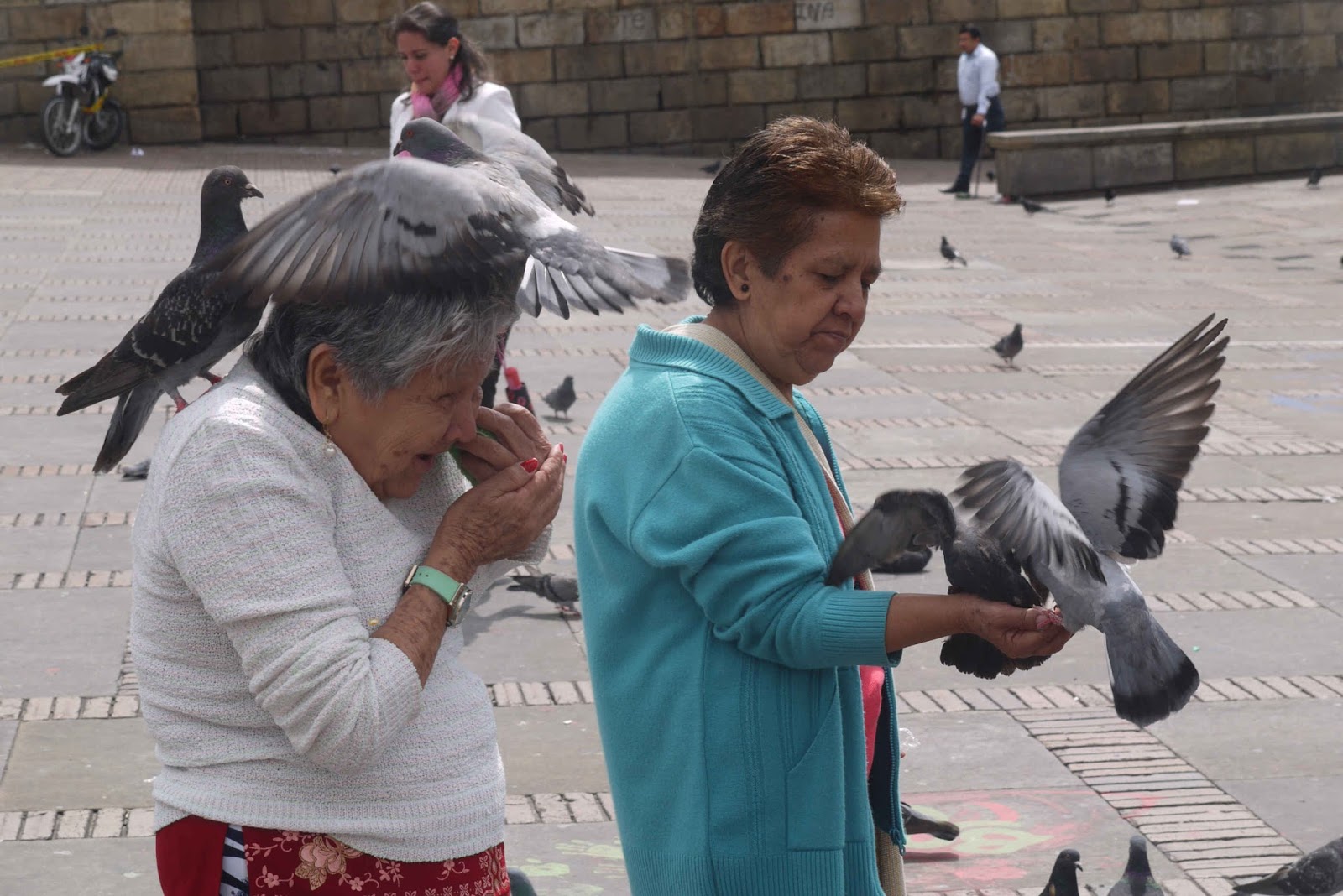
A human pigeon perch.
Pigeons are also a problem. Some people hate them and call them flying rats. And their feces corrode statues and public monuments. Which is why the city government recently banned pigeon feeding in Plaza Bolivar.

But other people love pigeons: They like to feed pigeons, run through crowds of pigeons and watch them scatter, even to put corn on themselves and become human pigeon roosts.

A pigeon selfie.
That's why the city's anti-pigeon rules are futile. The other day, post-pigeon ban, the buying and selling of corn and pigeon feeding were going on as normal.

All of which makes me ask: If Colombia cannot enforce a prohibition on its main plaza, amidst its government buildings, then how can it ever expect to do so in remote rural areas?

The answer is that it cannot, which is why drug prohibition has failed and likely always will.
Pigeon corn for sale.


Fighting for food!


Pigeons' droppings corrode public monuments.
By Mike Ceaser, of Bogotá Bike Tours

Tuesday, October 2, 2018

Lunch With Fido?


Animals stay out! Parchita waits for me on the sidewalk.
 Dogs accompany us at home, on walks, on vacation. So, why can't they join us at lunch?

Bogotá's prohibition against pets in restaurants is irregularly enforced, but does leave lots of dogs tied up in doorways in the sun or rain while their owners enjoy lunch or dinner.

No dogs allowed.
Now, Mayor Enrique Peñalosa, (although no favorite of the animalistas lobby because of the reappearance of bullfighting in Bogotá), wants to let the animals in.

In fact, what good reason is there to keep animals out? Dogs are dirty, but so are people. And many animals are better behaved than their owners. Besides, the person who pets his or her dog before entering a restaurant carries in lots of that animal's microbes, anyway. And at home pet owners share their kitchens and dining rooms with their animals to no apparent ill effects. (In fact, lots of research shows that early exposure to animals and their microbes helps kids develop healthy immune systems.)

This seems like the sort of thing which the market can decide: Restaurants which believe that their customers like animals could let them in, while more formal, straight-laced places can keep them out.


By Mike Ceaser, of Bogotá Bike Tours

Wednesday, November 2, 2016

Our Pigeon Problem

Young fun! An older woman gets a thrill from a headful of pigeons on Plaza Bolivar.

Feathered friends or rats with wings, Bogotá's got plenty of pigeons. Too many, says City Hall: the animals roost on statues, churches and historic buildings, damaging and discoloring them with their feces. A few years ago, the Cathedral placed spikes on its front to repel the animals. But, pigeons not being the brightest creatures, they impaled themselves, creating a gruesome version of crucifixion. The church removed the spikes.

Now, the city's considering more humane methods of population control, such as lacing their foods with contraceptives or building a pigeon roost, where their eggs would be taken away.

My bet is that the hated and beloved pigeons will be with us for a long time.

A pígeon in hand is worth two on the pavement.


The pigeons make the picture on Plaza Bolivar.

By Mike Ceaser, of Bogotá Bike Tours

Sunday, March 2, 2014

A Lady and Her Rooster


I often meet this woman in the Parque de la Independencia, where I walk my dog and she walks her rooster. The rooster is 3 years old and is named Gillo. She lives in an apartment, which is not the most comfortable home for a rooster, so the park is his opportunity to stretch his legs.


By Mike Ceaser, of Bogotá Bike Tours

Sunday, January 26, 2014

Pit Bulls and their People

A young couple and their happy pit bull. 
 Pit bull owners invaded La Ciclovia today to 'make others aware that these dogs aren't vicious'. Some pit bulls are definitely vicious, but those apparently stayed at home. These animals seemed happy and playful. But even so, don't get too close.
Walking pit bulls on La Ciclovia. 
Pit bulls on La Ciclovia. 
A pair of pit bull pups playing in the Parque Nacional. 
Don't discriminate against pit bulls!
Pit bulls and friends. 

Pit bulls and bicyclists. 

Sit down and smile!


By Mike Ceaser, of Bogotá Bike Tours

Sunday, October 6, 2013

Are Animals People Too?

'Break the chains of animal slavery.' I thot that by definition 'slavery' referred to people. 
Animal rights activists, some quite radical, staged yet another march today from La Plaza de Toros to Plaza Bolivar. Activists deserve our admiration for caring and getting off of their butts and speaking out.

However...my attention's always grabbed by the way these people generally attack bullfighting - even tho Bogotá's mayor has banned it here - while ignoring much greater cruelties such as cockfighting and factory farming, which continue virtually without criticism. 

Some of the marchers also called for 'animal equality' - yet, I saw only people walking leashed dogs, but not the reverse. While we're on the subject, how can I make myself equal to my goldfish?
Marching for animal equality - but they don't say equal to whom.

A bloody bull.

A bull's head rides above the crowd.

People walk their dogs on leashes. But, if animals are equal to people, shouldn't the dogs be walking the humans?

'Free the captain.' Does this refer to the Greenpeace activists arrested the other day by Russia?


By Mike Ceaser, of Bogotá Bike Tours

Sunday, June 2, 2013

A Farm for Bogotá?


Horses graze in the piece of land between Simon Bolivar Park and Calle 26.
Believe it or not, this idyllic piece of land is near the center of Bogotá, between Parque Simon Bolivar and congested Calle 26. The land is also at the center of a controversy over its fate.

About 31 years ago, this 26-hectare green space was designated to become part of Simon Bolivar Park, according to El Espectador, but the city has never found the money to buy it from its private owner. Now, the city's proposed and polemical Territorial Ordering Plan (POT) would designate much of it for urbanization. Neighbors are protesting.

The green space is located south of
Simon Bolivar Park, between it and
Calle 26.
The idea's promoters argue that the lot is located in the Teusaquillo district, which has already has more green space per resident than most other parts of the city. But that's a very narrow perspective. Bogotá is a very dense city, and Bogotanos come from all over to visit Simon Bolivar Park, which becomes extremely crowded on a sunny weekend. Those crowds will surely increase with the new Calle 26 TransMilenio line, which includes a station near this huge green space.

What's more, this land has to be unique in Bogotá. If it's covered up by - god forbid - a shopping mall or apartment complex, Bogotá will lose an once-in-a-city's-history opportunity.

Rather, Bogotá could use this unique piece of land to do something creative and memorable. And what occurs to me is a working zoo. Sure it sounds weird, but Bogotá's a very urban city increasingly isolated from the countryside which feeds it. An urban zoo would be great for kids to visit, as well as a great educational opportunity for students to learn about ecology, sustainable development, agriculture and much else in an interactive environment.

The area could also serve as a simple zoo, with species native to Colombia and the Andes, which would complement the nearby Botanical Gardens. (Bogotá does have a zoo, but a good ways south of the city center.)

I'm sure that ther are other excellent potential uses for the open space. But burying it under yet another forgettable development certainly isn't one of them.

By Mike Ceaser, of Bogotá Bike Tours

Sunday, April 7, 2013

'A Novel, Healthy and Curious Diversion'


The athletes are lined up. 
And he's off. 
After months of absence, the guinea pig races, with all of their drama and excitement, are back along La Septima. I'd wondered whether misguided animal rights folks had gotten them run off (the guinea pigs seem healthy and well-treated), but Juan, the pigs' trainer told me that he and his dad had been racing their animals in Barranquilla.

In fact, Juan said that he and his father are the only ones in Bogotá, and perhaps the world, who do public guinea pig races. Juan said his father invented the sport about 20 years ago. Juan himself has been doing racing the animals for six years.

Which bowl will he choose?
Juan carries on a constant, repetitive refrain, pointing out that this is a "novel, healthy and curious diversion" which won't break your bank. He also informs the public that guinea pigs, known as cuy, are eaten in the Colombian Department of Nariño. (They are also food in Peru and Ecuador.)

The races, of course, aren't really races. Bystanders put coins, usually of 200 pesos, on the overturned colored bowls, each of which has an entranceway cut into its side. Juan urges one of the animals to advance. The animal is supposed to race into one of the bowls, presumably attracted by the darkness. Sometimes, however, the pigs stop halfway, or apparently can't decide which bowl to enter. So, Juan urges another animal forward. When a pig enters a bowl, whoever placed a coin on that bowl wins five times the amount bet.

Nobody's sure how guinea pigs, which are rodents, got their name. Perhaps Europeans once thot they came from Africa, instead of the Andes. Or, Guinea may be a corruption of Guyana.
An undecisive guinea pig. 


There he goes. We have a winner!


Time to line back up little guy. 


By Mike Ceaser, of Bogotá Bike Tours