Monday, September 13, 2010

Saying 'Colombia' in Mexican

Mexico...but it could be Colombia a decade ago.
U.S. Secretary of State Hillary Clinton made an awkward statement the other day - suggesting that the violence in Mexico today resembles the insurgencies in Colombia at the height of their violence.

That comment offended lots of officials in Mexico, who argue that they've got the situation under control. In Colombia, at their peak, leftist guerrillas controlled nearly half of the country and had the capital under siege.

In Mexico, the drug-trafficking cartels lack the political agenda which the Colombian groups had, and claim to still have. However, it's certainly arguable that Mexico's level of violence, corruption and mayhem resembles that in Colombia during the era of Pablo Escobar.

The 'insurgency' debate is a side issue. The terrible reality is that, seemingly, Colombia's drug-fueled violence has shifted north to Mexico. An aggressive U.S.-financed crackdown on cocal leaf cultivation here in Colombia appears to have pushed coca leaf south, to Peru and Bolivia. Many people compare the phenomenon to a balloon, which you push in in one spot and bulges out in another. Similarly, perhaps, the violence has been shifted north.

Mexican ex-President Vicente Fox, a conservative who was a friend of George Bush, recently restates his opinion that drugs should be legalized, in order to take the profits away from the outlaw groups.

Maybe it's worth a try. The alternative isn't going so great.

Written by Mike Ceaser, of Bogota Bike Tours

Saturday, September 11, 2010

Bogotá's Battle Over Public Space


Vendors lined up on the Plaza San Victorino
In Bogota, like most of the developing world, public spaces serve as stages for much of life. Evangelizers yell at crowds on streetcorners. Singers croon salsa and cumbias for a few coins. Vendors yell out their offerings of drinks, candies, fruits and clothing. Nostrum hawkers and practicioners of black magic lecture believers. Young men play soccer. And couples walk hand in hand.


In recent years, Bogotá's mayors have made improving public spaces a central part of city policy. They've created new parks, cleaned up plazas and improved sidewalks and ornamentation along the newly built Transmilenio lines.

Move on, move on.

But keeping public spaces open to the public is a perpetual battle between the forces of law and those of poverty, apathy and corruption. For the poor - particularly Colombia's millions of internally displaced people, who have nothing - the city's sidewalks, parks and plazas are rent-free sales areas. In some areas, thru either sympathy or corruption, the police seem to leave vendors alone. In others, such as the Plaza San Victorino, police do periodic sweeps, or 'operativos,' in which they drive the vendors away from the plaza's center. The vendors know this is coming, and so they spread out their toys, clothes, shoes or other wares on a plastic sheet or blanket. When the police appear, the vendor pulls together the blanket's four corners, turning it into a sack, in which he carries away his wares.


Away you go!

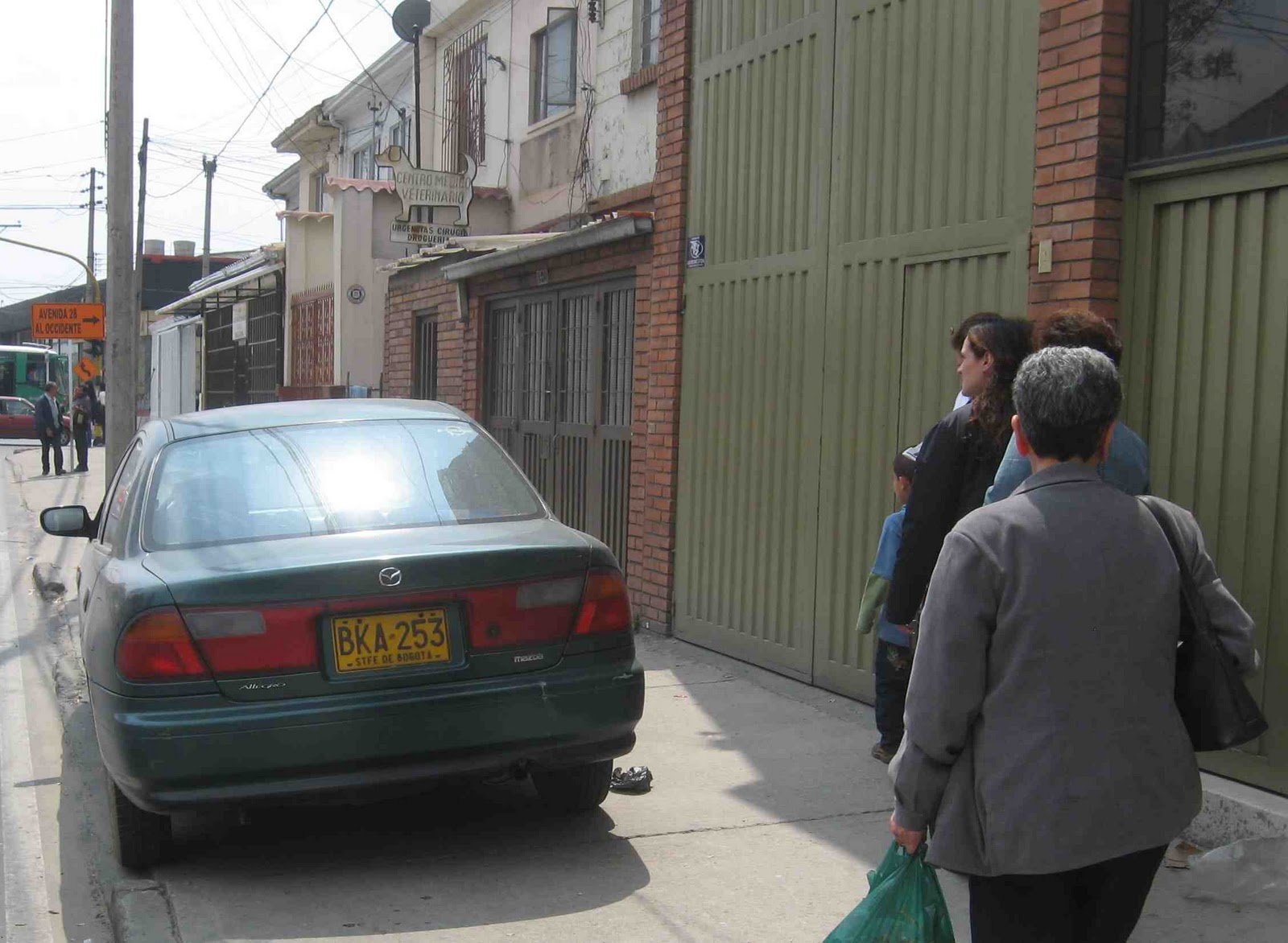
Unfortunately, however, the city's offensive against public space invaders appears to be directed primarily against the poor. The middle class and wealthy park their cars on sidewalks all over the city with no fear of tickets or towing.

But here's a good use of public space.


This blog written by Mike Ceaser, of Bogotá Bike Tours

Tuesday, September 7, 2010

A Tale of Two Drug Sellers

Leo Siegfried Kopp was a Jewish-German immigrant who founded Bogotá's Bavaria Beer Company in 1889. Pablo Escobar was a cocaine king who became one of the world's richest men.

Escobar, dead on a Medellin rooftop.
What did these men have in common (besides being Colombian)? And what are they doing sharing a blog entry?

Well, both ran businesses which produced and sold addictive drugs: Kopp sold beer; Escobar, infamously, created a cocaine empire. And, both are remembered, among other things, for being generous to their workers.

Kopp helped his employees get potable water and other services in their Bogotá neighborhood, La Perseverancia.

Kopp's tomb and statue, decorated with believers' flowers.
For his part, Escobar was famous for having built whole neighborhoods for Medellin's poor, for electrifying poor parts of the city and for building homes and soccer fields. Residents of towns near his Hacienda Napoles ranch still recall how Escobar used to send a truck filled with Christmas gifts for local children.

The difference was in their other business methods: Whereas Escobar placed car bombs, tortured and kidnapped in order to sell his mind-altering substances, there's no record of Kopp killing anybody - deliberately, anyway.

Today, the memory of Escobar continues scarring Colombia's image, whereas Kopp is a popular saint - believers sometimes line up a dozen deep to ask for favors from the statue on his tomb in Bogotá's Central Cemetery.

What's the difference? Was Escobar inherently evil and Kopp good?

Certainly, a guy like Escobar, who started out in petty crime, probably looked for a source of fast, easy money. So, if the illegal cocaine trade hadn't existed he very possibly would have gotten into some other outlaw trade, such as arms smuggling or human trafficking. But, then he would have killed fewer people and caused less mayhem, since those industries were much smaller (and would have been smaller still in the absence of an illegal cocaine trade).

And what if cocaine had been legal and Escobar had trafficked it anyway? Very likely, he would not have been a kind and gentle businessman. But it's hard to imagine him having car bombed, kidnapped and tortured. After all, what other dealer in a legal, if damaging, product does?

It's just worth thinking about: Two Colombians, both marketers of addictive drugs. But one remembered as a saint, the other a monster. The main difference between them? One product was legal, the other illegal.

This blog written by Mike Ceaser, of Bogota Bike Tours

Sunday, August 29, 2010

Colombia's Abortion Issue

An illicit abortion clinic in central Bogotá advertises itself as a women's health clinic.
In 2006 Colombia's supreme court legalized abortion in cases of rape, incest, danger to the woman's life and when the fetus has some severe deformation, making Colombia's one of the most progressive abortion laws in Latin America.

Since then, 649 legal abortions have been carried out, 61 percent based on fetal deformation, 20 percent on danger to the woman's life and 19 percent because the pregnancy resulted from rape or incest.

After three years, 650 legal abortions is an absurdly tiny number in a nation of 45 million people, where gender violence is relatively common and maternal mortality is high.

Nevertheless, for the procuradora general that number is apparently too high. In any case, she's been asking why the percentage of legal abortions justified by fetal deformity is so high. Is this disguised eugenics? Abortion for convenience? Neither of those explanations is likely, since even when they have a legal justification to abort, girls and women encounter many obstacles, in particular from doctors and hospitals who profess Catholic values. Rather, those looking for abortions of convenience will simply go to the many ilicit abortion mills which continue doing lively business across Colombia.

In contrast to the apparent crackdown on legal abortion is the Colombian legal system's great tolerance of drunk drivers - even including those who kill people. In recent years, with few exceptions, many drunks who injured and even killed people have been given house arrest - sending the message that drinking is all good, innocent fun, that it's not really their fault and that it's no big deal, anyway. Is there a pattern here? Perhaps it is that it's women who get pregnant, so why not make them responsible, while it's generally men who drunk and drive, who we'll laugh it off.

This blog written by Mike Ceaser, of Bogota Bike Tours


Tuesday, August 24, 2010

Chicha Wars!


El Portal de la Chicha, with protest signs.
Chicha, a drink made by fermenting corn, is Bogotá's most traditional brew. It's said that in past centuries so much chicha was made in La Candelaria that they used it to put out house fires.

Chicha has survived centuries of time and lots of opposition - including even deadly street battles against beer and liquor sellers. Today, commercially-made beer and whiskey have cut into chicha's market share, but the drink is still consumed in small bars all over the city - and particularly those along La Candelaria's cobblestone Callejon del Embudo, where university students crowd the small, dark chicha bars until late at night.

A mural goes up in el Callejon del Embudo.
But now Bogotá has plans to renovate and upscale the city center, and the chicha bars apparently are an unpleasant eyesore which the city wants replaced with sush bars and nicely-painted botique hotels. Tradition - who cares? Police have given the chicherias just a little while to shut down. 

But the bar owners are organizing to defend this most Bogotan of Bogotá drinks.


By Mike Ceaser, of Bogota Bike Tours

Wednesday, August 18, 2010

No more 'bases gringas'?

After the U.S. handed over the Panama Canal , the Panamanians also kicked out the U.S. military base there. Washington looked around, and finally rented a space on the Ecuadorian air force base at Manta to use for what it said were solely anti-drug flights. But then Ecuador elected leftist Pres. Rafael Correa, and he ended the U.S.'s rights to use the Manta air base. So, Washington looked east and found Colombia, with which it signed an agreement giving the US's military landing rights on seven Colombian military bases.


The US-Colombia agreement generated lots of
controversy, especially among leftists, who denounced the arrangement as 'US bases' and an example of US imperialism. Venezuelan Pres. Hugo Chavez suggested that the US and Colombia would spy on his country and were even preparing to invade Venezuela.

Yesterday, Colombia's high court ruled that the agreement was invalid because it had not been approved by Colombia's Congress. That appears unlikely to happen, unless Colombian Pres. Juan Manuel Santos is willing to rile up the Venezuelan government.

What's the lesson in this? First of all, the US doesn't look like much of an imperialistic power - not when tiny nations like Panama and Ecuador have evicted US soldiers without firing a shot.

And the decision shows once again that Colombia is a democracy with an independent court system - with a backbone.

At the same time, the US should find a lesson in this: Its war on drugs is unpopular in Latin America, where it is widely seen as an imposition. What's more, despite billions of dollars spent and many thousands of deaths, the war has produced little progress against the drug trade.

Perhaps a change of strategy is in order.

This blog written by Mike Ceaser, of Bogotá Bike Tours.

Thursday, August 12, 2010

A Nasty Reminder


A car bomb exploded this morning in Bogotá's Chapinero neighborhood, targeting Caracol radio's office, and injuring nine people, none of them seriously. The time of the explosion indicates that the bombers meant to attack the radio station, which has a conservative reputation, rather than kill people, altho an early riser on their way to work could easily have been blown to bits by the 50 kgs. of explosives.

Judging by history and their capacity to do damage, the most like perpetrators of this attack were the FARC guerrillas. But, whoever it was, they need to ask themselves: What's the point? Sure, you've shown that you can cause mayhem. Sure, you've shaken up Caracol Radio. But your revolution is no closer. All you've done is forced the state to shift more money from schools and soup kitchens to security. You've justified more expenses on weapons, and given another boost to the right-wing parties.

Think again. What's the point?

Authorities might also reflect that this is more evidence that the guerrillas, altho battered and weakened, are still there. Perhaps someone should consider trying a new strategy besides war. That could mean more education and other benefits for the poor. But it could also mean a radical strategy which might pull the rug out from under the guerrillas by taking away their main source of income: Drug decriminalization.

Blogged by Mike Ceaser, of Bogotá Bike Tours.