Friday, June 14, 2013

Jaime Barranco's Most Amazing Collection

Jaime in front of his home-museum in Teusaquillo.
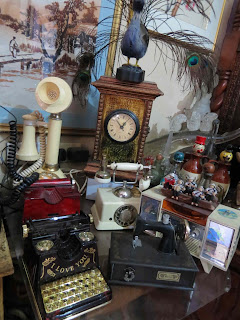
From outside, you wouldn't think that Jaime Barranco's home in Teusaquillo was any different from its nondescript neighbors. But inside it contains a lifetime's collection of knicknacks which Barranco collected from all over the world. Carved wooden masks from Africa, ceramics from China, cultural oddities from the U.S. and, of course, Colombian indigenous artworks. 
Jaime's one-man drum show. He played a
song he wrote about Colombian coffee.
It would be a museum, except that Jaime doesn't like that concept, which he considers too static. Rather, he believes that people need to actively 'appropriate' culture - as he teaches in art and music workshops in his home. 

Perhaps that's why he's stuffed every room of his apartment - including the bedroom and bathroom -with pieces from his collection, which must number in the thousands. He's got a table of Geisha dolls, a corner devoted to perfumes and walls upon walls of masks. Jaime's got stories, some of them of questionable anthropological verity, about many of the pieces. And, if you give him time (and later a tip), he's happy to tell the storie's 

At 77, Jaime's cheerful and active. "I'm enjoying life," he tells us. And, he clearly is. 

Macumba is located on Carrera 19 No. 42-88. Cellphone 313-234-9141. macumba.macumba (at) gmail (dot) com.

Carved masks line the entrance hall.
Masks and figures from Africa and China.

A nice still life of cans on the kitchen wall.
Even the bathroom's a showplace. 


Carved wooden masks.

These heads are mugs.

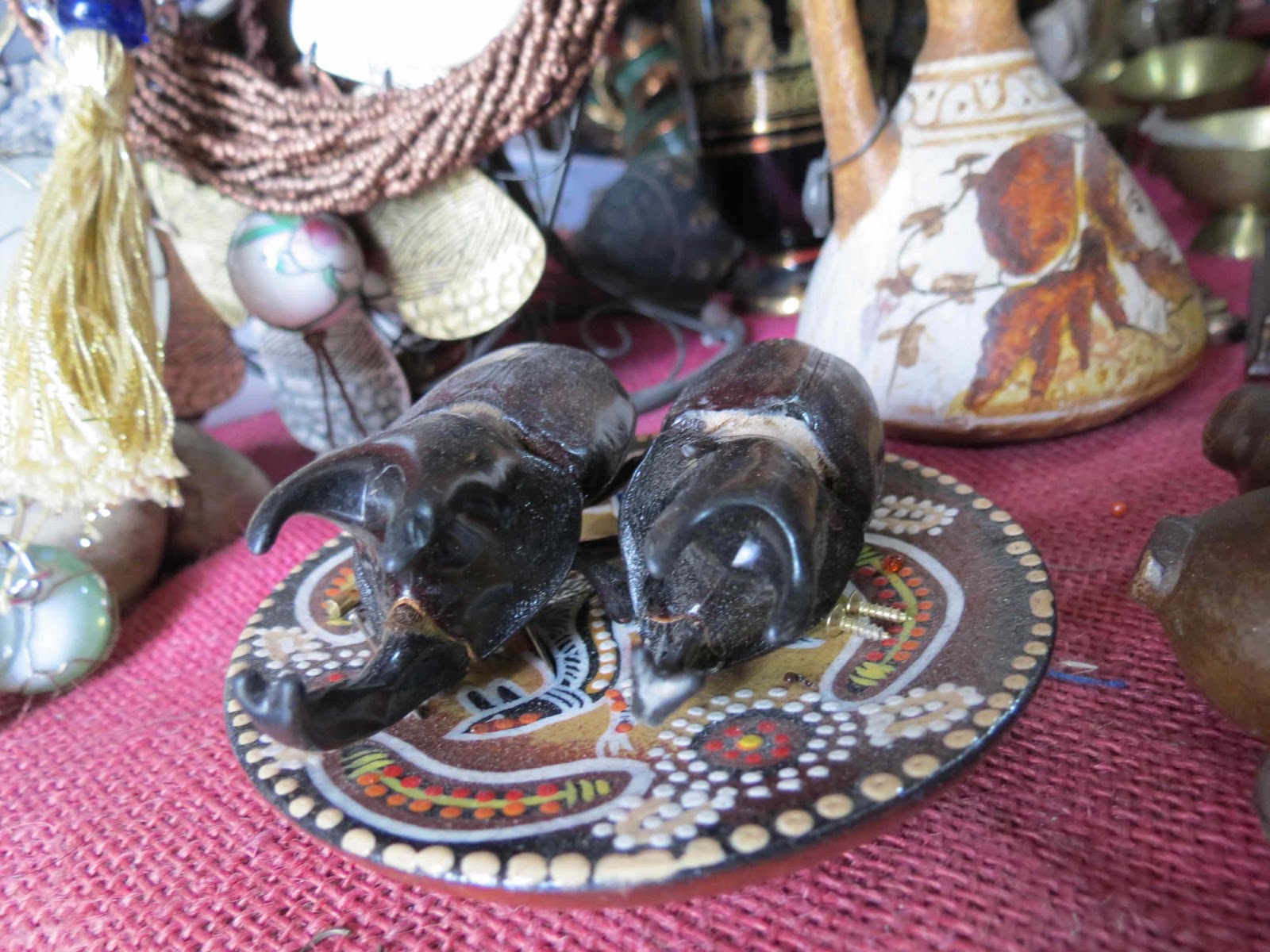
Dung beetles? Scarab beetles?

Erotic pottery. 

Erotic perfumes and colognes.


Jaime displays fossilized snails. 

Geisha dolls.


Looks like he's from India. 


Ken dolls and cars.
Mississippi Mud.


A perfume. 


Modern women face off against ancient Egyptians.

Hanging a witch on the kitchen wall. 


By Mike Ceaser, of Bogotá Bike Tours

Tuesday, June 11, 2013

Death as Climax and Mystical Matrimony


A nun on her deathbed.
What's is death like when it's the culmination of life?

Death portraits of nuns on display in the Santa Clara Church-Museum make one ask what these women were like. Many wear expressions that aren't tranquil or benevolent. A minority are smiling. Did they live lives of quiet, fulfilling prayer and contemplation, or bitter rivalries? Does a cloistered life mean peace of mind or repression of natural energies?

The exhibit's title: 'Opaque Bodies: Invisible delights of mystic eroticism' suggests that death should be the climax of these women's existences.


A peaceful, happy death.
Certainly, the nuns' cloistered life doesn't seem terribly natural. Some families sent in their daughters to a convent as young as 7 or 8, when they couldn't possibly have been able to choose for themselves (they could choose to leave, but that couldn't have been easy). Others were interned for 'bad' behavior - likely for not obeying sexual or romantic norms - and some widows chose a cloistered life, perhaps because a widowed woman had few resources for any other role in society. (virginity was not a requirement.) Nuns, of course, represent a certain ideal of femininity: humility, sacrifice, resignation and virginity - similar in many ways to the lifestyle required of some conservative Muslim women.
A satisfactory life?

The convent's central mission was to protect the nuns, particularly those of 'clean blood' - daughters of Spanish Catholic families.

Once inside the Santa Clara, the girls and women could not even see their families again and left only after death.

Altho the nuns, called Las Clarisas, had very little contact with the outside world, the convent did play a surprising economic role - lending money with interest. The convent held the belongings of its credit clients, similar to the pawn shops which today line Ave. Decima just two blocks west.


The museum's exhibit points out the changes in society's attitude towards death. Today, many people, prompted by marketing, aspire to eternal youth - a contrast with Colombia's sometimes violent culture. In contrast, the nuns supposedly conceived of death as a culmination of their religious life - a matrimony with Christ.

For a person who had lived such a closed existence, the prospect of entering heaven and accompanying Jesus must have provided hope and inspiration. Perhaps that was why being permitted to paint the deceased nuns' portraits was a great honor. Yet, only one of the painters signed his work.

Nuns, and young women preparing to become nuns, are fairly common in Bogotá. Many (I hope most) do charitable work, and a few are social activists. But the cloistered life still exists.

The Santa Clara Convent was built in 1649 and in 1969 purchased by the government of Colombia. The church officialy made it 'unsacred', and today it's operated by the Ministry of Culture. If you like that heavy, often overwrought, religious art, it's worth a visit. Admission is 3,000 pesos, free on Sundays.


The Santa Clara's other works are elaborate and intense religious items:


A Christ portrait with burning heart.


The Santa Clara's elaborate interior. 


Old woodwork.

An agonized Christ sculpture. 


By Mike Ceaser, of Bogotá Bike Tours

Luis Gonzalez's Pedal-Powered Campaign For President


'Against the Free Trade Agreement, the gringos and the fatherland's sell-outs.'

Luis González campaigning,
one voter at a time.
Luis González has been carrying out his self-powered presidential campaign along Ave. Septima for the past months. I often see him pedaling along on his beat-up one-speed bicycle mounted with the sign denouncing the gringos, free trade agreements and a loudspeaker blaring the speeches of assassinated politician Jorge Eliecer Gaitan.

Colombian politics is already buzzing about next year's presidential campaign, in which Pres. Santos looks likely to seek reelection, and Time Magazine says that his most likely opponent is his relative, ex-Vice Pres. Francisco Santos. Either one would likely support free trade agreements, a close alliance with Washington, a continued military campaign against the guerrillas and a privatized economy.

González, 52, would take a very different route if he makes it into the Casa de Nariño, which he's sure he'll do. In his administration, foreign military advisers would be expelled from Colombia, the state would nationalize all public services, health and education would be free and everybody would be guaranteed a job.

But before getting elected or even getting onto the ballot, González needs to collect the signatures of 520,000 voters. He's is planning a cycling campaign tour of the coffee region.

González motions toward the memorial for his hero,
Jorge Eliecer Gaitan.
He campaigns many days on Ave. Septima, by the spot where his political hero Jorge Eliecer Gaitan was assassinated in 1948 and where he seems to find a supportive crowd. But Gaitanistas are today a limited constituency.

Would González's policies work? Will he get the chance? González doesn't have any political parties behind him, nor money (he survives off of donations and by selling CDs of Gaitan's speeches). But, he says, he does have 'the people' behind him, and that's all he needs. Neither does his political history bode well. He ran multiple times for city council and mayor, mostly in his native Santander Department, and lost every time. Those failures don't disappoint him - he's sure that the only political position which matters is the presidency, so why not go directly there?


By Mike Ceaser, of Bogotá Bike Tours

Monday, June 10, 2013

Gustavo Rojas Pinilla: Political Chameleon

Flowers on dictator Gustavo Rojas Pinilla's tomb in Bogotá's Central Cemetery.
Grl Gustavo Rojas Pinilla.
General Gustavo Rojas Pinilla, who seized power 60 years ago this week, was Colombia's last outright dictator: he shuttered newspapers and massacred university students. But Rojas Pinilla was also a populist hero - and a progressive who gave the vote to women - and even the inspiration for an idealistic leftist guerrilla movement. Today, he retains a sort of progressive aura in the public memory. Go figger.

In 1963, Colombia was hemorraging from La Violencia, a vicious fratricidal war between Liberal and Conservative guerrilla armies. The far-right President Laureano Gómez was too sick to govern. Colombians called for a strong hand to stabilize and pacifize the country.

A memorial on Ave. Septima to the university
students massacred by Rojas Pinilla's
government.
Popular sentiment backed by the military turned to the accomplished general Rojas Pinillas, an engineer who had also directed infrastructure projects and been Colombia's delegate to the United Nations. His June 13 coup was bloodless and Rojas set about mending the country. He pardoned the guerrillas, introduced television and began a series of infrastructure projects financed by strong coffee prices.

But power corrupts, and the benevolent Rojas turned tyrannical. When spectators booed his daughter at an event in the bullfighting stadium, Rojas responded the next week by infiltrating the stadium with toughs, who beat and stabbed to death an undetermined number of government opponents. The newspapers censored by the government ignored the massacre. The very Catholic Rojas also persecuted protestant evangelicals.

The Justice Palace in flames following the
1985 M-19 guerrilla attack.
In 1955, students protesters marching down Ave. Septima were swept by government gunfire, killing some dozen of them. The next year, Rojas closed El Tiempo y El Espectador, Bogotá's two main newspapers (they promptly reopened under new names), and others.

But it was apparently the resurgence of La Violencia which finally turned public opinion and political party leaders against Rojas, forcing him out of power and into exile.

He was replaced by a military junta which oversaw the transition to a quasi democracy (for 15 years the Liberal and Conservative parties simply passed the presidency back and forth).

A plaque in Bogotá's City Hall denouncing
the attack by 'subversives' on the Justice Palace.
But Colombia wasn't done with this savior-turned-tyrant. Rojas returned, now transformed into nationalist populist. At the head of his ANAPO party, in 1970 he ran for president against conservative Misael Pastrana and lost narrowly - according to the official results. Rojas supporters cried fraud, likely with good reason. The election stood, but out of that allege fraud were born the M-19 guerrillas, whose legacy continues in Colombian politics.

The Justice Palace on Plaza Bolívar in Bogotá was
destroyed in a 1985 M-19 guerrilla  attack and
rebuilt about the year 2000.
The M-19 - young, educated, idealistic and media-savvy, carried out a series of dramatic operations which culminated disastrously with their 1985 attack on the Justice Palace on Plaza Bolívar. After the M-19 took the magistrates hostage, the military counterattacked with tanks fire. The Justice Palace was destroyed and about 100 people were killed, including 11 of the 12 justices. The building was burned and gutted.

A plaque in Bogotá's City Hall memorializes
people disappeared during the Justice Palace
conflict.
A few years later, the M-19 turned in their weapons and became a political party. In 1991, they even played an important role in the writing of Colombia's new Constitution, and can be credited for its progressive features.

Today, some of the ex-M-19 leaders are in Congress, and one, Gustavo Petro, is mayor of Bogotá.

Rojas' legacy has also persisted in more destructive ways. His grandson, Samuel Moreno Rojas, was mayor of Bogotá from 2008 to 2011, and allegedly stuffed his pockets in a huge corruption scheme. Now, Samuel and his brother Ivan, a senator, are in prison awaiting trial. They claim to be innocent.

Ironically, Samuel Moreno is accused of taking kickbacks on contracts for work on Ave. 26 - which his grandfather had constructed.

And Rojas' legacy probably isn't over.

By Mike Ceaser, of Bogotá Bike Tours

Sunday, June 9, 2013

Like Sons Like Father: The Uribe Polemic Continues

During his presidency, Alvaro Uribe generated either hate or adherence: For some, he was Colombia's savior, for others a warmongering ally of right-wing death squads. And, since he left office, Uribe has continued generating polemic as leader of the opposition to his succesor Juan Manuel Santos.

So, perhaps it's not surprising that Uribe's sons Tomás y Jerónimo Uribe Moreno are generating their own controversies.

At first glance, it's hard to understand why. The young men operate some admirable businesses: Artesanias de Colombia, which markets traditional handicrafts, and EcoEficiencia, which recycles and disposes of hazardous wastes, as well as providing other environmental services. They've also been involved in real estate and the family ranch.

Still, suspicions of favoritism have never gone away. During their father's eight years in power, some of those businesses grew tremendously.

But entrepeneurship deserves its rewards. So perhaps it's just the young men's style - or the reputation inherited from their hard-driving father - or political resentment - that's generated conflict.

Still, questions keep coming up. There were the links to a pyramid scheme. And when Bogotá was reorganizing its waste disposal system a few years ago, the traditional recyclers - poor people who pick thru the garbage on the sidewalk for whatever they can use or sell - charged the Uribe brothers with trying to monopolize the city's recycling industry and eliminate the independent recyclers' way of life.

The Uribes backed off of that recycling plan, altho they continue in the industry.

In 2009 the brothers were accused of receiving favors after a property they purchased outside of Bogotá was rezoned as a free trade area. Soon after that, someone created a Facebook group named 'I commit myself to kill Jerónimo Alberto Uribe, son of Alvaro Uribe.' The group's profile page said they wanted to show the Uribes the 'horror of war.' A young arts student turned out to be behind the Facebook group. He was absolved of any crime.

The brothers were back in the news this April after investigative journalists revealed that they had opened a bank account in a the British Virgin Islands, considered a tax paradise. The Uribes responded that a business partner had decided to open the account there in order to sell handicrafts and that the business had failed.

And last week El Tiempo published a long report about allegations that the brothers had engaged in tax fraud. In today's paper, the Uribes reject the charges and claim that their clients lied.

Throughout the young Uribes' business career has run the suspicion that they have benefited from their name and father's influence. In December 2010, ex-Pres. Uribe and journalist Daniel Coronell clashed on Twitter after Coronell reported that Tomás Uribe had met with a Brazilian construction company seeking contracts in Colombia. Coronell said that, however innocent Tomás Uribe might be, such a meeting didn't look good. The ex-president responded furiously and Coronell asked him to "Explain the fortune of your children."

Thru it all, president and now ex-president Uribe has given no ground in defense of his sons' honor. In 2008, he affirmed "my sons aren't corrupt. They aren't influence traffickers before the state...My sons have chosen to be men of work, honest and serious."

The family also argues that the younger Uribes have no contracts with the state.

It's probably inevitable that the ambitous sons of such a powerful, polarizing figure as ex-Pres. Uribe will attract controversy.

But it's also true that the sons of a president should walk very carefully, and, at a minimum, they've failed at that.
By Mike Ceaser, of Bogotá Bike Tours

Saturday, June 8, 2013

More Canal Trouble for Colombia?


A threat to Colombia? Old plans for a canal across Nicaragua are coming back. (Photo: Wikipedia)
In 1903, Colombia had just finished the bloody Thousand-days civil war. In Colombia's presidency was José Manuel Marroquín, a philosophy professor who reportedly was more passionate about writing books on grammar than governing. And the country was still smarting from the dismemberment it suffered when Ecuador and Venezuela broke away from La Gran Colombia.

It could have been Colombia: Construction of the Panama Canal (Photo: Wikipedia)
Enter the United States, led by Pres. Theodore Roosevelt, a military man, believer in Manifest Destiny and wielder of the 'big stick,' who was bent on expanding the U.S.'s power across the hemisphere.

A ship crosses the Panama Canal.
Roosevelt wanted to dig a canal across Central America to connect the Pacific and Atlantic oceans and save ships the long and dangerous passage around around the southern tip of South America. And the Colombian province of Panama was the logical place to dig it, since the French had already done years of excavation there. (The alternative was digging across Nicaragua.)

No warrior: Colombian Pres. Jose
Manuel Marroquin.
Bogotá's relationship with Panama was already tenuous. The province was isolated from the rest of Colombia - today, there's still no land connection between the two nations - and many Panamanians had long aspired for independence - even rebelling several times. The Panamanians also resented their sufferings during the Thousand Days War, which they felt was fought over issues foreign to them.

So, when Washington approached Bogotá proposing digging a canal across Panama, Colombian leaders worried. Bogotá had less than a century before already lost much of its territory, and now this big power from the north was proposing digging a trench across the country and then assuming long-term control of the corridor.

Colombia's Congress gave the Yanquis the cold shoulder and made big demands for the canal concession.

Theodore Roosevelt:
A rough rider.
The strategy backfired disastrously for Colombia. Roosevelt encouraged the Panamanians to stage yet another revolt and immediately recognized Panama's independence. Roosevelt even sent down U.S. warships to prevent Bogotá from putting down the rebellion.

Instead of losing temporary control of a corridor of land, Colombia lost a whole province.

It's interesting to think about how things would be different if Colombia had cooperated with the Roosevelt administration. Today, Panama would likely still be a Colombian province, giving Colombian much more economic and geopolitical importance.

But there's no changing history.

And today, Colombia's unfortunate relationship with Central American canals may be heading for a repeat.

The recent Hague International Justice Court's ruling expanding Nicaragua's Caribbean waters breathed new
Nicaragua still claims Colombia's San Andres archipelago,
located off of Nicaragua's coast. A nearby canal would
 impact them economically, geopolitically and
environmentally. 
life into that nation's hopes to build its own canal between the oceans. A canal across Nicaragua would be longer than Panama's, but have huge advantages. It would be a sea-level canal, meaning that ships would not have to be lifted and lowered in locks as the Panama Canal does, and it would be wider and deeper than Panama's. The world's biggest ships, mostly oil tankers, already can't fit thru the Panama Canal and still won't even be able to after that canal's current expansion is completed.

The Nicaraguan government is moving ahead with a concession to a Chinese company to dig a canal across the country. (There had also been talk of the Chinese building a 'dry canal' in the form of a railroad line between Colombia's Pacific and Atlantic coasts.) After the Hague ruling, some Colombian officials even suggested that the Chinese interest in building such a canal could have influenced the Chinese judge on the panel, but there's no evidence for that.

The Seaflower Marine reserve around the San Andres
archipelago would be hit with pollution and exotic species,
as well as huge sea traffic, if an inter-ocean canal is
dug across Nicaragua. (Photo: Unesco)
But a canal across Nicaragua could mean trouble for Colombia. It would inevitably increase Nicaragua's influence in the Caribbean, increasing pressure on Colombia's sovereignety over the San Andres Archipelago off of Nicaragua's coast. Nicaragua has long claimed the islands.

Adding a major shipping channel will also produce huge environmental impacts from ship movement, ship wastes and the introduction of exotic species. That's particularly worrying for Colombia's Seaflower Marine Sanctuary around the San Andres Islands. (Colombia is using the sanctuary to challenge the recent Hague court ruling, but its chances for success look slim.)

By Mike Ceaser, of Bogotá Bike Tours

Friday, June 7, 2013

The Coca Museum

The Coca Museum
I happened upon this 'Coca Museum' in today's mercado campesino on Plaza Bolivar. Museum organizer organizer William Morales.William Morales, a local musicion, said the museum is a community project, created in cooperation with the Museo de la Coca in La Paz, Bolivia, which they set up at different community events.
No, that's only cal, a ground stone or shellfish shell,
which is mixed with coca leaves to bring out their
active ingredients. It's held by museum
 

It caught my eye because for a long time about the idea of creating a coca museum here, altho mine would also examine the War on Drug's violence and arguments for and against prohibition.

Museum organizer William Morales said the goal is to 'sensitize' people about coca leaves, which have been often demonized. Until a few years ago, the government ran 'anti-drug' campaigns which called the coca bush 'the plant that kills.'

'Prophecy of La Coca.' The supposed indigenous
prophet said that the leaf would be a blessing
for indigenous Americans, but a curse for outsiders.
Of course, the coca leaf and cocaine are two completely different things. Traditional Andean cultures have religious, medicinal and dietary uses for the coca leaf. Europeans, after all, turned the leaves into an addictive drug. Nevertheless, the coca leaf remains on the United Nations' list of controlled substances (for every nation except Bolivia).

But I'd like to see a permanent Coca Museum somewhere in La Candelaria, close to the hotels and hostels where tourists party with cocaine ignorant about both coca's deep roots in Andean culture and the damage which drug money and the War on Drugs have created across the region. My Coca Museum would include documentary information of the coca leaf's traditional uses, cocaine's origins and uses and the story of drug prohibition: what have been its impacts? Is it good or bad? How can society deal with addiction and its impacts?

(Something about the lighting turned the photos red.)


Poporos used to grind cal to mix with coca leaves. 

'Coca leaf isn't white, it isn't black, it is green.'

'Coca leaf, from Satanization to Comprehension.'


'Coca leaf's health benefits.'

' Coca leaves kill hunger.'

A coca bush seedling.

Coca soap.

Brazilian President Evo Morales on coca leaf as food.


By Mike Ceaser, of Bogotá Bike Tours