Monday, March 9, 2015

Friends in High Places

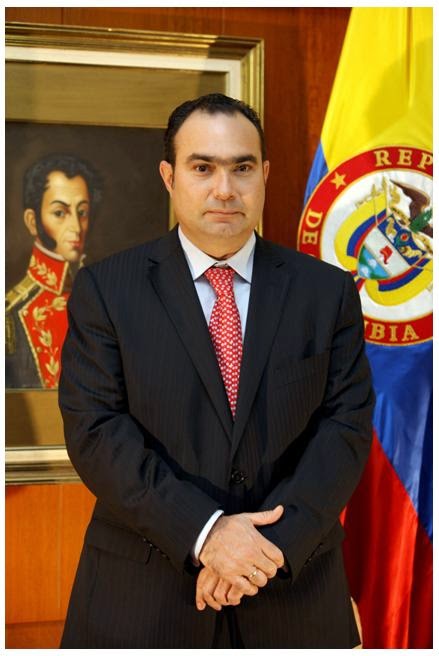
Judge Pretelt: In the middle of the storm.
When El Tiempo columnist Maria Isabel Rueda recently interviewed Constitutional Court Pres. Jorge Pretelt, she was impressed that Pretelt brought along the court's ex-president, Rodrigo Escobar Gil.

Because magistrate Pretelt is embroiled in allegations that he demanded a 500 million peso bribe in order to reverse a ruling against the Fiduciaria Petrolera S.A. oil company, Rueda asked Escobar Gil whether he was working for that company, known as Fidupetrol.

Escobar told her he was not.

But a few days later, Rueda writes, she learned that Escobar Gil had in fact signed a contract to help Fidupetrol in its battle to reverse a 22 billion peso ruling by the Supreme Court against the company. Fidupetrol's case was in Escobar Gil's old stomping ground, the Constitutional Court.

The episode is in the news because Pretelt, the Constitutional Court's current president, stands accused of asking for a 500,000,000 peso bribe in order to produce a court ruling favoring Fidupetrol. As it turned out, the court ruled against the company. Its attorney Víctor Pacheco then accused Pretelt of demanding a bribe to ensure that Fidupetrol's tutela succeeded and then failing to fulfill his promise. Pretelt denies the bribery accusation, but acknowledges that Pacheco visited him at home. Pretelt has taken a leave of absence.

Victor Pacheco, the man who started it all.
Update: El Tiempo reports that Pacheco, apparently contradicting himself, told prosecutors that Pretelt had in fact instructed Pacheco to give money to another court judge, Mauricio Gonzalez. Pacheco later informed Gonzalez, who made the affair public.

El Tiempo examined Pretelt's finances and found that he has acquired a large amount of property over recent years. Pretelt denied any wrongdoing and pointed out that he comes from a wealthy family.

Whatever the truth about the alleged bribe, the mere fact of an ex-court president representing a company with a case before the court calls the high court's version of 'justice' into question.

'La Ley Para Los de Ruana' - A common saying meaning
that only the poor have to obey the law.
After all, who can doubt that a an ex-court high court magistrate - much less its president - still has powerful influences on the court, whose inner workings he knows intimately and on which he must still have friends and political allies?

In this case, Fidupetrol's machinations failed them. But how many powerful people and companies have bent courts to their interests thru bribery and undue influence? And if that's the case on Colombia's top courts, how much corruption is happening in local courts? I now that I've heard multiple stories about people slipping judges money to get convicted relatives off with light sentences. And, the repeated spectacle of drunken drivers responsible for fatal accidents receiving home detention also undermines faith in the courts.

To rebuild respect for its courts, Colombia needs to take a few basic steps, including requiring more transparency about court officials' property and income and prohibiting retired judges and other court officials from working on cases before the institutions they recently belonged to.


By Mike Ceaser, of Bogotá Bike Tours

Saturday, March 7, 2015

Seven From The Same Mold?

All from the same mold? Candidates for rector of the National University.
The Universidad Nacional, Colombia's largest university and one of its most respected ones, is in the process of selecting its next rector, to serve from 2015 - 18. The new rector is to be chosen from seven candidates by the High University Council, which has only one student among its nine members.

As always, the selection process is generating opposition - unsurprisingly on the far-left campus. Student activists want to have vote and voice on the selection. The students will proceed to hold a vote and choose a far-left candidate - and be ignored by the university administration.

I have a suggestion for the university. Take a look at the slate of candidates: They all appear suspiciously white, male and middle-aged. Why not encourage women and minority candidates to participate (there and also on the council), and perhaps the student activists will be more willing to believing that the administration is open to new ideas.

Colombia's largest public university has serious issues of infrastructure, tuition and access to education. Perhaps by bringing in people of different backgrounds, the university can find novel answers to its troubles.

Wall art on the National University campus calls for electing leftist, one-time sociology Prof. Miguel Angel Beltran as rector. Accused of being a FARC guerrilla agent on campus, Beltran was imprisoned for two years, released and recently stripped of his title as professor. 
Encapuchados, or hooded activists, express their position about the rector selection on the Plaza del Che.
A banner by the university entrance about the rector selection. 
By Mike Ceaser, of Bogotá Bike Tours

Thursday, March 5, 2015

A Bitter Fate for Sugar Workers

Sugar cane workers protest for their jobs in Risaralda. (Photo: El Diario)
Harvesting sugar cane with machetes under broiling sun is a dangerous, exhausting and miserably-paid work, which is also highly unreliable, dependent as it is on the vagaries of weather and economy.

However, that terrible toil has supported countless Colombian families. And now that it is going away, they are rebelling.

Harvesting cane by hand.
The same field which employs some 120 machete-wielding laborers can be harvested by a single harvesting machine operated by only four people. Not only that, but the machine can collect the scrap vegetation, which can then be combusted to fuel the cane processing, rather than burned uselessly in the field.

The economic tensions fed strikes recently in Risaralda, particularly on a sugar refinery of the same name, which produced more than a dozen workers and policemen injured.

'We publicly denounce that the Risaralda sugar refinery has strongly promoted mechanization of the harvest as a way to persecute the union., the Sintrainagro union declared on its website. 'We call on government agencies to intervene in favor the workers and their families, for the right to work. Replacing working with machines, leaving them no other dignified source of employment, we'll be faced with unemployment and violence, because the people's needs do not disappear in this nation where prosperity is for some, but not all.'

Where are the workers? Mechanical harvesting of sugar cane.
The union ended the strike after Risaralda agreed to its other main demand: Ending the policy of subcontracting workers, who received little pay and benefits.

But the process of mechanization, which is driven by economic forces, is not likely to stop. Mechanization will end a way of life, albeit a tough one, and expel many thousands of people out of the countryside and into city slums, where they will find few job prospects and often fall prey to crime, drugs and violence.

Such is the reality, in the name of ever-cheaper sugar and ethanol.

By Mike Ceaser, of Bogotá Bike Tours

Wednesday, March 4, 2015

No Chinese Spoken Here!


Capt. Wu Hong under arrest. (Photo: El Tiempo)
Colombia aspires to be a plugged-in, globalized nation, and arguably its most globalized city should be the port and tourist magnet of Cartagena.

So, why in the world, can't that regional capital of a million people find a Chinese-language translator?

A few days ago, Cartagena port officials discovered that a Chinese ship bound for Cuba carried not only the oil pipes declared on its manifest, but also had hidden 100 tons of gunpowder, ammunition for heavy artillery and more than two million detonators.

The captain, Wu Hong, was duly arrested - but authorities found they could not arraign him because they had no Chinese-Spanish interpreter. A search of Chinese restaurants and shops produced no volunteers, perhaps because the people feared involvement in an illegal enterprise. Finally, a student from China was located and presented himself in court. However, when officials asked him for his cedula, the young man "scratched his head and said that he'd left it at home," El Tiempo reports. The youth departed and has not been heard from since.

Crates of contraband arms. (Photo: El Tiempo
Cuba's trafficking of war material is bizarre, unethical and ugly. The island nation has no borders and nor apparent enemies, particularly now that it's making friends with the United States. (And if the U.S. did invade - in violation of treaty commitments - no amount of artillery would save Havana from the planet's only superpower, anyway.) The arms cache is particularly worrisome in light of the discovery in Panama last July of weapons hidden on a Cuban ship bound for North Korea, a totalitarian dictatorship which regularly threatens to attack South Korea.

Ironically, Cuba is hosting the peace negotiations between the Colombian government and the FARC guerrillas.

But back to Cartagena's embarrassing lack of a Chinese interpreter. I needn't observe that China is the world's most populous nation, the world's second-largest economy and a huge investor in Latin America. It's also a great potential source of tourists.

Are there no students who did semesters in Chinese high schools or universities? No businesspeople who travel to China? No Chinese immigrants who've learned Spanish? No Chinese language scholars?

Cartagena's lack of Chinese interpreters is handicapping prosecution of this ship captain. But it surely throws much more of a wrench into the region's economy.

By Mike Ceaser, of Bogotá Bike Tours

Tuesday, March 3, 2015

Mockus's March for Life


March for Life volunteers recently in Bogotá's Parque Nacional.
Antanas Mockus lobbies for his March for Life.
Antanas Mockus, the widely-admired ex-mayor of Bogotá, is organizing a 'March for Life' in Bogotá for Sunday, March 8.

What's there to criticize about that?

Plenty, it turns out, from the perspective of ex-President Alvaro Uribe.

Last month, now-Senator Uribe made known to the world that Mockus's foundation 'Visionarios por March for Life, therefore, was a thinly disguised march in favor of those peace talks.
Colombia' had received hundreds of thousands of dollars in contracts from the government. That meant, Uribe insinuated, that Mockus was in cahoots with Pres. Santos - Uribe's political enemy - in support of the FARC-government peace talks going on in Havana, Cuba.

'They seem to be visionaries, but for the money, someone wrote on Twitter feed.

Uribe is a furious critic of the talks, which he charges will mean impunity for guerrilla leaders.

But what should it matter whether a man organizing a march for life actually supports a peace process? Mockus has never hidden his support for the negotiations, which appear on track to end Colombia's 50-year-old civil conflict.

And Mockus is suffering from Parkinson's disease, which could cut his life short. It would make no sense for him to throw his reputation for honesty and uncorruptibility into the trash for the sake of a single contract.

If you can, join Mockus's March for Life. It can only help.

By Mike Ceaser, of Bogotá Bike Tours

Monday, March 2, 2015

Faces of the Victims


These huge posters appeared on Calle 26 the other day, just north of the Central Cemetery. I'm told that they portray leftist victims of government and other violence, including particularly victims of the genocide against the Union Patriotica.


By Mike Ceaser, of Bogotá Bike Tours

Sunday, March 1, 2015

Power Corrupts, and....

Lord Acton.
"Power tends to corrupt, and absolute power corrupts absolutely. Great men are almost always bad men." - Lord Acton; April 1887.

Alvaro Uribe was unquestionably Colombia's most popular and powerful president of recent times. Thanks to his firm and aggressive policies, Colombia's guerrillas were beaten back, laying the groundwork for today's peace negotiations.

However, anybody who lived thru that time remembers how Uribe's aggressiveness could carry over into paranoia, which caused him to accuse principled leftists and even critical journalists of being guerrilla supporters.

Alvaro Uribe: the almost-dictator?
The consequences of that became clear last Friday, when two high officials of Uribe's government were convicted for their roles in the 'chuzadas' or eavesdropping case. In that scandal, the president used the DAS, then Colombia's secret police, to spy on political opponents and critical journalists. (The DAS was dissolved in the wake of the scandal.)

Uribe was so powerful that he succeeded in amending Colombia's Constitution to enable himself to
run for a second consecutive term. If the Supreme Court had not blocked his try for a third term, Uribe might still be Colombia's president today, instead of in the Senate, from where he attacks the Santos administration's peace talks with the FARC.

Ex-DAS director Maria
de Pilar Hurtado.
The chuzadas scandal, which many observers said was worse than Watergate, was only one of many which scarred Uribe's eight-year administration. Under Uribe's watch, the military also allied itself with right-wing paramilitary death squads, which committed horrific massacres while the regular troops stood by. And soldiers also murdered thousands of innocent young men and reported them as guerrillas in order to receive bonuses, in what became known as the False Positives scandal.

Uribe's great power may have caused a moral breakdown. Or, a lack of scruples may have helped Uribe, in Machiavellian fashion, to attain power. But in Uribe power and questionable morality coincided and for a while threatened to carry Colombia down the path of Latin American caudillismo.
Ex-Secretary of the presidency.

It was fortunate - and perhaps surprising - that after almost eight years of Uribismo the courts
retained enough independence to defy the president's try push a third term. Unfortunately, however, the same has not happened in nations such as Ecuador, Venezuela and Nicaragua, where presidents hold near total control - and the potential for near total corruption.

By Mike Ceaser, of Bogotá Bike Tours