Thursday, May 7, 2015

Visaje Graffiti


Visaje Graffiti gallery/workshop is located in Teusaquillo a few blocks west of the Casa-Museo Gaitan. The gallery is home to the Orfanato graffiti collective and also has rotating exhibitions by invited artists, currently exhibiting works by DJ LU.

We visited today during a bike tour and were shown around by grafitero Marcel, whose signs his work Vogel.

Visaje opens in the afternoons, until about 8 p.m.

3384071 - 3142987000


Visaje's front wall.
Marcel.


Works by DJ Lu, a professor of photography, make statements about violence, money, ego and social class
Assassinated comedian Jaime Garzon.


By Mike Ceaser, of Bogotá Bike Tours

Wednesday, May 6, 2015

Nicolas Neira, Martyr

Nicolas Neira, 1989 - 2005
Today, his anarchist companions, memorialized killed activist Nicolas Neira on the tenth anniversary of his death. Neira, a 15-year-old student, was killed in May 2005 after participating in May Day a protest on Carrera Septima just south of Calle 19, converting him into a martyr for other anti-state activists.

A candle for Nicolas Neira.
Neira, who had asthma, was reportedly overcome by tear gas and hit by riot police. He collapsed on the pavement, where he was trampled by the crowd. Neira was carried to a hospital, where he died May 6 from his internal injuries. The riot police did not aid Neira, forcing other protesters to find a taxi to transport him to a clinic. Police have alleged that Neira's injuries resulted from the protesters' own violence.

The individual police who allegedly hit Neira were never identified, but two police officials were banned from public posts for their responsibility in Neira's death. A judge ordered the Colombian government to pay Neira's family 160 million-pesos in compensation. That has not satisfied Neira's parents, but criminal charges against the police officials have not advanced and the family has taken the case to the Inter-American Commission on Human Rights. The tragedy also converted Neira's father, Yuri Neira, previously an insurance company executive, into an activist for victims of state violence.
Another plaque for Nicolas Neira.

At this evening's memorial, the anarchist crowd called the state 'criminal' and 'murderer.' "Death to the state," they chanted, "long live anarchism."

Yet, altho state security forces clearly carry responsibility for Neiras death, that same state did issue a judgment against itself and order itself to pay damages to its victims.

Perhaps the state is not really pure evil after all.


The memorial's location, on the Carrera Septima shopping strip, did not smack of anarchism and anti-capitalism.

The other day, an anarchist 'colectivo' painted this portrait of Nicolas Neira on Calle 26 west of the Central Cemetery.
By Mike Ceaser, of Bogotá Bike Tours

Fire in the Hills!


It's a repetitive tragedy - a forest fire in the hills adds more pollution to Bogotá's already-smoggy air and leaves scars on the hillsides.

This fire, near the Virgin of Guadalupe, burned all afternoon, destroying about 1,200 square meters of vegetation, but by the evening firefighters reported having it between 70 and 90% extinguished. The forest fires' causes include illegal campfires, discarded cigarettes, sparks from cars, and even arson.

Preventing such fires, particularly when the intention is criminal, is difficult. However, environmental authorities have often talked about replacing the hills' exotic tree species, particularly pines and eucalyptus, with less-flammable native species, and I haven't seen that happen.

Perhaps tragedies like this one should makes us grateful to the people deforesting the Eastern Hills to build luxury high-rises and massive parking garages. After all, once the hills' forests are converted into concrete and asphalt, there'll be nothing left to burn.


By Mike Ceaser, of Bogotá Bike Tours

Tuesday, May 5, 2015

Paying With Our Lungs - and Wallets

http://www.eltiempo.com/economia/sectores/gabelas-en-combustibles-le-han-costado-al-paas-mas-de-20-billones/15680576
'Subsidies for fuels have cost the nation more than 20 trillion pesos.'
Polluting on the public dole.
Bogotá's traffic congestion costs all of us everyday: In stress, pollution, lost time and damaged hearing. However, now El Tiempo reports that every one who pays taxes here is subsidizing every one of those cars, buses and trucks.

A recent report by the government's Mining & Energy Planning Unit calculated that between 2008 and August 2014, Colombia spent 20 trillion pesos subsidizing gasoline and diesel fuels. That's as much money as it plans to spend on the National Development Plan (PND) between 2014 and 2018.

Should Colombia really subsidize this?
There are economic and social justification for subsidizing buses and other mass transit. But I can think of lots better ways to do that than handing out subsidized diesel, which also subsidizes beer trucks owned by Colombia's wealthiest men, those smog-belching buses and trucks on Colombia's roads and gas-guzzling SUVs bereft of emissions controls.

So, fuel subsidies are not only terrible for the economy, but also an inequitable shift of money that should help the poor, to wealthy car and truck owners. Fuel subsidies are bad for cities, for the environment and the economy. But the government fears the protests which raising the price brings.

I can't help observing that, as destructive as Colombia's subsidy is, it's tiny compared to neighboring Venezuela, which is driving itself bankrupt spending about 15% of its GDP subsidizing fuels down to a few cents per gallon.
Take a whiff of that subsidized smoke.
Idling away the nation's wealth.
By Mike Ceaser, of Bogotá Bike Tours

Monday, May 4, 2015

Let Them Plant Coca Leaf?

A graphic from El Tiempo portrays the recent jump in coca leaf acreage in Colombia. 
The reports that coca leaf acreage in Colombia leaped during 2013 - by between 15% and 39%, depending on whose counting - are a big blow to drug warriors. That's because Colombia has been the model student in the War on Drugs, employing an aggressive United States backed campaign of manual eradication and aerial spraying against the base ingredient of cocaine. 
A plane sprays herbicide
 on jungle coca leaf plots.

The war on cocaine was never a grand success, as the drug's availability on North American city streetcorners attests. However, the fact that acreage has rebounded in Colombia even as the government used aggressive aerial spraying with glyphosate against the crop is a serious sign. 

And, now, the use of glyphosate in Colombia is being challenged because of a World Health Organization report that the herbicide might cause cancer. 
Historic coca leaf production, 2001 - 10.
Colombia's production is in light blue.

Drug eradication doesn't appear to have succeeded ever, anywhere in history, perhaps because it goes against basic laws of supply and demand. As the supply of drugs is cut, prices rise, increasing profits for traffickers and incentives to plant drug crops in other locations. There have been recent reports of coca plant cultivation in Mexico, far from the plant's three traditional sources: Colombia, Peru and Bolivia. 

Replacing drug crops with licit crops would make sense, if only those legal crops were as or more profitable than coca leaf. However, because coca leaves sell for high prices and have advantages of durability and easy transport, many campesinos will always want to produce them.

Perhaps there's a better solution: End futile and expensive eradication programs, which have done much to antagonize Latin Americans against the U.S., decriminalize the drug and concentrate on demand reduction in the consuming nations. According to one RAND report, that's a much more cost-effective way to reduce demand, in any case.

Manual eradication is slower and more dangerous.
World coca flows. (Graphic: UNODC.)

By Mike Ceaser, of Bogotá Bike Tours

Sunday, May 3, 2015

Cristo's Morbid Vision


Artist Cristo Hoyos and one of his funereal wreaths.
A wreath and noose.
Artist Cristo Hoyos believes that, during its long history of conflict, killing in some Colombian rural areas has become worse than horrific, worse than terrifying, worse than nightmarish: It has become boring and mundane.

Hoyos' work, now on display in the Gabriela Garcia Marquez Cultural Center in La Candelaria,
includes a series of flower wreaths embedded with violent symbols such as a knife, a noose and a weathered cow skull.

In Colombia, violence has been tied to the inequality of land ownership, Hoyos observed the other day at the exhibition. That's why his wreath series has a rural flavor.

Other Hoyos works portray impoverished Embera indigenous people, wealthy elite Colombians and displaced people, emphasizing the huge contrasts in a nation with a growing economy, a half-dozen billionaires, and millions of impoverished and victims of forced displacement.

Hoyos found the images for the exhibition, entitled 'Silence: Living Paintings,' in Colombian newspapers and magazines between 2008 and 2010.


Wealth and glamour. 
Displaced people.
Embera indigenous people from the Pacific coast region.
The other day, dining tables were set up in front of the paintings for a United Nations event.


By Mike Ceaser, of Bogotá Bike Tours

Friday, May 1, 2015

The March of Lost, Leftist Causes


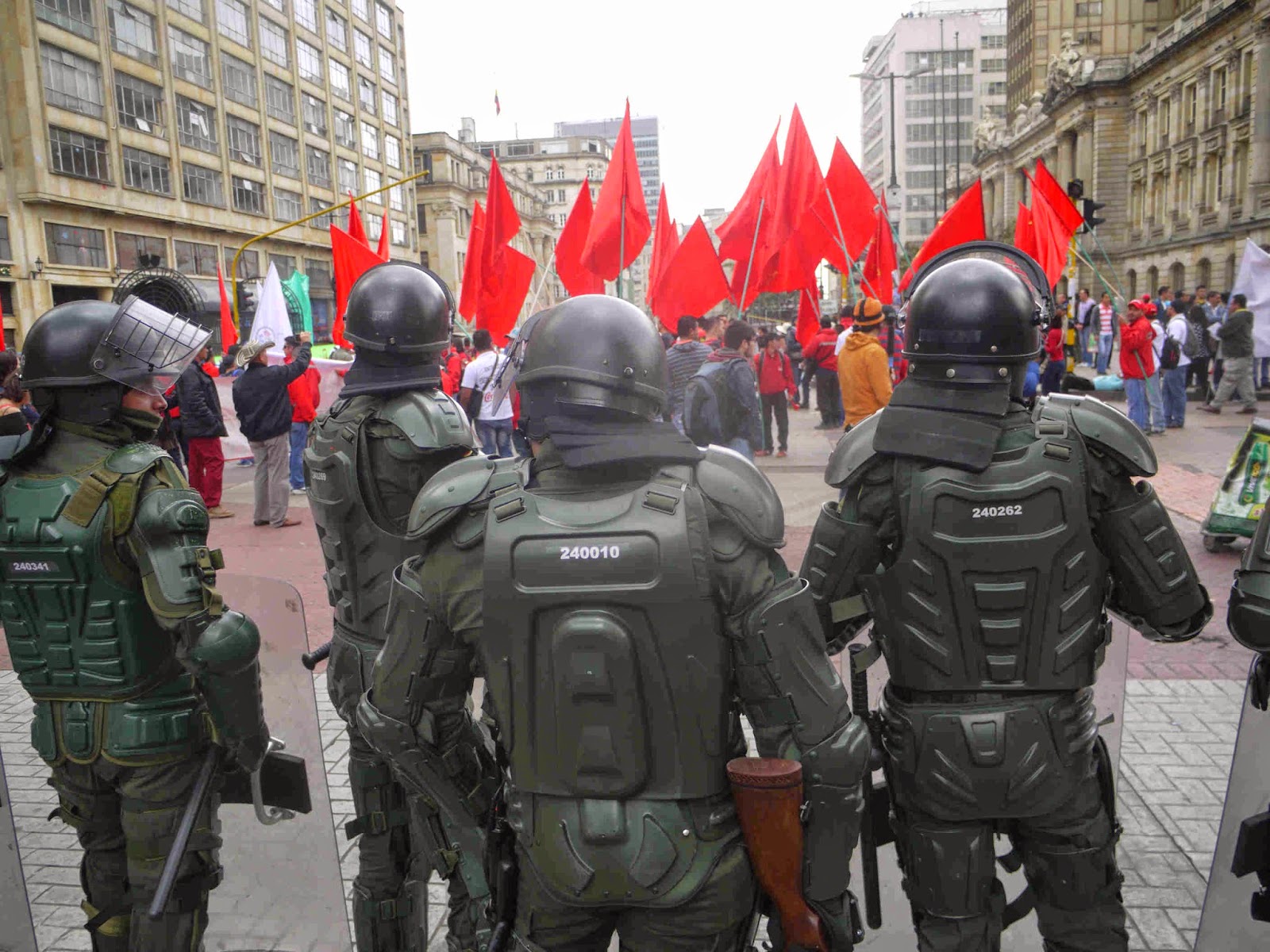
Riot police observe the march on Ave. Jimenez.
Undoubtedly, striking teachers and other workers deserve more pay, benefits and worker protections. But communism, anarchism and other radical 'isms' celebrated by marchers in today's May Day march aren't likely to help them, even if they were possible.

When Colombia's radical young activists get their feet on the ground and abandon fantastical for concrete causes, the can really improve workers' lots.
Anti-fascist skinheads march near Calle 22.

'They will not pass.' A popular communist slogan on Plaza Bolivar.

'I support my professor.' Teachers have been on strike for a week.
Simon Bolivar, on Plaza Bolivar, is recruited by feminist campaigners.


By Mike Ceaser, of Bogotá Bike Tours