Thursday, September 23, 2010

The Death of Mono Jojoy

Extra! Read all about it! Mono Jojoy is dead!

Mono Jojoy, the FARC guerrillas' second in command, was killed yesterday in a military bombardment of his jungle encampment, according to the Colombian government.

Jojoy, whose nickname refers to a kind of worm and whose real name was Jorge Briceño Suárez, will not be missed by many Colombians. He planned many of the FARC's military attacks on army posts as well as the guerrillas' strategy of using kidnapping to press for political concessions from the government.

For the guerrillas, this is yet another demoralizing blow following the deaths in recent years of Raul Reyes, Marulanda and other leaders. Likely, this will accelerate the number of guerrillas losing hope and abandoning their ranks.

Colombia's guerrillas' demise has been announced many times, and yet they continue, kidnapping, planting land mines, killing soldiers and driving civilians from their homes. Just as the 1993 death of Pablo Escobar only temporarily slowed the drug trade, Jojoy's death will not likely cause any fundamental shift in Colombia's conflict.

Mexico's drug-charged bloodbath demonstrates that ideology is no requirement for violence. And, in any case, Colombia's 'leftist' guerrillas have lost the last of their ideology, besides the rhetoric, and are little distinguishable from plain old drug traffickers and extortion gangs.

Blog written by Mike Ceaser of Bogotá Bike Tours


Tuesday, September 21, 2010

Drug Legalization's Downside?

News stories that use of illegal drugs is up in the US are worrying, as are the suggestions of a cause-and-effect link to more permissive marijuana laws in many U.S. states.

Back in the days when I was a California high school student 'Colombian gold' was the gold standard of pot. Today, California produces far more marijuana than Colombia does. But anything concerning the impacts of drug legalization is important to Colombia.

Legalizing cocaine and heroin would certainly reduce violence in Colombia, Mexico, the U.S. and other nations by taking a huge amount of income from illegal groups and reducing their incentive to fight against each other and state authorities. Corruption would also decline, and innumerable lives would escape destruction by either these outlaw groups or the law enforcement system.

Those are a few of the positives of decriminalization.

But, wherever those drugs labeled 'illegal' fall on the spectrum of addictiveness and destructiveness to mind and body, they indisputably damage many lives. So, any policy which increases drug consumption - whether legal or illegal - should concern us.

However, experiences in countries such as Holland and Portugal, where drugs have been decriminalized in various numbers and degrees, have suggested that such policies DO NOT increase use.

The jury's still out - keep watching the news.

Blog by Mike Ceaser, of Bogota Bike Tours

Sunday, September 19, 2010

Bogotá, how are we doing?


Bogotá Como Vamos does an important service by providing solid numbers about important issues such as pollution, traffic congestion, cost of living, recreation areas and other things which strongly affect quality of life. On their website, I just discovered the shocking information that Bogotá's diesel vehicles apparently are not required to use filters - or at least that no legal standards control such filters.

Recently, the city government issued a study evaluating Bogotá's competitiveness and quality of life. One thing which really struck me about the latest report, as published in El Tiempo, was Bogotá's low ranking on parks area per inhabitant. The creation of new public parks has been a major goal of recent mayors, and evidently it is needed, since even now Bogotá ranks below even cities like Hong Kong and Singapore which are not known as terribly green.

Filter anybody?
Another worrying factor is the city's high pollution. In particles smaller than 10 microns in diameter, Bogotá's air has a concentration almost three times that of London. Perhaps some diesel filters would help. Or phasing out old vehicles. Or prohibiting the burning of coal - that's right, coal -
in urban factories.

Similarly, only 28 % of the city's sewage is treated, as anybody who's smelled the Bogotá River has noticed. We've heard many promises from environmental authorities about cleaning up the water, but little progress.

The survey also found low educational levels - not surprising for a developing world city. Even more dramatic, I suspect, would be the percentage of people with higher educations who are toiling away in sales jobs, driving taxis or selling trinkets on the street.

At least one statistic suggests Bogotá still has time to save itself from one of the worst ills of urban life. Of the cities surveyed, Bogotá had the highest proportion of users of public transit. That means potential for long-term transit sustainability. But, with 100,000 new cars entering the city annually, and the rate likely to accelerate, Bogotá appears headed toward suffocation by car fumes unless city policies take this seriously soon.

See a Feb. 2011 scorecard here.

Bogotá, how are we doing of May, 2011 entry

Blog by Mike Ceaser of Bogota Bike Tours

Wednesday, September 15, 2010

Uribe in Georgetown


Colombian ex-Pres. Alvaro Uribe is now teaching in Georgetown University, and, predictably, students are protesting.

To the protesters, Uribe is little better than a mass-murderer. And they certainly have plenty of evidence to support their arguments: Uribe's apparent links to the mass-murdering paramilitaries; the thousand deaths of the false positives scandal, the chuzadas scandal, the rise in the numbers of displaced people...and on and on.

Yet, for many observers Uribe was a paragon of liberal democracy, who returned the rule of law to his country, generally tolerated criticism from the media, oversaw a growing economy and stepped down when the court ruled he should.

What will be history's verdict on Pres. Uribe? I suspect that it won't depend so much on Uribe, but rather on Colombia's future. If Colombia's economy continues growing, if the country becomes more stable and the guerrillas explode again - then historians will call him the president who put the country on track. But if these trends reverse themselves, then I think he'll be remembered as another deeply flawed president who ruled over a corrupt, violent, drug-ridden nation.

Those who are succesful write history in their manner.


Monday, September 13, 2010

Saying 'Colombia' in Mexican

Mexico...but it could be Colombia a decade ago.
U.S. Secretary of State Hillary Clinton made an awkward statement the other day - suggesting that the violence in Mexico today resembles the insurgencies in Colombia at the height of their violence.

That comment offended lots of officials in Mexico, who argue that they've got the situation under control. In Colombia, at their peak, leftist guerrillas controlled nearly half of the country and had the capital under siege.

In Mexico, the drug-trafficking cartels lack the political agenda which the Colombian groups had, and claim to still have. However, it's certainly arguable that Mexico's level of violence, corruption and mayhem resembles that in Colombia during the era of Pablo Escobar.

The 'insurgency' debate is a side issue. The terrible reality is that, seemingly, Colombia's drug-fueled violence has shifted north to Mexico. An aggressive U.S.-financed crackdown on cocal leaf cultivation here in Colombia appears to have pushed coca leaf south, to Peru and Bolivia. Many people compare the phenomenon to a balloon, which you push in in one spot and bulges out in another. Similarly, perhaps, the violence has been shifted north.

Mexican ex-President Vicente Fox, a conservative who was a friend of George Bush, recently restates his opinion that drugs should be legalized, in order to take the profits away from the outlaw groups.

Maybe it's worth a try. The alternative isn't going so great.

Written by Mike Ceaser, of Bogota Bike Tours

Saturday, September 11, 2010

Bogotá's Battle Over Public Space


Vendors lined up on the Plaza San Victorino
In Bogota, like most of the developing world, public spaces serve as stages for much of life. Evangelizers yell at crowds on streetcorners. Singers croon salsa and cumbias for a few coins. Vendors yell out their offerings of drinks, candies, fruits and clothing. Nostrum hawkers and practicioners of black magic lecture believers. Young men play soccer. And couples walk hand in hand.


In recent years, Bogotá's mayors have made improving public spaces a central part of city policy. They've created new parks, cleaned up plazas and improved sidewalks and ornamentation along the newly built Transmilenio lines.

Move on, move on.

But keeping public spaces open to the public is a perpetual battle between the forces of law and those of poverty, apathy and corruption. For the poor - particularly Colombia's millions of internally displaced people, who have nothing - the city's sidewalks, parks and plazas are rent-free sales areas. In some areas, thru either sympathy or corruption, the police seem to leave vendors alone. In others, such as the Plaza San Victorino, police do periodic sweeps, or 'operativos,' in which they drive the vendors away from the plaza's center. The vendors know this is coming, and so they spread out their toys, clothes, shoes or other wares on a plastic sheet or blanket. When the police appear, the vendor pulls together the blanket's four corners, turning it into a sack, in which he carries away his wares.


Away you go!

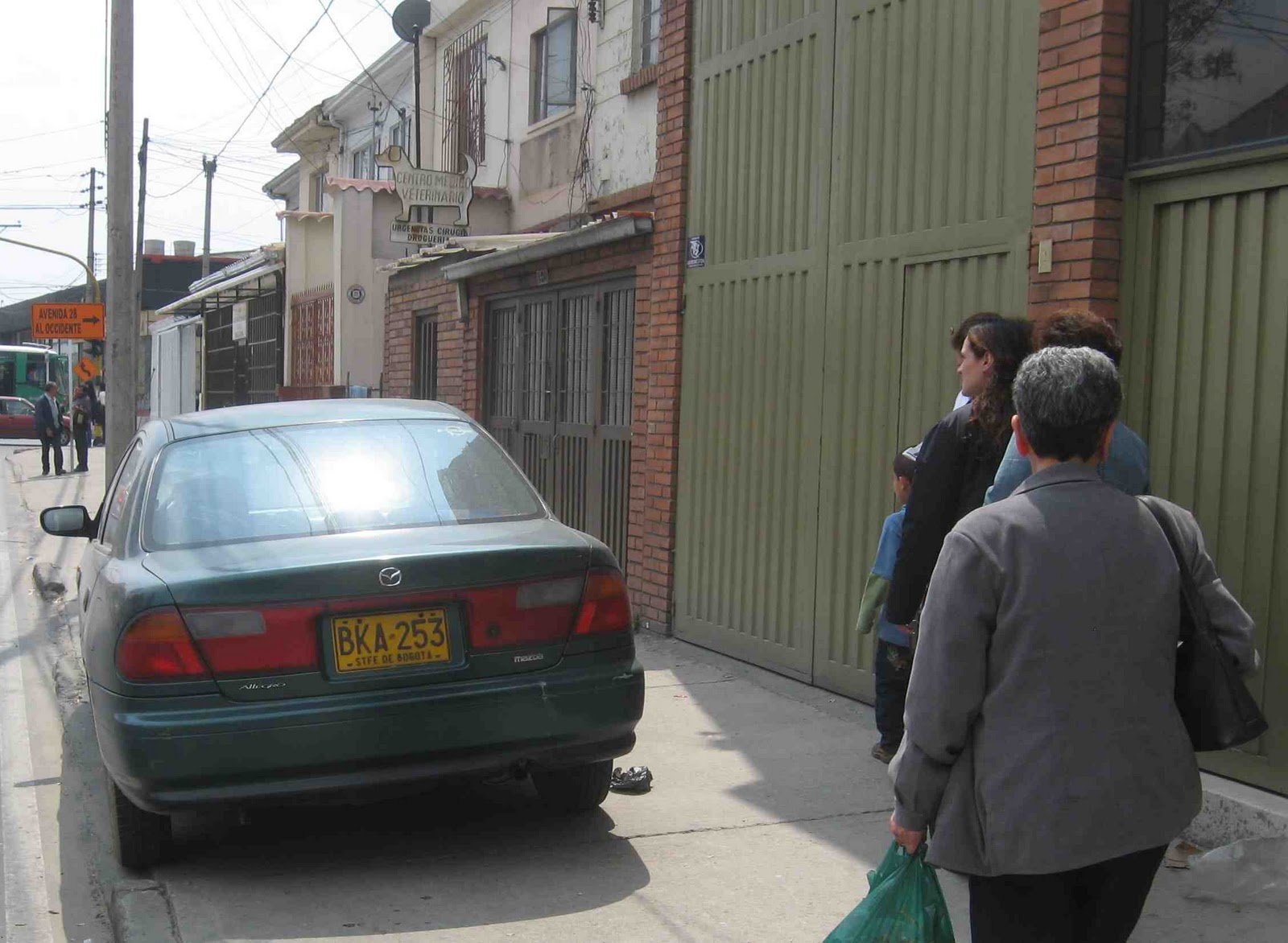
Unfortunately, however, the city's offensive against public space invaders appears to be directed primarily against the poor. The middle class and wealthy park their cars on sidewalks all over the city with no fear of tickets or towing.

But here's a good use of public space.


This blog written by Mike Ceaser, of Bogotá Bike Tours

Tuesday, September 7, 2010

A Tale of Two Drug Sellers

Leo Siegfried Kopp was a Jewish-German immigrant who founded Bogotá's Bavaria Beer Company in 1889. Pablo Escobar was a cocaine king who became one of the world's richest men.

Escobar, dead on a Medellin rooftop.
What did these men have in common (besides being Colombian)? And what are they doing sharing a blog entry?

Well, both ran businesses which produced and sold addictive drugs: Kopp sold beer; Escobar, infamously, created a cocaine empire. And, both are remembered, among other things, for being generous to their workers.

Kopp helped his employees get potable water and other services in their Bogotá neighborhood, La Perseverancia.

Kopp's tomb and statue, decorated with believers' flowers.
For his part, Escobar was famous for having built whole neighborhoods for Medellin's poor, for electrifying poor parts of the city and for building homes and soccer fields. Residents of towns near his Hacienda Napoles ranch still recall how Escobar used to send a truck filled with Christmas gifts for local children.

The difference was in their other business methods: Whereas Escobar placed car bombs, tortured and kidnapped in order to sell his mind-altering substances, there's no record of Kopp killing anybody - deliberately, anyway.

Today, the memory of Escobar continues scarring Colombia's image, whereas Kopp is a popular saint - believers sometimes line up a dozen deep to ask for favors from the statue on his tomb in Bogotá's Central Cemetery.

What's the difference? Was Escobar inherently evil and Kopp good?

Certainly, a guy like Escobar, who started out in petty crime, probably looked for a source of fast, easy money. So, if the illegal cocaine trade hadn't existed he very possibly would have gotten into some other outlaw trade, such as arms smuggling or human trafficking. But, then he would have killed fewer people and caused less mayhem, since those industries were much smaller (and would have been smaller still in the absence of an illegal cocaine trade).

And what if cocaine had been legal and Escobar had trafficked it anyway? Very likely, he would not have been a kind and gentle businessman. But it's hard to imagine him having car bombed, kidnapped and tortured. After all, what other dealer in a legal, if damaging, product does?

It's just worth thinking about: Two Colombians, both marketers of addictive drugs. But one remembered as a saint, the other a monster. The main difference between them? One product was legal, the other illegal.

This blog written by Mike Ceaser, of Bogota Bike Tours