Wednesday, August 8, 2012

The Oncoming Auto Avalanche!

A recent advertorial in El Tiempo boasts that some new luxury apartment buildings have ten parking spaces per apartment. Car elevators coming next?
This sentence in a flattering El Tiempo advertorial article about Bogotá's most expensive neighborhoods jarred me worse than lots of horrific crime stories:

Congested Carrera 30 this afternoon. 
Some new apartment buildings, the newspaper proudly points out, "include as many as ten parking spots per apartment."

Ten cars per apartment? In the auto-adiccted United States, the average family has only about three cars. Of course, these people are Colombia's one percenters, who possess everything short of Mitt Romney's underground car elevator. Still, for every family with ten cars, there are probably a half dozen with five and 50 with two automobiles.

Already traffic-strangled Bogotá just can't take it! And the city's got to take real measures.

No building your way out of a jam: El Tiempo reports
that an expensive new overpass hasn't relieved
traffic congestion. 
'Share your car.'
But give me an incentive to do it.
Pointless billboards like this one only make me feel more frustrated. Car-pooling is a good idea, but won't work without real economic and congestion-driven incentives to car-pool. Bogotá is seen as progressive thanks to its bike lanes and express bus network. But how about simple, old-fashioned policies like car pool lanes? Or a city-wide website to facilitate car-pooling, like this one for those commuting to La Universidad de los Andes?

Not in Bogotá: A car-pool lane in
the Washington, D.C. region.

By Mike Ceaser, of Bogotá Bike Tours

Tuesday, August 7, 2012

Free Drugs for Addicts?

Jeyson and Carlos, on Martyrs Plaza, said they've
been using bazuco and living on the street
for about six years.
Mayor Gustavo Petro's idea of creating centers where drug addicts would receive replacement drugs has generated lots of criticism, perhaps a reflection of Bogotanos' fundamental conservatism.

But the idea of such locations, where addicts can find what they crave in a healthier environment, as well as recieve other kinds of support, is used in Canada, Denmark, Switzerland and other places, and presumably works, since they've continued the policy.

Andres says addicts should
have to work for their fix.
And why not try it? After all, the situation could hardly be much worse, with drug addicts wandering many streets and plazas begging for coins and occasionally stealing to get that next fix. If you pass thru certain neighborhoods, then you've had to walk around homeless people sleeping it off on the sidewalk, and sometimes even defecating and urinating in public. It's unpleasant for passers-by and certainly miserable for the homeless, who may live in filth, cold and the rain and feel enslaved by their addictions.

I talked to Andres, an acquaintance who lives in La Candelaria and said he consumes marijuana and bazuco, a cheap and poisonous form of cocaine "but much less than I used to."

Addicts wander near El Bronx.

Andres opined that support centers could improve the lives of addicts and also reduce crime. He suggested that addicts should have to contribute something in return for recieving their fix - such as cleaning up the street.

"If they know that 'I'll sweep these two blocks and then get my vice,' then they'll be less likely to steal," Andres predicted.
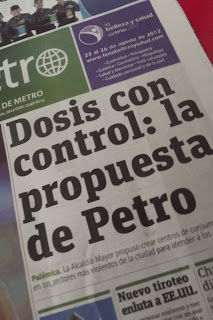
'Drug Doses With Control.'
The mayor suggested that one of the support centers could be placed near Martyrs Plaza and El Bronx, an area of addicts and human wastes. A police officer there was dubious about the idea.

If they receive free drugs, "the addicts will just sink deeper," he said.

But he agreed that if the program were combined with rehabilitation, it could be positive.

A homeless man smokes something
in the Santa Fe neighborhood.
The officer also warned about such support centers' impacts on neighbors. However, it's hard to imagine anything worse than the situation which already exists on and around Martyrs Plaza, one of the country's most important historical sites, where drug addicts and drug addled people wander day and night. Support centers could provide, in addition to cleaner drugs, needle exchanges, bathrooms, nurses and perhaps even psychologists. The policy would cost money, but could ultimately save money in improved public health, lower crime and a generally saner city.

The mayor's idea and the reactions to it are also indicative of Colombia's contradictory, even schizoid drug policies. While I talked to the officer, a few feet away other cops frisked young men for drugs - even tho the Supreme Court recently ruled that carrying and using a 'personal drug dosis' was a constitutional right, and even Pres. Santos has said that drug decriminalization is worth considering. But, to my question, the officer replied that the police did not recognize any such right. Yet, a few blocks away at a hip hop concert in Tercer Milenio Park young people were openly smoking pot.


Alcoholics drinking on San Victorino Plaza. The couple kissing alongside aren't paying attention. 

Homeless men sift thru trash on Calle 13. Most homeless people seem to be addicted to bazuco.

Sleeping it off on San Victorino Plaza. 

Men bathe in the Eje Ambiental's pools in La Candelaria. 
By Mike Ceaser, of Bogotá Bike Tours

Monday, August 6, 2012

Garzon Should Say Good-Bye

Vice Pres. Garzon.
Capable of the top job?
Quick - name Colombia's vice president!

You probably couldn't have named Angelino Garzon, who had been mostly invisible until he suffered a serious stroke two months ago.

Garzon, who made his career as a labor union leader and minister of labor, was probably chosen more to balance the ticket with Pres. Santos, who had been minister of defense, than for Garzon's executive ability if something happened to Santos.

And Garzon, who is 65, didn't start out well. Only days after taking office he had to undergo heart surgery. Then came the stroke. Pres. Santos says that Garzon is recovering fast from the problem, but a stroke is a stroke. And, Garzon's strange, slurred speech during a radio interview this morning showed that he's far from completely recovered.

The vice president may be nearly invisible in ordinary times, but if something were to happen to the president he would be suddenly thrust into the top job, with all of its pressures and responsibilities, and in a time of crisis. And Garzon, with his past and current medical problems, clearly isn't in shape for the task.

Garzon's recent reported comments backing a Constitutional Assembly, which President Santos opposes, only make the situation more complex.

Garzon should step gracefully aside and let the president appoint someone capable of doing the job, if, God forbid, that became necessary. And, if Garzon won't go willingly, then the president should firmly push him, for the best interests of the country.

By Mike Ceaser, of Bogotá Bike Tours

Sunday, August 5, 2012

Colombian History on Paper


The Candelaria's Luis Angel Arango Library, or BLAA, is holding this exhibit about Colombian newspapers' history, which the creators number at the good round number of 223 years.

Colombia, of course, has had a very eventful history, which has been reflected in its newspapers. And the newspapers themselves have been part of that history, for example with the assassination of El Espectador publisher Guillermo Cano (as well as killings and attacks on many others) and the car bombing of the newspaper's printing plant, both planned by Pablo Escobar. For their part, the media-savvy M-19 'invaded' sympathetic newspapers, to give them a justification for publishing the guerrillas' propaganda. Less dramatically, many journalists from all types of media have been forced into silence or exile by threats. 
The Avianca building in flames in 1973.
Perhaps paradoxically, and in contrast to the newspaper industry in developed nations, Colombia's dailies are healthy. Despite Bogotá's high poverty rate and illiteracy problem, the city has a half dozen dailies, ranging from El Tiempo and El Espectador, to sports sheets and sensationalist tabloids given to featuring gruesome crimes and naked women. Newspapers continue to thrive here thanks in part to the nation's strong economy and to low Internet penetration - altho that will inevitably change - and to the fact that the country's two richest families now own the capital's two leading papers.

For all of their weaknesses and errors, newspapers have played a vital role in informing the public and exposing corruption and misdeeds, and lets hope that they can continue doing, whether on paper or in cyberspace.

Crowds pay homage to politician Jorge Eliecer Gaitan after his 1948 assassination. 


A sharp commentary: Uncle Sam stabs
Colombia in the back by stealing Panama. 


Novelist Gabriel Garcia Marquez's Nobel Prize award in 1982.


One of Bogotá's first papers, circulated after the 1785 earthquake. 

To Arms! War with Peru in 1932! (Colombia's one and only foreign war, not counting independence.

Crusading El Espectador publisher Guillermo Cano is assassinated by Pablo Escobar.


A paper reports on the M-19's 1980 takeover of the Dominican Republic's embassy. 

A photo of Bogotá mayor and ex-M-19 guerrilla leader Gustavo Petro. In the background is the old Justice Palace, which the M-19 attacked, disastrously, in 1985.


By Mike Ceaser, of Bogotá Bike Tours

Saturday, August 4, 2012

What To Think

'What you must think.' These posters have appeared on walls around La Candelaria and other parts of Bogotá.

El Parqueadero, an underground section of the Museo de Arte complex in La Candelaria, held a bunch of exhibitions this evening about what you should think, more or less.

These posters, by an arts group, satirize the recently-introduced section titles in El Tiempo, Colombia's leading newspaper: 'Debes Leer,' 'Debes Saber,' 'Debes Hacer,' etc. Certainly pretty self-assuming - but do they reflect or lead to a general lack of thinking for ones-self?

On the other hand, can public exhibits, like this one by an arts group called Acciones Directas, really prompt people to think for themselves? I haven't seen many signs of it.

But most of the other exhibits had even less of a concrete message.


Brushing classes. 

Dining as performance. 

Gaitan looks back from 1,000 peso bill.

Bad portraits for 1,000 pesos. 


'Dream, Dance, Eat' - Maybe that's life. 
This exhibit's message was much clearer. 


As is this one, critical of genetically modified organisms. But if you really think about it, millions of us have grown up eating GMOs, with no apparent ill effects. 


By Mike Ceaser, of Bogotá Bike Tours

Bogotá's Newest Beach


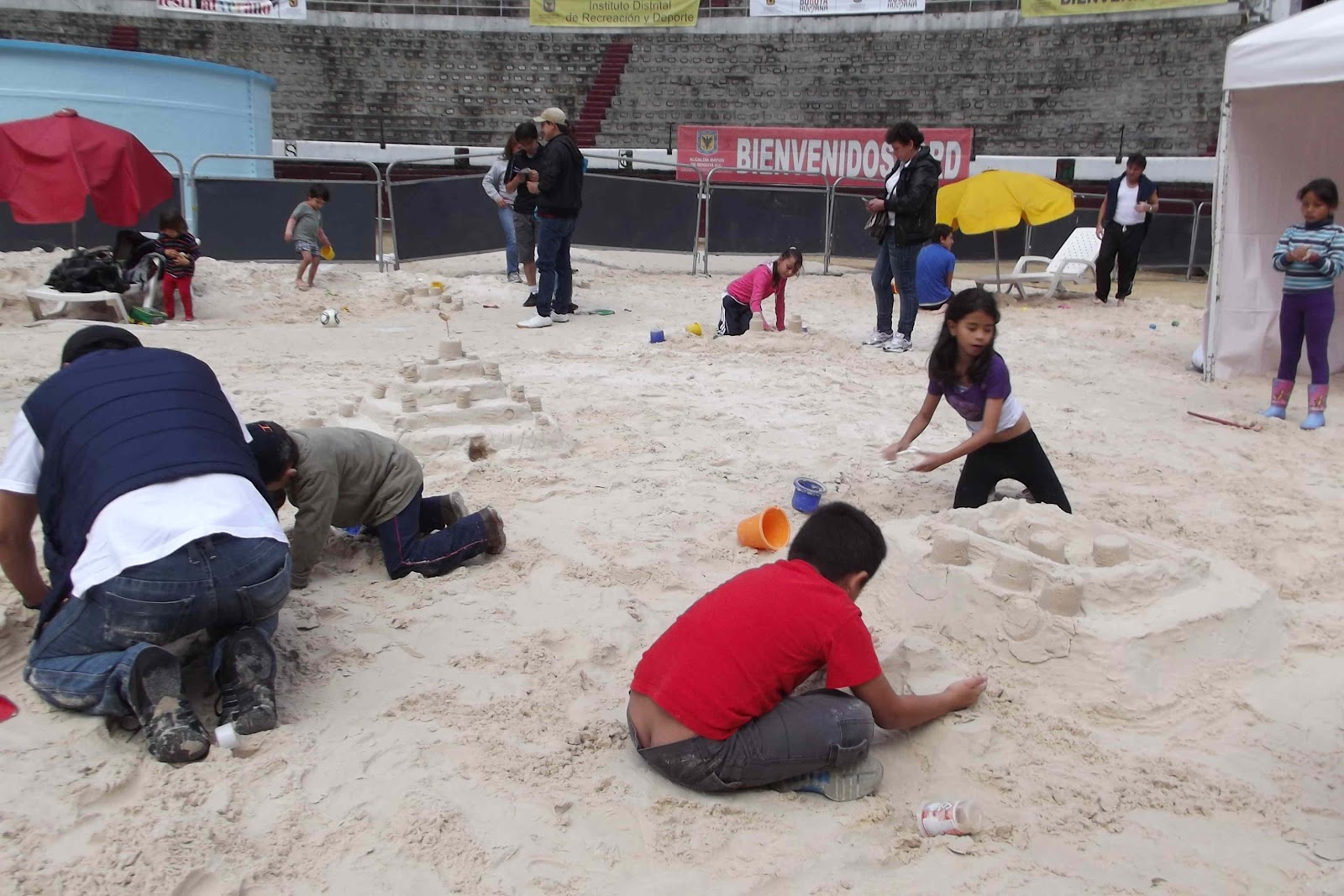
Bogotá's got a new beach! For the annual Festival del Verano (Summer Festival), they've built a beach in the Plaza de Toros - where in normal years amateur bullfighters would be facing off against angry bulls about this time. A beach isn't a beach without water, of course, so the bullfighting stadium also has a small swimming pool. 

Bogotá's only other beach is in Simon Bolivar Park. 


By Mike Ceaser, of Bogotá Bike Tours

Wednesday, August 1, 2012

Soldiers on the Streets

Soldiers on a streetcorner on Ave. Septima in downtown Bogota. 
The sudden appearance of soldiers on Bogotá's streets has disturbed many Bogotanos, including Mayor Gustavo Petro, who asserted that that's the job for police, not the military. 

Soldiers have long been a common sight around government buildings, often toting M-16s or Galil rifles. And I often meet army units marching thru central Bogotá, combining patrolling and do training marches - during which they carry out stop-and-searches, as I can attest from personal experience. But the soldiers-as-cops is a new thing. Crime is a big concern here, and Bogotanos, used to stern police tactics, don't seem overly concerned about the soldiers. But one has to wonder how effective an automatic rifle would be against a pickpocket.

Police frisk two young men on Carrera 10, in central Bogotá.
But Bogotá could make its police force much more effective by requiring cops to actively patrol, instead of standing around catching up on each other's personal news. 

Police in deep conversation on a street in the Santa Fe neighborhood. 


By Mike Ceaser, of Bogotá Bike Tours