Homeless men sleep in the one of the Eje Ambiental's dry pools.
The Eje Ambiental was a pride of Bogotá. Built by Mayor Enrique Peñalosa and designed by Rogelio Salmona, Colombia's most famous architect, the eje is a tree-lined avenue with reflective pools in its middle which passes near many of the city's most important monuments and historical sites, including the Quinta de Bolivar, the Plaza del Periodista, San Francisco Church and the spot where politician Jorge Eliecer Gaitan was assassinated.
Paper, plastic and cigarrettes float in
the 'Environmental Axis' waters.
The Eje, completed in 2001 and named after Bogotá found Jimenez de Casada, was intended to be part of the renaissance and beautification of central Bogotá. And, to a great degree it was. The avenue is popular among walkers and cyclists, who can pass by the Candelaria neighborhood, the Universidad de los Andes, the historic San Francisco and Las Aguas churches and the Quinta de Bolivar, a colonial home where revolutionary leader Simon Bolívar lived for several years. The avenue also leads to el Cerro de Monserrate.
Putting the waters to use. A homeless man washes himself in
one of the Eje's stagnant pools.
City workers periodically drain the avenue's pools, which represent the Rio San Francisco, which is now interred in pipes undergound, to clean them. But in recent weeks, they've left them dry. As a result, those pretty pools have turned into trash bins and dormitories and outdoor toilets for the homeless. Other pools, whose water is stagnant, float with cigarettes and discarded paper.
Still nice - the Eje's upper reaches still flow.
Negligence has turned a piece of Bogotá's pride into an eyesore - incomprehensibly, just when Bogotá's trying to show itself off to visitors for the Under-20 FIFA World Cup.
At the top of the Eje Ambiental is La Quinta de Bolívar,
once occupied by El Libertador.
Behind La Quinta is this trash-filled lot, which could be turned into a beautiful approach to Monserrate.
The final candidates for Bogotá mayor have filed their candidacies - and made promises that only their mothers could believe.
Dionisio Araujo, conservative candidate,
promises to get things moving.
Dionisio Araujo, the ex-president of the National Federation of Retailers, looks like the champion of promises. To eliminate traffic congestion, he promises to build urban freeways, eliminate intersections and traffic lights by building overpasses, and suspend the 'pico y placa' driving restrictions. Meanwhile, Araujo also intends to build a metro system.
To see how likely all those achievements are, just look at the success of current (suspended) Mayor Samuel Moreno, who got elected using similar wonderous promises. Instead, the only major project he's launched, building two new Transmilenio lines, is way over budget and behind schedule and has mayor's brother in prison and the mayor suspended from office and headed toward trial on corruption charges.
But Araujo will somehow whip the contractors into hyper-efficiency, eliminate corruption and manage to contract based on ability, rather than buddiness - despite the fact that he comes from the business world. Most fundamentally, Araujo will eliminate the law of traffic supply, demonstrated all over the world, according to which expanding road space only lures more cars onto the roads - quickly making traffic congestion as bad as ever.
At the same time, Araujo says he'll make the unpopular 'pico y placa' law 'history.' Pico y Placa has clearly failed, as the city's terrible traffic jams prove. Bogotá's car-owning middle and upper classes will love that promise - until they see the results: terrible traffic jams replaced by horrific ones. Unfortunately, the truly effective alternative to Pico y Placa, a London-style congestion charge, is even more unpopular politically.
For his part, Antanas Mockus, who's already been mayor twice, promises that education will reduce crime, traffic jams and corruption. Mockus may very well win, as he's remembered positively for his campaigns to improve city spirit. But I really doubt whether street mimes and TV commercials, which he used in his previous terms, will make Bogotanos clean up their bad habits. If sitting in traffic jams can't teach people that cars cause congestion, then I'm not sure that Mockus can either.
Bogotá traffic jam: Educated away?
On specific, gritty issues such as the proposed subway system and what to do about Seventh Ave., Mockus won't tell us, but promises to study them. It's always reassuring to know a leader's got a plan.
Ex-Mayor Jaime Castro
And Jaime Castro, another ex-mayor who just filed his candidacy (for the Indigenous Authorities of Colombia party, despite looking very white himself), promises to "save the city from the grave and profound crisis it's in" by, among other things, building not just an urban metro system, but a regional one. Perhaps Castro could look at Medellin, which in three decades has built only two urban subway lines.
Bogotá's dressed up for the Under-20 FIFA World Cup, taking place now until August 20th. The cup's also spawned lots of merchandising on the city's streets. Here are a few scenes:
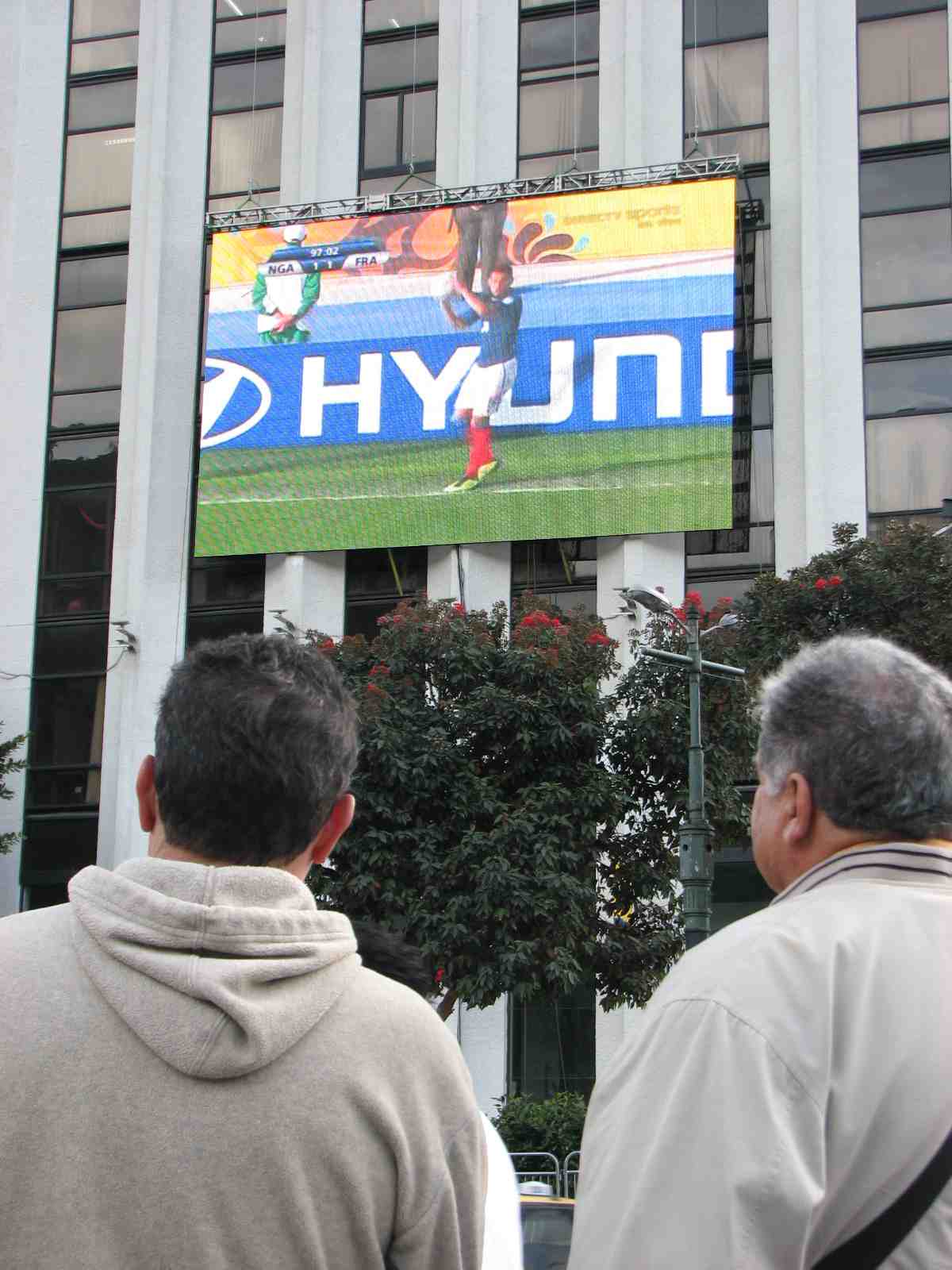
Watching a game on the side of the Colpatria Tower.
Buy my birds!
Buy my stuff!
Flags for sale on Seventh Ave.
Let Direct TV bring you the cup.
The red light district has also gotten into the act, including the La Piscina brothel.
Another brothel shows its support - or tries to attract international customers.
A huge screen on the side of La Torre Colpatria broadcasts the games.
Mockus has already been mayor of Bogotá twice before, from 1995-8 and 2001-3, and previously rector of the National University, Colombia's largest public university.
Mockus will be a strong candidate, because he's very well known here and has a positive, clean image. In his previous mayorships he did lots to expand public services and improve public spirit, for instance hiring hundreds of mimes to encourage drivers to respect traffic laws.
Mockus has run for president three times, the last in 2010, when he was the Green Party candidate and got plastered by conservative Juan Manuel Santos. Colombians supported Santos, who had been defense minister, in great part because they sought a strong hand to battle leftist guerrillas. Mockus, in contrast, was seen as a sort of eccentric intellectual. That's understandable: the man got married on an elephant in a circus and first caught the public eye by mooning an audience while university rector. Many Bogotanos may also question Mockus's dedication to the city - he left both mayorships early, the first time to run for president and the second to take a year's speaking sabbatical.
As presidential candidate, Mockus was also vague about his goals, promising mostly 'change.' Hopefully, as mayoral candidate, he'll tell us his positions on specifics such as the city's transit mess, crime and other issues.
But Bogotanos might just go for a man they hope will raise the spirit of a city in something of a malaise due to high crime rates, a corruption scandal involving the current mayor, and seemingly interminable public works projects.
Enrique Peñalosa, leading the race.
On the other hand, voters may still look for a strong hand, such as Enrique Peñalosa, who was mayor from 1998 to 2001 and is known for creating the city's express bus system, called Transmilenio.
Because Mockus helped found the Partido Verde (the Green Party), he's likely to take votes from Peñalosa, the Partido Verde's candidate, as well as from Polo Democratico candidate Gustavo Petro, since Mockus, like Petro, appeals to young idealists.
An August 1 poll by CM& Television put Peñalosa in the lead with 29% and Petro second with 20%. But a Mockus candidacy would garner 13% support, according to the poll, taking 4% percentage points from each of the leaders. Mockus' candidacy probably ends any possibility for a victory by Petro, who depended on cornering the leftist vote, while center voters splintered their support. The other three candidates are young and less well known, likely making this a two-man race between Mockus and Peñalosa.
Mockus' candidacy, incidentally, also shows the arbitrariness of Colombia's political party labels. Mockus is going to run as candidate of the Independent Social Alliance party, which until recently was called the Indigenous Social Alliance. Mockus is the son of immigrants from Lithuania. For his part, Peñalosa's Green Party doesn't have many environmental planks in its platform and is allied with conservative Pres. Juan Manuel Santos and ex-Pres. Alvaro Uribe.
I hope Peñalosa wins, to put the city in order on issues like transit, public space and rational growth policies. But my money's on Mockus, because of his charisma and positive image.
Mockus may also get the sympathy vote: he's been diagnosed with Parkinson's Disease, altho doctors say it won't affect his intellectual ability for years yet. Still, his political career is limited.
One year into his presidency, Juan Manuel Santos is enjoying great success: a strong economy, a clean, corruption-fighter image and warm relations with Colombia's leftist neighbors.
Perhaps it's no surprise, then, that his popularity is over 70%.
Probably the most dramatic change brought by Santos has been the change in relations with Ecuador and Venezuela, which were mutually antagonistic during the last years of Pres. Alvaro Uribe's administration. In contrast, Santos has called Venezuela's socialist Pres. Hugo Chavez 'my best friend.' Trade between the neighbors has grown. Unemployment has dropped to a still-high 11% and pollution is under control. The economy is growing at about 5%. That's not all due to Santos (almost all of the continent is booming), but at least he hasn't interfered with the growth.
Santos has also won support thru his backing of policies for victims of violence and anti-corruption efforts (which have produced tensions with Uribe, under whom Santos was defense minister). Under Santos, the army also killed FARC military commander Mono Jojoy, altho that hasn't produced any major shift in the conflict.
But Colombia's fundamental troubles remain: the economy still depends dangerously on raw material exports, the drug trade, with all of its corrosive impacts, continues. And the drug-fueled conflict with the leftist guerrillas continues, and violence has even surged during recent weeks. Nor has Santos taken the lead in advocating a shift in drug policy, which could do much to reduce Colombia's problems.
A graffiti, which originally said 'Neither God nor Saints' on a church wall in La Candelaria.
Santos, whose last name means 'Saints' and who comes from one of Colombia's most powerful families: three previous men with the 'Santos' surname have held Colombia's presidency, as did the previous administration's vice president, altho I'm not sure all of them were of the same family. And the Santos family is the traditional owner of the El Tiempo newspaper, which this weekend published several flattering reports about his first year in office.
They spend their free time in an empty stadium, one pushing a cart with bullhorns on it towards a companion wielding a red flag, in front of imaginary crowds.
One day, they hope to fight real bulls.
One day, they dream, the bulls will be real and the seats will be full. But theirs is no easy ambition. Their passion, bullfighting, looks to be in decline, and to many people is a holdover from the age of barbarism and gladiators.
Bu they persevere, out of love for their sport.
"One wants to continue the tradition," says Hernando, 17, whose uncle, father and grandfather are all bullfighters and who has dreamed of being little else.
"My mother says 'no.' She suffers a lot, fearing a goring," he said. "But my father says 'keep at it.'"
He and his friends are the young, aspiring bullfighters of Bogotá's Plaza Santamaria. They have not fought professionally, and only a few of them will fight in this year's amateur bullfighting season, held the first two weekends of August.
Why would a young man devote himself to an activity which many call barbaric, which brings him accusations of 'killer,' which is perhaps in terminal decline and which might very well get him severely injured or killed?
Heernando began practicing bullfighting at age seven - and still carries the scar on his leg from a goring a cow gave him at that age. Ten years of training later, he's still waiting for his opportunity to fight in La Santamaria, Colombia's and South America's premier bullfighting arena. He is waiting, he explains, until his father says he's ready. A bad first performance could permanently damage his bullfighting career.
The young men training to become bullfighters comprise a tight fraternity. There are only about ten of them in Bogota, guys who train every morning, who want to fight bulls, rather than boast of the glamor of 'being bullfighters.'
In a profession - the young toreros themselves differ on whether it is a sport or an art - in which the stars, such as El Juli, Jose Tomás and Pablo Hermoso, tower larger than life, the aspiring bullfighters speak of such men with awe. Those are men whose names can fill a stadium with tens of thousands of fans. They are men who can choose the bulls they will fight and make those animals dance and swerve with a precision of centimeters. And they are men who, above all, stand still in the face of raging bulls - sometimes to the extreme.
Yet, the biographies of the bullfighters' idols can read like emergency room logs. Famed Colombian bullfighter Pepy Caceres died at age 53 after being gored in the ring. Cesar Rincon, Colombia's most famous recent bullfighter and an idol to many aspiring toreros, got hepatitis from the transfusion he received after one goring. Jose Tomás, probably the world's most famous living bullfighter, almost died last year after being gored in Mexico. After 16 months of recovery, Tomás recently fought again - and landed back in the hospital, yet plans more fights. For the men and a few women who've already earned fame and fortune and yet return to face danger again and again, bullfighting must be more than just spectacle and violence.
Bullfighters in training start out fighting cows, which can be aggressive and dangerous enough. And many would-be bullfighters give up the first time they're thrown by an animal. But others accept such injuries as part of the profession. After all, bullfighting is metaphorical for danger. Many a bullfighter has gotten gored and returned to the ring to finish the fight.
After being gored, "one has more respect for the bull," Hernando said. "But no longer with fear."
But one of his companions disagreed: "The fear is always present," he said.
If bullfighting is violent and vicious, as its critics claim, it is far from one-sided. And, while those of us who eat meat depend on others to raise animals, often in inhumane conditions, and to kill them out of our sight, the bullfighter plays out this fundamental drama of life and death in the light of day, in front of a crowd.
For these aspiring young matadores, their profession is about much more than violence, and even transcends sport: it is art.
"It is my passion, my love," a 16-year-old aspiring bullfighter who had a long scar on his leg once told me.
And it is a difficult love, not only dangerous but also fickle. A bullfighter lives by his reputation - for bravery, for skill, for grace and subtlety. But for that he needs to face a bull which has vigor and aggression. A single disappointing appearance can so damage a young bullfighter's reputation that he will require a long time, if ever, to recover. The aspiring bullfighters also say that success requires a good manager who can get his torero a good place in an important plaza.
Anybody who stands in the path of a half-ton animal that wants to kill you and is capable of doing so, armed with only a piece of fabric (as bullfighters do during the first part of the fight) and who is not be scared, might be certifiedly insane. But showing that fear is a fatal mistake capable of destroying a fighter's reputation. And reputation can make or break a bullfighter.
Of course, it is an unequal match. The bullfighter may obtain glory, and the bull will almost certainly be killed. And the bull, naturally, has no comprehension of why these men harass, injure and kill it.
And all of this for a sport - or art - in decline. The Spanish province of Catalunia recently banned bullfighting, as has Ecuador.
The young men agree that their sport - or art - has fallen out of favor with many young people. They blame that on 'environmentalists' - their term for animal rights activists. It's a criticism they dispute. The bulls, they assert, live well until being brought out onto the arena. After all, for an exciting fight, it's important that the bull be strong and vigorous. For bullfighting, is much more than killing. It's a ritualized dance between man and beast, meant to display the man's courage and subtlety and the animal's power and aggressiveness.
And fighting bulls do roam free in the the fields, until being brought to the bullfighting ring, where the fight lasts 15 to 20 minutes. Their cousins, raised for milk or meat, usually have it much worse, packed into pens and stockades. But industrial animal-raising receives little criticism, perhaps because most people eat meat. Very occasionally, when a fighting bull is considered to have fought very courageously, it recieves an indulto or 'forgiveness' and is allowed to live. These sometimes become famous as stud bulls.
More than concern for animal rights, many of today's youth have lost interest in bullfighting in favor of sports like football and video games. Ironically, those video games often overflow with violence, while lacking bullfighting's grace and courage.
While bullfighting has seen grander days, it is far from gone. The sport's living legends can still fill stadiums with passionate fans. Perhaps that's due to our primordial fascination with the mortal clash between man and beast. In a world in which most of us spend our time fleeing danger while pursuing it in movies and virtual reality, bullfighting is one of the last pursuits where mortal danger is still real and deliberate.
"Bullfighting must survive!" asserts one aspiring torero.
But his friend sounds less sure. "One's purpose is to be the best - as long as it lasts," he says.
"My goal is Madrid: to triumph there," says Hernando.
"That's every bullfighter's dream," adds his friend.






 Posts