Friday, June 7, 2013

Bogotá's Renovated Planetarium


A starry-eyed couple at one of the planetarium museum's exhibits.
The planetarium's light show. (Photo from Unisabana)
Bogotá's recently reopened planetarium brought a pleasant surprise for me. The 44-year-old planetarium closed for three years of renovation, and it seems to have been worth it.

I didn't see the star show (the day's final projection begins, inconveniently, at 3 p.m.), but I'm sure it's nice, even with the 1968 Zeiss proyector. What impressed me was the building's new museum, which is small but manages to provides a nice interactive environment for schoolkids. You won't get new insights into the Theory of Relativity here, but for teenagers who never cared how gravity works, what goes around what in the Solar System and what a black hole is, the museum could spark curiosity and wonder. A dry, lecturing exhibit would have been a disaster.

Dressed right for a spacewalk.
With this renovation, the planetarium is finally coming into its own. During much of its history, it shared its space with various museums and before the renovation it was used for art exhibitions having nothing to do with space or astronomy. (A foreign couple I talked to were surprised to have found an exhibition featuring Marylin Monroe. At least she was a star, anyway.)

If you visit the planetarium, remember that the last group enters the space show at 3 p.m. and the last group enters the museum at 4 p.m.

A talk in the Planetarium's museum.

The planetarium is located between the Parque de la Independencia and the Plaza de Toros.

The planetarium's 1968 Zeiss projector got a technology upgrade and is still going strong. 

Schoolchildren chasing gravity. 


Bogotá's original observatory, built in 1803 and located near the Casa de Nariño. Julio Garavito, who is on the 20,000 peso bill, worked here. 

Children studying space. 

The planetarium is located in the Centro Internacional. The Hotel Tequendama is visible in the background. 


According to the planetarium's museum the famous statues of San Agustin had an astronomical element. 

The planetarium's café looks out over Parque de la Independencia. 

A statue of Copernicus in Parque de la Independencia. The bullfighting stadium is behind. 
A model of Galileo's telescope. Copernicus put the sun in the middle of the Solar System, but history's given Galileo the credit.

Soldiers march past Bogotá's historic space observatory, where astronomer Julio Garavito worked.

The tomb of Colombian astronomer Julio Garavito in Bogotá's Central Cemetery. Garavito is on the 20,000 bill, and some people believe that rubbing the bill against the tomb brings luck and fortune.


By Mike Ceaser, of Bogotá Bike Tours

Thursday, June 6, 2013

The Shoemakers' Protest

'No more Chinese shoes,' marchers demand.
A cross on Plaza
Bolivar blames
contraband shoes..
Shoemakers marched down Ave. Septima today to protest against the importing of cheap Chinese-made shoes.

Many of Bogotá's shoemakers, concentrated in the low-income Restrepo neighborhood, are unsophisticated people with home workshops, who evidently can't compete with large scale Chinese factories - even tho the Chinese have to ship their shoes halfway across the globe.

It sure seems like a bad deal for Colombia to put a lot of skilled craftspeople out of work just to have slightly-cheaper shoes. And, without good jobs, who'll buy those shoes, anyway?

But the solution isn't subsidies, as the government has doled out to potato, coffee and other farmers. That's an unsustainable solution. Instead, perhaps they could provide these people training and business advice, tax incentives and other assistance.

A requiem for the Restrepo neighborhood, known for shoemaking and other leatherworks.

A protester carries a model bus. I have no idea why.
A shoemaking workshop in the Restrepo neighborhood.

A man in his home shoemaking workshop in the Restrepo neighborhood.
Colombian or Chinese imports? A shoe store in Bogotá
The sign says 'Mr. President, We Are Victims.' 'No to Chinese products.'

The protesters' banner says 'No to Asian products.'

Protesters march down Ave. Septima today.... 

...with riot police close behind.


By Mike Ceaser, of Bogotá Bike Tours

A Reality Check from Semana Magazine


5.5 Million victims and counting...
'The world's most land-mined town.'
While Pres. Santos travels visits New York and London boasting about Colombia's potential for investors, this week's Semana magazine reminds us that there's still another reality out there for many Colombians, especially humble people in isolated rural areas.

The peace with the FARC in Havana are progressing, but lots of things could still knock them off track. And even if the FARC do fold up their tents, the drug trade will continue, pumping billions of dollars into illegal, violent organizations.

Will Colombia's long conflict, with all of its horrors, end only to be replaced by Mexico (and Pablo Escobar) style violence?

'A generation of victims.'

'3,000 false positives victims.'

'The massacre which nobody will forget.'

'The tragedy of the Chimilas' and other indigenous peoples.

'The mothers of Soacha', who lost sons to the false positives killings.

By Mike Ceaser, of Bogotá Bike Tours

Tuesday, June 4, 2013

Tipping Bolívar's Pedestal

Too tall a pedestal for Bolívar?
Few things are more annoying - or more deceptive - than turning heroes of history into gods. And few people have been carried closer to godliness than the Liberator Simon Bolivar.

Bolívar was unquestionably a great hero. He led the revolution which freed much of South America
Do they deserve to be heroes?
from oppresive Spanish rule, replacing tyrrany with nascent democracy and leading to the end of slavery.

But Bolívar was also a man with imperfections and contradictions, which have been generally sanitized from history (Bolívar's womanizing is an exception, but that's also admired in Latin culture).

In a corner of the Museo Nacional, which is full of Bolívar busts, portraits and quotes, there's a small exhibition calling into question the prefection of the Great Man.

Naval hero José Prudencio Padilla
was executed by Bolívar's supporters.
The episode involves another revolutionary hero, José Prudencio Padilla, who fought and won several naval battles critical to the revolution. Padilla also happened to be a man of mixed-race, which has complicated the story of his relationship to Bolívar.

According to what seems to be history's official version, Padilla opposed Bolívar and apparently betrayed him and even participated in a conspiracy to assassinate El Libertador.

But today Padilla's opposition to Bolívar looks like a principled stand against a man who wanted to make himself into president for life. In that, Padilla was allied with fellow revolutionary hero and Colombian president Francisco de Paula Santander, who famously told Colombians that 'The law will give you freedom.' While Bolívar advocated a centralized government with a strong president - himself - Padilla and Santander supported a system with a strong Congress and powers vested in the provinces.

Mariano Montilla supported Bolívar against
the 'threat' of race mixing.  He sent
Padilla to prison for 'fomenting
racial hatred.'
And Padilla may have been framed because of Bolívar's apparent fear of race-mixing and the influence of people of color. According to the Museo Nacional's exhibition "Bolívar and other generals feared that people of African descent would seize power and eliminate the dominant class."

In 1828, shortly after Bolívar escaped an asassination attempt, Padilla was arrested and executed by Bolívar's forces.

Bolívar apparently recognized his error and repented for his treatment of Padilla, writing in a letter that same year "...what most torments me is the just clamor by with which...Padilla's people will complain. They will say with great justice that I have not been weak but in favor of that infamous white man..."

By then, of course, it was too late.

I wonder what Venezuela's mixed-race Pres. Hugo Chávez, who worhsipped Bolívar, thot about this. Rather, I bet, he conveniently ignored it.

Racism isn't the only one of Bolívar's flaws which has been generally forgotten. He also ordered acts which we'd consider severe war crimes, but back then were likely accepted as a normal part of war.

Letter by Bolívar: 'I have not been weak,
but in favor of that infamous white man...'
North America's heroes were also, of course, deeply flawed men. Many owned and traded slaves while writing soaring rhetoric about the equality and freedom of mankind. They directed the displacement and near genocide of Native Americans.

All these were men of their time and it's not fair to evaluate them by today's standards. But neither do their deserve sanctification.


By Mike Ceaser, of Bogotá Bike Tours

Sunday, June 2, 2013

A Farm for Bogotá?


Horses graze in the piece of land between Simon Bolivar Park and Calle 26.
Believe it or not, this idyllic piece of land is near the center of Bogotá, between Parque Simon Bolivar and congested Calle 26. The land is also at the center of a controversy over its fate.

About 31 years ago, this 26-hectare green space was designated to become part of Simon Bolivar Park, according to El Espectador, but the city has never found the money to buy it from its private owner. Now, the city's proposed and polemical Territorial Ordering Plan (POT) would designate much of it for urbanization. Neighbors are protesting.

The green space is located south of
Simon Bolivar Park, between it and
Calle 26.
The idea's promoters argue that the lot is located in the Teusaquillo district, which has already has more green space per resident than most other parts of the city. But that's a very narrow perspective. Bogotá is a very dense city, and Bogotanos come from all over to visit Simon Bolivar Park, which becomes extremely crowded on a sunny weekend. Those crowds will surely increase with the new Calle 26 TransMilenio line, which includes a station near this huge green space.

What's more, this land has to be unique in Bogotá. If it's covered up by - god forbid - a shopping mall or apartment complex, Bogotá will lose an once-in-a-city's-history opportunity.

Rather, Bogotá could use this unique piece of land to do something creative and memorable. And what occurs to me is a working zoo. Sure it sounds weird, but Bogotá's a very urban city increasingly isolated from the countryside which feeds it. An urban zoo would be great for kids to visit, as well as a great educational opportunity for students to learn about ecology, sustainable development, agriculture and much else in an interactive environment.

The area could also serve as a simple zoo, with species native to Colombia and the Andes, which would complement the nearby Botanical Gardens. (Bogotá does have a zoo, but a good ways south of the city center.)

I'm sure that ther are other excellent potential uses for the open space. But burying it under yet another forgettable development certainly isn't one of them.

By Mike Ceaser, of Bogotá Bike Tours

Saturday, June 1, 2013

Petro's Master of Immobility

Traffic waits near the National University. We can't build our way out of this. 
Cars aren't moving, but the bicycle is.
Is there a lesson here?
Soon after his election, Mayor Gustavo Petro expressed an inspiring and realistic attitude about transit: 'Cars generate huge costs on society and their use should be discouraged, in favor of cycling, walking and public transit.' Bogotá, simply, can't handle more cars.

Petro also promised to make combatting climate change a fundamental part of his administration.

So, why in the world did Petro appoint Rafael Rodriguez, a car advocate from Paraguay whose experience is heavy with road construction projects and work with Japan's JICA - which notoriously proposed to solve Bogotá's traffic jams by slashing freeways across the city - to the post of Secretary of Mobility?

'Cars can't be controlled by decrees,' says
Rodriguez in today's El Tiempo 'Motor'
insert - one big auto ad.

Unsurprisingly, Rodriguez is now singing the car marketers' song.

Discourage driving, as Petro has urged? 'We shouldn't punish the private car,' says Rodriguez.

Promote alternative transport, like biking? Rodriguez wants to build more roads in the city.

Rodriguez's are worn out transit concepts which are being discarded by other cities, which are demolishing freeways because of the way they divide neighborhoods, scar the landscape and encourage crime.

It's also been widely documented that building more roads only encourages more driving, creating a vicious cycle - as Petro and other Progresistas have pointed out very well.

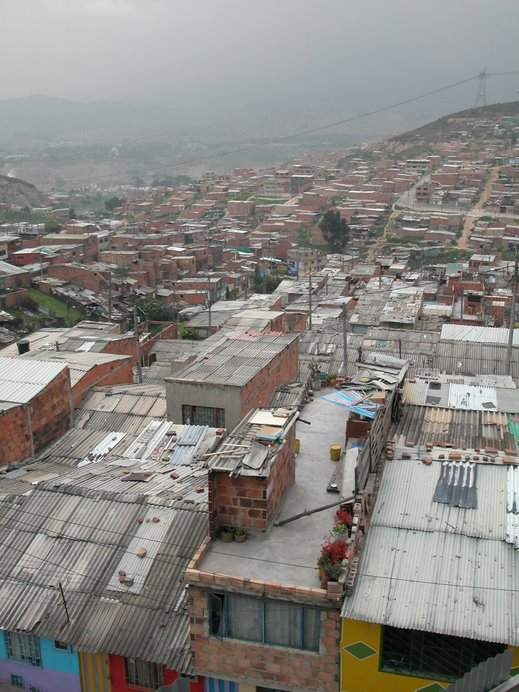
A hillside slum in central Bogotá. Should the city deprive
them of services to build roads for the rich?
It is true that Bogotá is being inundated by private cars. I read the terrifying statistic that in the last five years the number of cars has increased more than 50%. The roads will be overwhelmed - but that doesn't mean the city must spend its limited funds to pave itself over for the benefit of the wealthy car-owning minority, as Rodriguez wants to do - especially since that won't solve the problem. After all, those huge, wealthy U.S. cities have misspent fortunes paving themselves, and Los Angeles, Chicago and other cities are still notorious for their traffic congestion.

Promoting driving also promotes so many other problems being suffered by the United States, including sedentarism, obesity and the disintegration of city neighborhoods.
Nowhere to turn. Nowhere to go.
Better to have ridden a bike. 

And other problems here will worsen, particularly air pollution, thanks to all those cheap Chinese vehicles being imported and Colombian authorities' preference to not enforce their own air pollution laws.

In the U.S. some 40% of urban trips are of less than two miles, but 90% of urban trips are done by car. By shifting people onto their feet, bicycles or public transit, cities can gain huge benefits in health and liveability - and save money, too.

But the idea of promoting driving and building roads will benefit a few people: car builders and sellers and construction companies, who'll receive billions of public money.

But it would all be money wasted. I'm sure that Petro knows that. I bet that Rodriguez knows it too.

Rodriguez's predecesor Ana Luisa Flechas seemed to be on the right track. The city was working on creating a congestion charge and charging for parking on public streets. (Unfortunately, she was apparently a poor administrator.) Petro also wants to reduce the number of commercial parking spaces to discourage driving.

Rodriguez is likely to oppose all of those ideas as 'punishments for the private car.'

However, selfish and short-sighted transit policies like Rodriguez's will punish every Bogotano - drivers and non-drivers - for a long time to come.

By Mike Ceaser, of Bogotá Bike Tours

Fire, Knives and Broken Glass on Plaza Bolivar


I've seen this guy on Plaza Bolivar recently performing feats with flourescent tubes, broken glass, fire and knives. He walks on glass, inserts a knife up his nose, swallows flame, then swallows a flourescent bulb. Desperate? Pathetic? Self-exploiting? This can't be good for the health, especially those broken flourescent bulbs.


I can walk on broken glass.

Sticking a knife up his nose. Don't try this at home kids. 


Eating fire. 


How to wash your face with broken glass.


How exhilirating!
By Mike Ceaser, of Bogotá Bike Tours