Thursday, April 16, 2015

´Do As We Say, Not As We Sell´


'Get On the Bus', editorializes El Tiempo. But buy one of our advertisers' cars, first.
One of the huge, daily traffic jams on Calle 26.
El Tiempo, Colombia's largest newspaper, has long been part of the chorus calling for people to use mass transit instead of private cars. And I can't doubt their sincerity. After all, the evidence is there for all to see in the city's immense and ever-growing traffic jams.

But, while El Tiempo wants you on the bus, they clearly also want you to buy a car, whose propaganda constitutes much of the newspaper's advertising, including two weekly pull-out car magazines. (The editorial, in any case, is mealy-mouthed and consists mostly of cliches, while neglecting the only policy demonstrated to reducing car use - a congestion charge.)

El Tiempo's hypocrisy in calling for less car use while doing all it can to promote car sales, is an example of the contradictions in many of us, not least of all Bogotá's city government, which claims to want to reduce private car use. Until the government and others actually make their policies match their rhetoric, the traffic crisis will only get worse.
A lone cyclist weaves thru traffic near the National University.
One of the huge, daily traffic jams in La Candelaria.
By Mike Ceaser, of Bogotá Bike Tours

Monday, April 13, 2015

Where Have All Those Tires Gone?


Just a few months ago, the used car and truck tires littering parks and sidewalks across Bogotá were making headlines: In particular, after an illegal lot with thousands of tires caught fire, turning the air grey for days.

Then, government and tire industry leaders - and apparently did nothing.

Recently, however, I seem to see fewer tires on the sidewalks, making me wonder where they've gone.


This pile of tire shreds near Calle 26...

....were helpfully covered up recently.

Then, one day, I happened to look thru a gap into this nondescript vacant building behind the Central Cemetery.


The building is packed with hundreds, perhaps even thousands, of used tires.

Waiting to burn.
One day, a homeless person will sneak in to sleep and light a fire; the tires will ignite and smolder for days, turning the sky grey. A few months ago, an unregulated tire dump caught fire and polluted Bogotá's air for days.


But there is a solution: Apply a deposit to tires (and many other waste products), creating an incentive for people to dispose of them properly, as well as a subsidy for processing them into, say, asphalt.


By Mike Ceaser, of Bogotá Bike Tours

Sunday, April 12, 2015

Colombian Artists Thru Hernan Diaz's Lens

Journalist and movie director Guillermo Angulo and Vanna Brandestini, 1961, posing as silent film actors. 
Hernán Díaz (1931- 2009) lived and chronicled a golden age of Colombian creativity during the second half of the 1900s. His friends included Colombia's three great artists: sculptor Fernando Botero, architect Rogelio Salmona and writer Gabriel Garcia Marquez, as well as many lesser known figures of cinema, painting and photography. Díaz also photographed common people and presidents, as well as landscapes.

Díaz's work is now on display in the Biblioteca Luis Angel Arango, on Calle 11 in La Candelaria, across the street from the Botero Museum.

Alejandro Obregon, 1920-1992, painter, muralist, sculptor and engraver.
Beatriz Gonzalez, pop painter.
Argentine painter, muralist and sculptor Rogelio Polesello and Colombian sculptor Feliza Bursztyn. 
Painter and sculptor Eduardo Ramirez, Hernán Díaz, sculptor Édgar Negret and photographer Rafael Moure.
Scenes from Bogotá's Eastern Hills (which are now being paved over).


Feliza Burzstzyn.

Sculptor and painter Fernando Botero.
Painter and sculptor Freda Sargent 
Gabriel Garcia Marquez appearing serious and intellectual.
'Girl with Dog.'
Writer, poet and sculptor Gonzalez Arango.

Fernando Botero at work.


Landscape scenes.

Argentine-Colombian art critic and writer Marta Traba.


Six Colombian artists.
A sweets vendor.

Cartagena scenes.


By Mike Ceaser, of Bogotá Bike Tours

Friday, April 10, 2015

Where the Victims Lie?


El Parque del Renacimiento may have ended a mystery with this unimpressive monument to the thousands of people killed during the 1948 Bogotazo, who are supposedly buried underneath the park, whose name means 'Rebirth.'

The monument didn't seem to include any evidence for the remains' presence below the park, which was once the Children's Cemetery. But the remains' presence here would be logical, since I've seen photos of hundreds of corpses laid out in the nearby Cementerio Central.

If true, tho, maybe it explains why the park is so often vacant.

The park's monument.
An image of a newspaper headline reporting Gaitan's assassination 'by an agent of the government.' In fact, Gaitán was apparently assassinated by a mentally unstable man who had an obsession with the political leader.


Gaitán speaks in the Santamaria Bullfighting Stadium.
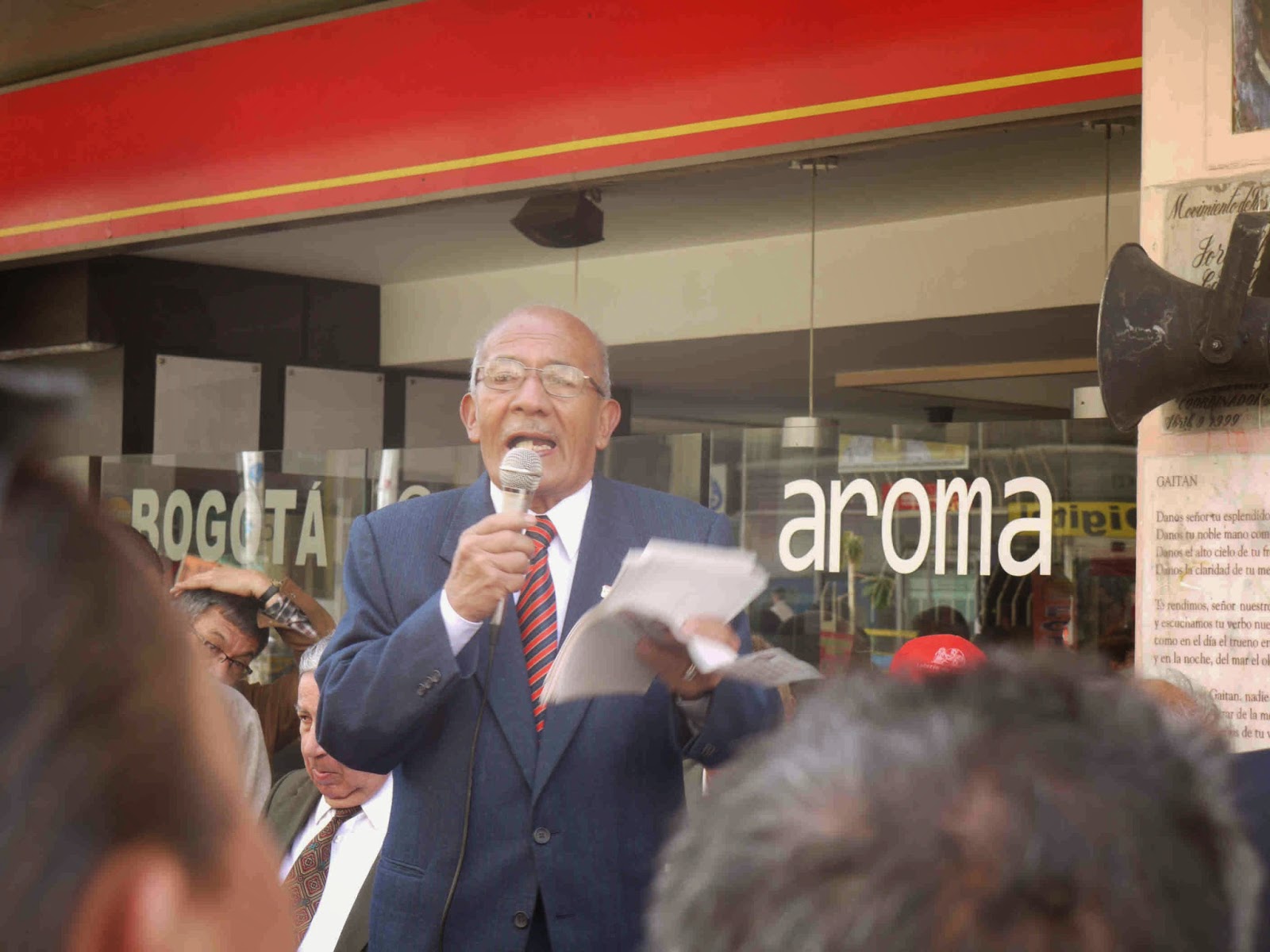
Yesterday, passionate followers of Gaitán held this rally by the spot on Ave. 7 and Jimenez Ave.

A Gaitanista makes an angry speech calling for Latin American unity.
An image of a smiling Gaitán.
A man sells DVDs of Colombian history.


By Mike Ceaser, of Bogotá Bike Tours