Friday, August 24, 2018

Bullfighting's Back for Good (or Bad)

Bogotá's Santamaria Bullfighting Stadium: Empty and lonely.
The plaza in its usual condition:
empty and unused.
In the latest round in the battle over bullfighting, the Constitutional Court has ruled that cities cannot ban bullfighting where it's traditional. That means that bullfighting will go on in Bogotá's Santamaria Plaza - for a while anyway. (Even if the bullfighters win in court, anybody who takes a look at bullfighting's aging audience can see that in another generation or two its fan base will check out permanently.)

Meanwhile, bullfighting's opponents are trying another strategy: calling on Bogotá's city government, which owns the Santamaria Bullfighting Plaza, not to rent it to the bullfighters.

Anti-bullfighting protesters.

Bicycle tourists outside the stadium.
That might be legally dubious, and it would also be a real pity. The bullfights would simply be shifted elsewhere, as they were while the Santamaria was being renovated a few years ago. Meanwhile, the handsome, Moorish stadium, would be even more abandoned than it is already.
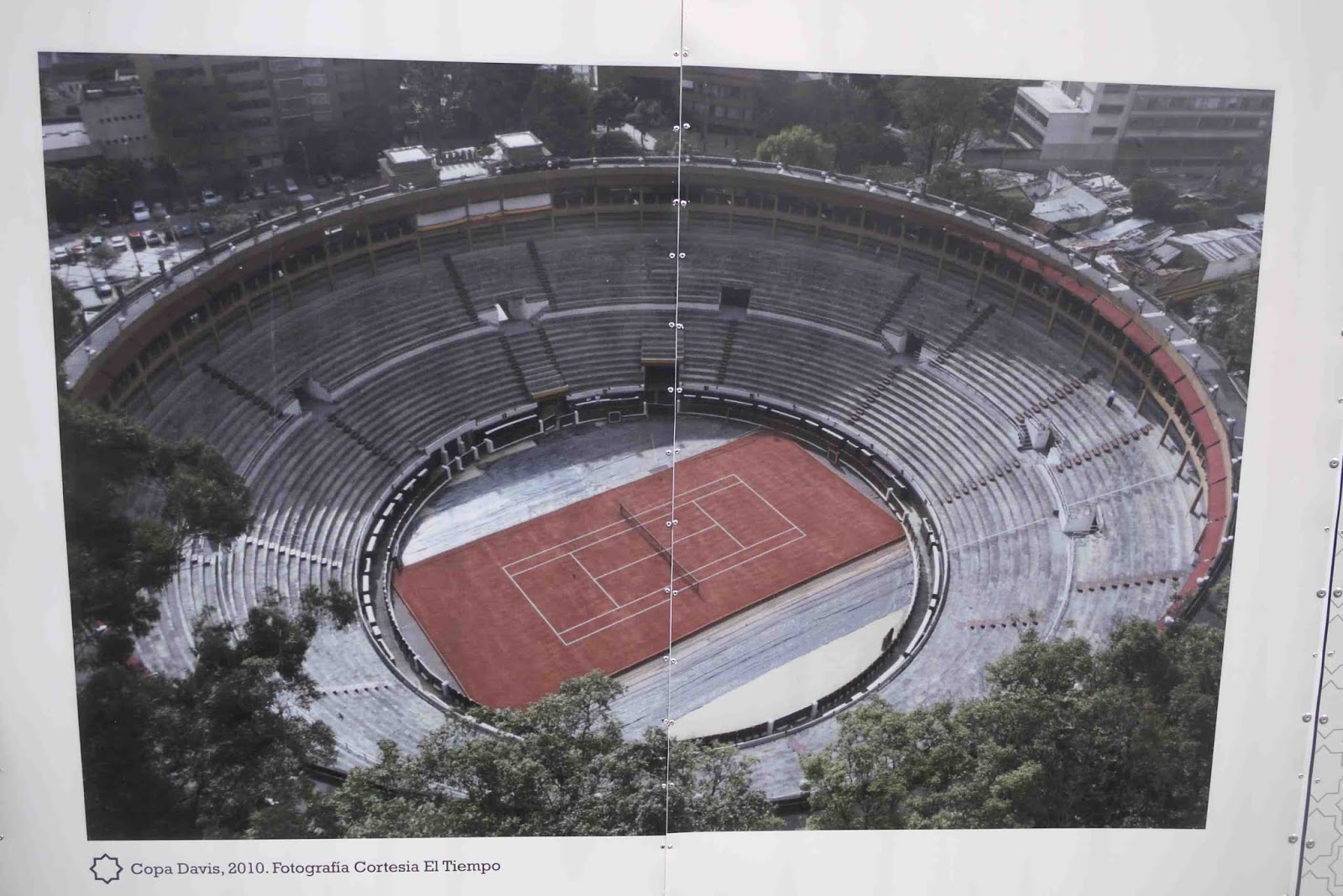
One of the few uses, a tennis match.
The Santamaria stadium, built in 1931, centrally located and recently renovated, is, incomprehensibly, almost never used for events except for bullfights. If the bullfights move out, then this Bogotá landmark will be even more completely vacant than it is already.

The Santamaria would be great for cultural and musical events. Imagine afternoon jazz festivals, weekend theatre, children's sports...the possibilities are endless. The lack of activities is incomprehensible.

If the city puts the Santamaria to other uses, as it should, then by all means ban bullfighting there. But until that happens, let this Bogotá landmark at least be used for something.

The plaza's only visitors. tourists.
Anybody who reads this blog knows that I have a bit of cynical view toward the bullfighting protesters. Sure, bullfighting is cruel and seems like a holdover from the Dark Ages. However, other thngs, such as cockfighting and factory farming, are much crueler and affect many more animals. Why does only bullfighting get protested?

By Mike Ceaser, of Bogotá Bike Tours

Six 'Yeses' and One 'No' on Corruption

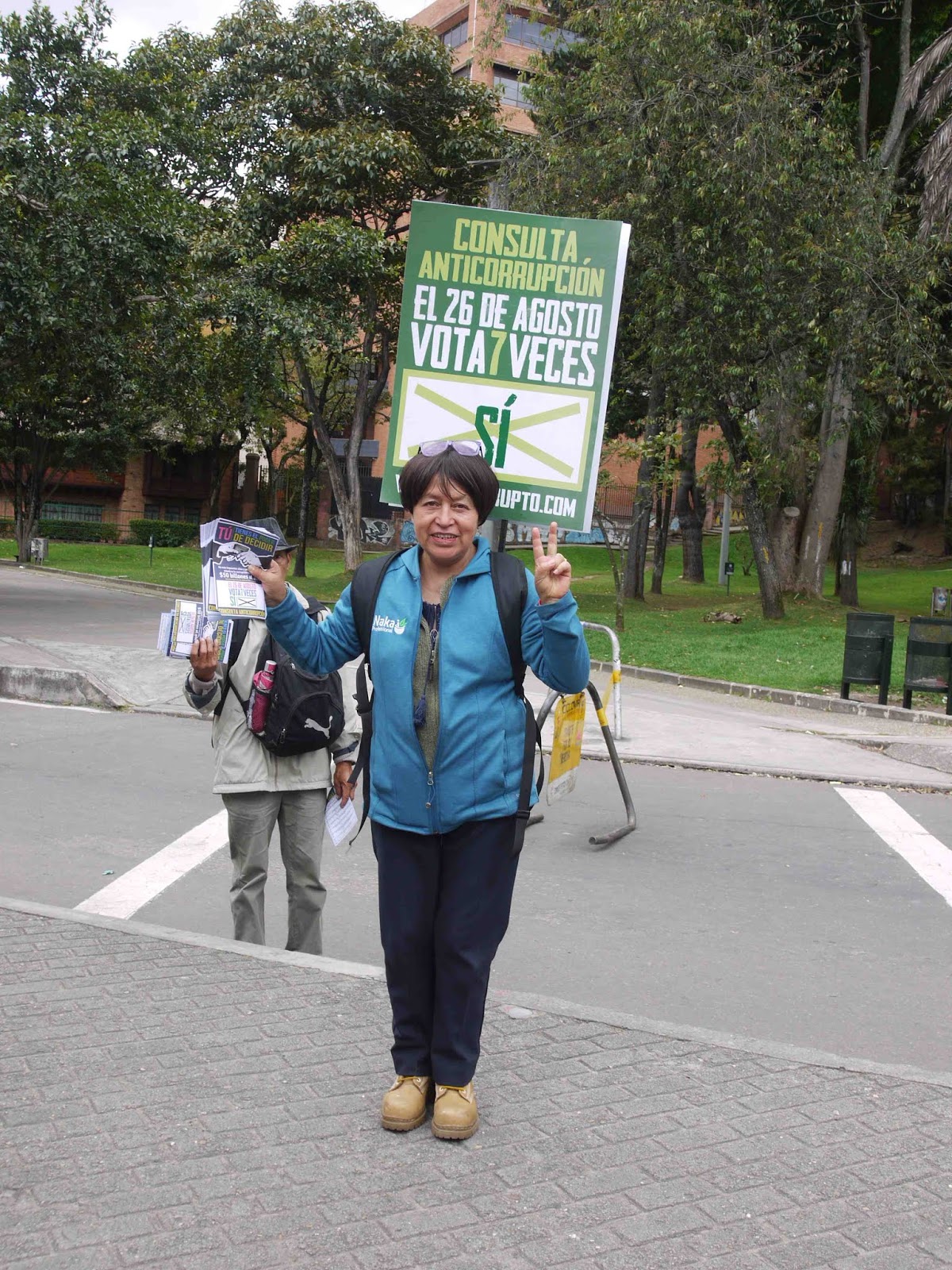
Campaigning against corruption.
This Sunday's anti-corruption referendum is well-intended - but also a bit misguided.

Most of the initiatives, which would increase transparency about government officials' finances, are positive.

But one of the referendum's measures would cut goverenment officials' salaries. That sounds satisfying to those of us who dislike politicians.

But stop and think for a minute: Is a politician who is well-paid or one who is poorly-paid more vulnerable to being corrupted? The poorly paid politician needs money badly and figures he has less to lose by letting a businessman grease his palm in exchange for a contract.

And policemen, who get paid miserably, are some of the most notoriously corrupt officials in Colombia.

Two tourists told me recently how they stepped out of their hotel in La Candelaria one evening smoking a joint, only to have cops pull up and threaten them with arrest. The brave defenders of the law finally let the tourists off for a payment of about 400,000 pesos. That's a huge chunk of a beat cop's monthly income. Many cops, I'm sure, make more money shaking tourists down than they do from their salaries.

Slashing politicians' salaries sounds more like anti-politician resentment than any rational anti-corruption policy.

For better or worse, the anti-corruption referendum is unlikely to reach the minimum participation level to have legal affect.

Needless to say, if Colombia really wants to reduce corruption it should remove one of corruption's biggest drivers: Prohibitionist drug laws.

By Mike Ceaser, of Bogotá Bike Tours

Thursday, August 23, 2018

Scientology in the Armed Forces?

A retired Colombian general pins an award recently
on Scientology leader David Miscavige
Revelations that the Church of Scientology, whose history is filled with bizarre beliefs and accusations of cultism and abuses, has worked closely with Colombian military personell have generated justified concerns.

There are many people - including some Hollywood celebrities - who are dedicated followers of Scientology, and appear to believe that they have obtained great benefits from it.

But the belief system - does it deserve the respect of being labeled a 'religion'? - includes some truly bizarre ideas about faraway planets and ancient volcanoes filled with hydrogen bombs and has been repeatedly accused of abusing its followers and engaging in exploitative cultlike behaviors.

A Colombian military man at a
Scientology event.
That's why it's worrisome when such an organization has an institutional influence over members of an armed forces. In case of conflict, where would these soldiers loyalties lie? Whose orders would they obey? What sort of values would they apply?

In particular, it's frightening and contradictory for an organization accused of imprisoning members
and forcing women to have abortions to be allowed to teach human rights to Colombian troops.

And Scientology's grandiose, even bizarre, claims about itself just make one shake one's head and wonder whether the organization has its head on straight. A 2015 Scientology press release about the inauguration of its new Bogotá building boasted about the legal and military high officials attending the ceremony, and called the event 'one of the greatest things ever to happen to Colombia.' Scientology has even credited itself with slashing Colombia's crime rate, boosting its tourism and reducing human rights violations.

That said, Scientology is clearly on the offensive in Colombia, with its expensive new headquarters in the city's north.

Interfering with others' religious beliefs is always sensitive. But when it comes to Scientology, both the government and potential followers should exercise lots of caution.


By Mike Ceaser, of Bogotá Bike Tours

Sunday, August 19, 2018

The End of the Trash Museum

Cyclists outside the Trash Museum back in the days of its full glory.
Bogotá's least popular anti-museum is no more.

The Trash Museum asks you what you're doing to the planet.
The Trash Museum, founded decades ago by the son of an upper-middle-class Bogotá family, became a regular stop on our bike tours, as well as a source of discord in its quiet Teusaquillo neighborhood.

As I heard the story, Antonio went to study in paris, where he rebelled against consumerism and wastefulness. He retunred hom, filled his family's house and yard with garbage. The museum became a landmark for bike tourists, but an eyesore for its neighbors, who at least once tried get to get Antonio evicted.

The house's front 'yard' was hidden behind a jumble of paper, plastic, boards and old shoes, decorated
'We are the trash culture!'
with signs denouncing mankind's wastefulness and announcing the planet's environmental collapse. 'How many of these objects came from your house?' asked one hand-scrawled sign. 'This is the way the world is,' announced another.

Passers-by contributed their own pieces of trash and even wrote their own statements. Sometimes, Antonio left his front door wide open, for anybody to enter and experience the museum's trash-packed interior, where he actually hosted friends.

The 'museum' even attained a degree of officialness. It was on Googe Maps and received an award from the Ministry of the Environment for environmental education.

"He was strong; a straight shooter." Antonio's brother gives us the sad news. But I suspect that the neighbors were relieved. 
A daring tourist ventures into the museum.
And Antonio certainly had his admirers, including his brother, who described him as "strong" and "a real straight shooter."

But, as much as I agree with Antonio's ideas - Bogotá's streets, sidewalks and waterways are strewn with paper and plastic from unnecessary packaging left over from mostly unnecessary products, which will either end up rotting in the Doña Juana landfill or float into the ocean, where animals will swallow it and choke to death.

A recognition from
the Ministry of
the Environment.
But Antonio, with his ways of antagonizing people, was not the best messenger. And I´m not sure whether his 'museum' was the product of principle, or just the rationalization of laziness. After all, Antonio spent his time indoors drinking himself to death.

Neither was he a particuarly pleasant person. Once when I stopped in front of the house with a bike
tour, Antonio Emerged from a amidst his trash and greeted us with an 'Heil Hitler.'

Later, we asked him what he did for a living.

"I'm the new Adolph Hitler," he told us.

About ten days ago, Antonio died, most probably from all of his drinking. His brother is clearing out his house and yard - a monumental task - and plans to rent out the property. Check it out soon on air BnB.
Hard at work clearing out the museum.

Ready to cart away the trash.
By Mike Ceaser, of Bogotá Bike Tours

Saturday, July 7, 2018

The Killings of Community Organizers

Protesters against the community leaders' killings rally in front of Bogotá's planetarium.
In recent months, Colombia has suffered an epidemic of killings of community leaders, which seems to be worsening in recent weeks. 
'Defense of Human Rights.'
I haven't seen evidence of a nationwide conspiracy behind these killings. Rather, perhaps they are a product of social tensions, illegal money and lack of rule of law or government presence in many regions. 

And it all once again highlights a fundamental paradox of Colombia: How can a nation of such nice, friendly people suffer such an undercurrent of violence?

Colombian leaders are vowing to stop the killings. But if they are linked to such fundamental national troubles, then the crisis will be difficult to resolve.


Protest signs on the Plaza Bolivar.

'There will not be enough tombs to silence all of us.'


By Mike Ceaser, of Bogotá Bike Tours

Thursday, July 5, 2018

Regulating Uber Off The Road

Uber: Going, going, gone?
Uber provides a terrible service in Bogotá!

So terrible, in fact, that many people prefer it over taxis because of Uber's nicer cars, friendlier drivers, greater control and more convenience. So terrible, that taxi drivers and companies are fearing for their carreers.

Is the solution to improve taxi service? Perhaps not. Instead, the government - undoubtedly pressured by the traditional taxi industry - is working on a law intended to legislate Uber out of existence.

The proposed law, which has yet to be reviewed, would require drivers from Uber, Cabify and other
Back to the future of old taxis?
such platforms, to drive only black cars with checkered sides. But that's just the beginning. Drivers would also have to have completed a course in the Sena technical school, completed a second course about how to treat customers, and god only knows what else.

All of these unreasonable, unrealistic requirements are for an industry - the gig economy on wheels - which has been operating pretty well on its own.

Anti-Uber marchers compare the
company to a proveer of prostitutes.
In truth, these proposed regulations have almost nothing to do with improving the quality of ride services. Rather, they're intended to destroy such services in order to protect the taxi drivers' vested economic interests.

'Uber out of Colombia.'
An Uber marketing stand.
Taxi drivers and companies unquestionably find themselves in an unenviable and probably unfair situation in the new economy. But the solution isn't to try to halt change - which has brought lots of benefits in the form of convenient transit and extra income for many people. Instead, the answer is to assist the taxi drivers to improve their service and, ultimately, train for jobs with better prospects.

None of which is to say that ride-sharing platforms don't produce negative impacts, particularly by increasing traffic congestion and pollution. But those are not just the fault of Uber, and should be addressed with a traffic congestion charge, pollution sanctions and other measures.

Incidentally, Colombian tourist guides are threatened by simlarly unreasonable ertification requirements designed to create barriers to entry and protect the interests of a small number of guides who were grandfathered into the industry and often do not even speak the languages needed to do the work.

Professional certifications like these are generally required for professions which involve big risks, such as medicine and engineering, or require intense knowledge, such as law. But driving a car? Telling tourists where Bogotá was founded?

These 'training laws' are really disguised barriers to competitors and attempts to monopolize their industries.

By Mike Ceaser, of Bogotá Bike Tours,

Saturday, June 30, 2018

Who's Sabotaging Colombians' Health?

'In less than 20 years, half of Bogotá's residents will be fat.' (El Tiempo)
The media reports that obesity in Colombia is growing to North American proportions.

Use of both legal and illegal drugs is rising among Bogotá youth.
And a recent survey of students found that use of both illegal drugs, like cocaine and marijuana, and a legal one: marijuana, is rising sharply among youth.

But both vices and drugs - legal ones, at least - have powerful lobbies to protect their right to poison their customers. Intense lobbying recently defeated legislation in Colombia's Congress which would have required companies to label foods high in sodium, saturate fats or sugars. (As if it would make any difference, judging by the rise in consumption of cigarettes, whose boxes carry big warnings.)

Perhaps televisions, cellphones and video games should carry warning labels, as well, because of the way they promote a sedentary lifestyle and waste our time.

Young women market Camel cigarettes near high schools and universities.

A young woman smoking.
What's the solution? Make these harmful products expensive, inconvenient to get and uncool. That won't be easy. But a good first step would be to actually enforce the law prohibiting the sale of loose cigarettes - which goes on on every streecorner and corner shop.

Cigarettes and candies for sale by a street vendor.
Who's sabotaging Colombians' health? Everybody, including themselves.

By Mike Ceaser, of Bogotá Bike Tours