Friday, October 7, 2011

Olave Turns Urban Neglect Into Art


A local official handling public funds. 


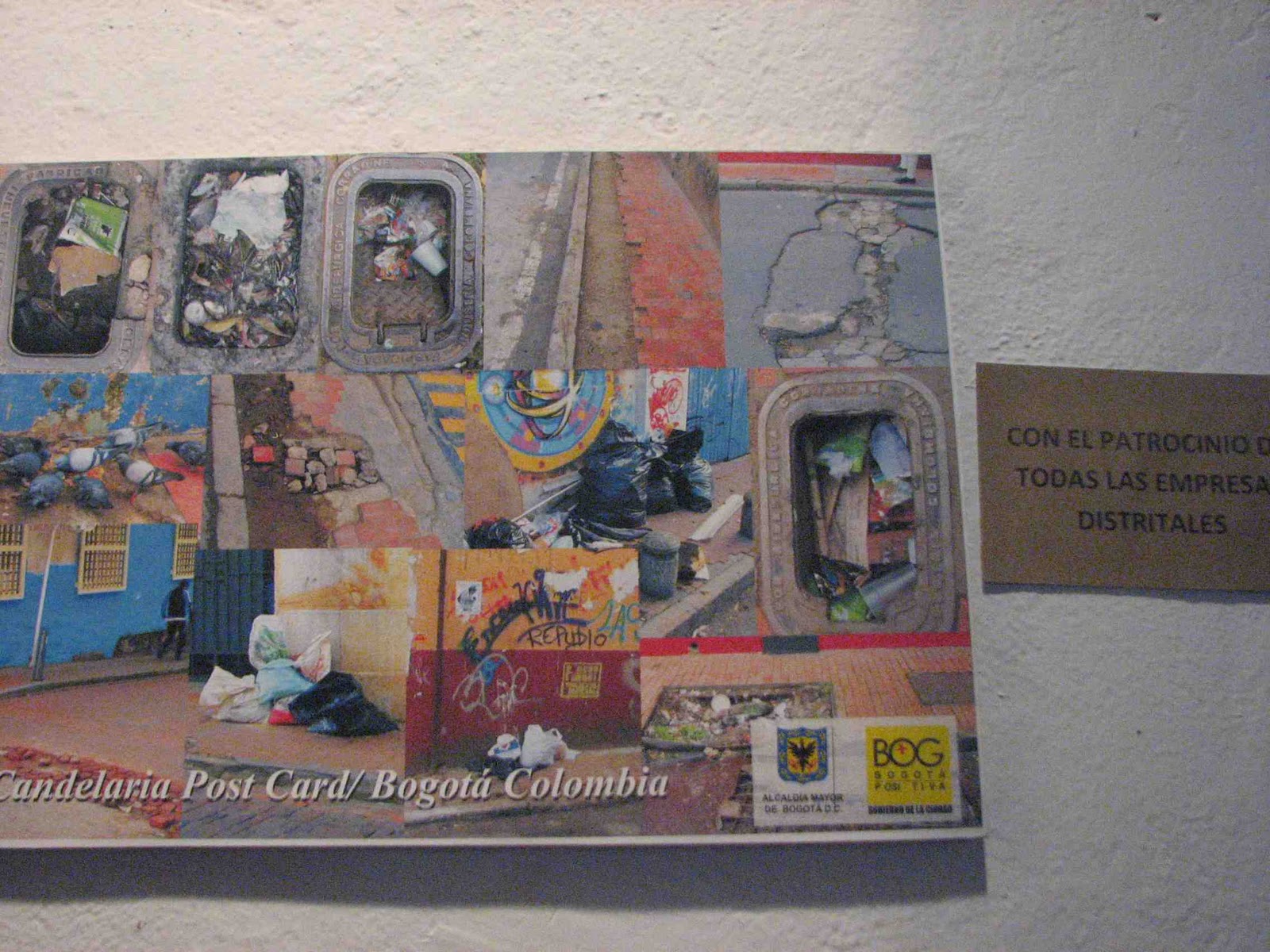
Jorge Olave, the artist who made the mysterious green men on La Candelaria's balconies, has an exhibition going on in La Candelaria's La Peluqueria hairdresser's/art gallery/music venue.

Olave's photographs turn examples of urban decay into urban monuments, and he turns his green men-in-waiting into symbols of official corruption.


A high local funcionary resting upon her accomplishments (bags of trash).

'An excellent climate for a pleasant rest.' 'Security permits outdoor sleeping.'


'With the sponsorship of the public companies.' (Utility boxes, sans lids.)

All tied up. A city transit official.

Treasures of La Candelaria. 


The view from La Peluqueria's front window. 

One of Olave's figures observes life in La Candelaria. 


By Mike Ceaser, of Bogotá Bike Tours

Everbody Against Peñalosa?

Enrique Peñalosa
Petro,
Mockus
and Parody -
all for one
& one for all?
With the alliance of candidates Antanas Mockus and Gina Parody into a single campaign headed by Parody, the campaign for mayor consolidated into a three-person race, led by Gustavo Petro and Enrique Peñalosa, with Parody close behind.

The Mockus-Parody union struck me as a bit strange. Mockus is a leftist who used public spirit to improve Bogotanos' behavior, while Parody's advisors include New York's law-and-order Mayor Rudolph Giuliani. Perhaps not surprisingly, the alliance didn't produce the hoped for results. Mockus's supporters went to all three leading candidates, leaving Parody in third place with 14% support in one poll. The biggest beneficiaries may have been Petro, who now has about 20% support, and the 'I don't knows' with 14%.

Now, El Tiempo reports that Conservative candidate Dionisio Araujo is also jumping onto Parody's campaign and that Petro and Parody may even team up. That would likely make their combined ticket unstoppable.

Peñalosa's solitude is surprising for a man whose mayoral term is generally seen as successful: he reclaimed public spaces, expanded the bike lanes system and started the express bus network, which successive mayors have expanded. But Peñalosa has a reputation as haughty and aloof, so it may be a personality issue as much as anything. But if he wins, perhaps that'll mean that he won't be beholden to anybody.

It's refreshing, at least, that all the leading players are seen as uncorrupt and well-intended. The campaign so far has been generally positive and carried out on a high level, focusing on real issues, such as crime, transit and quality of life.

With Bogotá sunk into chaos, congested traffic and lots of concerns about crime, the city needs a leader who can put it back on a positive track. Is that person Parody, who is young and unproven? Is it Petro, the one-time M-19 guerrilla? Or is it Peñalosa, whose previous administration earned him high approval ratings and put the city in order?

You can guess my opinion, and it's not just because Peñalosa (as well as Mockus) has rented bicycles from Bogotá Bike Tours.

By Mike Ceaser, of Bogotá Bike Tours

Wednesday, October 5, 2011

An End to Bogotá's Traffic Jams?

Nowhere to turn: Gridlock on Carrera 4.
You've seen them, often twice a day and much of the time in between, sitting motionless inside expensive metal boxes just as tho their purpose was to clog Bogotá's streets and avenues.

Better abandon your cars and walk. 
They're called car drivers, and they do it pretty well. According to El Tiempo, the average velocity on Bogotá streets has dropped to 23 kilometers/hour - and only 11 or 12 kms/hr on some corridors. That's little more than double an average walking speed and much less than a typical cyclist on Bogotá's flat terrain. In 2003, the paper reports, Bogotá's average traffic speed was 32 km/hr, meaning that traffic is slowing at a rate of almost one km/hr each year. And with hundreds of thousands of new cars entering the city, the congestion will only get worse.

The solutions proposed by politicians - a subway or urban freeways - would be either very expensive, far in the future or cause more pollution - or all these things. And they would only be stopgap measures, since experiences across the globe show that creating more space for cars only lures more vehicles onto the roads.

Visionary: Vicemin Felip Targa.
Enter Transport Viceminister Felipe Targa, who tells El Tiempo that Colombia might limit private car sales in Bogotá and create a congestion charge like London's. Targa points out that "when you drive during rush hour you're adding several seconds of delay to everybody else" and says that drivers should pay for that. The income would be used for road and public transit improvements.

Traffic jams are a perfect illustration of the tragedy of the commons, in which an individual benefits (or thinks he does) by driving a private car, but community in general suffers. "The best way to avoid" this trap, says Targa, is "thru tarification." Every car would carry a chip which would be used to charge the owner for entering the city center during congested times. Hopefully, that will push some people onto buses, TransMilenio or bicycles, or cause them to avoid unecessary driving.

The result: a less polluted, less congested, less stress-out city with a healthy population and better public transit. And everybody wins, including even those people who pay the congestion fee, because they'll get where they're going faster. After all, even if they don't know it, they're already paying a congestion fee in time wasted in traffic jams.

Green doesn't mean go. A few gridlocked cars block hundreds of TM passengers. 
By Mike Ceaser, of Bogotá Bike Tours

Vladimir Putin - the Cali Connection

Now that it looks like Russian strongman Vladimir Putin will have another (and another, and another...) term at the head of Russia, this historical tidbit seems worth noting.

Putin may have gotten his start with a bit of help from the Cali cocaine cartel.

Back in the mid-1990s when Putin was deputy mayor of the city of the city of St. Petersburg, he was on the advisory board of a company named SPAG, meant to encourage foreign investment in Russian real estate.

Cali cartel leaders. 
According to United States and European prosecutors at the time, SPAG was involved in laundering money for the Cali cartel. This story I found doesn't say whether the prosecutions against company officials (Putin was never charged with anything) were succesful.

The 1990s were a time in Russia of wild corruption and savage, unhindered capitalism and in Colombia of powerful drug cartels, so it's no surprise that the two hooked up.

The Colombia-Russia cocaine connection continues, as occasional news reports point out. And, some of the deals still involve important Russian businessmen. 

By Mike Ceaser, of Bogotá Bike Tours

Monday, October 3, 2011

The Zorreros Fight for their Way of Life

Out of place and out of time?
A zorrero trots up Carrera 13. 


'Members of the Constitutional Court,
we demand the right to work. '
Families who make their living with horsecarts protested today against plans to prohibit their way of life.

Bogotá's thousands of horsecart drivers, known as zorreros, mostly make their living by scavenging or vending things from the carts. You can't miss them as they drive up and down streets crying out for people to bring out their junk, which the zorreros will sift thru for anything they can sell, including scrap metal.

The zorreros have been broadly demonized by many Bogotanos. In recent weeks, I've seen two demonstrations, including one yesterday, at least partly directed against them, and a city law would prohibit them as of February 2012: supposedly, they are thieves, they are dirty, they abuse their horses and they mess up traffic.

This cart appears to be terribly overloaded. 

There's undoubtedly some truth to some of these accusations, altho I have seen no evidence that the horsecart people commit any more crimes than any other group of poor people. And, if they lose their horses and livelihoods, desperation would undoubtedly turn many working zorreros into criminals. The accusation that they cause traffic jams is even more preposterous, as a glance at any Bogotá traffic jam will show: Bogotá's traffic jams are caused by too many cars - not too many horsecarts. 

Horses and carts wait along Calle 13.
Yes, some of these urban horses are overworked, underfed and abused by their owners. But other zorreros seem to dearly love their horses and care for them like family members. In the past, animal protection organizations tried to enforce standards for protecting the animals, including regular veterinary check-ups. I think the results were mixed. But maybe the right mixture of funding and sanctions could actually protect these horses. For society, I'm sure, that would be lots cheaper in the end than turning working people into criminals, alcoholics and beggars, which is where the zorreros would most likely end up. After all, these people lack the education or skills to do anything else.
The zorreros, or horsecart drivers, are mostly poor,
unosphisticated people with little education. 

The most humane solution for the horsecart families would be to educate their children, opening up other options for them. Then, the horsecarts might disappear into the past, not because internal combustion vehicles are better than animal-drawn ones, but because Bogotá will have produced more good jobs and educated people to fill them. (By then, lets hope, cars will be gone from Bogotá's streets as well.)

A horse gallops up Calle 13. 
I'm convinced that the zorreros' greatest sin is being unsophisticated and seemingly anachronistic in a city that wants to appear slick and modern. All of this, as well as social isolation, compounds the zorreros' vulnerability.
 Today, they waved signs (most likely written by more literate supporters) and blew into horns. Google 'zorreros Bogota' and you'll find Facebook groups and You Tube videos condemning them - but almost nothing in their defense. In contrast, Google those expensive diesel vehicles which are flooding the city and you'll find lots of propaganda glorifying them - even tho they are responsible for poisoning our air and clogging our avenues.

But, money and sophistication talk these days - and the zorreros lack both of them.


By Mike Ceaser, of Bogotá Bike Tours

Sunday, October 2, 2011

Marching for Animal Rights


Pretty protesters. 

Members of the 'animalist' political party. 
When it comes to animal rights, Colombia seems to have a split personality: Many Colombians love animals. I see people feeding and helping pigeons on city plazas, I know ladies here in La Candelaria who populate their houses with rescued street dogs, and canine companions seem really popular and well-loved. Colombians' love for animals is so strong, in fact, that demonstrations and protest marchers for animal rights are more common than those for human rights. Yet, at the same time, Colombia is a conservative society with lots of poverty. So, bullfighting and cockfighting are popular here among some groups, as are rural practices like coleo and corraleja. Those four practices are actually protected by law, as 'tradition.' And horse-drawn carts called zorras are a common sight on Bogotá streets, driven by poor people who often scavange and resell trash for a living. Some of those horses are treated well, but others are overworked and underfed.

A protesting bull. 
Today's demonstrators included demands for a prohibition against circuses, bullfighting and the urban horsecarts, as well as representatives from an 'animalist' political party and people demanding 'animal equality' and an end to specieism.

But animal equality looked a long way off, even amongst those in the march, who included men on horseback, people walking dogs on leashes and with muzzles and trained dancing dogs.


Carabineros, or mounted police, who forgot their horses but made their own horseshoes. 

A canine conference. 

Carabiner drummers.
Green Man joined the protest. 

A green parrot. 

Mounted police follow the parade. 

A future policeman with his collie. 

How would YOU like to be the bull in a bullfight?

End speceism!

No more circuses! Animal liberation!


Pit bulls walk their people. 

Police dogs present!


Trained dogs lead the parade. 
                                                          A few four-legged friends in Bogotá.
A woman leads her llamas thru along La Ciclovia. 

Victim of modern diets: The supersized dog which inspired Botero. 

A cat eats a peach in Las Nieves market.

Exploited? Guinea pigs line up for the races in front of the San Francisco Church. 


By Mike Ceaser, of Bogotá Bike Tours

Saturday, October 1, 2011

24 Hours Without a Homicide?


Shoot 'em dead.
Today, we were watching bicycle polo in the National Park when this oddly-dressed troupe of young people appeared, and, without explanation, carried out a silent theatre.

Only afterwards did they explain: they were part of a campaign called 24-0, which is calling for a day without any murders. That's a tall order, particularly on a Saturday, in a city with a murder rate of almost two people per day. More importantly, the campaign is intended to draw attention to the problem, which overwhelmingly impacts poor people, and ask Bogotanos to think about solutions.

Down he goes. 
It's mind-boggling that Colombia, despite its wonderful people and culture and increasing stability, has a annual murder rate of 38 per 100,000 people more than double that of Mexico, at 18 per 100,000, which is under siege from narco cartels. That's to say nothing of Europe, Asia or even the gun-saturated United States.

It's tempting to blame Colombia's murder rate here on its half-century of armed conflict. But, in fact, that conflict can be blamed for only a few thousand murders per year. That's a lot, but only a fraction of the nation's 18,000 annual killings. However, I suspect that this conflict feeds a general atmosphere of lawlessness and a tendency to resolve conflicts with firearms. The closely linked illegal drug trade, of course, also fuels violence on all levels.

What would you do about this? activists ask passers-by.


By Mike Ceaser, of Bogotá Bike Tours