Wednesday, July 20, 2011

Scenes from Colombian Independence Day


Honor guards on the march. What if they were replaced by marching schoolteachers, or doctors?

Today, 20 de Julio, was Colombian independence day. Colombia dates the start of its revolution from a tussle over a flowerpot in La Casa del Florero on Plaza Bolívar.

As in many nations, independence is commemorated with a military parade. Unlike most other nations, however, Colombia's military is carrying on a seemingly unending conflict. Amongst all the exhibition of the selfless young men in spotless uniforms, there were reminders that war is terrible and that, despite its recent stability, Bogotá still sometimes feels like a city under siege.

Snapping pictures of marching honor guards on Seventh Ave. 

Lots of variety in headware and hair among the crowd. 

In La Candelaria, meanwhile, a soldier on the lookout for trouble.
Are these guys sharpshooters, or just interested observers?

These folks found a nice vantage point in a restaurant window. 

A disabled soldier is wheeled past the Plaza de Toros. Many are victims of guerrilla landmines. 

Special forces troops on the way home after the parade. This guy appears to be carrying a minesweeping device. 
Warplanes fly amongst downtown's high-rises. 

The parade passes over 26th Street, where express bus lanes are still under construction.  Impressively, they were at work on Indpendence Day. 
A mass in Plaza del Choro.

In the afternoon, Seventh Ave. turned into a street party. 


A Colombian flag hangs from a La Candelaria house. 
By Mike Ceaser, of Bogotá Bike Tours

Gunning Fast and Furiously to Colombia

Smuggled guns: Headed toward Colombia?
Fast and Furious was a United States anti-gun-smuggling operation intended to uncover gun smuggling routes into Mexico. But it went terribly wrong when some 1,400 weapons apparently went missing, according to CNN, and several appeared at the scene of the murder of a U.S. Border Patrol agent.

And now, several of the operation's weapons have reportedly surfaced in Colombia, in the hands of the violent drug-smuggling operation known as the Oficina de Envigado.

U.S. authorities messed this operation up badly. However, it still shows how far illegal guns go - all the way from the U.S. border to Colombia, where they just keep on killing.

Rational control of gun sales in the U.S. would not only save lives in the States, but also in Mexico, Colombia and many other nations.

By Mike Ceaser, of Bogotá Bike Tours

The Stupidest Species?

A young man tells people on La Plaza Bolívar that the world will end Oct. 15
Sell your home, quit taking your medicine, pull the kid out of school and hire a godless neighbor to care for the pets!

Jesus Christ will return Oct. 15 and rapture the chosen few. Believe it! After all, these folks say so, and so do posters appearing all over central Bogotá.


Why stay in school? These kids believe
the world's end is coming Oct. 15.

The failure of California preacher Harold Camping's forecast of the end of the world May 21 seems, paradoxically, to have made end-of-the-world predictions fashionable.


I pointed out to these people that many others had announced the end of the world - and yet the world is still here. That didn't shake their faith that Oct. 15 will be the one. I asked them to promise to give me their worldly belongings on Oct. 14, but they didn't agree. Seems pretty lousy for them to be trying to push these beliefs onto others when they're not fully committed to them themselves.

Posters on La Plaza del Chorro
 announce Christ's return.
Innumerable judgement day dates have come and gone, without taking the world with them, and the Christian Bible itself says that Jesus will return "like a thief in the night." But some preachers persist. After the sun rose on May 22, Camping shifted his end of the world date a few months to Oct. 21, and apparently some people actually believe him.

Earthworms, beetles, dogs and anteaters don't fall for end-of-the-world lies, which usually involve believers handing their money over to a religious leader. But humans keep believing, suggesting where they fall on the animal IQ scale.

Hmm. Maybe I can make some money on it by taking care of pets after their owners do or don't get raptured.

By Mike Ceaser, of Bogotá Bike Tours

Tuesday, July 19, 2011

Fun With Firepower on Plaza Bolívar

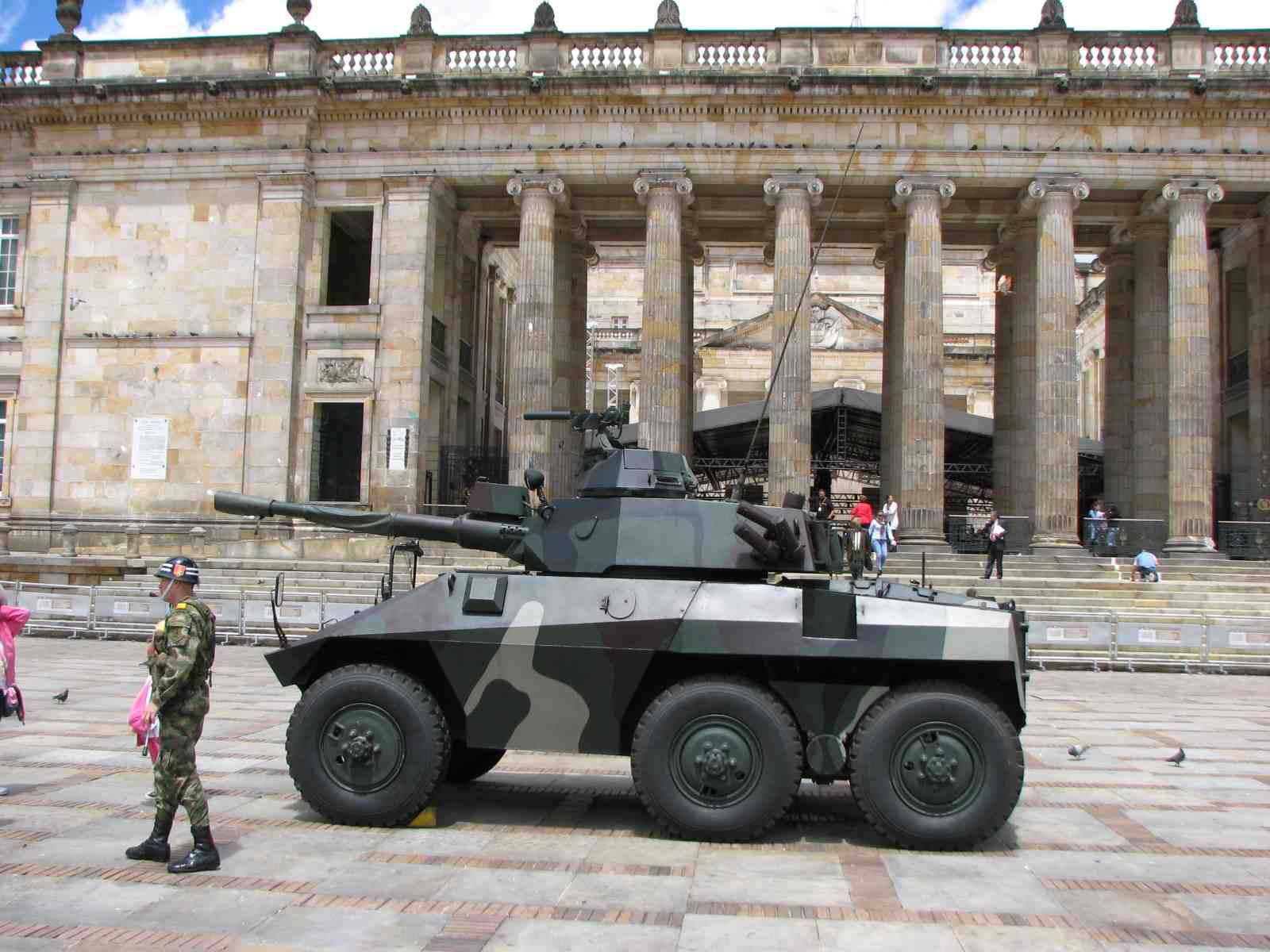
Anything wrong with this picture? Tanks, what wonderful things to play on. 
As part of the celebration of Colombian independence day, the 20th of July, the military rolled out tanks and a helicopter onto Bogotá's Plaza Bolívar.

With an ongoing armed conflict, Colombia's military plays a more important role than do the militaries of many other nations. However, it's a deadly business, rather than the fun and games that war looks like on a sunny day here on the plaza.

Can I drive one of these someday?

A military helicopter in front of Monserrate and the Cathedral. 

This was the helicopter used in the 2008 Operacion Jaque, which freed 15 hostages held by the FARC guerrillas. 


By Mike Ceaser, of Bogotá Bike Tours

Monday, July 18, 2011

Training for a Sport in its Twilight

Facing off: a bullfighting student, cape raised, faces off against another, playing the bull.

Their sport not only threatens participants' life and limb, but it's also in steep decline. Yet, some young men and a few young women still aspire to become bullfighters. And, during the first two weekends of August, young aspiring Colombian bullfighters will display their skill and courage in Bogotá's Plaza Santamaria.

One of the few remaining blood sports, bullfighting recalls the era of gladiators and non-believers confronting hungry lions. Like those practices, bullfighting appears to be on its way out. It's certainly declined in Colombia and it was recently banned in both Ecuador and the Spanish province of Catalunia. Last year, a Colombian judge ruled that bullfighting and other violent spectacles involving animals, including coleo, Colombian rodeo, and corraleja, Colombia's version of the running of the bulls, could continue but not expand or receive government support. All of these activities are undeniably cruel, but deeply rooted in Colombian culture.

Why, in the sport's twilight, do young people still aspire to risk their lives confronting angry bulls? Few can hope to achieve the glory of figures like Jose Tomas, el Juli or Colombia's own Cesar Rincon - altho they must dream of it. Does bullfighting's future have room for another generation of legends? Perhaps they also seek the extremes of human experience: few human activities so starkly confront a person with severe injury or even death. They may also aspire to the beauty and grace of bullfighting - despite its cruelty.

Today, bullfighting students were practicing for their debuts next month in Santamaria. Practicing with real bulls is both dangerous and expensive, so one young man plays the bull for his companion.

The August bullfights are free, and tickets are available at the stadium box offices beginning at 1 p.m. on the days of the the bullfights.


By Mike Ceaser, of Bogotá Bike Tours

Sunday, July 17, 2011

Bogotá's Dilemma: Subway or more Bus Rapid Transit?

Bogotá's Transmilenio vs. Medellin's Metro. Which is the better route?
Bogotá has become world famous for its express bus system, called Transmilenio. But city officials have long aspired to having a subway - in part because of Bogotanos' ambitions to be like cities of rich nations. Bogotá's current Mayor Samuel Moreno won the mayorality in 2007 to a great degree by promising to build a subway system. Ironically, Moreno has continued expanding the existing Transmilenio system and is now suspended from office and may be headed to prison for alleged corruption in that project. His subway plans are still just on paper.

Having a subway certainly could give Bogotá the sheen of modernity, and it would move many thousands of people quickly above or below the city's traffic congestion.

But would a subway be worth it? Before revving up the bulldozers, Bogotá officials should look at the experience of their rival city, Medellin.

Medellin's metro: an expensive trophy?
Planning for Medellin's shiny, modern Metro system began in 1979, and the first train ran in 1995. Since then, they've completed three lines, totaling 32 kms, plus two gondola lines, called Metrocable, and have a ridership of roughly 400,000 people per day. The system has cost $2.2 billion dollars.

In contrast, Transmilenio's planning began in 1997 and the first line opened three years later, in 2000. Barely a decade later, TM has 84 kms of routes and 114 stations and a ridership of 1.4 million people per day, at a cost of several billion dollars - I haven't found an exact number. I read that the total cost of the TM system would have paid for a single 30 km rail line. TM construction has also included public space improvements along the routes.

A rapid bus system also takes space away from private cars - a disadvantage to some, but a positive aspect for those of us who've seen how cars strangle cities. When there's more room on the road, more people take out their cars to fill it. And anybody who's visited Caracas, Venezuela; Santiago, Chile; or Mexico City has seen that subway systems do not eliminate traffic congestion.

Its subway hasn't solved Medellin's traffic jams.
Yes, Medellin's trains and gondolas make the city appear sleek and modern, in contrast to Bogotá's rumbling buses. But TM has put transit lines on the ground much faster at lower cost, and moves many more people. Today, in addition to continuing to expand the rail system, Medellin is also building a trolley line and an express bus system.

System maps tell the story: Transmilenio, left, after a dozen years, and Medellin's subway system, right, after 30 years. 
TM certainly has its problems (some of them infuriatingly easy to solve). And subways have big advantages, including capacity, speed, lack of air pollution and their impact on a city's image. But when it comes to getting a system on the ground quickly and economically and moving lots of people, bus rapid transit wins hands down. 

Perhaps once Bogotá's got a well-developed express bus network and the city's population has grown to big for the system on certain corridors, it should consider a subway. But, for the foreseeable future, more TM expansion looks like the best choice.

Related post: Five Mysteries about Transmilenio.

By Mike Ceaser, of Bogotá Bike Tours

Friday, July 15, 2011

A New Frontier for Cocaine Sales?

Harold Carrillo, facing a death sentence in China for cocaine smuggling.  Part of a trend?
Colombia is appealing to Chinese officials to spare the life of a Colombian man condemned to death there for cocaine trafficking.

Hárold Carrillo, a taxi driver from Cali, told his friends that he was traveling to China "for business," but was arrested in the Beijing airport with three kilos of cocaine hidden among his clothes. 


According to El Tiempo, a dozen Colombians are imprisoned in the People's Republic, two of them sentenced to death, for - surprise, surprise - drug trafficking. I suspect there'll be more.

China's booming middle class is growing so quickly and so rapidly gobbling up the planet's coal, petroleum, sharks' fins and lumber, that it's become a threat to the planet's biodiversity. Traditionally, China's drug of choice has been opium. But opium's sleep-inducing effects aren't exactly appropriate for the country's new, hard-driving culture. It may be only a matter of time before  the Chinese also discover cocaine, long the drug of yuppies and high-powered executives.

Recently, authorities have siezed shipments of cocaine both in Hong Kong and mainland China. And this article, about drugs shipped to Asia by mail, says that a kilo of cocaine in China sells for $200,000 - eight times what it's worth in New York and a hundred times what that kilo can be bought for here in Colombia. That means it's difficult to smuggle cocaine into China - but also that there's lots of demand there.

China is a huge country, with plenty of money and corruption - as shown by the repeated scandals over bad medicines and other products.

If many millions of Chinese develop a taste for cocaine, it'll likely mean the game's up for the already failing War on Drugs, as well as for huge swaths of Amazonian rainforest, which will be converted to coca leaf plantations and Colombia's still delicate democracy. Also, most likely, producers will plant coca leaf in Asia and Africa. This wouldn't be the first time. In the early 1900s, when coca leaf and cocaine were legal, the leaf was planted in Sri Lanka, Taiwan and Java. Why couldn't that be done again, especially in poor, corrupt nations such as Laos and Myanmar?

Mr. Carrillo had told friends he was traveling to the People's Republic for business. A long way for a taxi driver, but his story turned out to be accurate.

By Mike Ceaser, of Bogotá Bike Tours