Thursday, May 5, 2011

Colombia Needs More Salomon Hakims!

Salomon Hakim, 1922-2011
Salomon Hakim, perhaps Colombia's most renowned researcher, died today at age 88. A descendent of Colombia's tiny Lebanese immigrant community, Hakim studied and worked hard and described a new neurological disease now called NPH - despite being told by a prominent 'expert' that there was nothing new to discover in the field.

Not satisfied, Hakim also invented a valve which became a revolutionary treatment for the condition and which carries his name. His son Carlos now continues his father's work.

Salomon Hakim deserves Colombian's pride and recognition - much moreso than the football stars and pop singers who grab headlines and draw crowds. If Colombia means to grow its economy and its place on the world stage, it needs to give brainpower higher priority than muscular legs and sexy hips.

The World Bank recently reported that between 2003 and '07 Germans patented an average of 10,000 new inventions per year and South Koreans 5,000. Colombians patented 10. Hakim alone filed about two dozen patents.

There's a reason why Korea produced Samsung and Mitsubishi and Germany Bayer and Siemens, and I don't think it's because their people are any smarter than Colombians. But those nations have low levels of corruption and put lots of emphasis on education.

Let's hope that more Salomon Hakims are growing up among us.

Future scientists? Students on a field trip in La Plaza del Chorro. 
Read about Luis Parada, a cancer researcher and member of the U.S. Academy of Science. And another about Manuel Elkin Patarroyo, who has tried to develop synthetic vaccines.

By Mike Ceaser, of Bogotá Bike Tours

Wednesday, May 4, 2011

Colombia's Own 'Osama' Experience

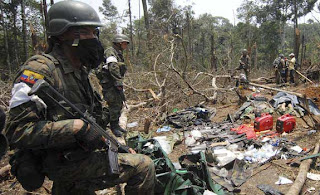
A Colombian soldier in FARC leader Raul Reyes' camp in 2008.  (Photo:  Cambio.com.co)
A terrorist leader is discovered hiding on the territory of a foreign nation. A surgical military strike kills him and some of his followers, boosting the popularity of the government's leaders but generating controversy about a violation of the sovereignety of a country which is suspected of having colluded with the terror group.

Sound familiar?

I don't mean the United State's successful operation against bin Laden's Pakistan hideout this week, but rather Colombia's 2008 raid against FARC 'foreign minister' Raul Reyes' camp in Ecuador. 

Alvaro Uribe, who was president at the time, and Juan Manuel Santos, then the defense minister, must be feeling a bit vindicated these days in light of the U.S.'s success with a similar tactic.

Like the killing of bin Laden, the Colombian raid was seen as a great blow against a terror group. And, around the same time the government killed several more top FARC's leaders, and the group's founder Manuel Marulanda died of old age.

Afterwards, both Ecuador and Venezuela broke diplomatic relations with Colombia and Venezuela Pres. Hugo Chavez even talked war. But they've since made up, and Ecuador's president is even visiting Colombia right now, to inaugurate a book fair.

However, in contrast to what many American hope will follow the death of bin Laden, the deaths of Reyes and other FARC leaders did not destroy the guerrilla group, which is weakened but continues operating in remote parts of Colombia, where it profits from the cocaine trade and attacks government forces.

In many ways, the FARC would seem to be an easier organization to defeat than al Qaeda: The FARC are mostly restricted to one nation, Colombia; they have no religious fanaticism (or suicide bombers), and their Marxist class ideology seems greatly weakened. And the FARC's refuges in Venezuela and Ecuador seem recently to have become less friendly to them.

Nevertheless, despite great strides by the government, the FARC appear capable of hanging on for quite a while longer, if not indefinitely.

One reason for the FARC's staying power, and one thing they have in common with al Qaeda, is a huge source of guaranteed income: in the FARC's case, cocaine money, and in al Qaeda's, heroin. (In fact, lots of Colombia's one-time poppy production shifted to Afghanistan after the U.S. invasion. I wonder which terror group Washington would prefer to receive the illegal income?)

The lesson: Colombia's learned that these groups are flexible, resourceful and not necessarily dependant on specific leaders. I suspect the same's true of al Qaeda.

By Mike Ceaser, of Bogotá Bike Tours

Tuesday, May 3, 2011

Let the Indio Amazonico Solve Your Troubles!

Drop a coin in my stomach. 


Bogotá is full of seers, healers and charmers. They hand their cards out on downtown streetcorners, promise miraculous cures and lottery wins on morning radio and sell nostrums to keep that true love on a short leash.

'He who gives seven times receives 70 times.' 
But none other might offer so many services, or employ so many religious figures, as the Indio Amazonico, whose store you'll find along Caracas Ave. in Teusaquillo. Just look for the obese golden Buddha statue in the doorway.

Three figures from a popular Venezuelan religion with
roots in Cuban and African traditions. Maria Leonza
is on the right. 
Besides the Buddha, you'll find Christ, tarot cards, holy oils and popular religious figures from Venezuela, amongst lots of other stuff. Corny and tacky don't really come close to describing el Indio Amazono, particularly touches like the Buddha, who's got a slot in his stomach to recieve believers' coins, or the bleeding plaster Jesus in his glass booth, littered with believers' bills.

Related Blogpost: Of Superstition and Precipitation.
'Thanks to the Indio for getting me out of jail. I was innocent.'
But if the Indio may seem deserving of a spot in a circus sideshow, but he also seems to serve a purpose. How else could he have endured for decades? The sidewalk in front of his 'temple' is decorated with believers' messages thanking the Indio for curing diseases, saving businesses and marriages, even for recovering a lost child. Could these all be fakes? They have the smack of authenticity to me. And if even a fraction of them are true, the Indio belongs on the fast track to sainthood. 

Making a purchase. 
Faith has evidently done well for the Indio, who comes from the Putumayo and is now in his 80s and practicing in New York, where he's found either more believers or bigger wallets, or both. Normally, one of his students, a profesora, fills in for the Indio in Bogotá. A consultation with her costs 30,000 pesos. But a session with the Indio himself, during one of his three or four yearly visits, costs ten times that amount.

In an interview in the 1980s published in a New York newspaper and posted on the temple's wall, the Indio said that client's most common problems are sexual impotence in men and weight problems in women.

By Mike Ceaser, of Bogotá Bike Tours

Supplying all sorts of happiness. 

'I'm doing well in love now, Thanks to the Amazonian Indian.'

Dropping a coin in the Buddha. 


Bogotá's Corruption Carrousel

Samuel and Ivan have seen better days. 
The other shoe dropped today as Bogotá Mayor Samuel Moreno was suspended from office because of allegations of corruption and mismanagement in public works projects. The mayor's younger brother Ivan, a senator, was arrested the other day because of the same scandal, so the two might soon be repeating those great days of childhood by sharing a bedroom. 

And yesterday authorities arrested many government officials for an alleged corruption scheme in public health services - functionaries created bills for non-existed services and pocketed the money.

The bad part is that officials are committing fraud, believing that they can get away with it. The positive part is that some of them are actually getting caught.

Mayor Moreno was unapologetic. In a speech today he boasted about his administration's accomplishments. Certainly, Moreno's carried forward public works which needed to be done - but they should have been done cleanly and efficiently.

Despite everything, this was the scene this afternoon near the National University. Evidently, Bogotá's young male population prioritized other interests, like the Real Madrid-Barcelona game.

It reminded me of my first crazy days in Caracas, Venezuela, when I was working as a journalist. I'd moved to the city just two few weeks before, had a malfunctioning laptop, no home internet connection and no friends in the city when a coup overthrew President Hugo Chavez.

Most of the city went into lockdown and I raced about desperately in search of an open internet cafe from which to file the biggest stories of my journalistic career. Finally, I found one and began typing furiously while on the television on the wall the coup leaders, a group of business and military men, were announcing the country's fate. Meanwhile, all around me, kids, oblivious and uninterested in their nation's fate, were playing video games and sending text messages.

An employee tapped my shoulder. "Would you mind changing machines?" he asked me. "Then you can continue chatting."

Chatting??!!! I thought. "I'm recording history!"

After about 48 hours, the coup fell apart and Chavez was swept back into power generating about 72 hours of frantic journalism. On the third day, I was back in the internet cafe racing against deadline to file another story when an employee tapped me on the shoulder again. "I have to ask you to leave," he said sternly.

"Why????!!!" I asked, in desperation.

I hadn't bathed in four days, and was driving out their game-playing customers. Fortunately, I found a less sensitive internet place across the street.

By Mike Ceaser, of Bogotá Bike Tours

Monday, May 2, 2011

Jose the Rapper of La Jimenez

Crazy man with the crazy hair!
I suspect that most people think Jose's crazy; I sure did. After all, there he is along Jimenez Ave. with his crazy hair, grinning and rapping while everybody else is doing constructive things.

Sure, Jose's crazy: crazy as it takes to earn his living doing something innovative and different, which he loves.

Many afternoons I see him there on the side of Jimenez Ave., near the expensive and conservative Los Andes University, rapping away by the entrance to a parking lot. He swings his arms about. He swivels his body. He raps about passing bicyclist, about his own history, about his pride in his Afro-Colombian heritage, about the weather, about anything. He grins. He waves. He's having fun.

'I'm a black guy from el Chocó. I'm here in the city to tell you the truth.'

Students and office workers walk by. Most barely glance at Jose, who, after all, is crazy. But a few pause to greet him or give him a coin. Jose raps on.


'I'm singing about people agonizing. Sending my greetings to the whole world.'

Some of Jose's raps are social, talking about oppression, racism, poverty and struggle. Or he raps on whatever he sees: a dog runs past, a cyclist passes, it's raining....He's been rapping about three years. He moved to Bogotá about eight years ago from El Chocó, a poor, mostly Afro-Colombian region near Colombia's Pacific Coast. The region's residents often get caught in the middle of territorial battles between guerrillas, paramilitary groups and plain-old drug cartels which battle over cocaine smuggling routes to the coast.

Jose said that back home he worked in gold mining. He loved mining, he said, but was driven away by violence which he didn't detail. Much of the gold mining is controlled by outlaw groups, making miners vulnerable to all sorts of violence. In Bogotá, Jose's world has changed completely. Here he's breathing car fumes, but back in the gold mines he was probably exposed to even more poisonous substances, like arsenic and mercury.


Jose stops traffic. 
In the evening, La Jimenez is a long traffic jam. Cars honk, drivers stew and inch forward almost against the bumper of the car ahead, as tho that would get them home any sooner. Jose dances out among the shiny machines and halts the traffic so that another can pull out of the lot into the traffic jam. He's still rapping. A window slides down and a pink hand gives Jose a coin or candies or something and then the window slides back up, sealing its occupant off from the world. Jose raps back onto the sidewalk, swinging his arms enthusiastically. Behind him, the cars wait in the traffic jam. Jose earns 10,000 to 15,000 pesos a day. He sometimes also scavenges stuff from the trash and sells it. It's enough to pay for a tiny room near the city's red light district. 

A coin for his efforts. 


"I'll do anything to earn money," he says, "except steal. I'm an honest guy."

Then he raps away.

What are those very sane people who work so hard to buy their shiny cars, who earn millions of pesos per month and sit trapped in those cars, thinking about this guy with the crazy hair rapping to the world?

Obviously, he's nuts.

See Jose rapping:


More entries about interesting local people:


The Armless Weaver of La Septima
The Box Man of La Jimenez.

The Lost Man who Guides Tourists.


By Mike Ceaser, of Bogotá Bike Tours

Sunday, May 1, 2011

Kate Moss and Colombia

Kate and my dog Parchita
I was surprised yesterday when I opened the El Espectador newspaper and saw a full-page ad featuring the gorgeous Kate Moss in all her beauty.

Nothing unusual about a beautiful model selling clothing, furniture and Falabella's other offerings - except that Moss has a history here: she was criticized by Colombia's then-Vice Pres. Francisco Santos after someone photographed her apparently snorting coke at a ritzy party.

"In Colombia, policemen, judges, journalists, common men and women are dying every day because of cocaine consumption," Santos was quoted in the Telegraph newspaper. "And I never once heard her say, 'I'm sorry'."

Moss did later acknowledge having a drug problem and checked into a detox clinic.

Santos might also have mentioned the deforestation and other environmental damage caused by coca leaf cultivation and cocaine production.

Colombia even launched a P.R. campaign called 'Shared Responsibility' to shame wealthy partyers out of consuming cocaine. It hasn't worked. European cocaine consumption has continued rising, particularly in the U.K., and the campaign's website is gone.

Santos was particularly angered that Moss kept getting big modeling contracts despite the scandal. Evidently Falabella, a big Chile-based retailer, believe the cocaine scandal hasn't hurt Moss's marketing power in South America.

Cocaine finances lots of viciousness in Colombia, including guerrilla, paramilitary and drug smuggling outfits which commit mass murders, plant land mines, drive peasants out of their homes and lots of other crimes. And anybody who uses cocaine, either in Colombia or overseas, should be aware of this.

Of course, these impacts would be reduced dramatically if only cocaine were decriminalized, as it probably should be. However, as long as cocaine remains illegal, it'll keep causing lots of damage and suffering.

A speech in 2007 by Antonio Maria Costa, director of the U.N. Office for Drugs and Crime:

"Nobody makes movies about blood coke. Worse than that: models and socialites who wouldn't dare to wear a tiger fur coat, show no qualms about flaunting their cocaine use in public." -

By Mike Ceaser, of Bogotá Bike Tours

May Day Mayhem

Looking thru a broken window on Seventh Ave.
Unions, student organizations and other held the annual May Day march/protest today, from the Plaza de Toros down to Plaza Bolìvar, clashing with riot police along the way. I didn't see the march, but did see the aftermath.

El Tiempo newspaper published this photo of masked, protesting youths and reported that 'a small number of marchers threw rocks and other objects at the police, who responded unreasonably, with tear gas, water cannons and indiscriminate blows.' Perhaps surprisingly, since the paper has traditionally been considered conservative and pro-establishment.

In contrast, El Espectador, tradicionally considered more leftist and anti-establishment, published this photo of a youth throwing a pipe at riot police, and reported that 'It was necessary to use high-pressure water hoses to disperse the revolting ones.' 
Colombian workers have plenty of things to complain about: low wages, high unemployment (over 10 percent), low union membership, a history of anti-union violence and lots more. But I'm not clear how smashing windows and painting buildings along Seventh Ave. will help solve any of those problems.

A few more post-protest scenes:

Posters along Seventh Ave. - that's Pres. Juan Manuel Santos.

Pres. Santos in a not-very-subtle poster. 'The mafia continues...'

'Danger, murderers, urgent, take things apart'

The front of the Cathedral on Plaza Bolívar.


Even Sr. Bolívar got masked by the protesters.


After a day fighting rioters, tired cops walk home.
By Mike Ceaser, of Bogotá Bike Tours