Thursday, March 17, 2011

Al Gore in Bogotá: Do as I Say, Not as I Do!

Al Gore in Bogotá
Al Gore, the former U.S. VP and campaigner against climate change, spoke in Bogotá yesterday at an environmental forum organized by the El Espectador newspaper. (See it here.)

The environmental problems "we've seen are nothing compared to what will happen if we don't stop using the atmosphere as an open-air landfill." - Al Gore in Bogotá.

After reading about the event, however, I felt like asking: 'Are these people really serious?'

Don't get me wrong: Al Gore is right, and has done a whole lot to gain attention for global warming, which has to be the world's most dire mid-term crisis. Gore is sincere, dedicated and deserves tremendous credit. And, in a few decades, as rising seas flood coastal cities, deserts spread and storms intensify, people all over the world will be crying 'Why didn't we listen to him?'


Al Gore's house - green?
However, Al Gore lives in an huge, energy-gobbling house and flies around the globe in pollution-spewing jet planes. Gore says he buys electricity from renewable sources and compensates for all of this environmental impact by financing anti-warming projects, such as tree planting, and I believe him. (Although many of these projects are questionable.) But, the larger point is that if he and other celebrity leaders of the environmental movement really want ordinary people to live more sustainably by driving less and wasting less, those leaders need to change their ways. That's particularly true for the middle class of developing nations like Colombia, who aspire to adopting Americans' exorbinant, wasteful lifestyles.

Bogotanos enthusiastically pump CO2 in the air. 
The statements by others at Gore's talks made me feel even worse. Bogotá Mayor Samuel Moreno, for example, promised that a planned subway would reduce global warming emissions.


Sorry, Mr. Mayor. Subways are great for moving lots of people around quickly and efficiently. But they do little or nothing to reduce driving. For proof of that, just look at cities like Medellin (Colombia), Caracas (Venezuela), Santiago (Chile), Mexico City and many others with efficient subways and tremendous traffic congestion. Moreno's scheme to build a network of urban freeways will only generate more automobile traffic.

In fact, the only way to reduce automobile use is to raise the cost of driving. Colombia has done that to some degree by raising fuel prices. But private car ownership continues booming in Bogotá, with March expected to show record car sales. Bogotá needs a London-style congestion charge, but neither the mayor nor any other Colombian is courageous enough to advocate one.

A Colombian coal mine. Carbon out of the ground, into the air.
Pres. Juan Manuel Santos also participated in the event, and expressed support for alternative energy and  Gore's idea of a carbon tax. A global carbon tax is a great, if political inviable, idea. But Santos' administration has worked hard to increase Colombia's coal, oil and natural gas production, while doing little to expand renewable energy.

This hypocrisy issue also applies to people like myself and my business, Bogotá Bike Tours. Bicycle tours are pretty 'green,' but our customers often arrive at our shop in taxis and almost always fly to Colombia in carbon spewing jet planes. Sustainable tourism is an oxymoron. Sustainable tourism means vacationing at or close to home. How many people fly to Colombia, whereas they could have had a great time in the mountains near home?

By Mike Ceaser, of Bogotá Bike Tours

Buy a moto and cut your life expectancy (and those of others)

Today on Jimenez Ave., a policeman comforts a woman just hit by a motorcycle.
Bogotá is experiencing an epidemic, a plague, of motorcycles. Rising gasoline prices, chronic traffic jams and slow, crowded buses have motivated many, particularly young men, to buy motorcycles. The motorcycle as a vehicle seems to encourage risk-taking and dare deviling. And the kinds of guys who ride motorcycles seem to be risk prone. Unfortunately, they also move at high speeds and have powerful engines between their legs. 

Shouldn't have ignored that stop sign!
In recent weeks I've photographed the aftermaths of two serious motorcycle accidents hear in La Candelaria within blocks of Bogotá Bike Tours' shop.

In one, a motorcycle apparently ran a stop sign at night and made a turn and collided with a car coming down the street. The motorcyclist had ignored the stop sign, bystanders told me (a common practice by car drivers as well.) 

Here they come!
I don't feel too sorry for a guy who rides recklessly at night, perhaps after a few drinks. But the bikes hit pedestrians too. Today on Jimenez Ave. I witnessed a case in which a motorcycle hit a pedestrian crossing a street, knocking her to the ground, beside the motorcycle driver who also fell. The accident happened so quickly and unexpectedly that I thot at first that both people had been riding the motorcycle.

An emergency medical worker later told me that the women had only injured her knee. That was very fortunate, as she might very well have injured her spine or her head. 

The driver apparently blamed the pedestrian for today's accident.
I've had my own experiences with motorcycles. A couple of months ago, after waiting patiently for the green light, I was crossing a street on my bike when a motorcycle, fresh from running the red light, came from behind me and hit me, knocking me over. Logically, the motorcyclist got angy at me, for damaging his rear-view mirror. Fortunately, I was only a little bruised. But I later realized that the jerk had damaged my bicycle. 

This can be minimized, if not eliminated. It seems to me that authorities need to enforce liability payments, crack down on unlicensed and drunk drivers and cite all drivers for relatively minor offenses such as running stop signs - which are now usually ignored.

Addendum: This year, Bogotá did prohibit the use of motorcycles with highly-polluting two-cycle engines. But I haven't seen the rule enforced. 

By Mike Ceaser, of Bogotá Bike Tours

Don't Blame Hollywood!

Shoot 'em up!
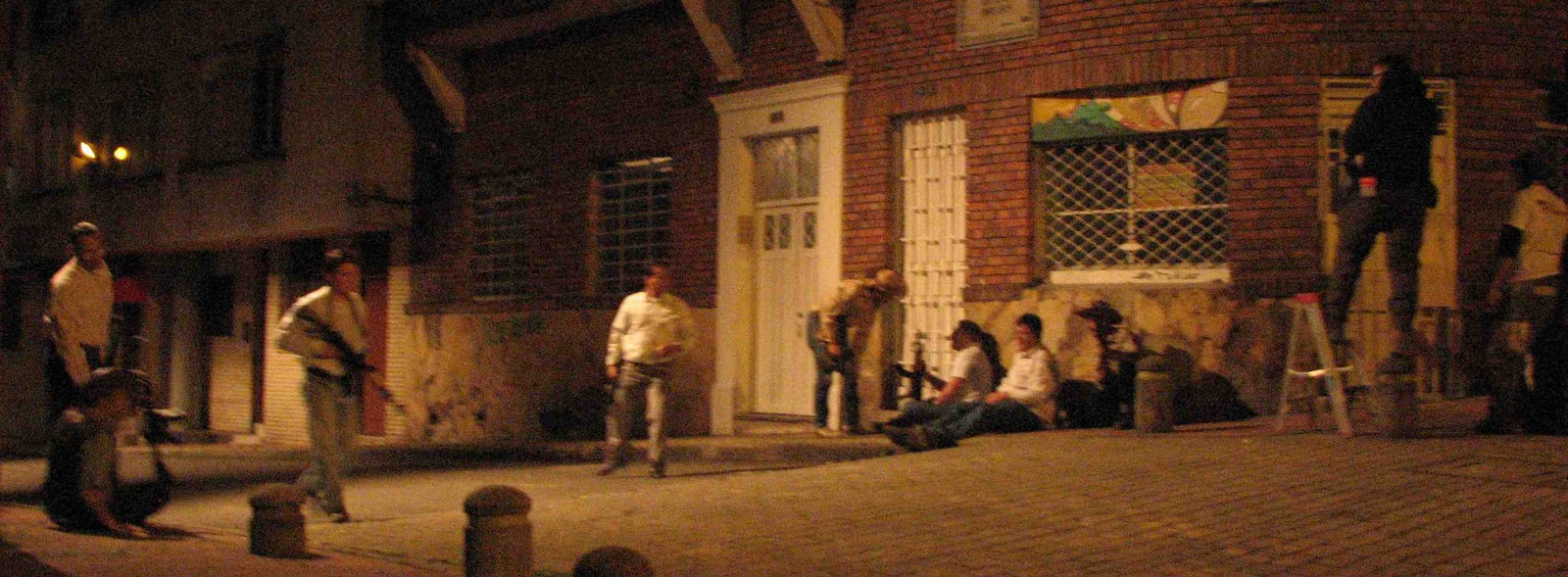
This evening, I ran across this television crew filming a new telenovela - to be called 'La Mariposa' - about drug cartels. They looked like the prohibition-era Chicago mobsters.

Colombians often blame Hollywood for perpetuating an image of Colombia full of drugs and violence while the Colombian government tries to sell the country as a tourist paradise.

The object of our affection, a loaded armored car.
But Colombian media also do their part in scarring their nation's image. Recently, government officials, newspapers and others have criticized the country's TV producers for glorifying narcotraffickers and painting Colombian history as more violent than it actually was. (The country has suffered some five civil wars, as well as huge riots, insurgencies, etc etc.- so is fictional violence needed?)

The neighbors love it! It's even better than television. 
Newspapers complain that the miniseries and soap operas will lure kids into criminal lives. Television producers respond that 'it's art'.

Cartel de los Sapos: Guns, money, cars, beautiful women - what more could a mobster ask for?
In fact, sex and violence sell, here and in the U.S. And television and the movies happily and profitably provide them, with few moral compunctions about the consequences. And Colombians do eat up violence - as tho real-life didn't have enough of it. The country still has an armed conflict in remote regions and a homicide rate far higher than that in the developed world.

The gunfight over, the casualties rise again. It doesn't happen this way in real life. 

By Mike Ceaser, of Bogotá Bike Tours

Wednesday, March 16, 2011

A Miniature San Agustin in Bogotá


Fierce guy!
Can't go visit the dramatic, mysterious San Agustin statues in Huila Department? Now you can see them in Bogotá's Los Martires neighborhood, but you might want to get down on your knees so that they appear to have their original dimensions.

The thirty-odd statues are the winners of a contest held by the local city hall. Some are much smaller copies of or inspired by the statues of San Agustin, which were created by an unknown civilization before 800 a.d. Others are modeled after the statues at Tierra Adentro, and still others are sorts of modern art.

They're in a tiny neighborhood park, behind a mini police station, in a gritty industrial neighborhood near the Central Cemetery, a mile or so from the Red Light District.

The real San Agustin monuments were built by a civilization between the time of Christ and about 700 A.D. The civilization later disappeared, and researchers have made little headway in understanding who they were or what the monuments represent. Many are by tombs or on hilltops.

See kids leaping off of the monuments.


The small park, adjoining a min-police station, is in a very un-Agustinlike setting. 
Some appear to show gods eating children. Wow. 
Big nose man. 
Chaman


Chaquira, without the hips. (There's actually place near San Agustin named Chaquira)
The real San Agustin was never this fun!
I'm happy!
Luis Octavio works marble and granite two blocks away on headstone row, behind Bogotá's Central Cemetery. 

This Muisca indigenous goddess Bachué, carved in a not-so-indigenous style. 

Novios, or lovers. 
See a slide show here


By Mike Ceaser, of Bogotá Bike Tours


The Garbage Museum


Undoubtedly, many people have visited museums only to declare the art 'garbage.' But Bogotá actually has a garbage museum.
Museum of the hidden work of men and women.
Today I tried to visit the museum, in a comfortable-appearing corner house in the middle class La Soledad neighborhood, just a couple of blocks from the City Council building and the National University. You can't miss it, with its suspended tangle of old shoes, toys, a discarded television case and other found objects. Is this folk art, or trash someone neglected to discard?

'The world is this way.'
I knocked on the wooden door, which had an illegible sign hung on it with letters made of trash, and alongside, where others might have hung ferns, old shoes and used styrofoam packaging. A light was on inside, and a young woman look out at me, but nobody answered the door.

A quick look shows that the place is making a statement. The sign on the corner says 'The world is like this,' while the one under the eaves is more pointed: 'Museum of the hidden work of man and woman.' The neighbors give it a shorter name, however: 'The Garbage Museum.'

Two teenage boys stopped in front of the house. Did they know the homeowner? I asked them. Yes, they'd met him, they said. The garbage museum was more than ten years old and the house's interior contained more trash. The owner smoked pot, they helpfully informed me. Did I smoke pot? No, I told them. They seemed to lose interest. They weren't looking for folk art, I guessed. They walked on.

A woman stopped on the corner and said she was a friend of the homeowner, Antonio Zea, a painter who worked only in black and red. His museum's purpose, she explained, is to force people to confront the trash they produce, rather than hiding it away. But I couldn't meet the artist now, she said. He'd been up late last night and wouldn't awake for another three hours. It was three in the afternoon. Such is the artist's life, I guess.


Zea's point is well-taken. However, in Bogotá trash is not exactly out of sight:

Not exactly out of sight, out of mind. A trashpile on a Bogotá corner. 
By Mike Ceaser, of Bogotá Bike Tours

Tuesday, March 15, 2011

Which way for La Septima?

Get me out of this traffic jam! The daily drama on Seventh Ave. 
The debate over what to do about bringing efficient public transit to La Septima continues...and continues....and continuess...

Recently, newspaper columnists and political leaders like mayoral candidate David Luna have criticized Mayor Samuel Moreno's 'Transmilenio light' plan for La Septima. Today, it received perhaps its death blow, when Mayor Samuel Moreno agreed to yet again postpone the project, at the request of Pres. Juan Manuel Santos, who said that Bogotá "would collapse" with even more street projects right now. (Carrera 10 and Calle 26 are already partially closed for Transmilenio construction.)

The National Museum, on Seventh Ave. 
For those who don't follow the twists and u-turns of Bogotá transit policy, previous administrations had planned Transmilenio lines for Seventh Ave. The street carries lots of historical and cultural value for Bogotanos. It also carries lots of traffic and connects some of the city's wealthiest (and private car dependant) neighborhoods to downtown. 

Seventh Ave. is special because it passes by many city landmarks, including Plaza Bolivar, the Presidential Palace, the National Park and National Museum and others. All those historical landmarks make it more difficult to fit a mass transit line onto La Septima, which is considerably narrower than avenues like La Caracas and La Decima.

Preliminary work along Seventh has already begun - just a taste of the traffic distrubances to come. 
That was one reason the Moreno administration used to justify slimming down the original TM plans to a 'TM light' with only a single lane in either direction - and no special lanes at all in north Bogotá - as well as little urban renewal work. Critics say the solution's the worst of both options - lots of expense and transit disruption for a half-baked transit line with very limited capacity. But Moreno has pointed out that his much-planned and much-promised metro line would run parallel to the Seventh, serving much of the ridership demand along the corridor.

Is there anything good about this?
Many neighbors of the Septima, who I suspect live in their cars, argue that such an important and emblematic avenue shouldn't be ripped up for a half-baked transit project which will certainly generate horrendous traffic jams during at least one year of construction. But they ignore the reality that this very emblematic avenue is now chaotic and polluted, that it suffers chronic traffic jams and will only get worse without fundamental changes. Today's El Tiempo editorial points out that right now we've got the worst of both worlds.

The weak link in the mayor's reasoning is that the metro work won't happen soon - if ever, despite Moreno's and Santos' assurances. The Moreno administration is embroiled in a corruption scandal over the TM expansions on 10th Ave and 26th Street. His subway plans have been widely criticized. it's not clear where the money will come from. And Moreno's got barely a half year left in office. Candidates are already campaigning to succeed him - and the early leader, ex-mayor Enrique Peñalosa, has historically opposed a subway as too expensive.

So, the subway is unlikely to happen soon, if ever, which means that Seventh Ave. will carry more and more vehicles during the next years, making a full-scale TM line necessary. And, Seventh Ave. really is special for Bogotá - so it deserves to be done right, with well-designed stations, artwork, green spaces and improvements to public spaces along the way. 


La Septima even has Shakira and her new boyfriend stalled.
Update: At a public hearing in the City Council building this Wednesday, transit officials asserted that Seventh Ave. is simply too narrow to fit eight lanes of traffic which would be standard for a full-scale Transmilenio line and four more lanes for the rest of the traffic. The Transit Secretary also said that building an underpass planned as part of the full-scale Transmilenio system would require closing Seventh Ave. for two full years.

Rail Future for La Septima?
Other speakers at the meeting argued in favor of a full Transmilenio line for the avenue, declaring that a subway will not come soon, if ever. And several speakers argued for a streetcar or light rail line for the avenue. In my view, advantages of light rail would include the reduced pollution and less maintenance costs. Also, high-income people seem to be more inclined to ride rail than buses. However, light rail would be less flexible and require passengers to off-board to transfer to and from the Transmilenio system. 

Finally, one speaker mentioned possible World Bank-financing to turn Seventh Ave. into something called a 'green corridor.' A nice fantasy!

In any case, the politicos have agreed that construction on Septima won't start full-bore until the TM lines on Carrera 10 and Calle 26 are completed.

By Mike Ceaser, of Bogotá Bike Tours

Monday, March 14, 2011

Welcome Al Gore to a Warming Colombia

Going, going, gone? Cocuy National Park's glaciers may be gone in 25 years. (Photo: Paisa Tours)
It doesn't particularly feel like it here in chilly, rainy Bogotá, but Colombia's weather is getting warmer. When Al Gore visits this Wednesday for an environmental forum sponsored by El Espectador, he'll have lots to talk about.

Per-capita, Colombians emit small amounts of carbon dioxide - although that is growing. In 2007, the average Colombian emitted 1.7 metric tons of carbon dioxide - much less than neighboring Venezuela, at 6  tons per capita, and a tiny fraction of the typical North American's almost 20 tons. However, Colombia is eagerly doing its part to dig fossil fuels out of the earth and ship them to the rest of the world to burn. Both coal and petroleum production are booming.

Flooding last year (AP photo)
But Colombia, with its tremendous biodiversity and great dependence on natural ecosystems for water, energy, food and the tourism industry, will suffer badly from global warming - in fact, it already is.

During last year's torrential rains and flooding, Colombia's leaders blamed the disaster on climate change. The New York Times reports that warming is wilting the country's coffee crop. Meanwhile, warming is killing coral reefs and 75% of Colombia's vital paramos, high-altitude wetlands, may disappear. Most dramatically, sea-level rises could turn the city of Cartagena into an island. Colombia's glaciers will be gone in a few decades.

Cartagena - an island?
Like the rest of Latin America, the retreat of Colombia's glaciers will hurt the country in many ways: river flow patterns will change dramatically, devastating agriculture and slashing the hydroelecticity generation on which the country depends.

A poor nation, Colombia is already spending millions of dollars to adapt to climate change.

Another angle: Lots of rainforest is destroyed for coca leaf cultivation and cocaine production. However, those impacts would be reduced if cocaine were not prohibited.

Here's my take on Al Gore's speech.

By Mike Ceaser, of Bogotá Bike Tours