Showing posts with label violence. Show all posts

Monday, April 16, 2018

Gaitán Revisionism

Gaitán supporters at the site of his assassination during the 70th anniversary, April 9 last week.
Gaitán DVDs on sale
on the anniversary of his
assassination last week.
Seventy years ago last week, on April 9, 1948 on Carrera 7's sidewalk Juan Roa Sierra gunned down a leftist, firebrand politician, Jorge Eliecer Gaitán, triggering the Bogotazo riots and creating a popular saint. With all the attention given to the martyr Gaitán around his asssassination's 70th anniversary, it's worth taking a closer look at the man - and his imperfections.

I'm not disputing Gaitan's passion and sincerity. And there's no questioning the courage with which as
congressman he denounced the 1928 massacre, by Colombian soldiers backed by the United States, of banana workers employed by the United Fruit Company.

However, if Gaitán was sincere in his motives, some of his methods and actions can be questioned. And that makes one wonder what he would have done if he'd been elected president.

A monument to Gaitán on Calle 26 near the Central Cemetery.
Gaitán had, after all, already served as senator, minister of labor and of education and mayor of Bogotá. His term as mayor had been most polemical, as he tried to impose draconian - some would say almost fascist - policies, such as dictating to residents what colors to paint their houses, requiring shoeshiners and taxidrivers to wear uniforms - and, most notoriously of all, prohibiting the ruana from the streets of Bogotá. The ruana, a sort of overcoat, is used by Colombia's poor, particularly country people, so banning it was tantamount to expelling the poor from Bogotá. The measures were intended to 'cleanse' and 'beautify' the city for its anniversary, but they got Gaitán ousted prematurely from office.

Just imagine if a right-wing politician like Alvaro Uribe were to try something like that. We'd never hear the end of it. But because it was Gaitán who did it, the episode gets forgotten.

It's perhaps not surprising that Gaitán had fascist tendencies. After all, he studied law in Rome in the 1920s, under Mussolini. Gaitán's populist, angry speaking style was undoubtedly also influenced by Mussolini. So, it's perhaps significant that, as far as I've heard, Gaitán never denounced the European fascists' hatemongering, mass murder and warmaking.

Gaitán was a succesful lawyer. But evidently not a crusading, moralistic one. After all, the very day he was assassinated Gaitán and his friends were celebrating the previous night's court victory - the freeing of a military officer who had murdered a journalist.

If Gaitán was unprincipled enough to defend a journalist's killer, what could the nation have expected
Gaitán's old house, now a museum, in the Teusaquillo
neighborhood. During his life, Gaitán was criticized
for his expensive lifestyle while rallying the poor
against the wealthy.
from him as president, in terms of rule of law? Of respect for a free press? Of civilian control of the military? Some speculate that a president Gaitán would have refused to relinquish power and become yet another Latin American strongman.

Part of the idolization and martyrization of Gaitán is the belief that if he had survived he would surely have been elected president. But that itself is far from certain. Gaitán was on the left edge of the Liberal Party, which was badly divided internally. And Gaitán was a very polarizing candidate, loved by many and hated by many. He might not have won the Liberals' nomination, or might have lost to a Conservative candidate. (A Conservative in fact was elected Colombia's next president.)

A strong parallel can be made to Robert F. Kennedy, assassinated in 1968 while campaigning for the Democratic Party's nomination for U.S. president. Like Colombia's Liberals, the Democratic Party was badly divided at the time, particularly over the war in Vietnam and ultimately lost the presidency to Richard Nixon.

Another aspect of Gaitán's matyrization are the conspiracy theories around his assassination: some claim that he was killed by the Conservative Party, by the Russians, by the Cubans, or - most of all - by the CIA.

These are interesting theories, but they all lack evidence. Yes, Gaitán had lots of enemies inside and outside of Colombia, many of whom would have loved to see him dead. But I've read a lot about Gaitán's assassination and never found a single piece of concrete evidence of a conspiracy.

Gaitán's apparent assassin, Juan Roa Sierra, was seized and lynched by a furious crowd immediately after the shooting, making it impossible to be definitively prove that he was the assassin or to know whether there was a conspiracy behind him. (Gaitán's killing triggered the horrific riots remembered as the Bogotazo, and the following low-grade civil war known as La Violencia.) But the crowd must have had a reason for attacking Roa. And, afterwards, Colombia hired Scotland Yard to investigate the assassination, who also concluded that Roa had done it.

And if the CIA had been behind Gaitán's killing, we'd know about it. After all, the CIA backed coups in Chile, Guatemala, Iran and other places, all of which is well documented from released CIA files. And the CIA tried many times to assassinate Cuban revolutionary leader Fidel Castro, and that is also well-documented. (Castro, coincidentally, was in Bogotá at the time of Gaitán's assassination and had a meeting scheduled with Gaitán that very afternoon.) If the CIA were behind Gaitán's killing, we'd know it by now.

We don't want to hear about the imperfections and failings of the 'great man' many believe Gaitan to have been. And that's amplified when the man is martyred. But John F. Kennedy and his brother Robert were cold warriors, and Robert worked for red-baiter and hatemonger Joseph McCarthy. Abraham Lincoln was racist and made a fortune as a lawyer by representing railroad companies when he might have been defending escaped slaves who being hunted down by southerners who claimed to own them.. The Rev. Martin Luther King was a womanizer. Winston Churchill was an unabashed imperialist and held backwards, racist beliefs which would make him a pariah by today's progressive standards. After the Cuban revolution, Che Guevara managed a prison where inmates, including young boys, were executed without trial just for having been part of the old regime.

None of these defects prevent these men from being 'great' because they stood for or accomplished important things - even if they had big flaws.

It is uncomfortable to think that a 'great man' who changed history, or might have, was killed by a maladjusted nobody. But that seems to have been the case over and over again. It's much more interesting and satisfying to believe in a conspiracy or great dark forces. But, to do that, one needs proof.

Who knows why Gaitán chose to represent a murderous military man - particularly when the military was murdering Liberals? Were the rest of his cases more idealistic, or similar?

By Mike Ceaser, of Bogotá Bike Tours

Wednesday, November 15, 2017

When Institutions Don't Work

Are they real, or just virtual?
Case One: For months, our building's sewage system regular crisis. During hard rains, the
wastewater would back up and come flowing up out of the bathroom drain, obliging all of us to grab mops and buckets and clean the mess up.

The landladies, who live upstairs, didn't care - until it happened to them. Then, they hired laborers to clean and rebuild the house's pipes. Then, the only step left was for the city's Acueducto, or Water, department, to hook the house's pipes up to the city sewer line.

That was months ago, and we're still waiting.

One of the landladies, who has physical and psychological problems, has visited Acueducto at least a half dozen times, and come back with promises that they would do the work 'in a few days', 'in a week', 'in a month', etc. They even wrote 'Emergencia!' in big letters on one of the work orders. They've broken all their promises.

To compound the situation's absurdity, the last time the landlady visited Acueducto, they told her she needed to first go get permits from the city's Transit and Public Space departments. And then come back to acueducto.

Shouldn't the water department, rather than the homeowner, have the responsibility of coordinating with the transit department about planned street work? And if they do want the homeowner to do the city employees' job, shouldn't they have told her this the first time she visited, months ago?

Or is all this delay and run-around their way of saying 'You need to grease my palm to get anything done'?
'God and Fatherland.'
And where does the
public service come in?

Case Two: More than two months ago, a foreigner who has lived in Colombia for years was walking down a Candelaria street when a youth stabbed him several times in the back.

The foreigner almost died of blood loss, spent more than a month in the hospital, underwent a half dozen surgeries, lost a piece of one kidney, and is now at home recuperating.

Meanwhile, what have the police done about this attempted murder? The police 'investigador' only interviewed the victim more than two weeks after the attack - and only after we complained to his superiors - and more than two months after the crime he has not talked to the witness. The street has many video cameras which might have captured the attack, but the investigador hasn't looked at the videos. Instead, he gave the victim's teenage son a letter authorizing him to obtain the videos.

"He wants me to do his job," the son says.

A Colombian acquaintance who works in a La Candelaria hotel had a similar experience after being stabbed in an attempted mugging. He went down to the police station and placed the denuncia, but hasn't heard from the cops since.

How many people have these criminals robbed, attacked or even murdered since? But identifying and catching them seems to carry a much lower priority with the cops than, say, shaking down kids for smoking pot or stopping tour guides for working without the benefit of a Sena certification.

And if the public institutions are this apathetic and abusive here, in central Bogotá, in one of the city's more important neighborhoods, the heart of its tourism industry, then what happens when someone needs help in Usme, Kennedy, Ciudad Bolivar or some other barrio popular?

Yet, the really remarkable thing is that Colombian institutions actually work WELL compared to those in many neighboring countries, such as Venezuela and Bolivia. Hundreds of thousands of Venezuelans have sought refuge in Colombia because of the astronomical levels of corruption and criminal violence there (as well as the collapsing economy and hyuperinflation).

In Bolivia, where I lived some 15 years ago, the public institutions seemed designed primarily to squeeze money out of the people they were supposed to serve. There, my landlady's telephone would get cut off periodically, and she'd have to go down to the phone company and pay someone a bribe to get it turned back on. And the police seemed to make a practice of arresting people in order to force them to pay a bribe to be released - a form of institutionalized state kidnapping for ransom.


By Mike Ceaser, of Bogotá Bike Tours

Wednesday, November 8, 2017

Crack Down on Guns!


'Popeye,' one of Pablo Escobar's killers, shows off a tool of his trade.
Years ago, working on a construction site in Texas, I met a tall Texan in his 50s who had just gotten out after ten years in prison. He was a good-natured man who I doubt would have stolen a wallet if he'd found it on a park bench. Rather, he'd gone to prison for killing a stranger.

Homicides in Colombia by guns
(light blue) and knives (dark blue).
Altho knives are much more common,
guns kill many more people.
(Source: El Tiempo
He told me that he and his father had pulled into a gas station somewhere in Texas and started filling their tank. Unbeknowest to them, the rule was 'pay before you pump,' and another man was in the office paying for the gasoline that my acquaintance and his father were pumping.

The other man, believing that these two were stealing his few dollars worth of fuel, did what Texans do: He pulled out his gun and ran toward them. My acquaintance, seeing the stranger coming at him with pistol pointed, pulled out his own gun and shot the other man dead.

One man died and another did ten years in prison - at huge cost to society - because of a misunderstanding over a few gallons of gasoline. If they had not been armed, they would have argued briefly and resolved the situation with a handshake.

Those sorts of routine, deadly confrontations - even more than mass shootings like the recent ones in Texas and Las Vegas - are why Colombia is right to tighten its gun control laws.

The correlation is clear: Number of guns and number of
gun massacres, the U.S. is in a class by itself.
(Source: New York Times)
According to a recent study by the Fiscalia, reported by El Tiempo, 7 out of 10 homicides in Colombia are committed by firearms.

"Firearms have a preponderant role in lethal violence in Colombia," the report said.

Bogotá can add one more fatality with the death this week of Daniela, a university student shot in the head by a mugger on her way home in April. She lingered in a coma for seven months while her family and friends agonized. The killer has not been caught.

Firearms are smuggled illegaly into Colombia from the United States, Central America and Europe. But others are purchased here legally, only to be used criminally. Of the almost 86,000 firearms seized by authorities between 2014 and '16, almost 20% had been purchased legally in Colombia but made their way to criminals.

What's more, the proportion of firearms confiscated from members of criminal organizations captured or killed has plummeted in recent years, from 94 guns for every 100 members of such organizations in 2010, to only 19 per hundred in 2015. That might mean that the organizations are getting better at hiding their guns, switching to other weapons, such as knives, or that corrupt police are confiscating but not reporting weapons in order to sell them on the black market - and back to criminals.

And that happens frequently. I once covered the crime beat for a small town newspaper in Mississippi. One of the most frequent items stolen in home burglaries were guns - perhaps legally purchased, but now in criminal hands.

As in the U.S., the large number of firearms in private hands in Colombia turns minor confrontations deadly. In the city of Cali, 42% of homicides result from such confrontations rather than contract killings. In Bogotá, the proportion is 21%, in Medellin, 14%, according to El Tiempo.

To tighten up access to firearms, the Fiscalia offers the example of Japan, which has only a tiny number of gun homicides. There, in order to obtain a permit to own a gun, a person must pass a written test, a gun handling test and a psychological examination.

In Colombia, a person must, among other things, show the results of a psycho-physical evaluation and explain why he or she needs the weapon for protection from threats.

Related: 

The Axis of Killing


A Gun Sale Gone Wrong


By Mike Ceaser, of Bogotá Bike Tours

Tuesday, December 2, 2014

1989, a Fatal Year

Wreckage of the bombed Avianca flight.
On the morning of Nov. 27, 1989, a teenager nicknamed 'El Suizo' disguised as a businessman boarded an Avianca flight from Bogotá to Cali. The youth carried a suitcase which his handlers had told him contained a device to record conversations of enemies of the Medellin drug cartel.

Five minutes into the flight 25 years ago, the young man, whose family survived by picking thru trash for things to sell, obediently pressed the 'record' button. But the suitcase contained explosives, which blew the Boeing 727 out of the sky, killing 107 people on board, including the young man. The wreckage fell on a rural area of Soacha, in south Bogotá, killing three people on the ground.

But the bomb's apparent target, presidential candidate Cesar Gaviria, had not taken the flight.
Aftermath of bombing of the DAS building in Bogotá.

The Avianca bombing was only the most deadly of the terrorist attacks and assassinations which took place in 1989, a quarter century ago. Only nine days later, a truck bomb containing about 500 kg of dynamite exploded beside the Bogotá headquarters of the DAS, Colombia's FBI, killing 52 people and injuring about 1,000.

The bomb was apparently planted by the Medellin Cartel to kill DAS director Miguel Maza Márquez, but he escaped unharmed.

In August of that same year, presidential candidates Luis Carlos Galán was assassinated, by a conspiracy also led by Escobar. Two newspapers, including Bogotá's El Espectador, were attacked with car bombs. And in Antioquia, both the governor and chief of police were assassinated.

Guards react to presidential candidate Galán's shooting.
Perhaps the most perverse crime of 1989 was the massacre of Rochela, Santander, when 12 court experts investigating the disappearance and murder of 19 businessmen were themselves massacred by paramilitaries.

And the most absurd episode may have been the drug-financed murder of a football referee, which forced the cancellation of a national championship game.

And, the next year, leftist presidential candidates Carlos Pizarro and Bernardo Jaramillo would be assassinated by right-wing forces.

Many of these crimes are still under investigation, including the Avianca bombing. Only one person,

'Colombia With Memory.' Relatives of victims
of Pablo Escobar.
one of Escobar's hit men, has been convicted for the bombing. Dandenis Muñoz, nicknamed 'La Quica,' is doing multiple life sentences in the United States because two U.S. citizens were on board the plane. Muñoz denies any part in the plane bombing, and several news reports support his case. But Muñoz unquestionably committed many atrocities during his years as one of Escobar's hit men. Popeye, another Escobar hit man, who was recently released from a Colombian prison, has acknowledged helping plan the bombing. Investigators today are particularly interested in whether public officials collaborated in the bombing.

The Avianca case is just one of many from that era which never seem to die. A few days ago, investigators disinterred the remains of M-19 presidential candidate Carlos Pizarro to test, among other things, whether one of his bodyguards may have killed him.

Escobar hit-man Jhon Jairo Velásquez, alias Popeye.
But, while the late '80s was one of the bloodiest periods in Colombia's history, the victims have not received the same government compensation as have some of those persecuted by leftist guerrillas, right-wing paramilitaries and government forces. That's because narcotraffickers' crimes are not considered political, even tho their victims may suffer just as much and be just as dead. (The Avianca case, however, has been officially declared to be a 'crime against humanity.')

Today, in an attempt to restart the peace negotiations with the FARC guerrillas, the government broached the idea of categorizing narcotrafficking as a 'political crime.' The idea is absurd on its face, but would enable a new level of impunity to the guerrillas, making possible a peace treaty which the FARC leaders could sign.


By Mike Ceaser, of Bogotá Bike Tours

Friday, August 22, 2014

Fewer Murders, More Injuries

Police hustle away a young man a week ago in San Victorino. I don't know what he had allegedly done - perhaps assault or theft.
While Bogotá leaders have crowed in recent years about the city's decreasing
rates of kidnappings and homicides - during 2013 the homicide rate was 16.7 violent deaths for every 100,000 Bogotá residents, down from 22.1 per 100,000 in 2011 -  personal injuries have increased, from fewer than 42,000 in 2009 to over 45,000 last year.

'A city under the scourge of
personal injuries
' reports El Tiempo.
The rise in personal injuries could well be a measurement issue. However, in a more peaceful city, one would expect a dramatic drop.

And, during the past few weeks, I've happened on more than my share of scenes of violence. Here are a few images.

An alleged thief lies on the sidewalk near the Museo de Oro. Other people had kicked him until the man in the striped shirt intervened. Soon after, police showed up and took him away. 
A policeman attends a young man (not visible), who had just been mugged by three youths who left his face and arm blooded before running off.  
The young man's injuries left blood splattered across the sidewalk.
By Mike Ceaser, of Bogotá Bike Tours

And If Galán Had Lived?

Luis Carlos Galán's assassination 25 years ago this past Sunday was one of many such political killings during the 1980s and '90s - but is still the most iconic.

The charismatic, incorruptible Galán would almost surely have won the 1990 presidential election. But an assassin's bullet killed him on the evening of August 18, 1989 while campaigning in Soacha. Galán's death and his popularity shared a common cause: His uncompromising opposition to the corrupting influence of the drug trade.

Galán was shot by an assassin who fired upward from his hiding place beneath the speaker's stage. Cartel kingpin Pablo Escobar and right-wing paramilitaries had planned the killing, but a quarter-century later investigators continue looking into corrupt collaboration by Galán's security detail.

What if the assassination had failed? Most likely the assassins would have tried again - they had already tried and failed once before, after all. And Escobar later bombed a passenger airline out of the sky in a failed attempt to kill Galán's successor, Cesar Gaviria. Gaviria, who would go on to win the presidency, had not taken the flight.

But if Galán HAD become president, history could have taken different turns. Galán's support of the practice of extraditing Colombian drug traffickers for trial and imprisonment in the United States - the punishment they most feared - could have made Colombia's drug war even more bloody and violent than it in fact was. But it might have been shorter, as well.

On the other hand, one of the signal events of recent Colombian history, the 1991 constitutional convention
Security guards scramble Aug. 18, 1989 in the
plaza of Soacha after Galán was gunned down.
which produced the humanist Constitution in force today, might not have happened at all. That's because it was Galán's assassination which motivated the convention's organization.

On the other hand, a President Galán's strong moral compass might have reduced the cynicism and disillusionment with politics which many Colombians continue to feel today. At least, that could have been true if Galán had become a successful president. That was far from assured, since, according to at least one opinion, his lack of willingness to compromise had earlier made him a terrible minister of education.

But if Galán had been an effective president, the consequences could have been limitless. A stronger, respected and less corrupt state could have reined in the cocaine economy and weakened the guerrillas. The right-wing paramilitaries which rose up in response to the guerrillas might never have appeared at all. Perhaps the failed 1998 negotiations with the FARC would have gone differently - or not been needed at all. In a more secure, successful Colombia, the election of hard-line Pres. Alvaro Uribe, with all its consequences in corruption and human rights violations, might not have taken place.

But I'm dubious about all of this. Unless you believe in the 'Great Man' theory of human history, there are broader forces which determine events. Colombia was able to beat back the cocaine cartels and waken the guerrillas not because of any one leader, but because of changes such as the end of the Cold War, which enabled the United States to direct money and attention toward other issues, such as Colombia's crisis.

Galán might have been an excellent, honorable president. And, today's Colombia might be better thanks to him. But I doubt he could have fundamentally changed the nation's course.

By Mike Ceaser, of Bogotá Bike Tours

Tuesday, July 29, 2014

A Shocking Proposal: Tasers for Colombian Cops


Cops on patrol today on San Victorino Plaza in Bogotá. They appeared to be carrying regular pistols.
Colombian media are asking whether the 'electric pistols', commonly known as tasers, are dangerous. Colombian police use some of the devices and may buy more of them.
Israel Hernandez, a Colombian-American
who died last August after being
tasered by police in Miami Beach.

The answer obviously is 'yes,' but that's the wrong question. Nothing is perfectly safe, particularly a device designed to incapacitate violent criminals by causing them pain.

And police will use some dangerous device, whether billy clubs, tasers or regular guns. The right question to ask is whether tasers are better than the alternative.

Tasers have a bad image here, and perhaps rightly so, because last August Israel Hernandez, an 18 year-old Colombian-American graffiti artist was killed in Miami Beach by a police taser charge.

A taser.
Hernandez's death was a tragedy. However, in August 2011 another young Colombian grafitero, Diego Felipe Becerra, died in Bogotá after police chased and shot him with a real gun. Becerra would probably be alive today if those cops had been using a taser.

According to Amnesty International since 2001 500 people in the United States have been killed by electric stun guns. Every one of those deaths is a tragedy. But every year tens of thousands of people in the U.S. are killed by firearms. If those were replaced by tasers, almost all of those people would have survived.

Bogotá graffiti artist Diego Felipe Becerra, 
shot to death in 2011 by police firearms. 
Any weapon can be deadly. I'm sure that many people have been killed with billy clubs. But tasers will more likely be used in place of real guns. For all the dangers of tasers, real guns are much more dangerous, not only to the suspect, but also to bystanders. A bullet can kill or injure someone hundreds of meters away. Miss with a taser charge and nothing happens.

According to a police study cited by Wikipedia, taser use reduced police deaths by 75%. The Taser company's website claims that their products have saved 128,000 lives and counting. I wonder how they came up with that number. However, if I were a youth being chased, rightly or wrongly, by police, I'd much prefer they carried electric pistols than ones with bullets in them.

Bogotá cops: better off with firearms,
electric pistols, or both?
And, if I were a cop, I'm sure I'd prefer an electric pistol to a real gun except in extreme situations. Say you're called to a tavern where a drunk construction worker is throwing chairs at the walls. You can't get close enough to club or tackle him. You could try to shooting him in the arm, but you might miss and kill him or another patron. And shooting a suspect would surely mean an investigation and newspaper headlines. So, you pull out your electric pistol and immobilize the guy, at minimal risk to other bar patrons.

Another danger of real guns was highlighted by the ongoing scandal over the importation of thousands of Sig Sauer pistols, apparently in violation of German law. Some of those pistols were stolen before police even received them - meaning that criminals are likely using them today to rape, robbery or even murder. I'd much rather that those criminals get their hands on tasers - which fire only one to three times and which the bad guys probably wouldn't even know how to use - than real guns.

It's amazing to me, too, how the potentially illegal purchase of tens of thousands of deadly real guns and the theft of some of them, produced little news, while the purchase of a few hundred electric stun guns has generated a firestorm. It's a testament to how blasé society has become about the proliferation of firearms.

By Mike Ceaser, of Bogotá Bike Tours

Saturday, July 26, 2014

Envisioning Violence

Paramilitary fighters overlook Medellin; by Jesus Abad Colorado.
Few nations have had more experience with violence in recent decades than has Colombia, and probably no region of the world more than Latin America.

'Comuna Trece,' by Jesus Abad Colorado.
So the exhibit 'Reality in Conflict' on now in the Espacio Arte Nexus in the Las Nieves neighborhood is timely and thought provoking. A girl peers out thru a bullet hole in a window in Medellin's notorious Comuna 13; Paramilitary fighters with automatic rifles overlook Medellin; Bolívar's plate crumbles into cocaine; Colombia's 1,000-peso bills carries not only one image of martyred leader Gaitan, but many.

The works, all of which come from private collections, span decades of art and include work by famed photographers and painters. Most are understated, but their message is still clear.

Unfortunately, the gallery, located on the second floor of a nondescript building in the Las Nieves neighborhood, is only open for walk-in visitors on Saturdays. However, you can call and make an appointment to see the exhibition on a different day. The exhibit ends Aug. 7. Tel: 249-5514

Amidst the plethora of abstract art exhibitions, which say almost nothing, this one's worth seeing.

'Violence Study,' by Alejandro Obregón.'
'Violence', by Luis Angel Rengifo.
'The harvest of the violent ones'. By Alfonso Quijano.
The nondescript Las Nieves building, on Carrera 8, nos 20-17, which contains the Espacio Arte Nexus, has been converted into art studios. Tel: 249-5514
A video by Fernando Arias.
Bronze sculptures by Fernando Arias.
'Flowrs for Diana', by Zoraida Diaz.
Juan Manuel Echavarria, 'Requiem NN.'
'The biggest weapon makes the rules.' By Moris (Israel Meza Moreno)
By Maria Cano.
From The New York Times, Sept. 1970. By Liliana Porter.
'Efluvio (Miedo)' by Johana Calle.
'Who can erase the prints?' by Regina Galindo.
'Boceto.' By Deborah Arango.
'Justice'. By Debora Arango.
'Knife fight class.' By Edwin Sanchez.
How to make a knife.
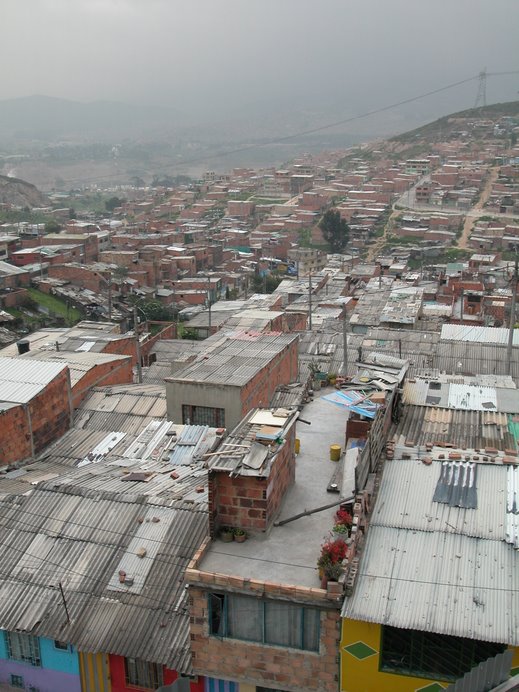
Slums.
'Tirofijo,' by Jonathan Hernandez. Tirofijo was the founder and historical leader of the FARC guerrillas.
'Shell ball', by Fernando Arias.
Multiple Gaitans, by Luis Hernandez Mellizo. Jorge Eliecer was a populist politician whose 1948 assassination triggered the Bogotázo riots.
'Knights of faith,' by Jose Alejandro Restrepo. (Rescue workers carry dead and injured out of the justice palace in 1985. 


Plates fracturing into - guess what?
'Bolivar's plate,' by Juan Manuel Echavarria.


'Legion,' by Carlos Castro: a music machine made from knives.


By Mike Ceaser, of Bogotá Bike Tours