|
| A newspaper announces deaths and injuries in labor conflicts in the banana region. (Photo: Radio Nacional) |
However, bizzarely, nobody's sure exactly what happened in Ciénaga, Magdalena on that 5 and 6 of
 |
| Banana workers of the era. |
The event burst into the news recently when conservative Senator María Fernanda Cabal claimed that it was the workers who attacked the soldiers that day.
"The confrontation did happen," she said on W Radio. "But what turned into a myth is the idea that the massacre was committed by the Army against unarmed workers. That's a lie: The workers were armed by the International Socialists, and they attacked by security forces."
"During that massacre, more soldiers than workers died," she added to the El Espectador newspaper.
That's exactly the reverse of the story I have learned, in which the striking banana workers had gathered in the town's plaza. Unbeknownst to them, the army had machine guns set up on the plaza's corners, from which they poured a murderous fire upon the strikers.
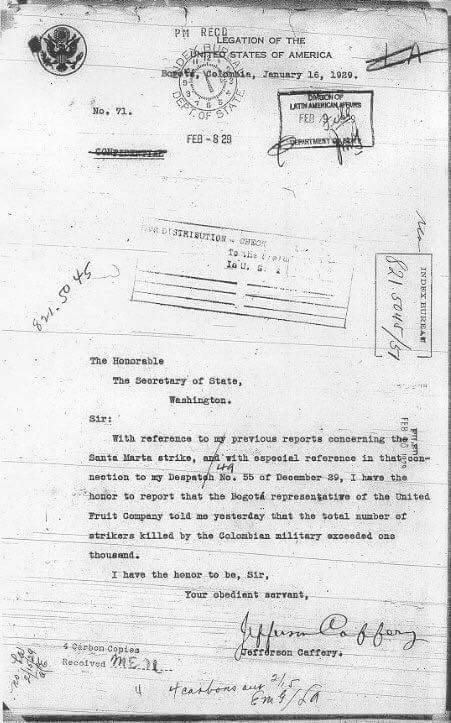 |
| February 1929 letter by the U.S. ambassador citing a fruit company executive's statement that 1,000 banana workers were killed by soldiers. |
The statement said that Cabal "discredits the profession" and "offends not only the dignity of the victims, but also the nation's historical memory."
Cabal is correct that the events of that day are unclear - but her accusations against the workers - based on a vision of great communist conspiracy - appear groundless.
Cabal first aims her criticism at novelist Marquéz, who made the masssacre a key event in 'One Hundred Years of Solitude,' the novel which earned him the Nobel Prize.
In that novel, the soldiers kill 3,000 workers. But Marquéz was always clear that he had written fiction, and exaggerated the number of dead to fit the dramatic proportions of his novel. He said that before writing he had first researched the event, but could not determine how many died.
"To say that all of that (drama) took place for just 3, 7 or 17 deaths...So I decided that they were 3,000 deaths, because was what was required for the proportions of the book I was writing," he said later.
But fiction became fact. The 3,000-deaths number was even repeated in Colombia's Congress - to Marquézes' objections.
In support of her argument, Senator Cabal also cited a book by Eduardo Mackenzie called 'Las FARC, Fracaso de un Terrorismo.' However, the pages which Cabal posted on Facebook argued only that no thorough investigation of the events was done, but did not support her argument that the workers massacred soldiers.
Perhaps the most concrete number came from the U.S. ambassador in Colombia, who sent a telegram to the U.S. State Department saying that a United Fruit Company official had told him that 1,000 workers were killed in the massacre. It's a suspiciously round number, but it doesn't seem likely that the either the company or the embassy would exaggerate the number of dead when they themselves were implicated in the killings.
We'll never be certain exactly what happened in Cienaga on that warm day in 1928. However, it is undisputed that the banana workers were badly exploited, at least by today's standards, by the fruit company. For example, they had to work Sundays, did not receive compensation for injuries, were paid not with tokens instead of money, and could only spend the tokens at the company's high-priced stores. And, with low banana prices, conditions had worsened, triggering the strike.
By Mike Ceaser, of Bogotá Bike Tours


 Posts
Posts