Showing posts with label urban sutainability. Show all posts

Sunday, August 27, 2017

Stump City: The Deforestation of Bogotá

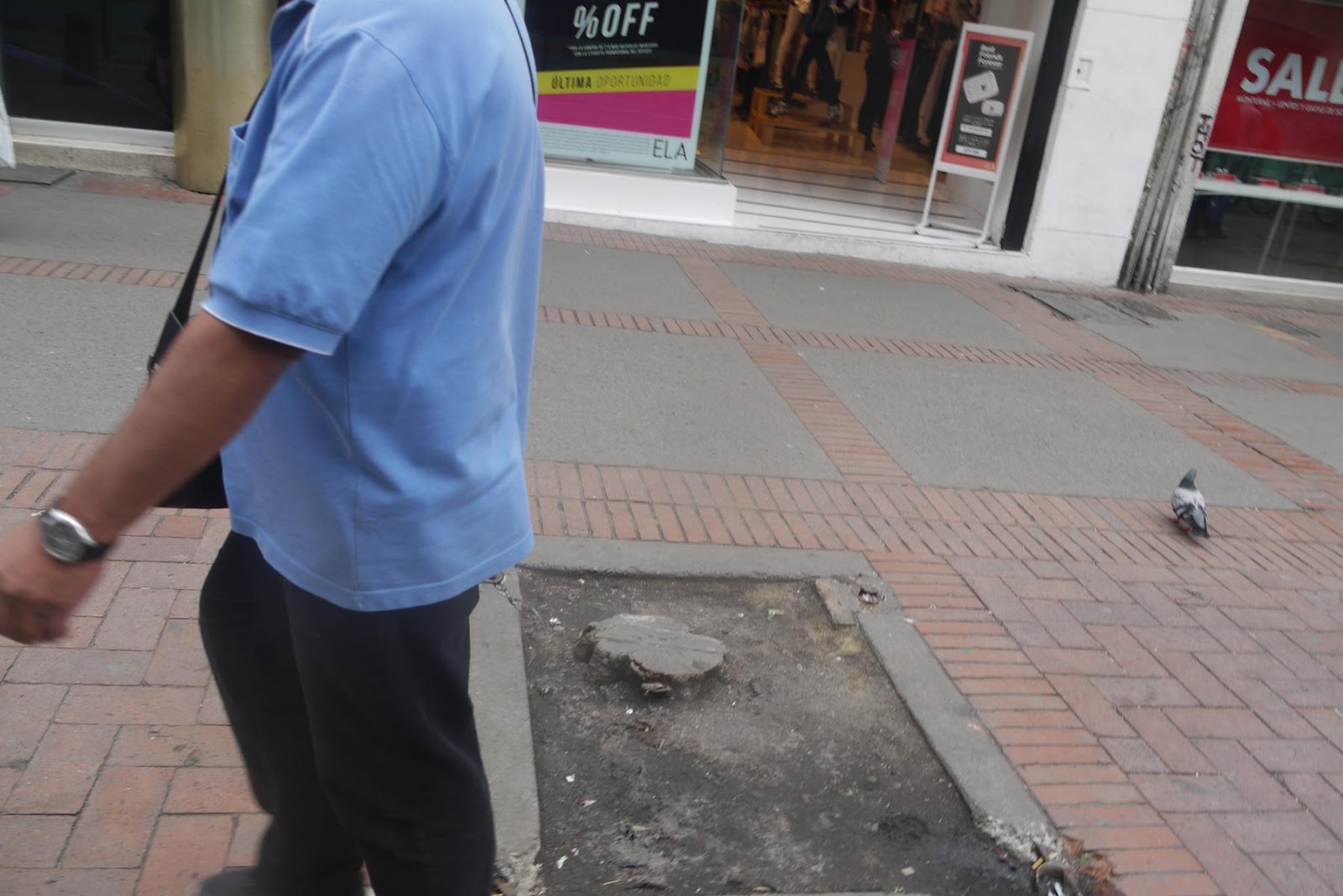
A freshly-cut tree stump on Carrera Septima, in the city center.
Trees cool cities down, reduce pollution, noise and stress, and add beauty to urban areas. They can also provide habitat for bats and birds, which eat pesty insects. But, sadly, anybody walking past the series of stumps along Carrera 7 in downtown could be forgiven for believing that Bogotá's suffering an urban deforestation.

A forlorn tree stump on Las Nieves Plaza.
Urban trees can certainly cause trouble: they fall down, drop branches and leaves, and their roots can break sidewalks and water pipes.

So, when one of those grand old trees becomes a nuisance, the easiest response may be to just cut it down. That solution is not only easiest, but also the most profitable: I understand that the city contractor gets paid for each tree it cuts down (rather than each tree it saves) and also gets to sell the lumber.

With incentives like that, it's a surprise that any tree is still standing.

It wouldn't be so bad if they actually replaced the trees, but the city rarely seems to.

Along Carrera 7, the stumps have it. I didn't see any signs of replanting, either.


In the Parque Nacional, this big tree is leaning over, but otherwise healthy. Will officials cut it or save it?
Manuel can't hold the tree up, but a steel or cement column might. Instead, bet that the tree will be cut down.
Update: The city is doing some sort of work on Carrera Septima, which may be the reason for cutting down all of those trees. Perhaps there's hope yet for the urban environment, if not for the rural one.

By Mike Ceaser, of Bogotá Bike Tours

Tuesday, April 28, 2015

Reaching for the Sky, Forgetting the Ground?

Trouble on the ground? The unfinished BD Bacata just became the tallest tower in Colombia.
According to news reports, the BD Bacata Tower, being built by the intersection of Carrera 7 and Calle 19, just became the tallest skyscraper in Colombia, surpassing the 48-story, 196-meter Torre Colpatria, on Carrera 7 and Calle 26.

Reaching for the sky: An artist's
rendering of the BD Bacata tower.
I suppose that this is something to be proud of - despite some development researchers' observations that the construction of arrogantly tall buildings often anticipates economic swoons. 

The Bacata's website boasts about the project's urbanistic positives - mostly the fact that its central location won't contribute to sprawl and will reduce travel times to reach it. Those certainly are pluses, as is the potential to use public transit in the area. 

But none of that obviates the need for planning and investment to keep the surroundings livable and transit in the area functioning - things that aren't often the case now, even without this immensity. 

The 66-story BD Bacata will contain a parking lot, shopping mall, offices, apartments and a 364-room hotel. None of those are designed for poor people. Sadly, even with the area's wealth of bus service, most of the complex's users will likely arrive by car, snarling the chaotic traffic on Calle 19 and the narrow secondary streets. (Carrera 7 is currently pedestrian-only during the day.) 

Central Bogotá's skyline, with the Bacatá on the left.
While the Bacata's construction is advancing rapidly, I've seen exactly no, (zippo, 0, nada) transit improvements nearby to prepare for the onslaught of vehicles which this city-in-a-building will generate. In a rational city, of course, the Bacata's builders would be required to contribute to TransMilenio and-or light rail lines to expand the capacity of the adjoining avenues.

I won't even speculate about the capacity of nearby water, sewer and electricity service, nor mention the lack of nearby green space. And, how about urban renewal of the adjoining blocks, which are quite seedy? Will the Bacata's residents and users dare to walk a block outside the building, or immediately take refuge in a private vehicle - compounding perpetual traffic jams?

In an interesting aside, the Bacatá claims to be the world's first crowd-funded skyscraper.

By Mike Ceaser, of Bogotá Bike Tours

Thursday, April 16, 2015

´Do As We Say, Not As We Sell´


'Get On the Bus', editorializes El Tiempo. But buy one of our advertisers' cars, first.
One of the huge, daily traffic jams on Calle 26.
El Tiempo, Colombia's largest newspaper, has long been part of the chorus calling for people to use mass transit instead of private cars. And I can't doubt their sincerity. After all, the evidence is there for all to see in the city's immense and ever-growing traffic jams.

But, while El Tiempo wants you on the bus, they clearly also want you to buy a car, whose propaganda constitutes much of the newspaper's advertising, including two weekly pull-out car magazines. (The editorial, in any case, is mealy-mouthed and consists mostly of cliches, while neglecting the only policy demonstrated to reducing car use - a congestion charge.)

El Tiempo's hypocrisy in calling for less car use while doing all it can to promote car sales, is an example of the contradictions in many of us, not least of all Bogotá's city government, which claims to want to reduce private car use. Until the government and others actually make their policies match their rhetoric, the traffic crisis will only get worse.
A lone cyclist weaves thru traffic near the National University.
One of the huge, daily traffic jams in La Candelaria.
By Mike Ceaser, of Bogotá Bike Tours