Showing posts with label transmilenio. Show all posts

Sunday, September 9, 2018

A Climate Protest Against...Peñalosa

Rallying for the climate - kind of - in the Parque Nacional.
At a rally against climate change yesterday participants protested against...Mayor Peñalosa.

The gas masks say 'No TransMilenio.' Does this make sense
 if it means keeping the old 'rolling chimney' buses around?
Some of the issues seem reasonable, such as protesting the recent cutting of urban trees (the city says that some trees have become hazards). And defending the Van der Hamm protected area north of Bogotá, which the city wants to develop (the city says the protected area has already been damaged).

But the rally's primary emphasis seemed to be opposition to the expansion of the city's TransMilenio express bus system...the very same system which has won international awards for reducing climate change gases.

And, while it is a different, if related, issue, many TransMilenio buses are relatively clean burning, and the city promises that buses on the planned
'Bogotá free of fossil fuels.' We'll
expect that one tomorow.
Septima corridor will be electric or gas-powered zero emission vehicles. Meanwhile, many of the old buses running on the avenue are literal rolling chimneys. Is keeping those polluters on the road by opposing TransMilenio really pro-environment?

Even more absurd were the calls for a 'Bogotá free of fossil fuels.' If only! But such unrealistic fantasies only distract from achieving real changes.

And if these people were really against climate change, they'd oppose the private cars inundating the city by the tens of thousands every year, which generate much more greenhouse gas per-rider than buses do, as well as hogging space and clogging roads. But I didn't see a word against private cars.
Two old 'rolling chimneys' which passed the park where they were protesting against TransMilenio.


Protest these? New relatively clean TransMilenio buses on Carrera Septima.


Don't cut down trees!


Smoking away. No contradiction between protesting pollution and polluting.
Smoking away: These pollution protesters saw no reason not to pollute themselves.

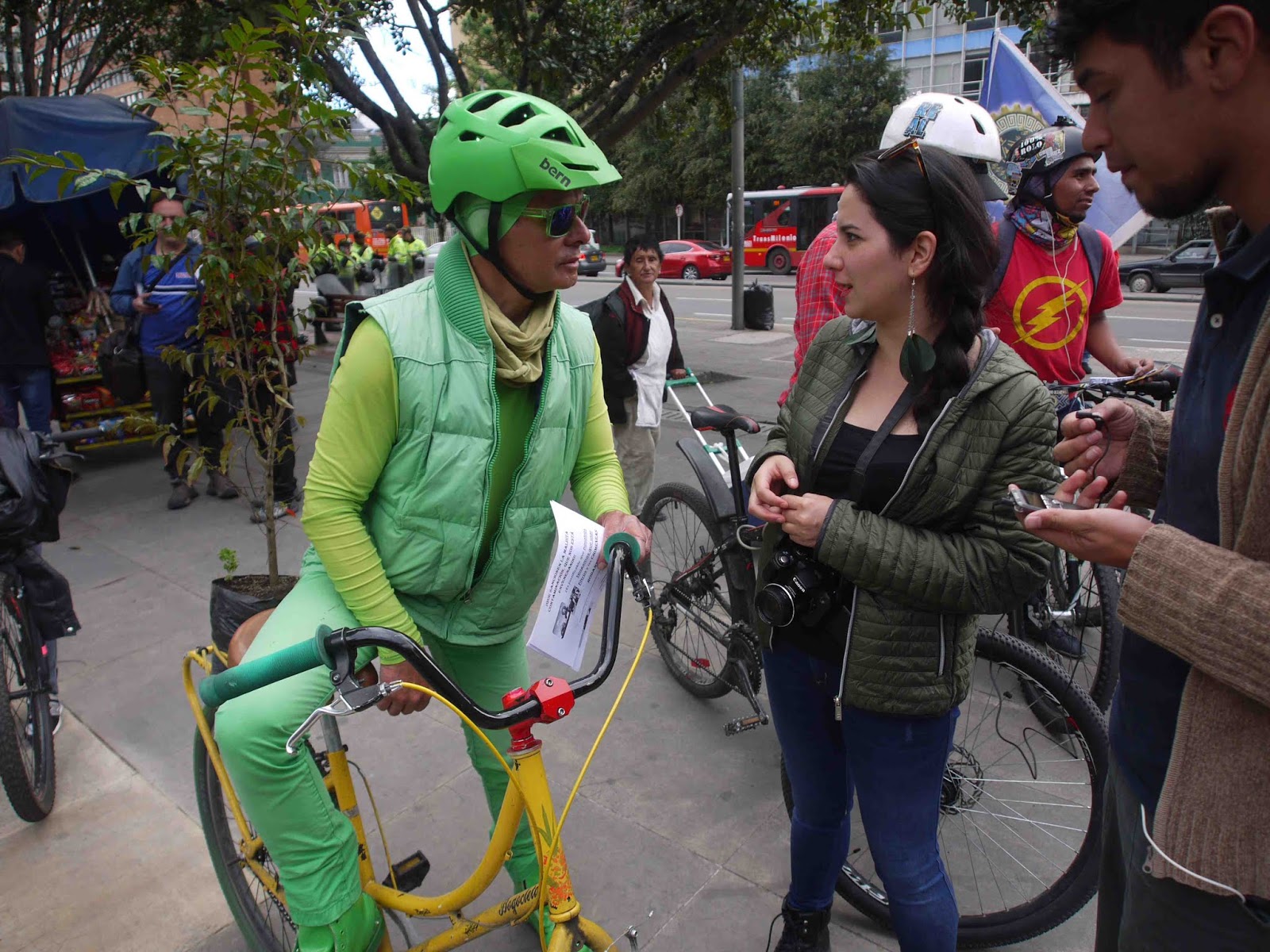
Activist Greenman at the protest.

No TransMilenio on Carrera Septima - because we like those old rolling chimneys!


No TransMilenio on Ave. 68.

Protect the wetlands.
By Mike Ceaser, of Bogotá Bike Tours

Friday, May 11, 2018

A Respite for Bogotá's Breathers?

A TransMilenio bus belches its way thru central Bogotá
recently. How much cleaner will the new buses be?
In a small victory for clean air, Mayor Peñalosa increased the advantage zero-pollution buses will receive in the bidding for a new fleet for TransMilenio from 50 to 400 points.

Unfortunately, I can't discover anywhere how many total points we're talking about: Are we talking about 400 points out of a thousand, or 400 points out of a million?

But apparently the 400 points are significant, since Peñalosa promised that thanks to them many of the 1,000-plus new buses will be Euro 6: basically electric or naural gas powered.

That will be a relief for us breathers, since many of the older TM buses are veritable 'rolling chimneys' because they've exceeded their planned mileage and obviously have neither been maintained or equipped with filters.

Electric buses, at least, can never pollute, no matter how old they get or how badly they're neglected. (And, because Colombia's electricity is mostly hydroelectric, it generates relatively little greenhouse gas.)

The clean buses will cost more to buy, (altho less to maintain), and they will also require the installation of new infrastructure in TM statiions. So, they'll be expensive up front, but will save Bogotanos untold amounts in health expenditures and human suffering, as well as the economic benefits from increased tourism and businesses' willingness to move to a cleaner, more pleasant city.

But that makes me ask: If City Hall is willing to go to that expense and effort to make TM cleaner, why not bother to sanction monstrosities like this bus I saw yesterday belching its way up Calle 19?


Or this truck I spotted smoking away today along on Calle 13 near the train station?


By Mike Ceaser, of Bogotá Bike Tours

Wednesday, October 25, 2017

TransMilenio Along La Septima?

What will help travelers on Septima move faster?
Carrera Septima, Bogotá's most iconic avenue, is often congested and chaotic - and generally an ordeal for commuters.

A man walks by a window side opposing
the proposed TransMilenio line.
Proposed (and stillborn) solutions have come and gone: Dig a subway line below the avenue; Add a Transmilenio line; Build a light rail line. Convert La Septima into an 'eco-avenue.' And on and on...

Meanwhile, the avenue grows ever more chaotic and congested.

Each of the ideas had its disadvantages; A subway line would cost a fortune and generate monumental urban trauma during construction. A light rail line would cost less, but carry fewer passengers than a subway or even buses, according to some experts. And TransMilenio bus lines are cheaper to build, but more expensive to maintain, and often pump out black diesel smoke. Also,  wealthier commuters such as the residents along Ave. Septima often prefer trains to buses.

A bicyclist pedals his way between cars and buses.
Would the redesigned Carrera Septima include a bike lane?
Doubt it.
As everybody following Bogotá's news knows, the Peñalosa administration has decided on a TransMilenio line, generating protests from residents, who worry about pollution and say that the avenue is too narrow at some points.

The city, in response, vows that the Carrera 7 buses will be clean. However, we've heard that story before about both TransMilenio and the infamous Sitp buses. (Concerned neighbors should demand that only electric or natural gas-powered buses operate on Carrera 7, guaranteeing low emissions.)

In some places, Carrera Septima is too narrow, and the city
would have to purchase land parcels along the way.
Critics also say the avenue is too narrow to fit two exclusive TransMilenio lanes, stations, as well as
two lanes in each direction of normal traffic. City halls disagrees, but acknowledges it will have to purchase all or part of some 300 adjoining land parcels - which sure seems like a lot.

I still like the idea of a light rail line, which would not pollute, would have lower maintenance costs than buses and would add an elegance to the historic avenue.

Yet, even if the TransMilenio solution is not the ideal, it would definitely be a big improvement over the existing chaos. The city needs to do something to rescue its most historic thoroughfare, whose congestion costs Bogotá commuters innumerable hours every day, and unless they break ground soon, they may never do anything.

This building's owner displays his opposition to the TransMilenio plan.
A few meters of Parque El Chico's grass would have to be chopped off
By Mike Ceaser, of Bogotá Bike Tours

Tuesday, October 3, 2017

Motors Matter More Than Lungs

Straight out of TransMilenio's tailpipes and into our lungs.
Bogotá's Secretariat of the Environment just decided not to require TransMilenio and Sitp buses to use filters to reduce their pollution.

Anybody who traveles Bogotá's streets can see why many of those buses are called 'rolling chimneys.'
Air pollution causes thousands of premature deaths in Bogotá each year, as well as untold suffering for the aged and for people with asthma and other breathing ailments.

But the agency that's supposed to protect Bogotá's environment (and presumably our health) took the side of the bus owners, who claim that filters would damage their engines. That might come as a surprise in the many cities around the world which have required filters for years - and where residents breathe clean air. It's enough to make one suspect that the Bogotá bus owners' real agenda is to save money by sending their unfiltered filth belching into our atmosphere.

A SITP bus does what it knows best:
pump billions of diesel particles into our air.
Instead, the law instructs bus owners to select from a range of anti-pollution options, including valves, conventional filters, magnetic filters, etc. In other words, by giving the owners many alternatives, none will be enforced.

And even if the owners are right about the engine damage, it only means an additional cost - undoubtedly still much cheaper than the immense health and environmental damage caused by Bogotá's toxic air pollution.

Besides the medical and environmental impacts, how many companies have chosen to locate elsewhere because of the gray air? How many tourists have opted to spend their time and money elsewhere to give their lungs a break?

Putting the economic interests of bus owners first is a bad bargain for the city all around.

Bogotá's environmental agency has made it clear: Their motors are woth more than our lungs.

An afterthought: The polluters are shifting their costs onto cyclists and pedestrians in a very concrete way: by forcing them to buy the filters, to cover their own mouths.

Dressed right for Bogotá's air.
By Mike Ceaser, of Bogotá Bike Tours

Thursday, May 11, 2017

No More Colgados for TransMilenio?

The TransMilenio system finally found a solution to the problem of colgados, or fare jumpers, who run across the bus lanes and leap onto the station platform when the sliding doors stay open too long.

Unfortunately, the solution's pretty radical - and ugly.

Pedestrians cross the Ave. Caracas beside a TransMilenio station. Note the anti-fare-jumper barrier on the right.
Jump this wall! (Also on Ave. Caracas). The opportunity to save a few thousand pesos tempted many to risk their lives.
However, on Carrera 10 the stations lack barriers.
And the TransMilenio station on Plaza San Victorino also lacks barriers:

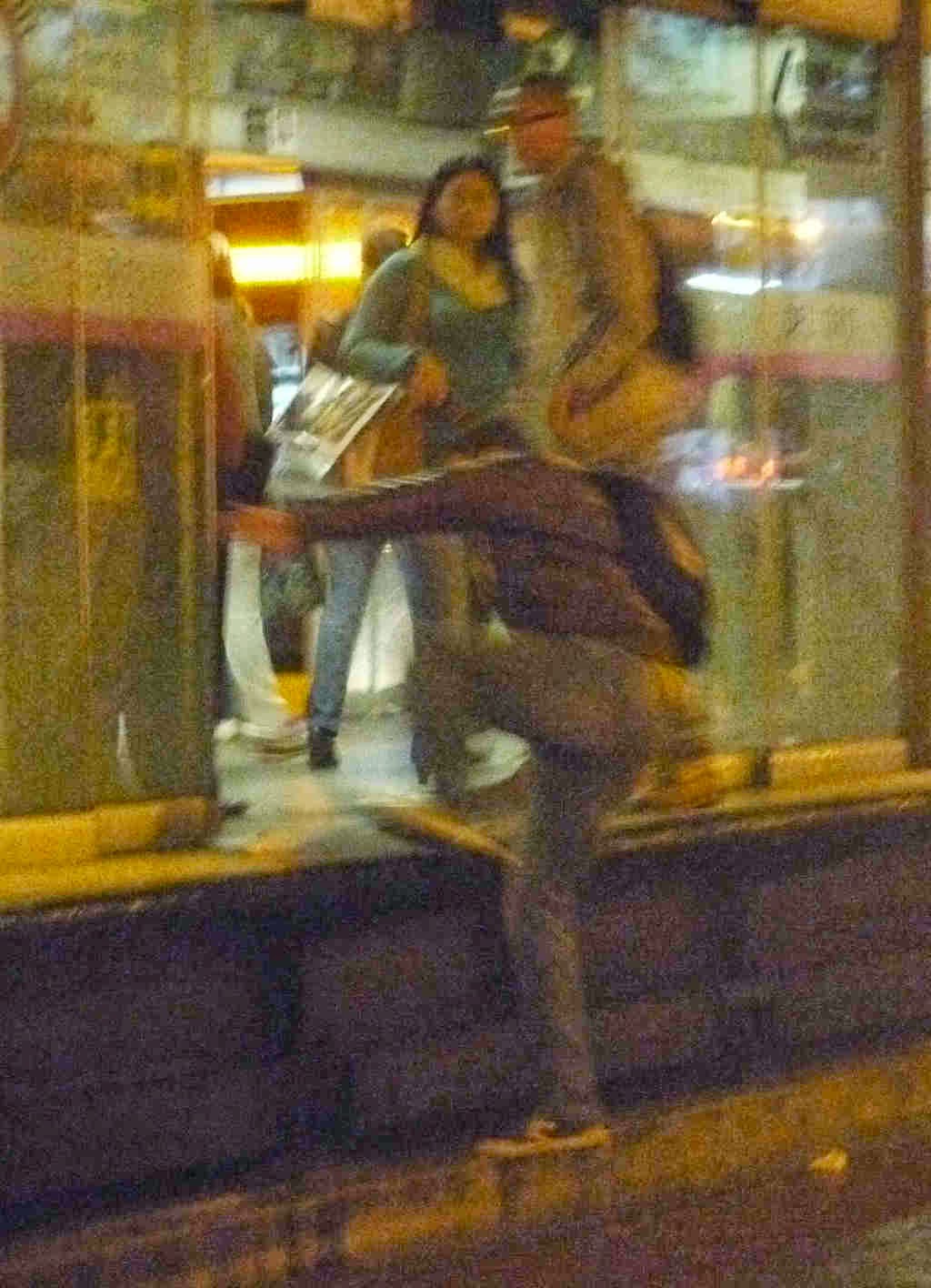
Young men rrace across and leap onto the bus platform.


Well, maybe not such an acrobatic leap....


That's quite an athletic leap!

By Mike Ceaser, of Bogotá Bike Tours

Friday, November 14, 2014

Why Pay to Ride TransMilenio?

A team effort. 
I spent about 20 minutes by the Museo de Oro TransMilenio station this evening, and observed people jumping into the station at a rate of several per minute - and I only observed one side of the station. Repeated at stations across the city, that's a pretty substantial proportion of the station's ridership. 
Nice leap!
Assuming that all these people would otherwise pay fares to ride, the colgados represent a huge loss of income for the troubled system. Most these fare-jumpers looked like they could have afforded paying a few thousand pesos to ride the buses. But jumping thru the doorways is not only cheaper, but also faster and more fun, since it obviates standing in fare lines. The jumpers appeared to wait until their bus approached and then jumped into the station and stepped immediately into the bus, minimizing their chances of being caught by a TransMilenio employee or one of the auxiliar police who sometimes patrol stations. 

As for the paying passengers in the stations - they didn't appear to mind. 

Just made it. 
What could TransMilenio do about this problem? They might repair the station doors so that they close between buses, a fix which would also keep the cold drafts out. 

Or, they could just place fare takers in the doorways.


An athletic move!


The police, more concerned with moving away street vendors, didn't seem to care. 


By Mike Ceaser, of Bogotá Bike Tours