Showing posts with label santa fe. Show all posts

Saturday, January 28, 2012

A 100th Anniversary for a Millenial Site

Researchers in San Agustin in 1946 (Photo: El Espectador)
The Parque San Agustin in Huila Province is celebrating the 100th anniversary of scientific research about the site's famed 2,000-year-old monoliths. For its own part, Bogotá's own San Agustin Park in the Santa Fe neighborhood is passing a more modest first birthday.

Monuments in San Agustin, Huila Province.
Huila's San Agustin archeological park is the only place in Colombia with pre-Columbian monuments. But their makers remain a mystery. The people, called Agustinianos after the present-day town nearby, created about 300 stone monuments between about the first and eighth centuries after Christ. Then, their civilization disappeared, perhaps pressured by the invasion of other peoples, climate change or other causes.

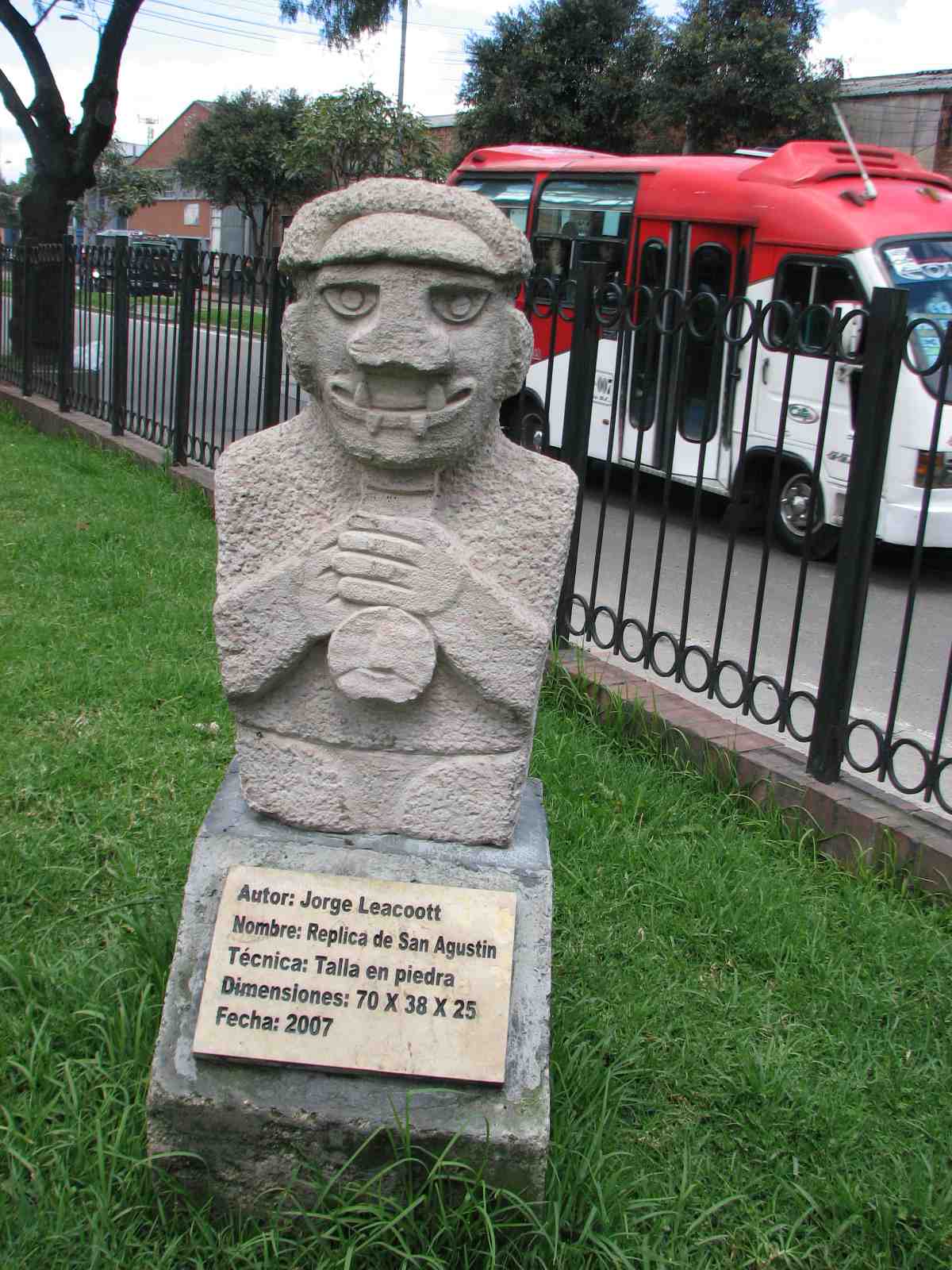
San Agustin in Bogotá.
The Swiss writer Erich Von Däniken, who saw extraterrestrial influences in many ancient human civilizations, credited aliens with influencing the ancient Agustinianos. Others have theorized about Mayan, Egyptian or even Viking connections. All those speculations, which have little evidence, short-change the native Colombians, who undoubtedly were capable of creating magnificent stone monuments without outside help. Researchers theorize that the monuments were used for ancestor worship and may have represented reincarnation. Many mix human and feline charcteristics, suggesting the mixing of human and animal spirits. Perhaps the monuments provided gateways between this world and the next.

A bicycle tourist
beside the famous
'Doble Yo' figure.
The monuments in Bogotá's own park, which is located in the very urban Santa Fe neighborhood behind the Central Cemetery and just a few blocks from the red light district, have a better-known origin: They were created by local sculptors, including some of the people who carve headstones nearby.

For the rest of this year, the San Agustin Archeological Park in Huila plans to commemorate the Colombian and foreign archeologists who began researching the region in 1913. Research there continues, and probably will never end.

Perhaps more significant for us than the original Agustinianos' origin was their disappearance. Like the Mayans and the monument builders of Easter Island, the Agustinians were replaced by a much simpler culture incapable or uninterested in creating such massive objects. 

Did the original Agustinianos fall victim to climate change? Overpopulation? War? Environmental destruction? We may never know. But, for a nation like Colombia challenged by many of these problems and others, the Agustinianos' disappearance serves as a warning about preserving the environment and finding peaceable means to end conflict. 


While Huila's San Agustin region appears bucolic, much of rural Colombia suffers from erosion, pollution, deforestation and desertification. And Bogotá's Santa Fe neighborhood captures many urban ills, including litter, air and noise pollution. Sometimes, it seems, cities like Bogotá are carrying out an experiment in how a species can poison itself in its own wastes.

This figure, in Bogotá's Santa Fe neighborhood, appears to suffer from an indeterminate gender.

The Bogotá park is a green island amidst urban noise and pollution. 


Posing with a face. 

These figures might represent male midwives, or gods devouring infants. 


By Mike Ceaser, of Bogotá Bike Tours

Sunday, February 27, 2011

Santa Fe Celebrates its 70th


Today, Bogotá's Ciclovía was invaded by hundreds of red, screaming, flag-waving youths. Communist revolutionaries? Fanatic followers of Venezuela's Hugo Chavez?

Don't let that red star fool you. They were supporters of the Independiente Santa Fe football team.

The march forced cyclists onto the sidewalk.
Together with Millonarios, Santa Fe is one of two traditionally dominant Bogotá teams, and the two carry on an intense rivalry. Since the end of the era of the drug barons with their sackfulls of money, Colombia has generally disapppointed in international football competition. Even though futbol is the unquestioned king of sports here, and Colombia has the same population as Argentina, Colombia's national team didn't even qualify for the last three World Cups.

Colombian football hasn't quite escaped the notoriety of the 1994 murder of national team member Andres Escobar just days after he'd scored an own goal during the World Cup. And the professional football league is still trying to break connections with drug cartels.

Watching out for trouble.
For its part, Santa Fe is a perpetual contender, but last won the Colombian professional football championship in 1975. But what they lack in trophies, Santa Fe's fans make up with enthusiasm and decibels - but sometimes also violence. The barras bravas, gangs of drunken fans who fight and have even killed one another, are a chronic problem in Colombia - probably explaining the many cops escorting these celebrating fanaticos.

The littered aftermath. 
By Mike Ceaser, of Bogotá Bike Tours

Thursday, August 5, 2010

Bogotá's Red Light District


Bogotá's red light district, known formally as the 'Tolerance Zone,' is sleazy, down-market and, late at night, dangerous. But the place is honest, and, hopefully, the world's oldest profession is practiced here more safely and with less exploitation than it would be if it were prohibited. Tragically, there are also children who prostitute themselves around here, often to support drug habits. Here's a news report about a police sweep which detained five underage girls working as prostitutes in the Santa Fe neighborhood.

A transvestite prostitute prances on Carrera 16 and Calle 20
Bogotá has several other designated tolerance zones, where prostitution is legal. But in no others are the prostitutes permitted to work the streets - as they do quite flagrantly here. The Santa Fe neighborhood is even informally divided between female sex workers and a smaller number of transvestites, each group with its own area. In a recent decision, the city decided not to legalize expanded street prostitution, pending more evaluations of Santa Fe's situation, and to try to tone down exhibitionism there.

In Bogotá, lots of illegal prostitution also goes on outside of the designated areas. High class prostitutes are callede 'pre-pagos,' because they charge in advance by credit card. Don Juan magazine recently did a story about the city's prostitution. Colin Post chronicles his adventures in some of these establishments on his blog.

Related posts: A Profession Like Any Other?

The Red Light District's Guardian Angel
Exhibitionism - a transvestite shows off his stuff to bike tourists.
Many prostitutes at least seem quite satisfied with their profession. But critics of legalized prostitution say that many of them were tricked or forced into the profession while still minors.
Not all those working the streets are women, or at least born women, anyway. 

The children of Patos al Agua (a local school?) planted these plants full of love and friendship. Help us to protect this gift we give to the neighborhood.' A few weeks later, the note and plants had disappeared. 

La Piscina (The Swimming Pool), a famed brothel.
So celebrate! For its anniversary, La Piscina is throwing the bed out the window!
El Castillo brothel, and beside it Dolls House
El Castillo's building has been designated as having 'architectural patrimony,' which is probably the main draw for clients
Waiting in a doorway

Related posts:

The Red Light District's Guardian Angel

A Profession Like Any Other?

Bogotá's Red Light District

Not Such a Glamorous Profession
This blog written by Mike Ceaser, of Bogotá Bike Tours