Showing posts with label rogelio salmona. Show all posts

Friday, October 20, 2017

A Look Back at Rogelio Salmona

The Torres del Parque, in the La Macarena neighborhood, above the Plaza de Toros Santamaria.
If you've lived in or even just visited Bogotá, you've seen the work of architect Rogelio Salmona - or at least his influence.

A stilt walker in the Gabriel Garcia Marquéz Cultural Center
in La Candelaria, designed by Salmona and financed by
the Mexican government.
Born in France in 1939 to a Jewish family, Salmona's family emigrated to Colombia in 1931. In 1948, in the wake of the Bogotazo riots, Rogelio moved to Paris and spent a decade working with famed architect Lecorbusier. He returned to Colombia in 1958.

Salmona died on Oct. 3, 2007, a decade ago this month.

Salmona, Colombia's most famous architect, loved to work with brick and incorporated lots of curves into his buildings. In a socially striated nation where many are paranoid about crime, Salmona integrated his apartment
Rogelio Salmona
complexes into their surroundings, rather than walling them off. Salmona also designed the Virgilio Barco Library in north Bogotá, the graduate studies humanities building on the Universidad Nacional campush, and the Nueva Santa Fe apartments and the neighboring Archivo General de la Nación, both just south of La Candelaria, as well as many others.

Walking thru many of Salmona's works, with their curving lines and stepped pools of water, gives one a sensation of a visit to an Arab desert oasis. And in fact, Salmona spent time in northern Africa.
An interior hallway of the Gabriel Garcia Marquéz
Cultural Center.

Unicyclists pedal on Jimenez Ave. in central Bogota. 
The Nueva Santa Fe apartments, just south of La Candelaria.

Entrance to the National Archive, also just south of La Candelaria.
The National Archive.


By Mike Ceaser, of Bogotá Bike Tours

Monday, April 14, 2014

Finally, a Bridge to Somewhere


Concrete beams and a construction crane to lift them across Calle 26, where they will connect Parque de la Independencia to the modern art museum.
After a multi-year legal battle between the city and neighborhood residents, work has finally restarted on the bridge over Calle 26, between Parque de la Independencia and the Museum of Modern Art.

Neighbors had sued to stop the project, objecting in particular to the way it invades the park. It was halted for years while the court battle played out. The neighbors are right about the project's poor design. But, now that it's been started, it seems like the best solution is to finish it once and for all. The long-suffering park used to be much larger, but sections were sliced off as the city built avenues on its western and southern sides.

The idea of expanding the park above the avenue came from famed architect Rogelio Salmona, who also designed the Torres del Parque behind the nearby bullfighting stadium. Ironically, many of those fighting the bridge project live in those towers.

The section of Calle 26 between Carrera 3 and Carrera 7 will be shut for three months while huge beams are lifted into place. The platform, which is to contain green space and areas for cultural activities, is supposed to be completed in early 2016.

Three neighborhood residents - part of the group which fought to stop the project - watch the construction.


By Mike Ceaser, of Bogotá Bike Tours

Sunday, May 19, 2013

The Legacy of Rogelio Salmona


The entrance to the Archivo Nacional, just south of La Candelaria, one of Rogelio Salmona's many works in Bogotá.
Pedestrians walk along Jimenez Ave., the Eje Ambiental,
designed by Rogelio Salmona but never completed
and now sadly neglected. 
Rogelio Salmona is unquestionably Colombia's most famous architect of recent times. Born in 1929 in Paris, the son of French and Spanish Jewish parents, Salmona's family moved to Bogotá in 1934. He grew up in the Teusaquillo neighborhood, and after the Bogotazo violence returned to France to work for years with famed architect Le Corbusier.

Returning to Colombia in 1957, Salmona taught in the Universidad de los Andes and designed many buildings and other structures which have become landmarks, mostly in Bogotá, but also scattered across Colombia.

Salmona's works are known for their brickwork, their curves and for being open to and integrated into their surrounding environments. With their quiet pools and interior patios, they seem to bring the outdoors inside. Those characteristics also show the deep influence of Arab/Moslem architecture in Salmona's style.
The Gabriel Garcia Marquez Cultural Center in La Candelaria. The building was designed by Salmona and built by the Mexican government in honor of the Nobel-Prize winning novelist, but contains nothing about the writer. 


Las Torres del Parque, behind Bogotá's bullfighting stadium. The complex curvers around the stadium, and was supposed to house people of all classes, but now seems to be inhabited by the wealthy. Salmona lived in one of the towers during his final decades. 
The Jorge Eliecer Gaitan house-museum, which has never been completed. 

A view of the Biblioteca Pública Virgilio Barco and its contiguous park, which forms part of the Parque Simon Bolivar. 

Visitors cross bridges in the Biblioteca Pública Virgilio Barco.

A pathway to the Biblioteca Pública Virgilio Barco.

Pools and pathways in the Biblioteca Pública Virgilio Barco.

Pools of water at the entrance to the Biblioteca Pública Virgilio Barco.

Pools and bridges at the Biblioteca Pública Virgilio Barco.

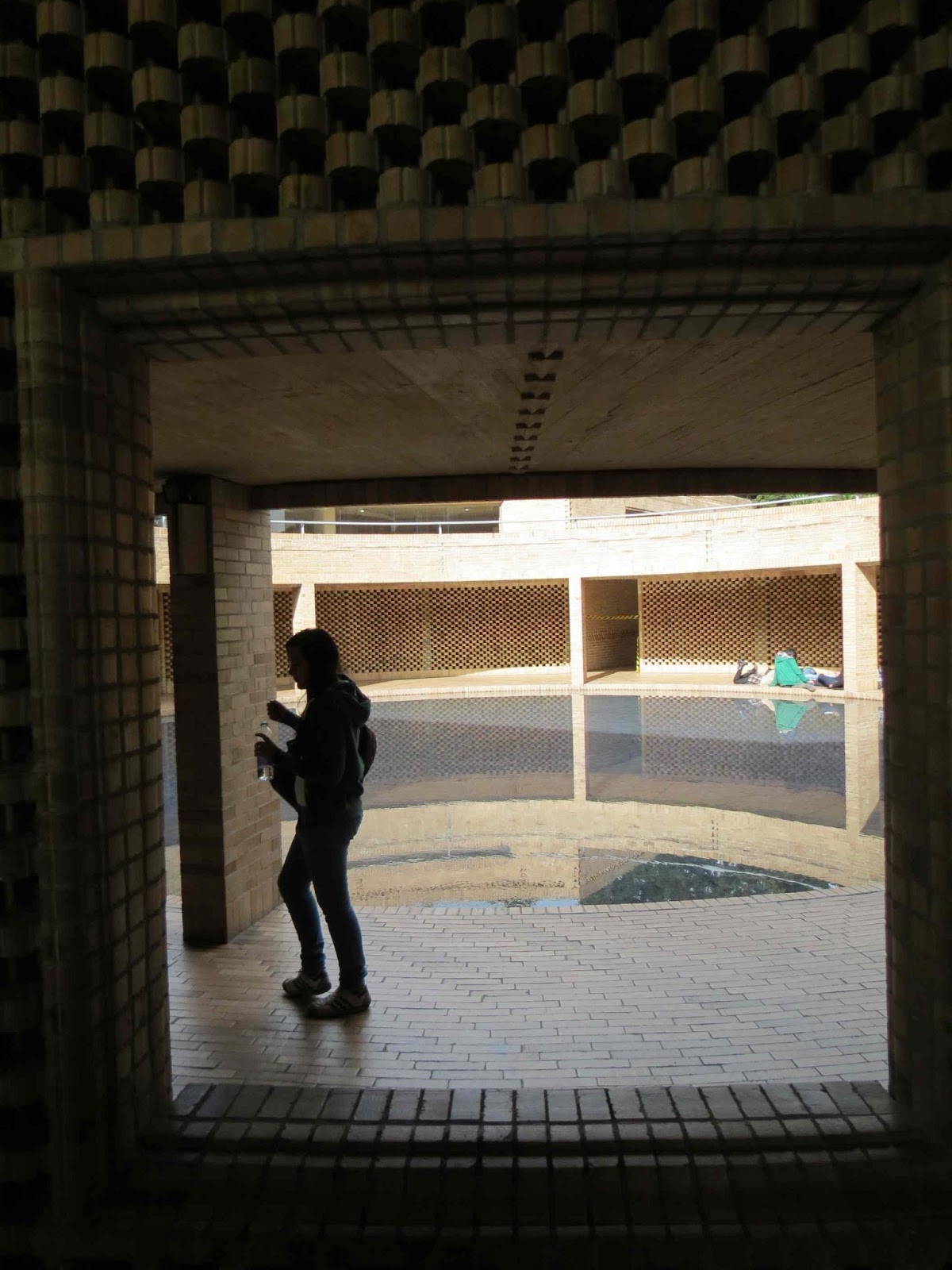
Entrance to the Postgraduate Social Sciences Building on the National University's Bogotá campus. 

Brickwork on the Postgraduate Social Sciences Building on the National University's Bogotá campus


A pool in the Postgraduate Social Sciences Building on the National University's Bogotá campus


Students relax in the Postgraduate Social Sciences Building on the National University's Bogotá campus
By Mike Ceaser, of Bogotá Bike Tours

Friday, March 9, 2012

Searching for Gabo

The Gabriel Garcia Marquez Cultural Center, on the right on 11th St, was built by the Mexican government. 
Novelist Gabriel Garcia Marquez's 85th birthday this week seems like a good excuse to visit the Gabriel Garcia Marquez Cultural Center on 11th St., in La Candelaria.

The center was designed by
Colombian architect Rogelio Salmona.
The cultural center was built in 2008 by the Mexican government's Economic Cultural Fund. (Garcia Marquez, knicknamed Gabo, has lived in Mexico City for many years, so there is a connection.) It's a handsome building, designed by Colombian architect Rogelio Salmona, with his characteristic curves and open spaces. The center also has a huge bookstore and hosts many exhibitions and cultural events, including talks and concerts. On Sundays, they often hold public aerobics in the center's open-air atrium.

The center has a great bookstore,
including books in English. 
In other words, the cultural center's a handsome place and a very positive addition to the neighborhood.

But I've always wondered why they don't have anything about the center's namesake, Nobel Prize winner Gabriel Garcia Marquez, author of One Hundred Years of Solitude and Love in the Time of Cholera, among many other works. In the past, the center has been decorated with portraits of Mexican writers, including Carlos Fuentes, a good friend of Garcia Marquez. Occasionally, I've seen Garcia Marquez's portrait there as well. And, naturally, the center has Garcia Marquez's novels - as well as  novels by many other authors.

I once asked some of the center's employees whether it wouldn't make sense to have an exhibition there about Garcia Marquez's life and work.

Well, they explained, but this center was built by Mexico. Sure, I agreed, but it is named the Gabriel Garcia Marquez Cultural Center.

They seemed to grudgingly agree that it'd be nice to have something about the Colombian novelist. I haven't seen anything, tho.

But if they prefer not to include any exhibitions about him, then why not just change the name? Then, at least, Gabo-worshipping tourists wouldn't come there looking for information about their literary idol.


Telling Part of the Tale: Gabriel García Márquez in La Candelaria


By Mike Ceaser, of Bogotá Bike Tours

Sunday, November 27, 2011

Snapshots from Belen: History, Poverty and Architecture.

An old woman walks past a weathered building in Bogotá's Belen neighborhood. 
The Belen neighborhood is La Candelaria's southern neighbor and its poorer cousin. Like La Candelaria, known as Bogotá's historic center, Belen contains many elegant old buildings - altho many are in decay. But the city's efforts to rejuvenate Belen, which is both poor and troubled by crime, have demolished many old buildings to build dramatic, modern structures such as the archives of Bogotá and Colombia. The government also tried to lure in middle class residents with the Nuevo Santa Fe apartment complex, built in the mid-1980s.

A residential street in Belen. 
The city also recently slashed an avenue thru the heart of Belen, dividing the neighborhood in two. Belen was once contiguous to La Candelaria, until the city bulldozed Calles 7 and 8 to create the avenue connecting the Circunvular Ave. with the Presidential Palace. 

Amidst the history and architecture is a neighorhood with lots of poverty and questions about its future. Will the city continue its renovation projects until the old community is gone? Will La Candelaria's tourism industry and university community spread into Belen and price out its current residents?

Belen means Bethlehem. Like Egipto, Las Cruces, La Candelaria and other central Bogota neighborhoods founded by the Spanish, its name is Biblically inspired.

Carpentry shops on Calle 8.

Entrance to the Archivo de la Nacion, the National Archive, designed by architect Rogelio Salmona

The Archivo de la Nacion's side view. 
A mural showing a woman holding a caged child.
Nectorio in his carpentry shop on Calle 7.
Part of the El Nuevo Santa Fe apartment complex, also designed by Rogelio Salmona
An older couple taking a rest in front of the Nuevo Santa Fe apartments.
Children playing futsal. 

The Archivo de Bogota, a graceful building which occupies a whole block and is a favorite of skateboarders and young cyclists.

A beggar stands in front of the preserved facade of an art-deco-style building. The building was demolisehd and replaced with a government ministry.  

A decaying building, covered with tents. 

Fronts of crumbling buildings. 

A handsome doorway. 

An old doorway shows its age. 


La Iglesia de Belen. 

A very old church, whose name I don't know. 
For years, this sign has promised that nice apartments will be built on this empty lot across the street from the Archivo de Bogota. 
 
Another empty lot with an old billboard promising new apartments. 

The San Agustin Church, across the street from the Presidential Palace, the Palacio de Nariño. 
A doorway. 

A stairway in the Archivo de la Nacion, with the Nuevo Santa Fe apartments behind. 

A handsome old building, probably owned by the government. 

A wall of the Archivo de la Nacion. 

A once-elegant home, now worn. 


By Mike Ceaser, of Bogotá Bike Tours