Showing posts with label Gabriel Garcia Marquez. Show all posts

Wednesday, December 13, 2017

Marquéz on the Web

Gabriel Garcia Marquéz
When Nobel Prize-winner Gabriel García Marquéz's family decided to sell his documents to a center in Texas after his death in 2014, it caused lots of teeth grinding back in Colombia. After all, Marquéz, a leftist buddy of Fidel Castro, was no great admirer of Yankeeland - and was even banned from entering the U.S. for many years.

Yet, the Harry Ransom Center in Austin, Texas has accomplished something which many Colombian institutions with less resources and sophistication might not have: It has placed tens of thousands of pages of Marquéz's documents online, where they are indexed and accesible in both English and Spanish. Expect a flood of high school and college papers on topics such as Marquéz's relationship to other authors, his publishers and the evolution of his works.

Bill Clinton and Marquéz.
The New York Times reports that the documents have already destroyed the myth that Marquéz (like Jack Kerouac with his On The Road) wrote his great novel One Hundred Years of Solitude in a spontaenous flow of creativity. Rather, Marquéz 'regularly sent out sections for reactions from friends and literary critics. He also published about a third of the chapters in newspapers around the world before the book’s publication, and sometimes made adjustments according to audience reaction,' says the Times.

Of course, Marquéz's relationship with the U.S. wasn't one dimensional. He traveled across the U.S. South, admired and learned from North American authors such as William Faulkner and Ernest Hemingway, and was buddies with Bill Clinton.

Among the documents on the Ransom Center's website are manuscripts, reviews, press clippings, letters and lots of photos of Marquéz with other literary luminaries, such as Chilean poet Pablo Neruda, Venezuelan newspaper editor Teodoro Petkoff and even U.S. film makerWoody Allen.

By Mike Ceaser, of Bogotá Bike Tours

Saturday, April 18, 2015

One Year On, Where's Gabo?

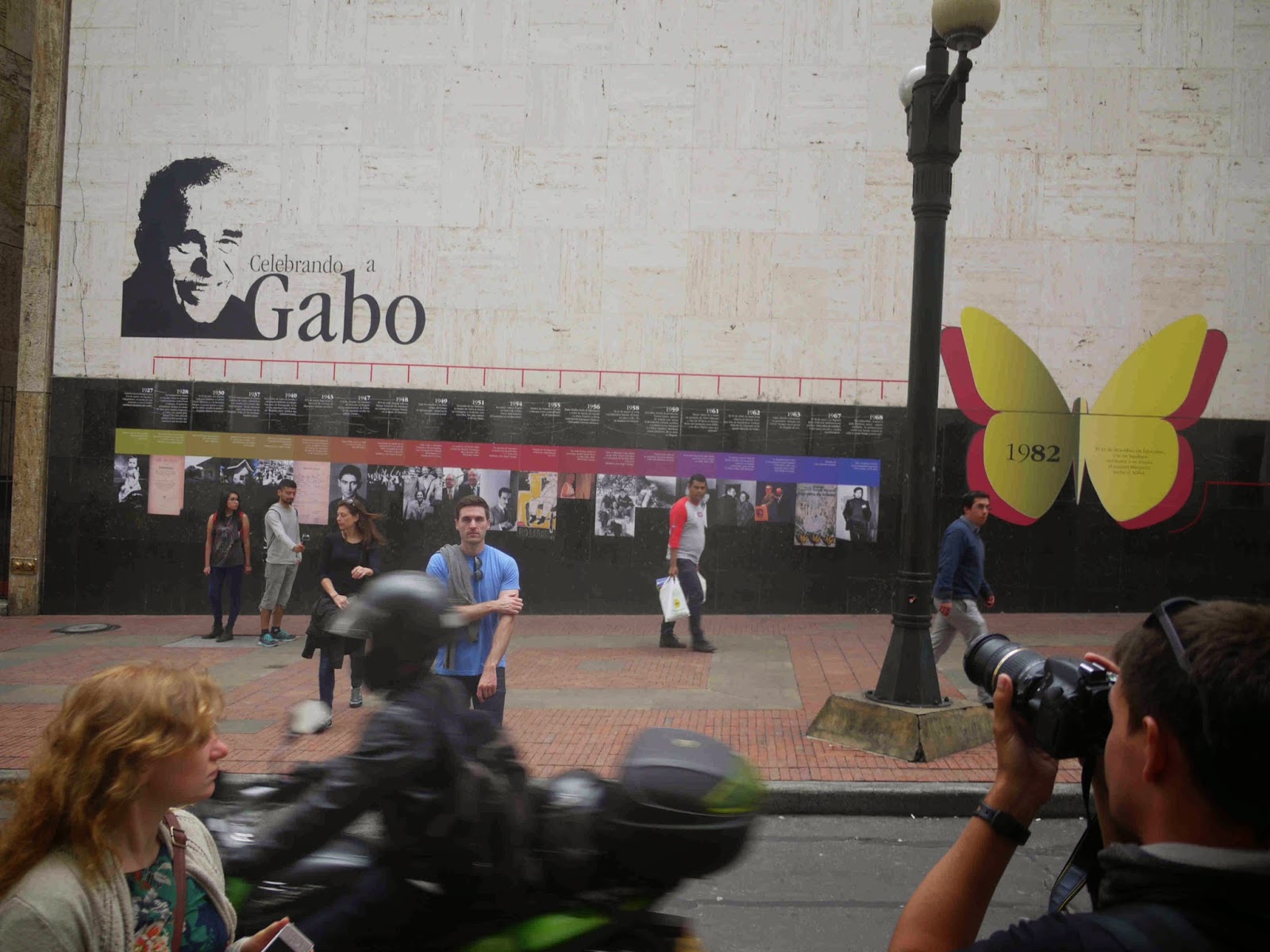
This display about Marquéz's life on the BLAA library's wall has been up for more than a year.
On the one-year anniversary of Gabriel Garcia Marquez's death in Mexico City, I searched for him thru La Candelaria, where Gabo lived for several years while in high school and later while working as a journalist - and came up empty.

Sure, there's the exhibition about Marquez's life on the wall of the Biblioteca Luis Angel Arango onCentro Cultural Gabriel Garcia Marquez, which was built by the government of Mexico. But the center - bizarrely - contains no exhibition about Marquez's life and works.
Tourists in the Gabriel Garcia Marquez Cultural Center,
in La Candelaria. The Mexican-built center
has no exhibition about the author.
Calle 11, but that's been there for more than a year. And down the street is the

Only the Biblioteca Nacional, north of La Candelaria, is exhibiting a few objects related to Gabo, such as his Smith Corona typewriter. (The bulk of Marquez's manuscripts and other documents were sold by his family to the Harry Ransom Center, a part of the University of Texas, in Austin.)

The 'liqui liqui' suit in which Marqués
accepted the Nobel Prize for literature.
The suit was on exhibition in the
Museo Nacional.
Paris, where Marquez grew into a novelist in the post-World War II years, has created a 'Gabo Trail,' along which fans can visit cafés and theatres he frequented, streets he walked, apartments where he lived and a hotel where he enjoyed a bohemian life. And in Cartagena you can also do a prepared tour of Gabo sites. By the same token, in New York, you can take a Mark Twain walking tour, and in Key West, Florida and Havana, Cuba, you can take Hemingway tours.

Bogotá could do something similar - and without much effort. After all, Marquéz wrote colorfully about the neighborhood in his autobiography 'Living to Tell the Tale.'

Many visitors to Medellin do tours about that city's (and Colombia's) most famous son, Pablo Escobar. Colombia's international publicists must grit their teeth every time they hear about that. But Colombia's image handlers have no grounds to complain about the villains being highlighted unless they do their best to celebrate the nation's heroes, as well.

And, while they're at it, why not also create a GGM cultural center which actually contains something about the novelist.

Marquéz's Smith-Corona typewriter, now on display in the Biblioteca Nacional.
A portrait of Marquéz along Carrera 10, in central Bogotá.
By Mike Ceaser, of Bogotá Bike Tours

Wednesday, November 26, 2014

Gabo Lands in El Imperio

Marquéz at work on 'One Hundred Years of Solitude.'
The Marquéz family's sale of the Nobel laureate's papers to an academic center in Austin, Texas has, understandably, generated lots of polemic back in Colombia.

"For the National Library (of Colombia) it would have been an honor to have those materials," Culture Minister Mariana Garcés told the FM radio. "For Colombia, it's a great pity not having them."

She said that Colombia had expressed interest in the collection.

One of the manuscripts donated to the Harry Ransom Center.
(Photo: Harry Ransom Center)
But the location is also appropriate in some ways. For one thing, the Harry Ransom Center, which is part of the University of Texas, also holds documents from some of Marquéz's literary influences, particularly William Faulkner, whose fictional Mississippi community helped inspire Marquéz's town of Macondo.

Perhaps more relevantly, Marquez lived the last half century of his life in Mexico City, where he is buried. Some Colombians resented what they considered Marquéz's small contributions to the mostly poor people who inspired his stories. So, it's in a way appropriate that his papers will rest outside of Colombia as well.

Marquéz's corrections and editions on manuscript
of 'The General in his Laberynth.'
But the Texas donation also draws attention to the Colombian novelist's often difficult relationship with the United States. A life-long friend of Cuban dictator Fidel Castro, the young Marquéz worked for Cuba's government news service, Prensa Latina, for which he was based for a time in New York. But because of Marquéz's relationships with leftist groups, including the Colombian Communist Party and the M-19 guerrillas, Marquéz was for decades banned from entering the U.S., which he sometimes referred to as 'El Imperio' - until his friend Pres. Bill Clinton reversed the order. Now, Colombian Marquéz scholars will have to travel not only to El Imperio, but to the land of the Bush family, in order to study the Colombian idol.

Marquéz's family did not completely stiff Colombia. Items including the typewriter he wrote 'One Hundred Years of Solitude,' on and his Nobel Prize medal will go to the Colombian National Library.

Many commentators on the El Tiempo newspaper's story about the sale seemed to get a cynical pleasure from the spectacle of the leftist writer's family selling his material to a United States institution.

"That's the Colombian left," wrote Fercast0513. "Just imagine, Gabo's son sold his leftist father's files to a university in the North American empire."

By Mike Ceaser, of Bogotá Bike Tours

Friday, June 20, 2014

Gabriel Garcia Marquez's Bogotá Years

Gabriel Garcia Marquez's portrait in the exhibition in the National University's library.
In 1942, the teenage Gabriel Garcia Marquez arrived in Bogotá, and found the city dark, rainy and generally depressing. Nevertheless, it would be the place where he would find his leftist ideological formation, enroll in university, publish his first poems and short stories and get his start in journalism.

Publications by and about Marquez
in the Nacho's library.
Unfortunately, however, you won't learn much of that from the sparse exhibition about Marquez on now in the lobby of the National University's main library, which was renamed after the Nobel Prize-winning author after his recent death.

Paradoxically, a lot more information about Marquez was on display recently in an interesting and detailed exhibition that was up only during a brief book fair on the university's Ché Plaza.

The exhibition in the library will interest Marquez fans: there's his university inscription document, as well as editions of books by and about the novelist. But it's embarrassingly sparse for a man of such accomplishment and the university's most famous ex-student.

I wish I knew where the book fair exhibition is stored away. Perhaps somewhere in the university's
Marquez's Universidad Nacional registration paper.
literature department. It's worth seeking out for anyone wanting a fuller picture of Marquez's life.

That exhibition included Marquez's famous (or infamous) description of the Bogotá he encountered in 1942  on arriving from the warm and sunny coast.

"Bogotá was then a remote and sad city, where a drizzle had been falling since the beginning of the century."

But Marquez grew to like - or at least appreciate - the Colombian capital's quirks and characters, including its spark-throwing streetcars and dignified funerals. He also became an habitué of the cafés in the city center, where he debated literature with other intellectuals.

Marquez enrolled in a high school in Zipaquira, north of Bogotá. The school was incorrigibly leftist,
and Marquez later recalled that even his physics professors graded students more on their ideology than their learning.

"I dare to think that most of my professors graded me more on my personality than my tests," Marquez wrote.

But, he added, a professor named Calderon saw talent in one of Marquez's short stories and urged him to continue writing, despite classmates' teasing, "if only for my mental health."

Marquez's first published
story 'The third resignation.'
In 1947, Marquez enrolled in the National University to study law, primarily to please his parents. But his university career cut short by the April 1948 Bogotazo riots, which sent the budding author to Cartagena. His memories of the University are less pleasant: He describes law school as "an alley with not exit" and didn't understand the subject - despite having Alfonso López Michelson, son of a president and later president of Colombia himself, as a professor. Marquez's best memories of university life were his long walks and talks with other leftist intellectuals, including priest Camilo Torres, the university's chaplain, who two decades later would claim his own place in Colombian history by joining the ELN guerrillas and finding martrydom in his first battle.

It was in Bogotá that Marquez read a version of Franz Kafka's 'Metamorphosis' rewritten by Argentine writer Jorge Luis Borges, which revolutionized Marquez's literary mindset. In 1947 and '48 he published his first three stories in El Espectador: 'The third resignation,' 'Eva is inside her cat,' and 'Tubal-Cain forges a star.' The three displayed the influence of Kafka and of the Bible.

 Marquez later recalled how he'd been told to climb to the second floor and hand his manuscript to the
Marquez admired populist politician Jorge Eliecer Gaitan,
whose 1948 assassination sent Marquez to Cartagena.
paper's literary editor. However, terrified, Marquez simply left the pages in reception and ran away. Nevertheless, two weeks later the story was featured with its title in grand letters.

Four years earlier, Marquez's first published work, a poem called 'Song,' (Canción), appeared in El Tiempo's literary supplement.

Marquez later became a reporter for El Espectador. In 1955, the paper's editor asked Marquez whether he had plans for the following Friday. Marquez did not, and the editor assigned him to a two-week trip to cover a political meeting in Geneva, Switzerland. Marquez's reporting trip to Europe would extend to five years, during which, while living in Paris, he wrote his first novels.

In 1955, El Espectador sent Marquez to Europe to
cover a political meeting. He stayed for five years.
Marquez eventually would warm up to the cold city of Bogotá. He later said that he had "5,000 anecdotes about Bogotá, the city where I was formed."

And he even reconciled the Andean city with his coastal roots. Bogotá, he would later write, "is a green and endless beach at 2,600 meters above sea level."

'Insomnia' by Marquez.
Marquez with friends in Bogotá.
Related entries:

Tuesday, April 22, 2014

A Very Colombian Send-Off for Márquez

People lined up today to attend a mass in honor of Gabriel García Márquez.
Today's mass honoring the late Colombian novelist Gabriel García Márquez struck me as an only-in-Colombia event. To enter the Catedral de Bogotá you had to pass thru three (count 'em) police checkpoints, where you were frisked and your bags searched. Would terrorists and assassins really try to infiltrate a revered novelist's memorial service? Well, maybe, in Colombia. 

Just to make certain that nobody could mistake Plaza Bolivar for a scene from a magical realism novel, in front of city hall a group of people displaced by violence were camped out demanding government assistance. 

The principle memorial ceremony for Márquez was held yesterday in Mexico City, where he lived the last half-century of his life. Márquez was cremated and his ashes are to be divided between Mexico and Colombia, but it's not clear where Colombia's share will be kept. Márquez's hometown of Aracataca wants the ashes for a museum about the novelist's life (even tho some of the town's residents feel that Márquez should have helped them more).
'Goodbye to our Gabo.'

A young man waiting in line reads a newspaper about Márquez. Very few of the people waiting to honor the novelist used their time to read.

A last-minute clean-up for Simon Bolivar, who is normally covered with graffiti.
Not a country of magical realism: People displaced by Colombia's violence demand government assistance on Plaza Bolivar. 

Police search people on their way to mass. There were three police checkpoints. 


A generator supplying electricity to the event belches out smoke. 
By Mike Ceaser, of Bogotá Bike Tours

Saturday, April 19, 2014

Gabriel García Márquez: Already Forgotten?


A few months ago City Hall on Plaza Bolivar carried a huge banner in memorial of the deceased South African leader Nelson Mandela. I expected at least as much for Márquez, but City Hall's wall is empty. 
Today, I took a cruise thru La Candelaria in search of some memorial to Nobel Prize winner Gabriel García Márquez, who died a few days ago in Mexico City.

Colombian Pres. Santos declared three days of national mourning for this great Colombian, as well as a memorial service next Tuesday in the Cathedral de Bogotá. Márquez's funeral is to be held Monday in Mexico City, where the novelist lived for a half century. He has already been cremated, but it's not clear whether they will be interred in Mexico or Colombia.

Strangely, even tho Márquez lived and worked for a time in La Candelaria (he worked for the El Espectador newspaper before moving to Paris and becoming a novelist) and several institutions here carry his name, I found no memorial to the novelist.

In the town of Aracataca where Márquez was born, the people seem to have mixed feelings about their most famous son. Márquez visited only rarely and contributed little of his fortune to the development of the town, which still doesn't even have fresh water.
The Gabriel García Márquez Cultural Center was built by the Mexican government's cultural agency. Strangely, the building has never had an exhibition about Márquez, but I expected SOMETHING about the man's passing. However, I saw nothing. 
The old El Espectador building on Ave. Jimenez. They might have hung a black banner here, or a photo of the novelist.

A flag a half mast on a government TV station building on Calle 26 - the only official sign I saw of Márquez's passing. 
A newspaper vendor in La Candelaria. Since Márquez's death, several papers have reported an almost nothing else. 

People ponder an exhibition about Márquez's life on the wall of the BLAA library in La Candelaria. But the annual exhibition was here before the novelist's death. 

By Mike Ceaser, of Bogotá Bike Tours

Thursday, April 17, 2014

Gabriel Garcia Marquez: A Complicated Character

Gabriel García Márquez: 1927-2014
Gabriel García Márquez, Nobel Prize Winner, Colombia's most famous author, leftist icon and a writer whose work captured Colombian history and culture, died today at age 87.

I'll leave evaluating his fiction to others with better literary taste, except to say that I've enjoyed his autobiography and journalistic reporting more than his fiction, and his lesser-known works - particularly the historically-based ones - more than his master work, One Hundred Years of Solitude.

It's sad that Márquez, Colombia's only Nobel Prize winner and a pioneer of a style of fiction known as magical realism, died as the second-most-famous-Colombian, behind the monstrous Pablo Escobar. 

Márquez will be remembered as a great artist and great Colombian - both of which are true. But, unfortunately, he'll also be remembered as a kind of saint and patriot - which is less true.

Márquez was a leftist, and perhaps something of a leftist of convenience during his later decades. During its early years, when it was still politically palatable, Márquez associated himself with the M-19 guerrillas. Threats resulting from that relationship drove him out of the country, and Márquez lived for the last half century in Mexico City, even tho Colombia's political climate had improved enough to permit him to safely return home.

Márquez's leftist rhetoric and ideas earned him the friendship of Fidel Castro, whom Márquez visited repeatedly in Havana, where Márquez had a home. Márquez, who got his start in writing as a journalist, also created a foundation to teach journalism and purchased and then sold a weekly newsmagazine, Cambio. Yet, I almost never heard anybody call Márquez on the contradiction between promoting free speech and befriending - and thus supporting - the hemisphere's last dictator and greatest repressor of free speech.

Márquez was sometimes criticized for not being more philanthropic. The comparison to singer Shakira, of Hips Don't Lie fame, is not flattering. Shakira's art may be more superficial than Márquez's, but with her Pies Descalzos children's foundation she's given a lot more to her country.

In 1972, after winning the Venezuelan Romulo Vallegos literary prize, Márquez gave the $100,000 award to a Venezuelan political party: the Movement Toward Socialism. Couldn't Marquez have found a worthy cause at home? his critics asked.

Where Márquez rested on his leftist laurels, his sometimes-friend, sometimes-enemy, fellow Peruvian Nobel Prize winner Mario Vargas Llosa, remains politically active and opinionated (Vargas Llosa is also a decade younger).

Márquez was certainly a great artist. But whether his character made him a great man is a different matter, and the two shouldn't be confused.

Addendum: Maria Fernanda Cabal, recently elected to Congress with the conservative Centro Democratico Party, made waves by tweeting a photograph of Márquez and Fidel Castro with the phrase 'Soon they'll be together in hell.' A few hours later, she erased the tweet. She later tweeted that she didn't question Márquez's literary greatness, but did question his 'indifference toward Colombia.'

By Mike Ceaser, of Bogotá Bike Tours

Tuesday, May 8, 2012

Marquez in the Moscow Metro


In a strange case of ideological intersections with perhaps a bit of time warp mixed in, the city of Moscow's metro has decorated its 'Poetry Car' with Gabriel Garcia's Marquez's poetry.
Colombia's ambassador to Russia Rafael
Amador amidst a crowd of Gabo fans.

Marquez only a little bit of poetry (mostly sappy romantic stuff) - just enough to decorate a single car, evidently.

The Leo Tolstoy Cultural Center in La Candelaria has a small photographic display about the rolling exhibition. It's appropriate, since the Cultural Center is something of a throw-back to the old Soviet Union, with its busts of communist icons and tomes and talk about socialism's victories. Appropriately, too, Marquez is a leftist and buddy of Fidel Castro, and the subway system construction was begun by Josef Stalin, albeit before most of the world had realized what a monstrer he was.

Today, of course, the Soviet Union is gone, as is communism, replaced by a savage capitalism. But the dream lives on in a few places, including the Leo Tolstoy Cultural Center.

Lenin in Moscow's metro. 
The subway exhibition provides an excuse to reflect on Bogotá's own plans to build a subway, which are now experiencing yet another resurgence.

With 12 lines, 306 kilometers of rails and 185 stations, Moscow's metro is a colossal achievement - and some of its stations, which are built like palaces, show that. I read that the Soviets' philosophy was to make it a sort of palace for the common people, in the place of the old Czarist palaces which the revolution had overthrown. That's good enough. Decorations aside, the Moscow Metro is also said to be the world's most densely-used metro.
A Moscow Metro station - an underground palace. 


But despite all of this, Moscow is a chaotic city full of traffic jams, as you can see here:


Moscow, with about 11 million people, isn't much bigger than Bogotá, altho they do have lots more money. Thos who believe that a subway would be a magic bullet for Bogotá's transit problems ought to look at Moscow and think again.

Stained glass in Moscow's Metro. 
If Bogotá does go ahead with subway construction, the first trains probably won't be rolling for another decade, at least, and then it'll be only a single line, measuring perhaps a dozen kilometers - a few percent of Moscow's system. But in the meantime, millions more cars will have flooded into the city.

Can anybody believe that, without strong measures to discourage car use, the traffic congestion and pollution above ground won't be many times worse?

Here's good advice from one of the video's commentators: "I say tax cars at every intersection and use the monies to build public transport systems."

By Mike Ceaser, of Bogotá Bike Tours

Friday, March 9, 2012

Searching for Gabo

The Gabriel Garcia Marquez Cultural Center, on the right on 11th St, was built by the Mexican government. 
Novelist Gabriel Garcia Marquez's 85th birthday this week seems like a good excuse to visit the Gabriel Garcia Marquez Cultural Center on 11th St., in La Candelaria.

The center was designed by
Colombian architect Rogelio Salmona.
The cultural center was built in 2008 by the Mexican government's Economic Cultural Fund. (Garcia Marquez, knicknamed Gabo, has lived in Mexico City for many years, so there is a connection.) It's a handsome building, designed by Colombian architect Rogelio Salmona, with his characteristic curves and open spaces. The center also has a huge bookstore and hosts many exhibitions and cultural events, including talks and concerts. On Sundays, they often hold public aerobics in the center's open-air atrium.

The center has a great bookstore,
including books in English. 
In other words, the cultural center's a handsome place and a very positive addition to the neighborhood.

But I've always wondered why they don't have anything about the center's namesake, Nobel Prize winner Gabriel Garcia Marquez, author of One Hundred Years of Solitude and Love in the Time of Cholera, among many other works. In the past, the center has been decorated with portraits of Mexican writers, including Carlos Fuentes, a good friend of Garcia Marquez. Occasionally, I've seen Garcia Marquez's portrait there as well. And, naturally, the center has Garcia Marquez's novels - as well as  novels by many other authors.

I once asked some of the center's employees whether it wouldn't make sense to have an exhibition there about Garcia Marquez's life and work.

Well, they explained, but this center was built by Mexico. Sure, I agreed, but it is named the Gabriel Garcia Marquez Cultural Center.

They seemed to grudgingly agree that it'd be nice to have something about the Colombian novelist. I haven't seen anything, tho.

But if they prefer not to include any exhibitions about him, then why not just change the name? Then, at least, Gabo-worshipping tourists wouldn't come there looking for information about their literary idol.


Telling Part of the Tale: Gabriel García Márquez in La Candelaria


By Mike Ceaser, of Bogotá Bike Tours

Tuesday, May 31, 2011

Telling Part of the Tale: Gabriel García Márquez in La Candelaria

Avenida Jimenez in La Candelaria and the El Espectador building, where Gabriel Garcí Márquez once worked. The building, which now contains offices and a Crepes & Waffles restaurant, is curved one on the far right. 
I just read Gabriel Garcia Marquez's autobiography 'Vivir Para Contarla' ('Living to Tell the Tale'), only nine years after it was published. It's not exactly hot off of the presses...(but then I also recently reread Frank Norris's 'The Octopus,' only a century after it was published.)

Café Pasaje on Plaza El Rosario. Popular tradition holds that
Gabo used to frequent this historic cafe, altho he doesn't
mention it in his autobiography.
Living to Tell the Tale tells a lot about Márquez's formative years and Colombian history. And it also fills in a chapter of Márquez's life which has received little attention but undoubtedly influence him: his life and work in Bogotá's La Candelaria neighborhood.

I have to admit that I'm no great fan of Márquez's fiction, probably due to my own obtuseness. I rarely grasp the point of his inventions - or, maybe, insomnia epidemics, visiting gypsies and other fantasies are simply supposed to be entertaining in themselves. On the other hand, I have enjoyed Márquez's journalism and other non-fiction, which is informative and entertaining.

Márquez is of course a lively storyteller and seems to have a great memory - almost incredibly so - which, combined with his knack for witnessing some of the landmark events in Colombian history, makes this book a great education. And many of those events took place in La Candelaria.


The spot where Gaitan was assassinated in 1948 on Seventh Ave. just south of Jimenez.  Márquez recounts that he arrived on the spot just minutes after the assassination and saw a mysterious man apparently directing events.
A plaque commemorating
students massacred by
Rojas Pinilla's forces.
Márquez writes, for example, that he arrived on the scene just minutes after Jorge Eliecer Gaitan's 1948 assassination in downtown Bogotá, which triggered the bogotazo riots and deepened the political fratricide known as La Violencia. Márquez describes a man on the assassination scene apparently directing events, as tho the whole thing had been planned and choreographed. Márquez writes that six years later, in 1954, he happened upon the scene as dictator Gustavo Rojas Pinilla's forces massacred protesting students just a few blocks north along Seventh Ave. The following year, the dictatorship would briefly shut down both  El Espectador, Marquez's employer, and its competitor El Tiempo.


A streetcar burns on Plaza Bolívar during the bogotazo riots.
Márquez grippingly describes the murderous riots which followed Gaitan's assassination, as well as the killings of La Violencia. The violence forced Márquez to take temporary refuge on Colombia's more peaceful Carribean coast, where he eventually set most of his novels. It's interesting to speculate about what Márquez's fiction might have been like if he'd stayed in Bogotá - or whether he would have become a great writer at all without experiencing the history and magical atmosphere of Cartagena.

Plaza del Periodista (Journalists' Plaza) beside the old El Espectador building. Márquez  likely hung out here. 
As a reporter writing for various newspapers, including Bogotá's El Espectador, Márquez had a privileged viewpoint on the nation's politics and its authoritarian government. I enjoyed reading, for example, about the reporters' efforts to report events despite official censorship.

The view today from the window of the office of Guillermo Cano, El Espectador's director when Marquez worked for the paper.  Cano was assassinated in 1986 by cocaine king Pablo Escobar. 
All the while, Márquez was working on his fiction. From the start, he had a special talent, and editors recognized this. But getting published was still a challenge - encouraging for all of us with ambitions of inventing tales.

I found this old photo of an El Molino candy shop
on Jimenez and Carrera 8.
Might this have also been the location of the
El Molino cafe which Márquez frequented?
And it was heartening to read about a time when writing really mattered; when young intellectuals met in La Candelaria's cafes, got drunk and debated all night about novels and poetry.

Almost all of Márquez's debating companions, however, were also men, as were most of his co-workers and friends. In 'Living to Tell...,' we learn about Marquez's mother and sisters' struggles to keep the family afloat despite his father's philandering and business failings. But almost all of the many other girls and women in Márquez's life were sexual partners, many of them prostitutes. Nothing wrong with a healthy young man's lively interest in sex, but did Marquez really meet women only in bed? For that matter, were all of his lovers, particularly the prostitutes, really the happy, carefree, warm-hearted women he portrays? Or have six intervening decades and a little magical realism in memory erased their troubles?

Fidel Castro and Marquez chumming it up. 
The autobiography also left me more perplexed than ever about the origins of Márquez's political thinking. He's well known to be a socialist, which is one reason why he had to leave Colombia (he's lived for decades in Mexico City) and is close friends with Cuba's long-time dictator Fidel Castro. It's never made sense to me that a novelist and journalist, who even established his own political newsmagazine, Cambio, would support a dictator whose regime permits no free press. Márquez's own accounts of his struggles against government censorship just deepened that contradiction for me.

Of course, Living to Tell the Tale ends with Márquez at 29 and moving to Paris, his politics still nebulous. Most likely the City of Light's leftist intellectuals influenced the young Márquez...but how could the Soviet Bloc's repression of freedoms not have disillusioned him on the false promises of communism?

Maybe he'll give us the the answer in the next installment. Let's hope that he lives to tell more tales.

Related Blog Entry: Searching for Gabo

By Mike Ceaser of Bogotá Bike Tours