Showing posts with label catholic church. Show all posts

Tuesday, September 5, 2017

What Can We Expect from the Pope?

The Caras celebrity magazine welcome Pope Francis.
Even before Pope Francis's arrival, we can thank him for the cease-fire agreement with the ELN guerrillas, who (in contrast with the FARC) have long ties with the church: They once even had a
Le Monde Diplomatique asks whether
Francis will manage to alter the
Colombian church's conservatism.
priest as a leader. A bit paradoxically, however, during his visit the pope is to beatify a Colombian bishop assassinated by the ELN in 1989.

But more substantial changes seem unlikely - despite all the anticipation and commercialization.

Francis will visit a Colombia whose Catholicism is declining, both in terms of the number of faithful and in terms of the church's influence. Altho about 79% of Colombians still identify as Catholics - one of the highest percentages in the region - a much smaller number appear to attend church. And evangelical churches are growing rapidly, particularly among the poor, as they are across the region. The Catholic Church has also lost its central role as an institution. The 1991 Constitution transformed Colombia from an officially Catholic to a secular nation. And during the recent, and successful, peace negotiations with the FARC guerrillas, the church did not play the role as mediator it had in earlier talks.

A demonstrator complains to the Pope that the Colombian
government hasn't fulfilled its obligations to displaced people.
Neither has the Catholic Church been able to prevent reforms
legalizing euthenasia, abortion in some cases, same-sex marriage and adoption by gay couples. Nor has the nation's Catholicism been able to prevent a world-high 84% of babies being born to unmarried parents.

At the same time, Francis will also encounter extremely conservative Catholics, led by ex-attorney general Alejandro Ordoñez, who reject not only those liberal legal changes, but also Vatican II.

José Galat, the conservative rector of Gran Colombia University, has even called Pope Francis a 'heretic' and claims that Francis 'is paving the way for the anti-Christ.' Colombian church officials have told believers not to watch the university's television channel, TeleAmiga.

A rough night for muggers. The night before the pope's arrival soldiers stand guard in La Candelaria.


The security for the Pope is extreme, and exaggerated. On the day of his arrival, Ave. 26 is to be closed down for the whole afternoon. And the morning he gives mass in La Candelaria, the whole neighborhood is to be shut to cars and even bicycles. All this, even tho one guerrilla group is at peace with the government, and the other just reached a cease-fire agreement. If anything happened to the pope, it would be a tragedy, of course. But wouldn't ordinary presidential security be enough?


Hundreds of believers line up outside the Cathedral of Bogotá to see an image of the Virgin of Chiquinquira.

The Pope's visit means commercialism.

Readying seats in Plaza Bolivar for the Pope's mass.

Want a papal shirt?

A sign on a post asks the Pope to oppose Bogotá Mayor Peñalosa and neoliberalism.


A rare sight. The Simon Bolivar statue in Plaza Bolivar is free of graffiti and pigeon droppins.
A billboard on 26th St. welcomes Pope Francis.
By Mike Ceaser, of Bogotá Bike Tours

Sunday, April 26, 2015

The New Face of the Iglesia de Lourdes

A front view of Lourdes Church, with kids playing on the plaza.
The 240-year-old Iglesia Nuestra Señora de Lourdes, in the heart of the Chapinero District, was unveiled last month after some three years of renovation. The work on the striking gothic-style was not without controversy, however: the project was criticized for damaging parts of the church, including old stone slabs and installing a beam which altered the building's design. Even the church's priest, Adolfo Vera López, who directed the work, received criticisms for his lack of expertise in restorations.
Still, to my untrained eye, the building looks nice. And it was also nice to see it crowded with faithful this afternoon. 
The virgin. 
The church's interior, during mass.

Church doorways.


'Lourdes, Cultural Capital.'
Archbishop Vicente Arbelaez, who had the church built in 1875, hasn't been treated with great respect.
The tiny park behind the church has also seen better days.


By Mike Ceaser, of Bogotá Bike Tours

Thursday, July 11, 2013

Waiting to See a Bit of Madre Laura

Waiting to see a bit of Madre Laura in the Cathedral of Bogotá.
Madre Laura, the Colombian nun who is on her way to sainthood, visited Bogotá today - or at least a tiny bit of her did. Catholic Church officials put a fragment of one of her ribs on display in the Cathedral de Bogotá. The somewhat grotesque spectacle was reminiscent of the display of a vial of Pope John Paul's blood in the cathedral not long ago.

By Mike Ceaser, of Bogotá Bike Tours

Sunday, May 12, 2013

Not Always a Saintly Mission

Madre Laura and native Colombias
(Photo: Radio Super Popayan)
The national celebration over the canonization of Madre Laura, Colombia's first saint, should be tempered with reflection on the tragedy of America's indigenous people's since the continent's 'discovery' by Christopher Columbus.

Madre Laura worked tirelessly and selflessly to defend and evangelicize Colombia's native peoples and should be admired and honored for her efforts. I have no doubt that she meant the best and aided many native people.

But evangelization, one of the central themes of Europeans' interaction with Native Americans, has also produced great tragedy. Spreading the Catholic faith was one of Spain's justifications for colonizing the Americas (Spain had just driven the last Arab armies from its territory - and expelled its Jews and Moslems). But spreading Catholicism often became a cover for the exploitation, enslavement and even mass murder of native peoples.

Even in its most benevolent and well-intentioned forms, like Madre Laura's efforts, evangelization permanently changed indigenous people's values and ways of living. In southern Bolivia I saw the results of United States evangelicals' efforts to convince the Ayoreos, a hunter-gatherer people, to switch their faith from an owl to Jesus Christ and settle down around evangelical missions. But after the hunter-gatherers abandonded their traditional lifestyle, they discovered junk food, alcoholism, prostitution, crime and Western diseases such as measles, diabetes and obesity. When I visited them, they were inhabiting plastic and cardboard shacks in slums on the outskirts of the city of Santa Cruz. The slum did have a ramshackle Christian church, tho. I met a daughter of one of the missionaries, who expressed only pride in her parents' accomplishments.

In May 2007 indigenous leaders responded angrily to Pope Benedict's claim that Catholicism was 'not imposed' on native peoples.

"While we are believers" in Christianity, said Luis Andrade, director of the National Indigenous Organization of Colombia (ONIC), "we cannot accept that the church tries to deny its responsibility in the aniquilation of our identity and culture."

Of course, Christian evangelicals have not been the only Westerners to impact native cultures. Hunters, miners, soldiers, guerrillas, farmers and slave hunters have all done so, and without the evangelicals benevolent goals. And, evangelicals such as Madre Laura have often defended indigenous peoples and what remains of their culture from such hostile outside forces.

Still, it's hard to think of anything more fundamental to a people's culture and way of life than their religion. So, by replacing that religion with a foreign one, western evangelicals permanently change - and perhaps destroy - native people's ways of life.

By Mike Ceaser, of Bogotá Bike Tours

Sunday, March 31, 2013

The Jesuits in Colombia

During Easter Week a man sells posters of Pope Francis on Ave. Septima in Bogotá.

With the Catholic Church's first-ever Jesuit Pope and first-ever Latin American Pope, I wondered about the history of the Jesuit Order, the Company of Jesus, in Latin America.
The Church of St. Peter Claver in Cartagena. 

Founded in 1540, the Jesuits, or the Company of Jesus, have built a reputation for humility, social activism and dedication to the poor. In those senses, Francis's story provides some contradictions. Jesuits, after all, are not supposed to seek positions of authority. And, while Francis does show a real humility and vocation for the poor, by my reading the Argentine Catholic Church and Francis (then Jorge Mario Bergoglio, the Provincial superior of the Society of Jesus) in particular, could have done much more to oppose and condemn the human rights violations of the Argentinean dictatorship. Instead, the church hierarchy kept publicly quiet, altho Francis says that he worked privately to protect victims.

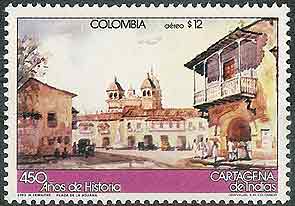
A Colombian stamp honors Javeriana
University's 250th anniversary. 
Across Latin America, during the colonial era the Jesuits were known as evangelists, educators, businessmen and protectors of the native peoples. They are perhaps best remembered for the huge misiones they established in several South American nations, where native peoples were employed, evangelicized and protected from slave hunters. Today, the ruins of many misiones have become tourist attractions. They are also controversial, because of their mix of exploitation and obligatory religious changes. But the Jesuits also seem to have protected the Indians and respected other parts of their culture more than did other Europeans, who often wanted only to enslave and overwork native peoples.

In contrast to their relatively enlightened work with native peoples, the Jesuits were also important buyers and employers of slaves from Africa.

I haven't found any Jesuit misiones in colonial Colombia, known roughly as La Nueva Granada (there were many in Brazil, Paraguay, Bolivia and Argentina), but the order did found many schools and haciendas in La Nueva Granada during the colonial era.

In 1767, apparently due to tensions caused by the Jesuits great economic power, as well as liberalizing and secularizing trends in Europe, the Jesuits were expelled from the territories of Spain and their properties auctioned off. Some 50 years later, after the Restoration brought back the old order, the Jesuits would be allowed to return, but they never regained their old power.

Today in Colombia the Jesuits run many educational institutions, the most best-known of them being the La Javeriana Universities in Bogotá and Cali. La Javeriana is the only private university I know of with any reputation for leftist activism. They also have several prominent high schools, including the Colegio San Bartolomé. The Jesuits also established the Bogotá-based Center for Investigation and Popular Education (CINEP), which studies poverty, armed conflict and environmental issues.

A bit surprisingly, given the Jesuits' vocation for the poor and independent thinking, none of the Colombian priests-turned-guerrillas have been Jesuits. Recently, however, two Jesuit priests at La Javeriana U. have been disciplined by the Jesuit hierarchy for violating church doctrine. One spoke out in favor of abortion and another questioned the virginity of Mary, the mother of Jesus.

Which brings up another contradiction in Pope Francis. Despite the Jesuit's reputation for progressivism and independent thinking, in Argentina Francis collaborated with Popes John Paul and Benedict to eliminate Liberation Theology ideas from the Argentine church. Liberation Theology, which urges believers to imitate Jesus's actions and values rather than his supposed holiness, was pioneered by Colombian priests.


By Mike Ceaser, of Bogotá Bike Tours

Wednesday, February 13, 2013

The Possible Next Pope's Colombia Connection

Cardinal Marc Ouellet
In the jostling for the man who'll replace Pope Benedict, oddsmakers have made Canadian Cardinal Marc Ouellet the favorite. The election of a non-European pope would be a watershed moment for the Catholic Church, and Ouellet, 68 even has a Colombian connection. He taught courses in Catholic seminaries in Bogotá, Manizales and Cali. (In fact, there's a Canadian Catholic seminary on the hill right above my apartment, where it blocks the morning sun. Did a possible future pope once walk there?) Ouellet is president of the Pontifical Commission for Latin America and his experience in Colombia and other parts of Latin America might give him a sensitivity to this very Catholic region.

Two of the other often-mentioned possible popes are Africans, and another is Argentinian.

Under the very conservative Pope Benedict, the Catholic Church seems to have lost relevance in the eyes of many young people thru its blanket opposition to abortion, gay marriage and other progressive social ideas. But if some hope that a non-European pope could make the Catholic Church more progressive, Ouellet probably won't bring that. His Wikipedia entry says that he's an extreme opponent of abortion, even in the case of rape, and a critic of the progressive Second Vatican Council, which contributed to the progressive Liberation Theology movement popular in Colombia in the 1960s.

If the Catholic church's actions in Colombia are any indication of Ouellet's ideas, it's not encouraging. The church recently placed a gag order on a Colombian Jesuit priest for questioning the Virgin Mary's virginity, amongst other heresies. The Colombian Catholic hierarchy has also stuck to unyieldingly conservative positions on subjects like gay rights, contraception, abortion and euthenasia and tried to stamp out the last vestiges of the Liberation Theology movement.

It's hard to imagine that the Catholic Church isn't opening a huge breach between itself and the young people who must be its future.

It's hard to imagine that the Catholic Church isn't opening a huge breach between its Eurocentric mentality and the developing world, which must be its future.

It's still likely that the next pope will be European, as every previous pope has been, simply because most of the cardinals, who elect the pope are European. In fact, 28 cardinals are from Italy alone - more than from all of the Americas, or Africa and Asia combined. This despite the fact that there are far more Catholics in Latin America than in Europe, where the number of Catholics is declining. And it is despite the fact that European nations have generally become more secular, and in many cases legalized gay marriage, abortion and euthenasia, while most Latin American nations have stayed true to Catholic values - at least in their legal systems.

And many African nations are even more conservative on social issues.

That's why a non-European pope might not be a more progressive move for the Catholic Church.

By Mike Ceaser, of Bogotá Bike Tours

Thursday, October 25, 2012

The More the Church Changes...

...the more it stays the same.

That seems apparent from the appointment of Colombia's latest (and only voting) Cardinal, the Archbishop of Bogotá, Rubén Salazar Gómez. He's the third Colombian currently in the elite group of 'princes' of the Roman Catholic Church.

This is an honor for Colombia and gives Colombia a bit more influence in the Catholic hierarchy - but it doesn't bode well for the church's future.

According to this profile in El Tiempo, Salazar is a dynamic man whose career has been marked by concern for the poor, and, in particular, for displaced people. But Salazar's ideological positions are doctrinaire conservative: he opposes euthenasia, abortion, gay marriage and adoption by same-sex couples.

"What does it mean to die with dignity?" Salazar asks in the article. "That a doctor injects a sick person with a poison or a lethal injection?"

Salazar doesn't explain what makes that sort of painless, quiet death less dignified than a long, agonizing one full of suffering and uncertainty for the sick and his or her relatives.

Those ideological positions aren't surprising, of course. After all, Pope Benedict just ordered the United States' largest organization of Catholic nuns to reform for not sufficiently denouncing abortion, gay marriage, etc.

But, in a world that's steadily liberalizing, the Catholic Church looks increasingly outdated and irrelevent. Perhaps principled, too; but that might not help it hold onto believers as young people increasingly see precepts such as not using contraception as absurd. Colombia, for example, is discussing regulating euthenasia, which is already de facto legal here, as well as expanding abortion rights as well as those for same-sex couples.

Camilo Torres, the guerrilla-priest.
Would he have opposed
gay marriage and euthenasia?
It's a far cry from the 1960s, when Colombia was at the center of the progressive Liberation Theology  movement within the Catholic Church. So progressive, in fact, that several Catholic priests, most (in)famously Camilo Torres, ran off and joined guerrilla groups. Pope Benedict has done his best to snuff out the remnants of Liberation Theology. Salazar seems to personify the dedication to the poor, which is admirable, but seems less concerned about some of society's other unfortunates.

Observers of Catholic issues have noted that of the seven new appointees, who will officially don the red hats on Nov. 24, none are Europeans and all but one are from developing countries. In contrast, most of the 12 cardinals appointed in February were from Europe. Benedict may be adding geographical variety to the College of cardinals. But apparently not ideological variety.

Vatican observers noted that this is the first time since the 1920s that a Pope has appointed two groups of new Cardinals in the same year. Is this an indication that Benedict is not as healthy as he appears, and wants to pack the College with conservatives in order to influence the vote for his succesor? Or, does this have something to do with the Vatileaks scandal (in which a Colombian played a part)?

In any case, if the College were to elect a new Pope today, Salazar's would be the only Colombian vote, since the other two Colombians wearing red hats, Pedro Rubiano Sáenz and Dario Castrillón Hoyos, are over 80 and therefore no longer eligible to vote in papal elections.


By Mike Ceaser, of Bogotá Bike Tours

Friday, October 5, 2012

Anti-Abortion Hypocrisy

The Santa Ana Church in Teusaquillo and three adjoining clinics reputed for providing illicit abortions. 
One of the reputed illicit abortion clinics is
physically attached to the church. 
In the face of proposals to expand abortion rights in Colombia from four narrow cases to abortion on demand, the Catholic Church is launching a new campaign to prohibit abortion in all cases. This Sunday's mass in churches nationwide is to include denunciations of abortion and appeals to defend the lives of the unborn.

I consider opposition to abortion to be a respectable and principled position, altho I fundamentally disagree with it. Abortion opponents, who believe that a fetus is a human live from the moment of conception have, reasonably, compared their position to the battle against slavery.

A fourth clinic, circled in red here, is across
the street from the church entrance. 
For someone like me who doesn't believe that a mass of cells can be compared to a person, that argument falls apart. And, even when it's prohibited, abortion, like illegal drugs and prostitution, happen anyway, making one ask whether the prohibition does more harm than good.

That is particularly clear in Bogotá's Teusaquillo neighborhood, where the Santa Ana Church is surrounded by women's health clinics with a reputation for providing illicit abortions.

I've never understood how these clinics keep operating untroubled. Their activities are an open secret among young bogotanos, and Internet searches bring them up. Is it corruption? Official apathy? A deliberate policy of tolerance, like the nearby prostitution 'tolerance zone'?

Whatever the reason, it's certain that the Catholic Church must know about what's going on across the street from and right behind the Iglesia Santa Ana. So, why doesn't the church begin its anti-abortion campaign across the street from the Santa Ana Church? The fact that it turns a blind eye to these places reveals a fundamental hypocrisy.

Abortion opponents know perfectly well that prohibition always generates a black market, and that's almost impossible to stop. So, they're taking the self-righteous route - they want to be able to pat themselves on the back and receive plaudits from the Vatican by passing an abortion ban in Colombia. But they want to save themselves the difficult and unrewarding work of dealing with a real world, in which laws mean little

Incidentally, I'm not writing from hearsay.

A couple of years ago, when I was still a journalist, a friend and I entered several of these clinics and she told them she was seeking an abortion (she had in fact had an abortion in one of these places a few years before). All of them offered us an abortion, and the doctor in one assured us that 'Lots of women had one abortion after another, with no problems.' But, not long before that, a woman had died in one of the clinics from a botched abortion. While she hemorraghed, the clinic staff refused to call a hospital so as not to get themselves into trouble. Instead, they called her family to come get her. But by the time the relatives arrived, the woman had died.

That particular clinic was shut down, but reopened. I'm not sure whether they still perform abortions there.

By Mike Ceaser, of Bogotá Bike Tours

Thursday, April 5, 2012

La Candelaria's Churches: An Easter Tradition

A woman sells rosaries in front of La Candelaria Church, in La Candelaria. 
Today, thousands of Catholic Bogotanos fulfilled the tradition of visiting the historic center's old churches, called 'The Seven Monuments.' In front of each church, vendors offered incense, rosaries and religious portraits. Of course, not all the commerce was religious: believers could also find fruits, sweets, toys and other stuff.


Seventh Ave., full of people. 
The Cathedral of Bogota, on a crowded Plaza Bolivar. 
 
Incense for sale by the San Francisco Church. Vendors offered seven kinds of incense, perhaps because the neighborhood has seven 'monuments' which believers visit.
Empty beer cans are great for burnin incense. 


Seventh Ave. crowded with believers and partyers. 

Las Aguas Church, with Monserrate behind. 

Las Nieves Church. 

Incense smoking. 

An indigenous woman and children begging by San Francisco Church. 

A juice vendor tried to multiply his profits by offering religious images. 

A man offers the crowd mamonsillos on Seventh Ave. 

A rosary vendor beside the San Francisco Church. 
Selling on the steps of the Cathedral. 
By Mike Ceaser, of Bogotá Bike Tours