Showing posts with label traffic. Show all posts

Friday, April 6, 2018

More Motorcycles, More Problems

A crowd of motorcyclists roar along an avenue in central Bogotá.
El Tiempo: 'Motorcycles take more
and more passengers from buses
.'
Bogotá is becoming inundated with motorcycles. For their riders, they provide an alternative to having to wait for buses or idle in traffic jams. But for cities they create problems including crime,  traffic chaos and a weakened mass transit system.

Perhaps surprisingly, motorcycles also pollute - a lot, particularly those motorcycles with small two-stroke engines which burn oil and often leave behind a stream of white smoke dense with particulate
A motorcycle belches out white smoke.
matter. Bogotá officials have repeatedly declared they would restrict the two-stroke motorcycles, but instead they are proliferating. (Today, even many 'bicycles' are equipped with dirty, noisy engines - altho they still behave like, and claim to be, bicycles.)

Motorcyclists are also linked to crime. I myself was once mugged by a group of young men on motorcycles. And official concern was so much that several months ago Bogotá banned male motorcyclists from carrying other males as passengers.

A motorcycle club rally in La Candelaria. Most Bogotá motorycles are smaller, newer and more practical.
But perhaps motorcycles' most worrying impact for urban liveability is the way that they drain
Motorcycles lined up in a Bogotá neighborhood
dedicated to repairing motorcycles and selling
morotcycle parts.
passengers from mass transit. If mass transit ridership drops far enough - and that's already happening in Bogotá - it will make mass transit economically inviable, reducing its availability and pushing even more people to cars and motorcycles and worsening Bogotá's terrible traffic.

Motorcycles are involved in a dosproportionate number of accidents and injuries.
By Mike Ceaser, of Bogotá Bike Tours

Tuesday, November 28, 2017

The Carification of La Candelaria

An apartment building goiing up with a parking garage.
A new kind of apartment building is popping up in La Candelaria: Ones with car parking incorporated. 

That might sound nice and convenient, but it means worse traffic congestion, more pollution and even worse health for the neighborhood. 

Until now, the minority who owned cars parked them in commercial lots and paid for the privilege.
A new apartment complex with parking garage:
Makes an ugly contrast with the neighborhood's
historic homes.
But incorporated parking changes the dynamics and economics. Now, by acquiring an apartment, you're paying for a parking space whether you want it or not. That means that those who don't own cars, subsidize those who do (as happens with all 'free' parking.) It also sends a signal: 'You should own a car, and use it for transport.'
The convenience of having a car at hand means that many residents will use them, even to go two blocks to buy some beers. That means even worse traffic jams, and less exercise for residents. It also hurts the local economy, since residents with cars are more likely to go across town to shop in some supermarket, rather than supporting a local shop. 

And, of course, more driving means less exercise and all the harm that causes. 


By Mike Ceaser, of Bogotá Bike Tours

Friday, October 27, 2017

When Numbers Lie

Perhaps - but probably not - you saw this brief article in El Tiempo recently:


Under the headline 'Ecological Vehicles Improve their Position,' the article boasts that the registration of electric and hybrid vehicles shot up in September by 26.3%. The writer doesn't seem to know basic math, since the previous months fewer than half such vehicles were registered, meaning that September actually saw a registration leap of way over 200%.

Potential relief for our lungs from Bogotá's polluted air? Don't be so hopeful.
'October started badly for car sales.'

Translated into absolute numbers, in September only 24 'green' vehicles were registered, and 9 and 11 in July and August. Those numbers are so measly as to be insignificant.

After all, in the first half of October, 7,260 new vehicles were registered in Colombia, a number which the national retailers federation, Fenalco, called 'disappointing.'

At that rate, in a good month for 'ecological' vehicles and a 'bad' one for sales of conventional, smog-belching ones, the so-called 'green' vehicles accounted for only a little more than one tenth of one percent of all car sales.

(It's also worth recalling that, depending on the materials used to build them, particularly the battery, electrical vehicles can produce lots of environmental impact.)

Incomprehensibly, the government has even placed quotas on the number of ecological vehicles which can be imported each year, at about 5,000 annually thru 2027. I doubt they limit imports of conventional gas guzzlers. Of course, at the rate they're going, the imports will never come close to that number. E-vehicles are more expensive than conventional ones (altho less expensive to operate), environmental values here don't seem very strong, and Bogotá has few vehicle charging stations - and in fact removed some of them recently.

A Renault Twizy electric car in north Bogota, alongside a truly ecological vehicle.
Colombia provides some tax and import-duty benefits for importers and buyers of electric vehicles, but they obviously are not enough. And until the government gets serious, mostly by raising the price of gasoline, don't expect any real change.

By Mike Ceaser, of Bogotá Bike Tours

Thursday, January 9, 2014

The Chaos of Carrera Decima

Traffic chaos on Carrera Decima.
Carrera Decima, one of the main arteries in central Bogotá, is a model for how an urban avenue shouldn't function.

But, with the completion late last year of a TransMilenio line on La Decima - years behind schedule - things were supposed to improve.

It hasn't worked out that way.

The chaos continues. The TransMilenio line has few buses. But perhaps that's because the city hasn't bothered to retire the polluting, decades-old buses which compete with the new TransMilenio line. Perhaps as a result, cars, motorcycles and aged, traditional buses invade the supposedly exclusive TransMilenio lanes.

And this problem isn't just about Carrera Decima. If lack of respect for TransMilenio's lanes spreads from here, it'll mean chaos and accidents throughout the city.
Cars and other vehicles invade the 'exclusive' TransMilenio lane. This cop doesn't care.


Futile task: A TransMilenio employee tries to direct traffic.
Buses which reached retirement age years ago belch out pollution. 
By Mike Ceaser, of Bogotá Bike Tours

Thursday, September 12, 2013

Crazy Car Economics


Does cheaper fuel mean a better life...or just more traffic jams?
A Bogotá city counciler wants to limit parking lot fees, altho they have been regulated over and over again in recent years.

Colmbia's public, Congress, truckers and legal system are fighting - as always - over the formula for pricing diesel and gasoline.

All of which makes me wonder: Why does Colombia insist on trying to control the prices of things driving related? If the government tried to control the prices of, say, carrots, shoes or newspapers, we´d call it ridiculous (and accuse the government of becoming Chavista, with all of the shortages and economic chaos government price controls bring.)

I have a modest proposal: Allow the market to set gasoline, parking and other prices. That's how Colombia, which so enthusiastically embraces free trade and capitalism, handles nearly all the rest of its economy.

Why should the car economy be different?

-A bus belches pollution. Deserving of cheap fuel?

In fact, subsidizing or limiting costs for driving is one of the most damaging things a country can do. Low prices produce short-term populist support for leaders but generate long-term damage for society. That's because of the huge externalities, or social impacts, which cars produce: stress, noise, pollution, traffic jams, sedentarism, inefficient use of land, global warming, and on and on. Gasoline and other taxes don't come close to paying for those costs.

Subsidizing gasoline is also a subsidy primarily for those who least need it - big corporations and the wealthy - who consume much more fuel than the poor do.

Lowering the fuel price will cost the treasury trillions of pesos, according to the government. That money supports destitute senior citizens and provides subsidies for poor families.  That will have to be made up somehow - either in fewer services or higher taxes somewhere else. Or else the poor will go cold and hungry for the sake of bigger traffic jams and more pollution.

Underpricing parking (and worst of all offering free parking) produces terrible urban impacts, including encouraging driving and creating parking shortages. The same drivers who celebrate low parking rates today will complain when parking lots shut down and then park their cars on the sidewalk.

Fuels should be taxed heavily in order to discourage unnecessary driving and to compensate for driving's huge infrastructure costs and impacts on society. But let markets determine the base price. That way, oil companies and gas stations will charge based on their costs and what they could get by exporting the fuel. In other words, they'd charge what the fuel is worth. What's wrong with that? After all, it's how the coffee, banana and flower markets work.

How will Colombia make up the huge deficit from cutting gasoline prices? How about taxing books? Food? Bicycles?
Graphic from El Tiempo comparing international gasoline prices. Colombia is at the upper - cheaper - end of the left-hand column. It's also notable that the western European nations, which have high standards of living, also have expensive gasoline. Basket cases such as Venezuela subsidize fuels.


By Mike Ceaser, of Bogotá Bike Tours

Thursday, April 11, 2013

Is Bogotá Ready for a Congestion Charge?

Drivers wait, and wait, on a downtown Bogotá street. With a congestion charge, they might be home by now. 
Stopped cars block
a TM bus.
Does Bogotá need a traffic congestion charge?

Is it ready for one?

The answer to the first question is a clear yes, as anybody who's sat thru the city's massive traffic jams can attest. But the second question is more complex.

The municipal and national governments are preparing legislation to enable the city to charge drivers who contribute to traffic jams, particularly in central Bogotá, according to El Espectador.

A private car, which may carry only one person,
can occupy almost as much road space as a bus,
with dozens of passengers.
This week, two transit experts from Transport for London visited Bogotá to advise the city about congestion charges and other policies. The Britons told El Espectador that London's charge had reduced congestion by 35%, while also financing public transit. (It's also reduced air pollution.)

But the two men seemed to damn Bogotá's transit with faint praise: "There's potential," they opined, "but (the transit systems) should be more integrated."

Bogotá's Parque Nacional turns into a public parking lot on
many days. Here, cars block a pedestrian ramp.
They might have added that TransMilenio is inadequate for the city and that the private buses are old, polluting and chaotic. Meanwhile, the number of private cars, which hog 80% of road space but transport only 20% of people, is exploding.

London implemented its congestion charge when its transit system was ready, the Britons pointed out. Today, London's transit system includes its subway, light rail lines, buses, a cable car, river boats and public bicycles.

Bogotá is not quite there yet.

However, as the number of private cars explodes, Bogotá's huge traffic jams will only get worse, unless official take strong measures soon. And pico y placa has clearly failed.

Bogotá has a surplus of thousands of old, polluting buses.
But city leaders fear the bus companies' ire 
Congestion charges, like all taxes, generate lots of opposition at first. But where they've been implemented, residents generally come to like them once they experience the benefits. After all, today drivers are paying a high price in less concrete ways: lost time, burned fuel and more stress and pollution.

A congestion charge will not be the perfect solution. Nor will it convert Bogotá transit into that of London or Paris. But it can only be an improvement over the sorry situation that exists now.


Car economics: 'What they sell', 'What you buy' and 'What we all pay.'


By Mike Ceaser, of Bogotá Bike Tours

Wednesday, November 21, 2012

How Much is a Life Worth?

That apparently depends on who you are and how interesting your death is.
University student Luis Andres
Colmenares, whose death has become
a national obsession.
Take the death of Luis Andres Colmenares, a popular student at the Universidad de los Andes whose body was discovered under a bridge in a north Bogotá park two years ago. Since then, we've seen an unending drama of news stories, court appearances, arrests and releases of suspects and tales of romance and betrayal. Colmenares, who was just another student, even has a Wikipedia entry and El Tiempo lists nearly 2,000 stories about his case. Most recently, a journalist even published a book about the case - in which he concludes that Colmenares' death was an accident.

Certainly, Colmenares' death was a tragedy for him, his family and friends, no matter what caused it. But does it really rate all of this attention in a country in which many people die violently every single day?

The grieving family of six-year-old Isaac, killed by a bus.
(Photo: El Tiempo
In contrast, take the case of six-year-old Isaac, who was hit and killed the other day by a bus, which also severely injured his friend. Even tho the bus driver, who witnesses said had run a red light and tried to flee the scene, had tens of millions of unpaid traffic fines, the last I heard he was resting comfortably at home. He hadn't even lost his driver's license. And how about his victims? A bus company lawyer claimed the company had done nothing wrong by hiring an evidently dangerous driver. He did mention something about insurance benefits for the victims, but didn't sound very sure.

In fact, now that the few days of attention to Isaac's death have passed, the bus company will likely give a token payment to Isaac's family, who are very humble people, and then continue with deadly business as usual.

Luis Colmenares was just another partying
student until his death made him interesting.
A dealth like Colmenares', which might have been a murder, accident or even a suicide, is no easy thing to prevent, and the resources and attention spent on it don't seem to have gotten us any closer to preventing a repeat. But in Isaac's case we know who killed him and how it happened. And prevention, if anybody has the will to do it, seems clear enough: make sure that bus companies and drivers pay for the consequences of their actions. (which is why one of those miserable, ambulance-chasing liability lawyers could do great things right now.) The city also needs to take measures to end the murderous 'War over the penny,' in which buses race each other to pick up passengers.

But the Caso Colmenares will continue monopolizing the public's attention, while little anonymous Isaac seems to have already been forgotten by all but his family - and traffic goes on as deadly as usual.

By Mike Ceaser, of Bogotá Bike Tours

Wednesday, June 6, 2012

An Explosive Encounter

The CTI is the Cuerpo Tecnico de Investigacion

I took these dramatic photos of this unscheduled encounter a few weeks ago in La Merced, the swanky Londonesque neighborhood (built by the British Petroleum Co. in the 1930s) just south of the National Park.

Fortunately, the CTI studies explosives, but doesn't carry them.

I have suspicions, but no way to know whether alcohol or just plain stupidity, speeding and negligence caused this. Nor whether anybody was injured, altho the impact looks quite violent.


By Mike Ceaser, of Bogotá Bike Tours

Saturday, June 2, 2012

Will Bogotá Get on Track?

Cars in central Bogotá. Private cars,
often carrying only on person,
take up most of the space on Bogotá's streets.

Mayor Petro's ambitious transit blueprint will dust off a mode which Bogotá hasn't seen for a long, long time: Trains.

Trolleys and streetcars have played a big role in Bogotá's history, but today the only train that operates in Bogotá is the vintage tourist train which carries holidayers to and from Zipaquira on weekends and holidays.

Work on the Museo Nacional TransMilenio station,
supposed to open for operation early next year.
A light rail line along La Septima would be
the continuation of this TM line. 
Petro's plan puts a streetcar on Seventh Ave., another train on the projected Longitudinal Avenue of the West (ALO) and two more on avenues crossing the city. Then, of course, it also includes a subway line making a loop thru central Bogotá. Then, there also two new TransMilenio lines and a pair of cable cars serving poor neighborhoods in south Bogotá.

If the plan actually gets completed, the city will be encircled by passenger rail lines.

Of all those projects, the streetcar, or Tranvia, on Ave. Septima has generated the most controversy. Critics say a light rail would only carry a few thousand people per hour - far less than a subway line, or the corridor's commuter flow. Under that reasoning, light rail will do wonders to turn Ave. Septima -which passes by many of the city's most important landmarks - from a chaotic, polluted mess to an orderly, pleasant and efficient avenue. The city also has a grand plan to turn the avenue into a 'green corridor' complete with electric buses and facelifts all along its route. But a light rail won't come close to handling La Septima's future passenger demand.
Progress: Ave. Septima's bridge over
Calle 26 is supposed to be done within a few weeks.

Still, thousands of passengers per hour is substantial. And a streetcar has the advantage of attracting higher-income commuters who would be reluctant to get onto a bus or even a subway.

These projects - if they're actually built - will move bogotanos faster across the city. But don't expect them to solve the city's traffic congestion or pollution nightmares. By a decade from now, when much of this infrastructure may have been completed, a million additional private cars will have flooded the city.

That is the real transit crisis facing the city. And without strong measures, such as a congestion charge and fines for single passenger vehicles, the city's transit faces collapse with or without new rail lines.
TransMilenio buses pass a traffic jam on Carrera 30,
near Palo Quemao market. Unless the city takes
strong measures about exploding private car use,
it'll turn into one big traffic jam. 


By Mike Ceaser, of Bogotá Bike Tours

Thursday, February 2, 2012

On Cars and Colombia


Nothing movin': A routine traffic jam in La Candelaria.
Today's Car-Free Day in Bogotá (a misnomer) is a good time to look at cars in Colombia.

Gray skies at dawn: Morning
pollution above central Bogota. 
Colombia actually has a low per-capita level of car ownership, compared to wealthy nations and even many other developing countries, thanks in part to high gasoline prices and historically high import tariffs. That might come as a surprise to anybody trapped in Bogotá's horrendous traffic jams, but it's also a warning of how monumental those traffic jams could be as more Colombians buy cars. That's already happening: 150,000 new cars are brought into Bogotá every year, and that number looks likely to accelerate with increasing economic growth and free trade agreements with the United States, Korea and the European Union.

If authorities don't take strong measures soon, Bogotá will strangle in traffic.

A parked car blocks a handicapped
ramp in the National Park. 
The auto industry does generate lots of jobs in car assembly plants, sales, maintenance, etc etc. But the auto industry also bleeds Colombia's economy: about 60% of new cars are imported, taking capital out of the country, and each additional car consumes more gasoline, which otherwise could be exported and produce more income for Colombia's economy.

Add to that the pollution, traffic congestion and health problems caused by too many cars, and it's clear that automobiles are a drag on Colombia's economy, as well as its environment and quality of life.

Bogotá's Pico y Placa policy has obviously failed. Mayor Gustavo Petro wants to create a London-style congestion charge: that's not only a good idea. It's a necesity for this city.

Sensible transit? A cyclist passes cars in a traffic jam. 


Related blog posts: Scenes from Car-Free Day


Bogotá: One-Way Trip to Becoming Los Angeles, Calif.?


Green or Grey Bogotá?


By Mike Ceaser, of Bogotá Bike Tours

Scenes from 'Car-Free' Day

An impossible scene on a normal day: A bicyclist has the whole street to himself in the Santa Fe neighborhood. 
Today was Bogotá's annual Car-Free Day, when privately-owned cars - but not taxis, buses, work or official vehicles - are banned from the streets.

This block in La Candelaria
is normally blocked with cars
 parked against the sidewalk. 
The decade-old event begun by Mayor Enrique Peñalosa is intended to get auto-addicts thinking about alternative ways to get around, such as bikes and mass transit. At that, it's only a partial success, since many car users simply postpone trips to the next day. Commerce and activity generally declined today. I saw fewer street merchants and the public markets were quieter.

'This Thursday Feb. 2
the city takes a deep
breath thanks to
Car-Free Day.'
But I did see more bicyclists out today, as well as many more motorcycles. Traffic in general was down, making the city peacefuler, a bit less polluted and easier to navigate thru.

The Car-Free Day riles many auto addicted bogotanos, who have so internalized traffic jams that they take them for granted instead of seeing them as the urban blights they are. But hopefully perhaps it also opens a few people's minds.

However, to really change people's habits, we'd need both more frequent Car-Free Days and longer periods without cars. Those things aren't likely to come soon. But Mayor Gustavo Petro's plan to create a congestion fee for private car use just might accomplish something similar.

Experts from the National University reported that sulphur and ozone air pollutantion did not decline significantly during the Car-Free Day - principally because many of Bogotá's buses are decades old. I'd say, rather, blame it on the pollution - whether the vehicles are new or old.

"In 12 years of reflection with Car-Free Day, today we haven't taken a single action which contributes to solve these transit problems which burden the city," said the director of the Observatory on Logistics and Transit of the Center for Development Research at the National University, who has the notable name of Jose Stalin Rojas.

Sr. Rojas is exaggerating, at least a bit - if not for the TransMilenio express bus system and the Pico y Placa rule the city would be even worse. Let's hope that new mayor Gustavo Petro does bring some real changes, including a congestion charge and the Integrated Public Transit System (SITP).

On a normal afternoon, this intersection is in gridlock. Today, the skateboarders and pedestrians  are in the clear.

Here's the same spot on a normal day. Does this make any transit sense?


And this avenue near the Universidad Central normally is a traffic jam every evening. Today, things were moving. 

Impossible on an ordinary afternoon, workers roll a cart carrying lumber down a La Candelaria street. 
'Fewer cars, more clean air' says this bus stop billboard.

The Gran Estacion shopping mall got into it with this newspaper ad - which offers to refund part of shoppers' taxi fares. How's that for logical?
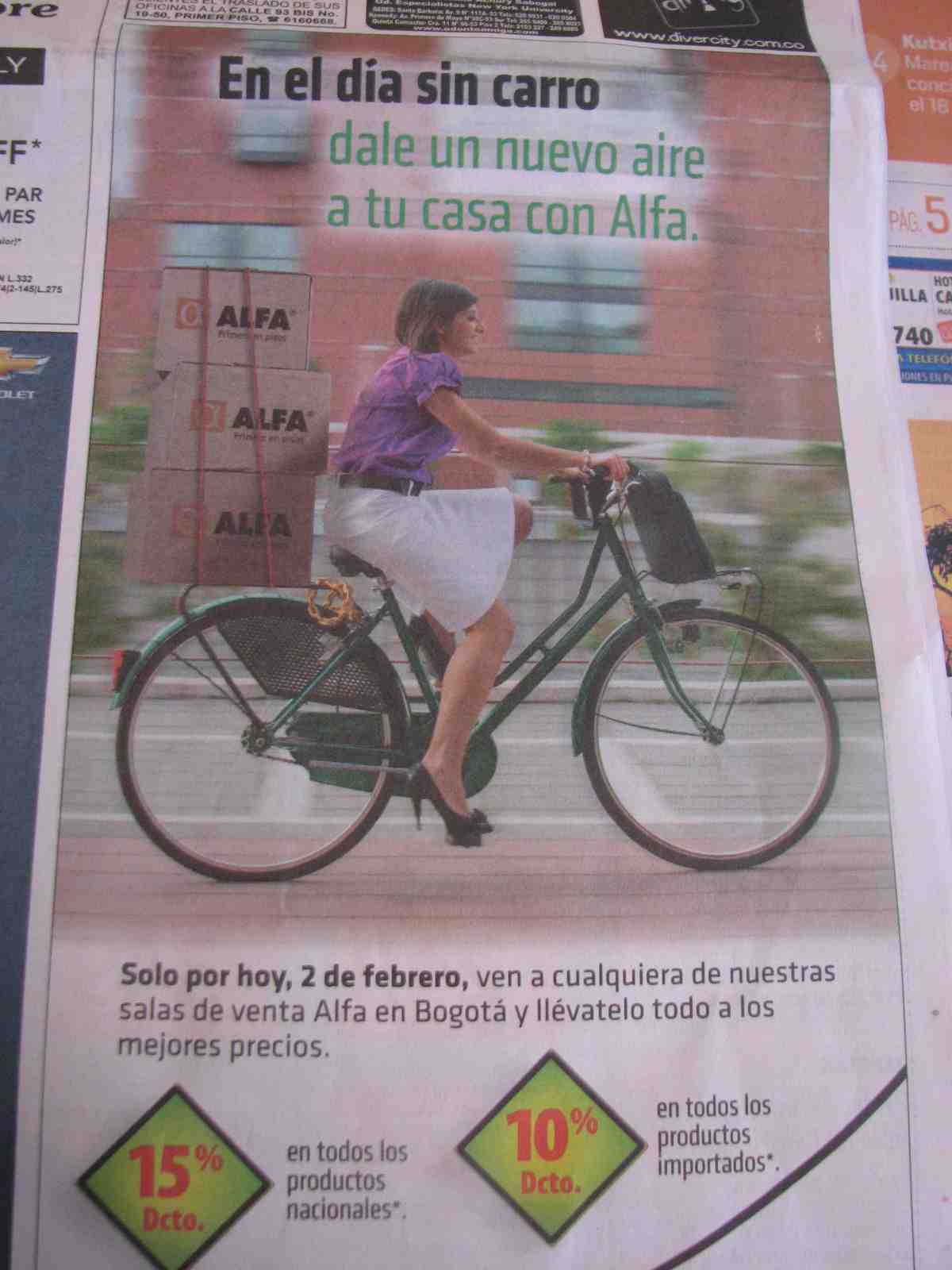
Ceramic floormaker Alfa got into things with this ad in El Tiempo urging people to 'Give some fresh air to your house with Alfa...'

but alongside Alfa's ad was one selling cars...
It was not a motorcycle-free day. 
Or a pollution-free day. Note the grey sky. 


The red light district still had some activity. 
Normally, the Palo Quemao Market's parking lot is crowded at mid-day. 


Today, workers played soccer in the market's parking lot. 

Waiting in a crowded TM station. 

Zorreros, or horsecarts, were not banned. 
Related Posts:


Bogotá: One-Way Trip to Becoming Los Angeles, Calif.?


Green or Grey Bogotá?


By Mike Ceaser, of Bogotá Bike Tours