Showing posts with label churches. Show all posts

Monday, March 4, 2013

Fading Grandeur: La Iglesia del Voto Nacional

A grand, elaborate and nearly vacant church.

Some photos I took today of the Iglesia Voto Nacional on Los Martires Plaza. This weekend the Los Martires district held its annual festival and you can still see the band's stage on the plaza.

Los Martires has been in the news recently because of the city government's efforts to impose order on the adjoining street of perdition known as El Bronx.

The neighborhood played a fundamental role in Colombian history. Revolutionary battles took place in the area. And during the revolution, the Spanish executed many Colombian patriots in the area. After the disastrous 1,000 Days War, the Iglesia del Voto Nacional was constructed in 1902 to show the nation's gratitude for peace and hopes for a peaceful future. (Voto means 'vow.') Tragically, it didn't work, since and Colombia's internal armed conflicts have continued.

Over the last century, the neighborhood around the church has declined economically. The Plaza, which memorializes some of the country's greatest martyrs, is the haunt of homeless drug addicts. But the church preserves a lot of its original grandeur. Sadly, however, few parishioners were there to appreciate it today. However, a church employee told me that many people do come for Sunday mass, including even the Italian ambassador.

The Iglesia del Voto Nacional on Los Martires Plaza. 
The neighborhood around the church, once wealthy, now has relatively few residents, and many of them drug addicts, who are less than devout. But the Bogotá city government has plans to bring new life and residents into the city center, which could also bring more congregants to El Voto Nacional and the center other mostly-empty churches.

The employee also told me that the church's exterior structure was recently repaired. Now, they're looking for financing for the interior of this landmark of Colombian history, culture and faith.

During today's mid-day mass fewer than a dozen people sat in the pews, which had room for perhaps a thousand. But a woman attending the door said that on Sundays many people come. 


Soldiers stand by Los Martires' Plaza's monument to Colombia's martyrs. 

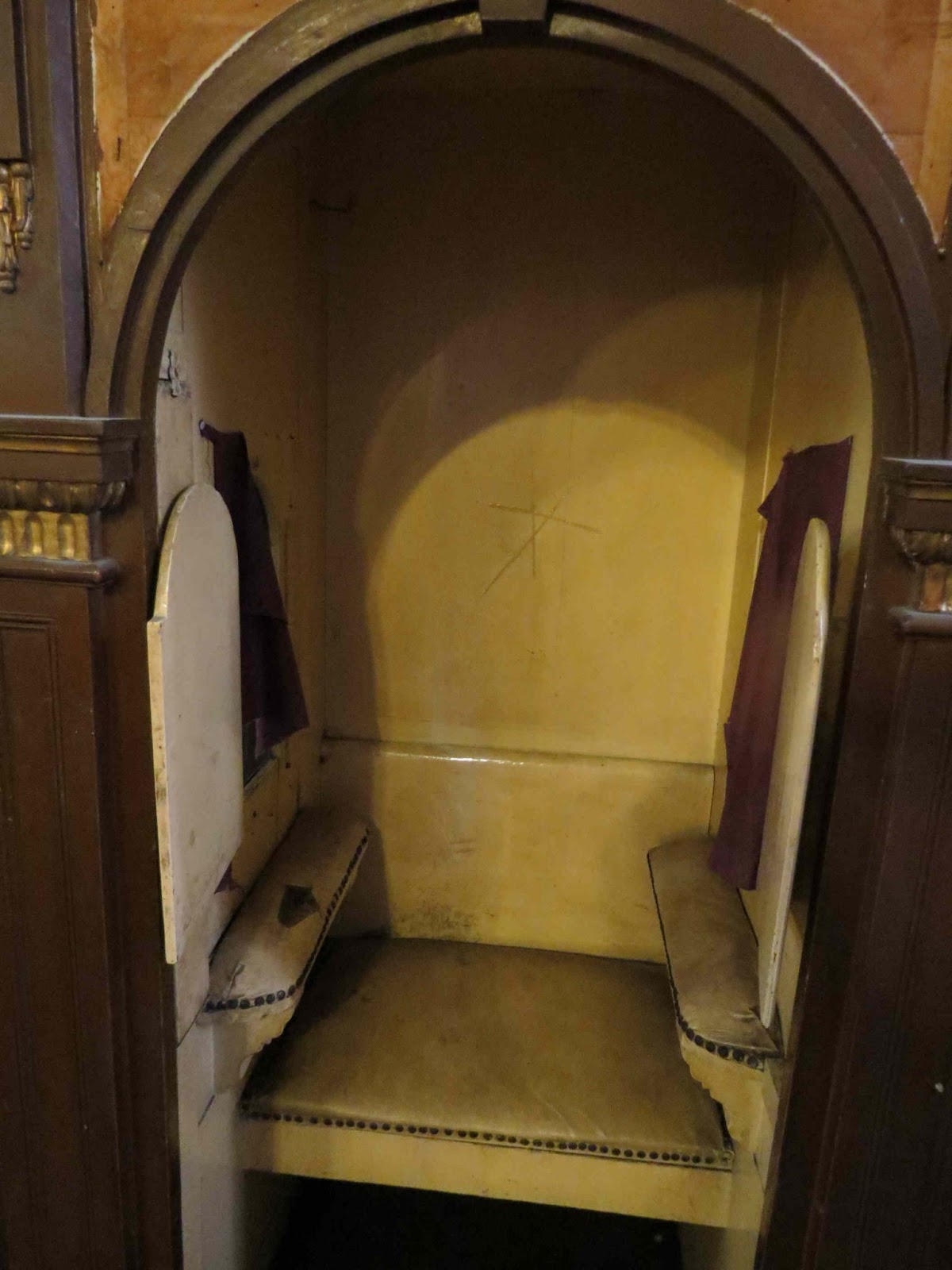
A seat waits for the priest to hear confesion. 
The priest appears tiny before the church's elaborate decorations. 
The infant Christ, backlighted in a window. 


The church's ceiling paintings badly need cleaning and restoration.... 

...as does this one on a wall. 


A saint in a stained glass window. 
The Voto Nacional's arched entranceway.


Believers' candles. 


Will these empty pews ever be full again?

By Mike Ceaser, of Bogotá Bike Tours

Tuesday, February 14, 2012

A Restored Camarin for El Carmen


The restored Camarin de Carmen, on 9th St. in La Candelaria. 

Built in 1655, the camarin - a sort of box extending from the side of a church on Calle 9 just above Carrera 5 in La Candelaria - hung on for centuries despite weather, riots and earthquakes as the church building was converted into a military barracks, a school and finally a theatre. But more than three centuries of endurance ended in September 2010, when a delivery truck driving the wrong way on the cobblestone street smashed the ancient structure, severely damaging one of La Candelaria's oldest and most significant pieces of architecture.
A view of Calle 9,
with el Camarin on the right. 

Some placed responsibility on the neighborhood's mayor: she had ordered removed a pair of chains which neighbors had fixed across the street's entrances to block traffic.

After a legal tussle, the company which owned the truck agreed to pay for repairs, and last Saturday, after 15 months of restoration work, the camarin was replaced as close to its original form as possible.

A view down the street towards the Presidential Palace. 
A camarin is a tiny chapel built behind an altar to hold a religious image, in this case La Virgen del Carmen.

A coat of arms on ths street. 
The camarin's return restores an important piece of one of the most colonial-appearing streets in La Candelaria, Bogotá's historical center. The block of 9th Street between Carreras 4 and 5 is one of La Candelaria's few stretches of cobblestone. On its south side is the Colegio Salesiano and on its north the Colegio Santisimo Rosario and a resource center for informal street vendors. On the block below is the Ministry of Foreign Relations, and two more blocks downhill the Presidential Palace, La Casa de Nariño.


And a colorful window on 9th St. 


Graffiti mars this colonial street. 

A handsome old house a block uphill. 

The Ministry of the Exterior, across from el Camarin. 

A poem set in a window. .

And a piece of poetry on a wall. 


Police stopped and searched this old man who had been sitting in a doorway. A security guard told me 'That old man doesn't do any harm, but behind him come many others. They used to mug people all the time on this street.' The cops made the old man move on. 

A lamp two blocks up the street. 


By Mike Ceaser, of Bogotá Bike Tours

Monday, December 19, 2011

Bogotá, City of Churches


A Bogotá chapel in a long-ago scene. 

When the Spanish invaded the New World, spreading Catholicism was one of their principal justificiations for creating their new empire. After all, Spain had expelled the last Muslim kingdom from the Iberian Peninsula in 1492, the same year Columbus reached America, making the fabulous new territory seem like their reward for defeating the Muslims.

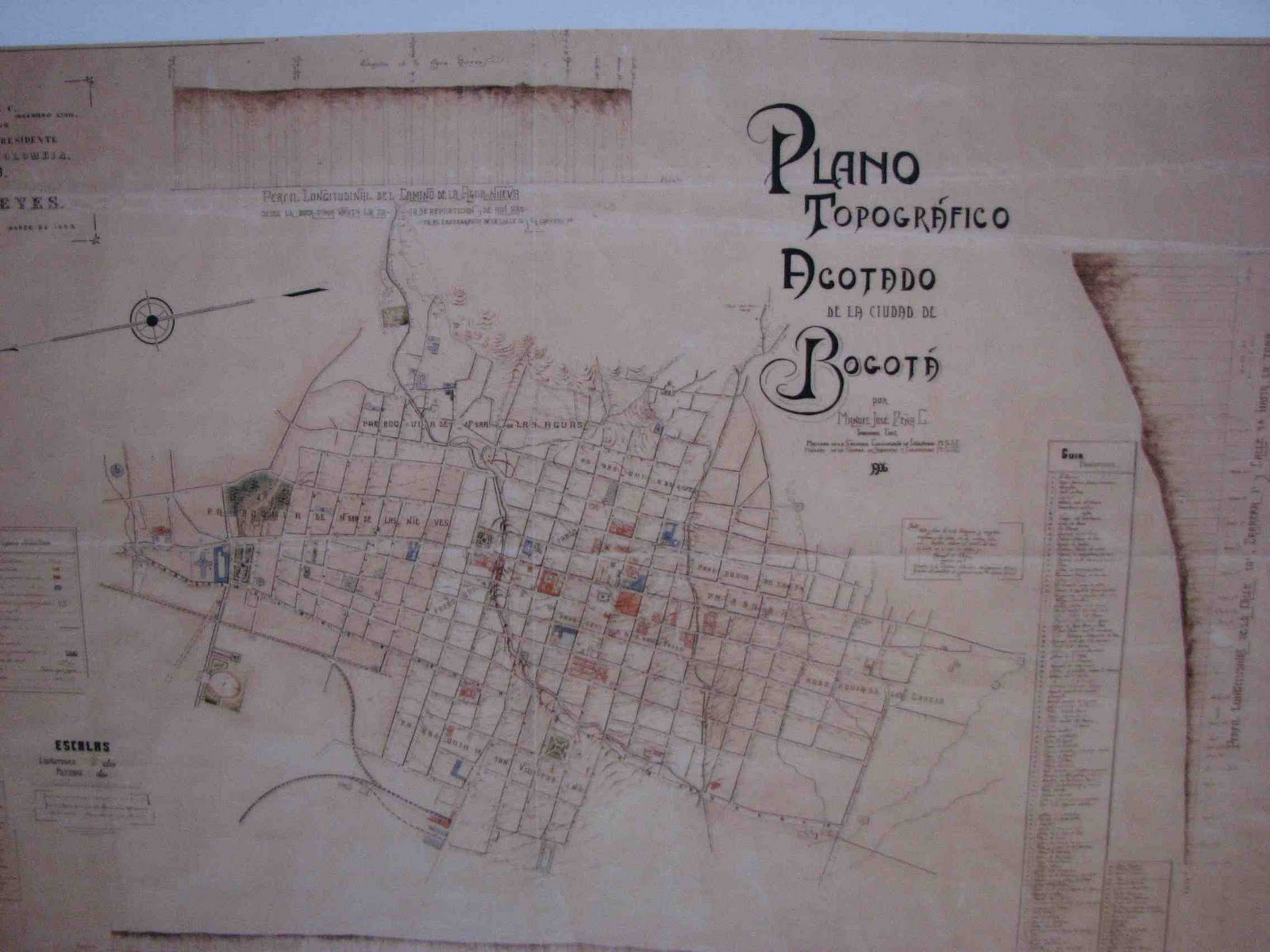
A historic photo of central Bogota showing
locations of 21 churches. 
Bogotá was no exception. The city's historical center, La Candelaria, has nearly two dozen Catholic churches. Altho the Spanish conquistadores fell far short of saintliness: they built their empire on slavery, mass murder and forced religious conversion - altho some Catholics, like the Jesuits, did try to protect the native American people.

But whether they represent holiness or exploitation, Bogotá's Catholic churches, many of them centuries old, are historical and cultural treasures. Sadly, tho, several old churches have been destroyed, by the 1948 Bogotazo riots or to make way for 'progress,' such as the broadening of avenues. Recently, tho, others have been restored.

The Amigos de Bogotá Foundation, on Calle 12 No. 6-67, has an exhibition about the history and architecture of Bogotá's churches. The foundation's exhibit was designed by the architect Mauricio Uribe, of Los Andes University.

The Cathedral on Plaza Bolivar undergoing renovation. 


The Vatican's embassy in Bogota, on Calle 12 and Carrera 4. It was destroyed in April 1948 during the Bogotazo riots following the assassination of Jorge Eliecer Gaitan. 

The Iglesia de Egipto, perhaps a century ago. 

A church in the now shut San Juan de Dios Hospital in Bogotá's Los Martires district. 

Bogotanos crowd Seventh Ave. in front of San Francisco Church. The building in front was called El Humilladero and used for punishing sinners. 
San Francisco Church today. Three colonial churches stand here side by side. 

Las Cruces Church, south of La Candelaria. 

Tenth Ave., where an old church was demolished to make way for 'progress.' 


A Dominican monastery between Calles 12 and 13 and Carreras 7 and 8, built in 1888. The monastery was demolished to make way for Seventh Ave., and its adjoining church was leveled a few years later. 


Lions on the side of the Cathedral. 

The Cathedral of Bogotá on Plaza Bolivar today.


A church model with behind it the interior of the Cathedral of Bogotá. 

A historic scene on Seventh Ave., with the Cathedral in the background. 


A door of La Bordadita Church, now inside El Rosario University. 

Las Nieves Church, which was recently restored.


By Mike Ceaser, of Bogotá Bike Tours