Showing posts with label san agustin. Show all posts

Thursday, December 5, 2013

The Absent Idols

Empty spots wait for monuments in the National Museum.
To commemorate a century of arqueological investigations in San Agustin, the National Museum has an exhibit on about the storied monuments. The exhibition includes images and lots of historical and anthropological information - but no monuments, or even reproductions of them.

Their absence is due to opposition by San Agustin area residents, who blocked the temporary transfer of some monuments to Bogotá, fearing that they could be damaged or not returned. The museum describes the locals' attitude as selfish. But the Sanagustinianos remember well that dozens of San Agustin statues were taken away in the early 1900s and remain in storage in Gemany.

The San Agustin monuments, located in Huila Department near the town of San Agustin, were created between about the time of Christ and 900 a.d. According to the museum exhibition, they may have been created by several different cultures. Nobody's sure what the figures represent or who created them, but climate change apparently played a key role in the cultural flowering and decline. According to the exhibition, the great period of monument building coincided with a time of abundant rainfall and good harvests.

An artist's rendering of an indigenous man
before the arrival of the Spanish.
The Sanagustianos' insistance on controlling the statues also suggests some questions about ownership of natural and artistic resources. There's no evidence that the people now living near the monuments are related to the ancient monuments' creators. So, why should they have any more right to control the monuments than someone from Bogotá, Medellin, or even New York? In this sense, are ancient monuments any different from gold or coal deposits? Nobody put them there, either?

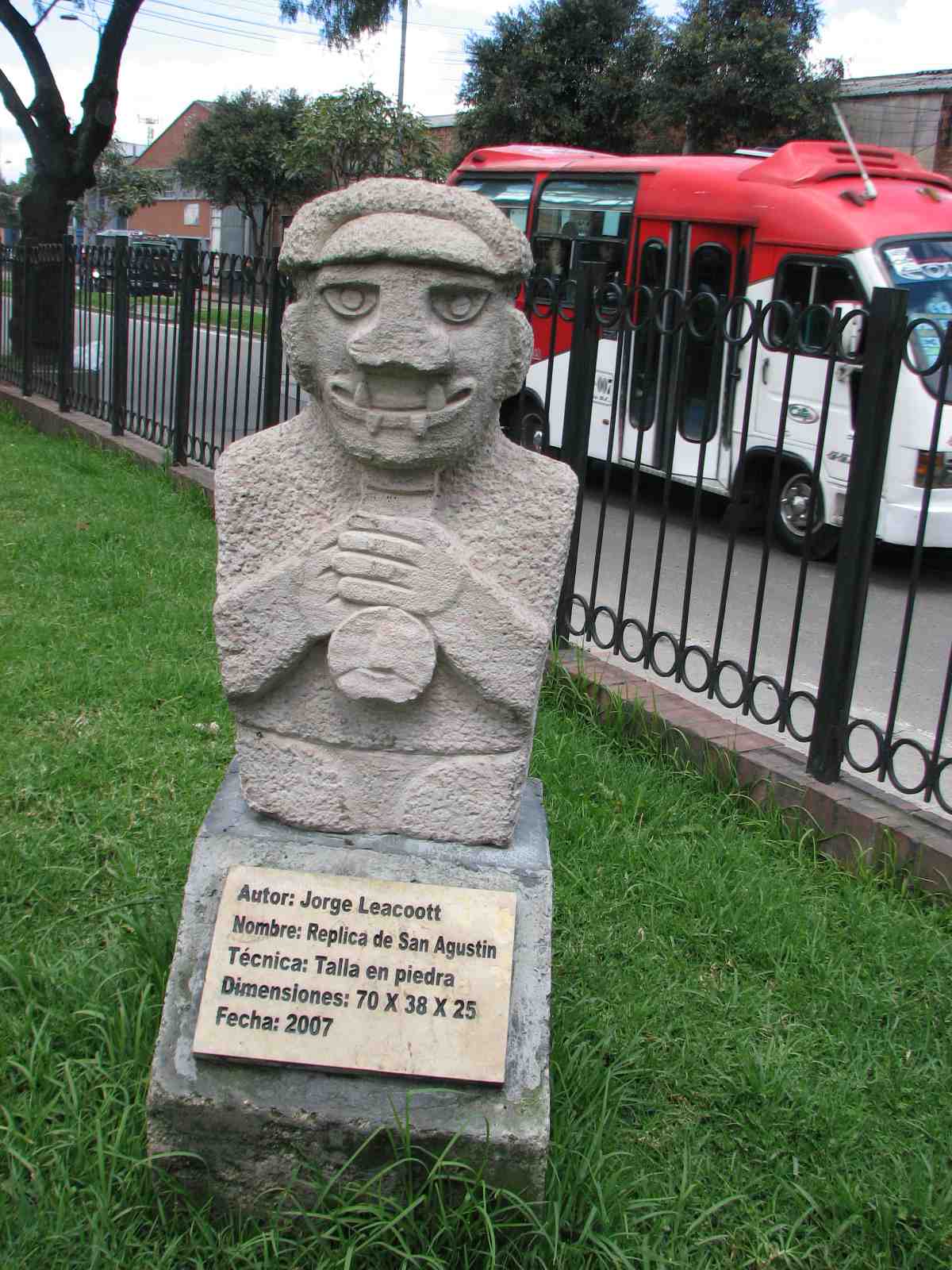
In any case, those interested in seeing San Agustin monuments in Bogotá can visit replicas in the Los Martires district. 

Information about European and Colombian writing and research about the monuments. 
Altho the first Europeans visited the area in the 1530s and described the monuments, German ethnologist Konrad Theodor Preuss is considered to have done the first investigations in 1913.


By Mike Ceaser, of Bogotá Bike Tours

Saturday, February 11, 2012

Los Martires' Festival of the Rock and Flower


Today, the Los Martires District celebrated the Festival of the Rock and Flower in the San Agustin Park, which contains reproductions of the famous monuments found near the Ecuadorean border.

The festival featured flowers and stonework, which are characteristic of the district, since it is the site of Bogotá's Central Cemetery. 

The festival was nice, and the little San Agustin Park is a surprising and interesting spot amidst Los Martires' traffic, industry and vices.

Bringing a renaissance to Los Martires should be a priority for Bogotá: after all, the neighborhood is in the city's heart and boasts some historical landmarks, including Los Martires Plaza, the La Sabana Train Station and several elegant old churches and grand old houses, now run-down. It also contains lots of retail, small industry, several educational institutions, the city's low-rent red light district, the notorious El Bronx, and lots of poverty and social problems.

The execution of 'La Pola'
Liberty
But Los Martires also has great potential: whenever the 26th St. and Carrera 10 TransMilenio lines are FINALLY finished, the neighborhood will have good transit access - and that will improve more if Mayor Gustavo Petro follows thru on his idea of putting a regional train line on the existing corridor, which runs right thru Los Martires.

The city might consider Los Martires as the site for the teaching hospital which National University medical students have long asked for. It would be fitting, since the Nacho's original hospital was located beside Los Martires Plaza, now the site of the military recruiting headquarters.

Educational institutions and quality low-rent housing would both revitalize the neighborhood and contribute to the mayor's goal of densifying the city. The city could also find space for a green area which would truly be a central park for Bogotá. One potential space would be part of the huge lot behind the La Sabana Train Station.


A groveling stone figure. 


Some scenes from Bogotá's Los Martires district. 
Bicitaxis lined up by Los Martires Plaza. 

A pedicab, or bicitaxi, passes by the Voto Nacional church. 

A horsecart, or zorrero, by Plaza España. The driver is loading a mattress he just found. 

An aged, graffitied building on Plaza España. 

On Plaza España, concrete seats which I've never seen used. 

Vendors on Plaza España, with the Hospital San Jose behind them.
By Mike Ceaser, of Bogotá Bike Tours

Saturday, January 28, 2012

A 100th Anniversary for a Millenial Site

Researchers in San Agustin in 1946 (Photo: El Espectador)
The Parque San Agustin in Huila Province is celebrating the 100th anniversary of scientific research about the site's famed 2,000-year-old monoliths. For its own part, Bogotá's own San Agustin Park in the Santa Fe neighborhood is passing a more modest first birthday.

Monuments in San Agustin, Huila Province.
Huila's San Agustin archeological park is the only place in Colombia with pre-Columbian monuments. But their makers remain a mystery. The people, called Agustinianos after the present-day town nearby, created about 300 stone monuments between about the first and eighth centuries after Christ. Then, their civilization disappeared, perhaps pressured by the invasion of other peoples, climate change or other causes.

San Agustin in Bogotá.
The Swiss writer Erich Von Däniken, who saw extraterrestrial influences in many ancient human civilizations, credited aliens with influencing the ancient Agustinianos. Others have theorized about Mayan, Egyptian or even Viking connections. All those speculations, which have little evidence, short-change the native Colombians, who undoubtedly were capable of creating magnificent stone monuments without outside help. Researchers theorize that the monuments were used for ancestor worship and may have represented reincarnation. Many mix human and feline charcteristics, suggesting the mixing of human and animal spirits. Perhaps the monuments provided gateways between this world and the next.

A bicycle tourist
beside the famous
'Doble Yo' figure.
The monuments in Bogotá's own park, which is located in the very urban Santa Fe neighborhood behind the Central Cemetery and just a few blocks from the red light district, have a better-known origin: They were created by local sculptors, including some of the people who carve headstones nearby.

For the rest of this year, the San Agustin Archeological Park in Huila plans to commemorate the Colombian and foreign archeologists who began researching the region in 1913. Research there continues, and probably will never end.

Perhaps more significant for us than the original Agustinianos' origin was their disappearance. Like the Mayans and the monument builders of Easter Island, the Agustinians were replaced by a much simpler culture incapable or uninterested in creating such massive objects. 

Did the original Agustinianos fall victim to climate change? Overpopulation? War? Environmental destruction? We may never know. But, for a nation like Colombia challenged by many of these problems and others, the Agustinianos' disappearance serves as a warning about preserving the environment and finding peaceable means to end conflict. 


While Huila's San Agustin region appears bucolic, much of rural Colombia suffers from erosion, pollution, deforestation and desertification. And Bogotá's Santa Fe neighborhood captures many urban ills, including litter, air and noise pollution. Sometimes, it seems, cities like Bogotá are carrying out an experiment in how a species can poison itself in its own wastes.

This figure, in Bogotá's Santa Fe neighborhood, appears to suffer from an indeterminate gender.

The Bogotá park is a green island amidst urban noise and pollution. 


Posing with a face. 

These figures might represent male midwives, or gods devouring infants. 


By Mike Ceaser, of Bogotá Bike Tours

Wednesday, October 26, 2011

Jumping for Joy


Today, these kids were leaping off of the monuments in the San Agustin Monument Park in the Santa Fe neighborhood.

The kids probably shouldn't have been doing this. The monuments were made by stoneworkers at the nearby Central Cemetery, mostly in the style or as reproductions of the monuments at San Agustin, the only site in Colombia with pre-Hispanic monuments. In fact, two of the monuments have been knocked off of their bases, most likely by gymnastic boys.

But looking at it from another perspective, these kids are engaging in a healthy, challenging activity, when they might instead be smoking pot or playing violent video games. Perhaps one day they'll be on the national acrobatics team.


This monument is one of two which have been broken off of their bases, most likely by kids playing on them. 


By Mike Ceaser, of Bogotá Bike Tours

Wednesday, March 16, 2011

A Miniature San Agustin in Bogotá


Fierce guy!
Can't go visit the dramatic, mysterious San Agustin statues in Huila Department? Now you can see them in Bogotá's Los Martires neighborhood, but you might want to get down on your knees so that they appear to have their original dimensions.

The thirty-odd statues are the winners of a contest held by the local city hall. Some are much smaller copies of or inspired by the statues of San Agustin, which were created by an unknown civilization before 800 a.d. Others are modeled after the statues at Tierra Adentro, and still others are sorts of modern art.

They're in a tiny neighborhood park, behind a mini police station, in a gritty industrial neighborhood near the Central Cemetery, a mile or so from the Red Light District.

The real San Agustin monuments were built by a civilization between the time of Christ and about 700 A.D. The civilization later disappeared, and researchers have made little headway in understanding who they were or what the monuments represent. Many are by tombs or on hilltops.

See kids leaping off of the monuments.


The small park, adjoining a min-police station, is in a very un-Agustinlike setting. 
Some appear to show gods eating children. Wow. 
Big nose man. 
Chaman


Chaquira, without the hips. (There's actually place near San Agustin named Chaquira)
The real San Agustin was never this fun!
I'm happy!
Luis Octavio works marble and granite two blocks away on headstone row, behind Bogotá's Central Cemetery. 

This Muisca indigenous goddess Bachué, carved in a not-so-indigenous style. 

Novios, or lovers. 
See a slide show here


By Mike Ceaser, of Bogotá Bike Tours