Showing posts with label Plaza Bolivar. Show all posts

Saturday, October 6, 2018

Pigeon Prohibition?


A human pigeon perch.
Pigeons are also a problem. Some people hate them and call them flying rats. And their feces corrode statues and public monuments. Which is why the city government recently banned pigeon feeding in Plaza Bolivar.

But other people love pigeons: They like to feed pigeons, run through crowds of pigeons and watch them scatter, even to put corn on themselves and become human pigeon roosts.

A pigeon selfie.
That's why the city's anti-pigeon rules are futile. The other day, post-pigeon ban, the buying and selling of corn and pigeon feeding were going on as normal.

All of which makes me ask: If Colombia cannot enforce a prohibition on its main plaza, amidst its government buildings, then how can it ever expect to do so in remote rural areas?

The answer is that it cannot, which is why drug prohibition has failed and likely always will.
Pigeon corn for sale.


Fighting for food!


Pigeons' droppings corrode public monuments.
By Mike Ceaser, of Bogotá Bike Tours

Tuesday, September 11, 2018

El Prado Museum on Plaza Bolívar


Until Sept. 19th Madrid´s famed El Prado Museum is displaying life-size reproductions of some of its most famous works on Plaza Bolivar. After that, they'll be in Parque de la 93 and then in Parque El Tunal. 


By Mike Ceaser, of Bogotá Bike Tours

Friday, November 3, 2017

Botero in Chinese?


You could be forgiven for thinking that Fernando Botero, the Colombian artist known for creating, err, 'voluminous' figures had embraced everything Chinese, based on a walk across Plaza Bolivar these days. The plaza's southern end is populated by Botero-like fat female figures, but with Chinese features and much more dynamic poses.

These are in fact works by Chinese artist Xu Hongfei, which the Guardian newspaper describes as "jolly, state-approved sculptures."

The sculptures were displayed in London on exactly the 25th anniversary of the Chinese government's murder of hundreds or thousands of pro-democracy activists on Tiananmen Square. Similarly, here in Bogotá, they provide some superficial fun while the world seems to spin out of control around us.

If you want to see them, then hurry. They'll be gone on Nov. 7.


By Mike Ceaser, of Bogotá Bike Tours

Thursday, October 19, 2017

A Memory, and a Warning

Tables and photos on Plaza Bolivar today memorialize murdered members of the Union Patriotica political party.
Supporters of the Union Patriotica political party held a memorial on Plaza Bolivar today honoring the 3,000 to 5,000 members of the party who were assassinated in the late 1980s and early '90s in what is remembered as the 'genocide of the Union Patriotica.'

The U.P., founded in 1985, was linked to the FARC, and many saw it as the guerrillas' tentative effort to integrate into Colombia's political system. The killings, carried out by right-wing paramilitaries support by the regular Colombian military, ended that initiative. 

The U.P. killings carry a special resonance today as the FARC guerrillas demobilize and integrate into society. Although the paramilitary groups formally demobilized in the mid-2000s, many people claim they continue operating in remote parts of Colombia. 

Ironically, the FARC carried out their own political 'genocide' in the early 1990s against demobilized members of another leftist guerrilla group, the Ejercito Popular de Liberacion, EPL, who had formed a political party. In the best Stalinist fashion, the FARC called them traitors to the guerrilla movement and proceeded to murder about 200 ex-EPL members.


By Mike Ceaser, of Bogotá Bike Tours

Sunday, July 16, 2017

The Venezuelan Opposition's Moment

A selfie with the crowd in back, as Venezuelans voted today on Plaza Bolivar.
'The people decide!
Colombia has filled during recent years with Venezuelan political and economic refugees, and today they showed their strength. Thousands filled Plaza Bolivar for a plebiscite designed to weaken Venezuela's increasingly hapless, corrupt and authoritarian government.

The opposition's positions will win overwhelmingly - and the government will ignore it and continue
with carreening toward dictatorship. On July 30, the government plans to hold a vote vote to elect an assembly to rewrite the nation's Constitution. But the voting system and representation were designed by the Venezuelan government to guarantee itself a majority.

The people decide!, on three
questions designed to
weaken the government.
Interestingly, the Maduro government has recently suspended regional elections it was sure to lose, arguing that with oil prices low it could not afford to hold the vote. However, it did miraculously find the money to hold the constitutional assembly vote it plans to wind.

The government in Caracas has also used its packed Supreme Court to nullify all decisions taken by parliament, which is overwhelmingly dominated by the opposition.

Today's ballot, designed and promoted by the MUD opposition coalition to Venezuelan Pres. Nicolás Maduro, contained three questions:

- Do you reject the constitutional assembly planned by Nicolas Maduro without the previous approval of the Venezuelan people?

- Do you demand that the armed forces and all public functionaries obey the 1999 Constitution and back the decisions of the National Assembly.

'Gochos united in Bogotá.' Gochos are people
born in the Venezuelan state of Tachira.
- Do you approve of the public authorities and the creation of a national union government and the holding of free and transparent elections to restore the constitutional order.

Many observers believe that in Venezuela power ultimately rests with the military. Opposition leaders argue that the government has violated the 1999 Constitution, written under the leadership of the now-deceased Hugo Chavez and would like the military to refuse to obey the government.

.Whatever happens in Venezuela: Continued crisis, outright dictatorship, revolution or civil war, it will mean huge impacts on Colombia, in terms of trade and immigration.

In a celebratory mood, Venezuelans oppositionists line up to vote on Plaza Bolivar.

Painting Venezuelan flags.

A Venezuelan exile's sign: 'Maduro, it's your fault that my children miss their grandparents.'


Venezuelan government opponents pack the Plaza Bolivar.
Venezuelans walk to vote.


By Mike Ceaser, of Bogotá Bike Tours

Wednesday, November 2, 2016

Our Pigeon Problem

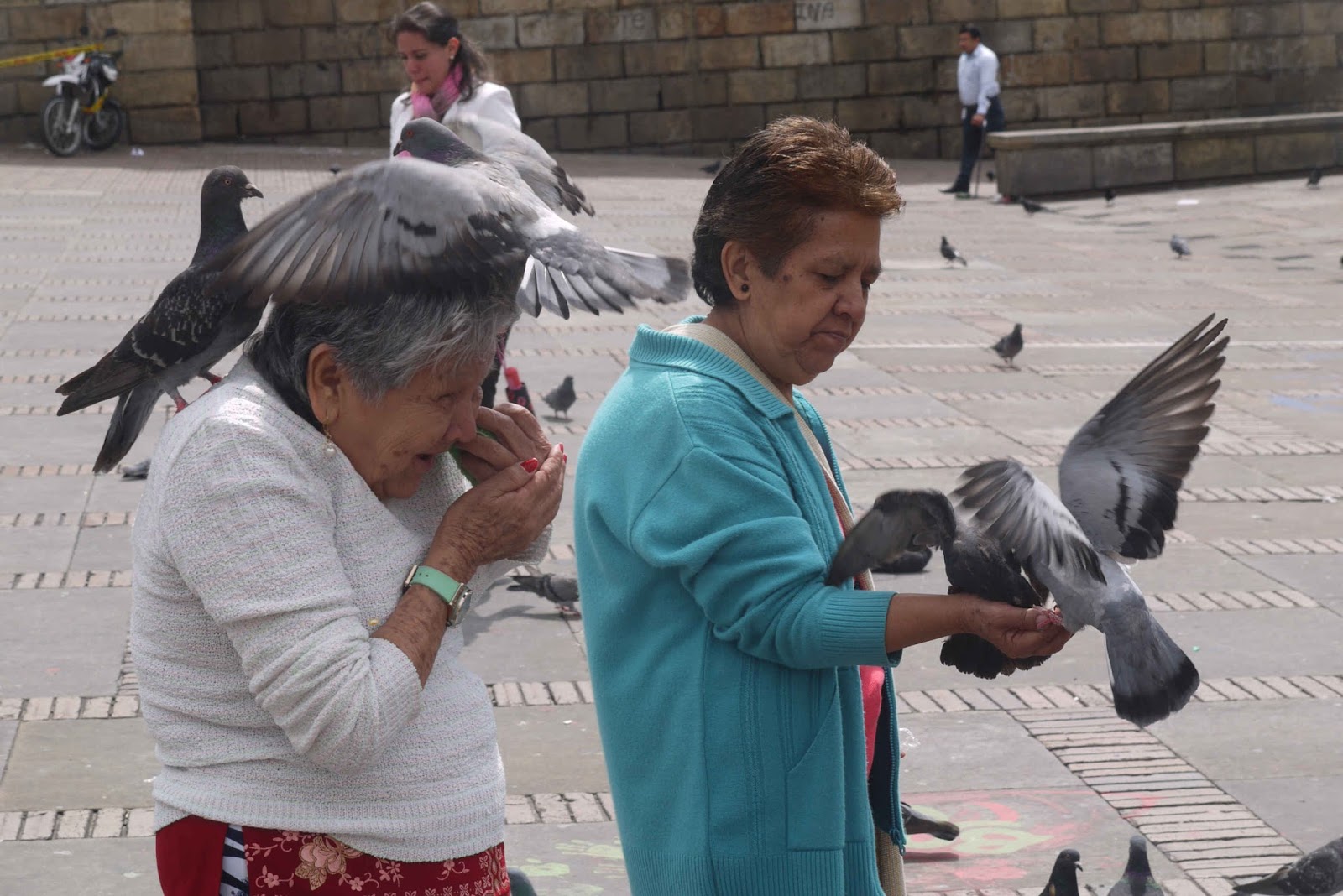
Young fun! An older woman gets a thrill from a headful of pigeons on Plaza Bolivar.

Feathered friends or rats with wings, Bogotá's got plenty of pigeons. Too many, says City Hall: the animals roost on statues, churches and historic buildings, damaging and discoloring them with their feces. A few years ago, the Cathedral placed spikes on its front to repel the animals. But, pigeons not being the brightest creatures, they impaled themselves, creating a gruesome version of crucifixion. The church removed the spikes.

Now, the city's considering more humane methods of population control, such as lacing their foods with contraceptives or building a pigeon roost, where their eggs would be taken away.

My bet is that the hated and beloved pigeons will be with us for a long time.

A pígeon in hand is worth two on the pavement.


The pigeons make the picture on Plaza Bolivar.

By Mike Ceaser, of Bogotá Bike Tours