Showing posts with label guerrillas. Show all posts

Saturday, November 11, 2017

The War We Have Not Seen

Massacre victims.
A paramilitary commander kidnaps a woman on suspicion of guerrilla sympathies, holds and rapes her, and then murders her to keep her quiet.

A teenage FARC guerrilla, eight months pregnant, wants to have her baby. But the guerrilla leaders
Massacring civilians.
force a doctor to abort her pregnancy. When the doctor and the baby's father both object, the guerrilla leaders order them murdered, too.

A child soldier flees a paramilitary unit, but is recaptured. The paramilitary commander gathers together the students from the local school to watch the execution, as a warning.

A guerrilla unit commander, ordered to blow up a military vehicle, becomes bored with waiting, and decides to bomb a car carrying a civilian family instead.

FARC guerrillas, suspicous that a local schoolteacher is reporting on them when she leaves town, capture and hang her.

A funeral.
Such horrors became almost routine during Colombia's long and senseless conflict. And such accounts, told by ex-combatants, many of them only children when they joined up, are on display now in Bogotá's Museum of Modern Art, illustrated by childlike paintings.

The project is called 'The War We Have Not Seen', by the Points of Encounter Foundation, and captures a few of the conflict's innumerable horrors, horrors which would have made headlines in any normal country, but, if not for this project, would have gone unnoticed here.

The museum has, incidentally, done a good job of becoming bilingual.
A hanging.


A river of death.


Killing a woman.


Kidnap victims.

A massacre.

A paramilitary officer. In the background, a woman he raped and then murdered.


By Mike Ceaser, of Bogotá Bike Tours

Monday, June 12, 2017

Equal Opportunity Evil

A family's memorial to their daughter, who, along with her boyfriend, was murdered, chopped to pieces and thrown into a river by paramilitaries.
A few of the disappeared, who number in the tens of thousands.
A photo exhibition on now in the Centro de Memoria on Calle 26 beside the Central Cemetery makes a simple point: In Colombia's long conflict, there are no good guys. The leftist guerrillas, right-wing paramilitaries and even the government forces have all committed terrible crimes.

The victims of all sides, and the only good guys, are Colombia's civilians. Kidnapped, 'disappeared' and driven out of their homes and off their land, civilians have been attacked by groups which often claim to be defending them.
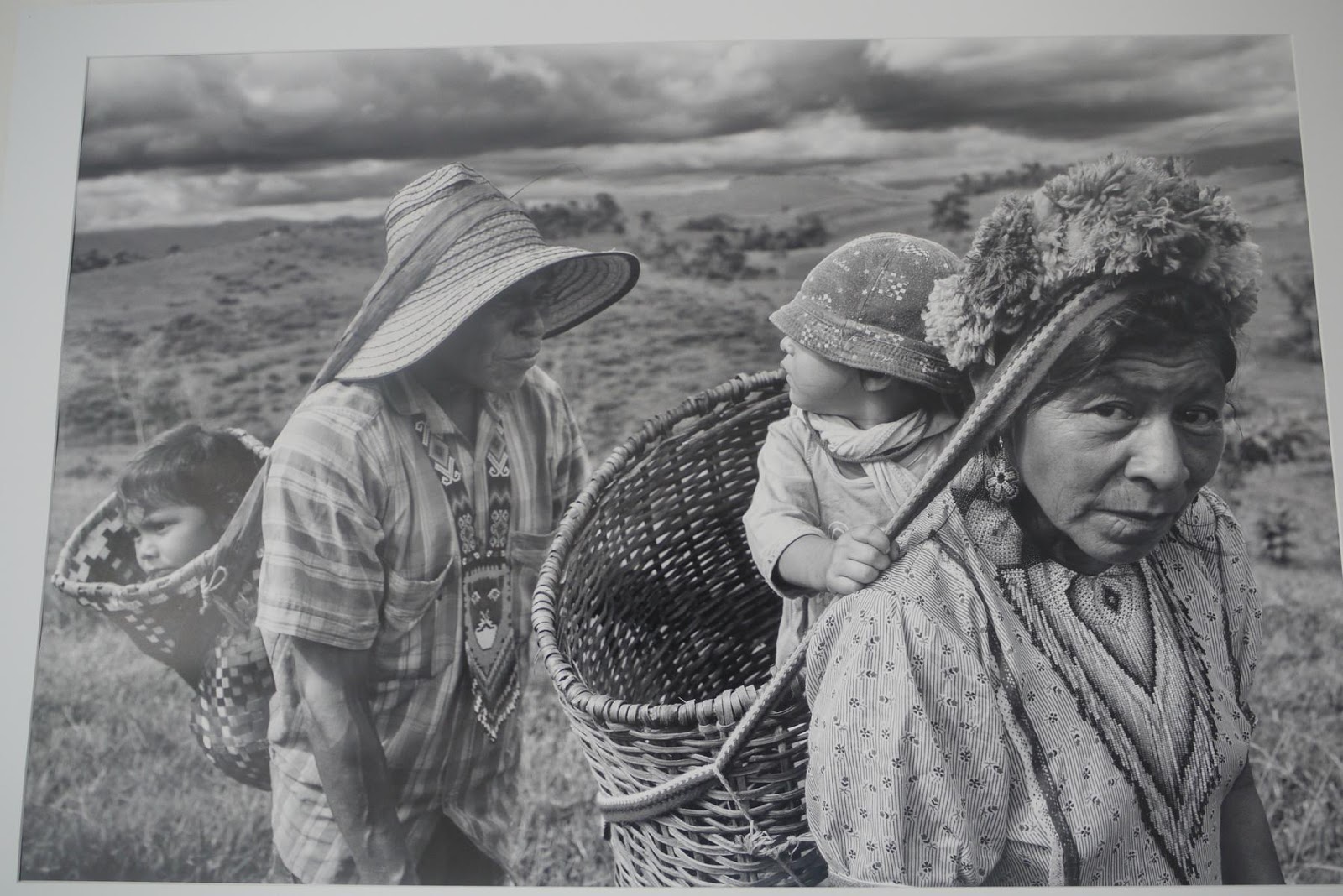
Displaced Embera indigenous people.

Today, the FARC guerrillas, Colombia's oldest and largest guerrilla group, are turning in their weapons and demobilizing. However, where the FARC go away, other illegal groups try to move in to take over the guerrillas' drug trafficking, extortion and illegal mining businesses.


Displaced Emberá Chamí indigenous people.

The Centro de Memoria, off of Calle 26 near the Central Cemetery.

Sadly, the Centro de Memory, including its exhibitions, is usually vacant.


Female guerrillas. Young people in parts of rural Colombia may join illegal groups because they know no other authority.
Girls and women in guerrilla groups may be exploited sexually and forced to have abortions.

Indigenous guards, who have struggled to exclude other armed groups from their territories.

Burying a pregnant woman, apparently murdered with government collaboration.
By Mike Ceaser, of Bogotá Bike Tours

Sunday, September 11, 2016

Injustice, Recycled

Extradited paramilitary leader Salvatore Mancuso.
The New York Times has this long and detailed piece about the light punishments received by many of the far-right paramilitary leaders who demobilized in the mid-2000s and were extradited to United States prisons.

The story makes a strong point: these guys, who may have smuggled tons of cocaine - not to mention ordering massacres, rapes, kidnappings and forced displacements - have gotten shorter sentences than some streetcorner pushers. (Here's ex-Pres. Uribe's response to the story.)

The story, however, is a bit narrow. While the paras' sentences are scandalously short, in the U.S. they did more time on drug charges than they would have back in Colombia for crimes, including crimes against humanity, under the infamous Justice and Peace Law. And, in theory, the death squad leaders are supposed to be returned to Colombia to be prosecuted for their non-drug crimes, altho the Times reports that many have obtained residency in the U.S., apparently as payback for revealing their cocaine smuggling secrets.

As a result, crimes such as massacres, kidnapping, rape and forced displacement, may never be punished at all.
A paragraph from the New York Times story listing some of Mancuso's alleged crimes.
Impunity? Aftermath of the massacre of Bojayá, in which a
FARC missile  landed on the town's church, klling more than
a hundred women and children hiding inside.
But the biggest scandal here, in the eyes of many, is that Colombia is about to do it all over again with the FARC guerrillas. The FARC have also committed horrendous crimes and human rights abuses, if perhaps not on the same scale as the paramilitaries', and under the peace agreement their leaders can not be extradited and will not even go to prison, as long as they confess what they've done. Instead, they'll get 'special detention,' a vague term likely to mean restricting them to a specific municipality.

And FARC members guilty of crimes against humanity, as long as they have confessed, will even be eligible to serve in Congress in one of the FARC's ten guaranteed seats.

None of which is to say that the FARC-government peace deal is not a good thing. However, political leaders should be careful that the FARC deal does not follow the paramilitaries down a path of injustice.

By Mike Ceaser, of Bogotá Bike Tours

Sunday, April 5, 2015

The Lessons of the EPL

An EPL fighter. (Photo: Semana)
When someone calling themselves the EPL issued a communique a few days ago expressing its interest in joining the FARC-government peace talks in Havana, many Colombia observers probably scratched their heads.

After all, Colombia is only supposed to have two guerrilla groups: the Revolutionary Armed Forces
'Combating, we will win.' The EPL's logo.
of Colombia
, or FARC, who recently commemorated their 50th anniversary, and the smaller National Liberation Army, or ELN, which is in talks about peace talks. But the EPL, or Popular Liberation Army? Didn't they disappear years ago?

In fact, Colombia did once have an EPL guerrilla group, but whether it still does is controversial. And that story illustrates the troubles of negotiating with and demobilizing guerrilla groups.

The EPL was founded in 1967, and grew to have some 4,000 fighters. It specialized in extortion, kidnapping, cattle rustling and money laundering. In its formal philosophy, the EPL adhered to the ultra-Stalinist ideas of Albania's brutal communist dictator Enver Hoxha. In 1991, weakened by attacks from the military and right-wing paramilitaries, some 2,500 EPL fighters demobilized, handing over 850 rifles and founding a political party named Hope, Peace and Liberty, or EPL by its Spanish initials.

'Megateo' in front of an EPL banner.
But the EPL's troubles weren't over. It now became the target of both the left and right. The FARC, calling the demobilized EPL fighters traitors to the revolutionary cause, deliberately murdered several hundred of them. (Ironically, at the same time, members of the FARC-associated Patriotic Union party were being murdered by right-wing forces. The U.P. martyrs have been memorialized, the EPL victims forgotten.) Then, in 1993, EPL defiant leader Francisco Caraballo was captured by the military, and in 1996 one of the group's few remaining fronts turned itself in to the military, while another joined a paramilitary group, supposedly the guerrillas' sworn enemies.

After that, the EPL mostly evaporated, except for a few clashes with the military and the 2006 kidnapping of a businessman and politician's son by people claiming to be EPL members.

However, in 2013 Víctor Ramón Navarro, or Megateo, presented himself to reporters in Catatumbo as head of the EPL's Libardo Toro's front.

To United States and Colombian authorities, however, know Navarro basically as a drug trafficker, Semana magazing wearing gold rings encrusted with diamonds and emeralds.
Want an easy 9 billion pesos?
A wanted poster for 'Alias Megateo.'
for whom they offer millions of dollars in rewards. And his sincerity as a communist revolutionary was called into question when a photo appeared of him wearing a thick gold necklace and he showed up for an interview with

And reporters with Semana magazine also wondered about Navarro's guerrilla legits when his 50 fighting men appeared wearing new uniforms similar to the Colombian military's and carrying brand new Israeli-made Galil rifles. Who or what was sponsoring these people?

Now, the EPL guerrillas want to join the peace talks. But do they still exist, and are they really guerrillas, or a criminal band calling themselves guerrillas?

Some say that the trouble started back in 1991, when the EPL only partially demobilized. And that may have been in part due to the violent hostility from the FARC, who evidently didn't want to lose a guerrilla ally.

With the government-FARC peace negotiations advancing in Havana, the EPL's story illustrates the many ways which a peace deal can go wrong. Does the FARC's central command really control all of its units? Might some guerrilla fronts refuse the peace deal, or morph into violent criminal bands stripped of ideology? Could a guerrilla demobilization trigger another episode of murderous revenge taking?

Meanwhile, someone will have to decide whether the so-called EPL guerrillas deserve the amnesty offered to political groups which have resorted to violence, or should be fought and incarcerated as simple drug traffickers.

By Mike Ceaser, of Bogotá Bike Tours

Friday, July 25, 2014

How to Get Away With Financing Terrorism

A mural in Bogotá shows bananas and victims of violence. 
Between 1989 and 2004 the Chiquita banana company paid millions of dollars to Colombian guerrillas and paramilitary groups.

The organizations are or were classified as terrorists by the U.S., Colombian and European governments. And, while Chiquita was paying terrorists millions, the organizations were violating human rights in all kinds of horrific ways: torturing, massacring, kidnapping and driving peasants off of their lands and out of their homes. While Chiquita was paying off the paramilitaries, they murdered 4,000 people in Uraba province and drove 60,000 off of their land, according to the leftist organization COHA.

Chiquita claims that it had no choice but to make these payments in order to protect its workers from murder
and kidnapping. But the companies' critics charge that Chiquita also paid the paramilitaries, at least, in return for the far-right organization's repressing unions and peasants - sometimes with violence.

Read horrific accounts of paramilitary violence here.

The paramilitaries also smuggled at least one shipment of weapons - and perhaps several more - into Colombia thru a port controlled by Chiquita's subsidiary Banadex.

And Chiquita clearly did have an alternative to funding terrorists: it could have pulled out of Colombia.

In 2007, Chiquita, whose annual revenues are in the billions, paid a $25 million fine to the U.S. government for funding terrorists. (If you or I funded terrorists, we'd probably go to prison. But Chiquita's ex-lawyer is U.S. Attorney General Eric Holder.)

The Colombian victims of the terrorist groups which Chiquita was funding received nothing.

However, 4,000 relatives of those victims sued Chiquita in U.S. courts - and yesterday their lawsuit got nixed.

The court didn't reject the lawsuit based on the facts of what happened. Chiquita confessed that it paid off the terrorists, and the terror groups' actions are public record. However, the court ruled that the plaintiffs couldn't sue Chiquita in the U.S. because the crimes were committed in Colombia.

But the plaintiffs' lawyers argue that the decisions to fund the terrorists were made in Chiquita's U.S. corporate offices. According to the Associated Press and Wikipedia, a Chiquita executive wrote a note saying the payments were the "cost of doing business in Colombia" and pointed out the "need to keep this very confidential - people can get killed." Chiquita's outside attorneys had also advised the company that the payments violated U.S. anti-terror laws, but the company continued paying until it sold its Colombian interests in 2004.

The plaintiffs' attorneys say they'll appeal.

Perhaps the victims can now sue Chiquita in Colombia - except that the company sold its Colombian subsidiary, Banadex, in 2004, and no longer has assets here the plaintiffs could sue for.

The lesson: If you're going to finance terrorists, it helps to be a rich, well-connected multinational.

By Mike Ceaser, of Bogotá Bike Tours

Friday, July 11, 2014

Fifty Years of the ELN

Looking for a rest? ELN fighters on the march. 
In July, 1964, a group of young Colombian leftist intellectuals fresh from studies in Havana, Cuba,
A pipeline blown by an ELN bomb.
founded the ELN guerrillas. During the half-century since, Cuba's revolution has entered its senescence and its patron the Soviet Union has disappeared, but the ELN has struggled on with its revolutionary attacks and manifestoes. The ELN recently 'celebrated' its 50th birthday by bombing an oil pipeline and an oil workers camp, planting 50 land mines and killing four policemen in Arauca Department.

The ELN, or National Liberation Army, will soon follow Colombia's larger guerrilla group, the FARC, into peace negotiations with the government and, by bombing and murdering, the ELN wants to assert that it still matters.

It's a strange way to throw a birthday party. But the ELN guerrillas, despite their idealistic roots and rhetoric, seem to have devolved into destructiveness and cynical self-justification.

The ELN's most famous member, guerrilla-priest
Camilo Torres painted on the wall of the
Universidad Nacional's library in Bogotá.
The ELN has always had a somewhat softer image than their big brothers, the FARC. That's in part because, being smaller, the group has committed fewer atrocities. And because the group's leaders have included several Catholic priests, who have given the ELN an image of idealism and maintained a distance from narcotrafficking - altho not always much of a distance. In recent years, the ELN has reportedly joined the FARC in protecting drug crops and taxing drug shipments, altho may not traffic cocaine and heroin itself. In contrast to the FARC, the ELN has traditionally made much of its money by extorting foreign oil companies, and kidnapping their workers and blowing up their pipelines if they didn't pay up.

I once interviewed a woman who had been a member of an ELN unit, which marched thru the countryside collecting ransom payments and extortion money. One time, in a rural region, they learned of a traveling salesman offering plumbing supplies. The ELN commander observed that the region didn't have running water, and concluded that the man must be a spy. The guerrillas captured and murdered him.

The woman had participated in one of the ELN factions' many demobilizations and lived in Bogotá.
What kind of rifle would Christ carry?
A Christ-like Camilo Torres
painted by Oscar Rostgaard, 1969.
Her commander, who had also demobilized, drove around in an armored SUV with two government-supplied bodyguards because he was considered a possible assassination target. He and other ex-guerrillas were supposed to be carrying out an agricultural development project, but it sounded as tho it was failing. He had fathered a child by the woman guerrilla, but she accused him of abandoning and betraying her - which made me doubt his idealism.

The ELN's most famous member, and one of its most idealistic, was Camilo Torres, a Catholic priest who was also chaplain of the National University. A follower of the Liberation Theology movement, in 1966 Torres gave up on society and joined the ELN. He was killed in his first battle, becoming one of the Colombian Left's many martyrs.

I wonder what the idealistic Torres would think about the ELN''s 50th-year anniversary communique, which lamented the 'high costs of these 50 years of effort in human lives of many of our companions,' but ignores the ELN's innumerable civilian victims.

The time for the ELN's violence and ideology have come and gone. Fifty years are enough.

By Mike Ceaser, of Bogotá Bike Tours

Sunday, August 18, 2013

Colombia's Invisible Mines

Colombia exports about 100 tons of tungsten per year. But, strangely, the country has only one legal tungsten mine - and it isn't operating, according to a recent Bloomberg News report. Instead, the tungsten - used in cars, smartphones and tablet computers - apparently comes from an illegal mine called Tiger Hill operated by the FARC guerrillas in southern Colombia.

Today's El Espectador contains a report about Colombian municipalities which recieve substantial incomes from gold mining royalties. Strangely, however, many of those municipalities have few or no gold mines.

Then there's coltan, also used in many electronic devices. Colombia has little coltan - but Venezuela apparently has lots of it, in particular near the Colombian border. In 2009, Venezuela prohibited coltan mining. That didn't shutter the industry, however, but just pushed it into the hands of outlaws such as Colombia's guerrillas, paramilitaries and other criminal groups.

Illegal mining has long been a bane for Colombia's society, economy and environment. Illegal artesanal miners use poisonous materials such as cyanide and mercury but don't have the knowledge or resources to safely dispose of them. But illegal mining has become a growing source of income for illegal groups. In 2012, Colombia exported almost $2 million dollars worth of tungsten to a single company in the United States which manufactures wire and other industrial supplies, according to Bloomberg news. After Bloomberg inquired, the buyer said it would stop purchasing Colombian tungsten.

And the legal mining industry, with all of its own social and environmental impacts, uses the spectre of illegal mining to pressure governments to approve large-scale mining. After all, in a country like Colombia with abundant minerals, corruption and weak rule of law, if legal companies do not exploit minerals, most likely somebody else less answerable to the law will do so.

By Mike Ceaser, of Bogotá Bike Tours

Monday, June 24, 2013

A Nation Kidnapped

FARC kidnappees held behind barbed wire in a jungle prison.
No other crime, perhaps, has scarred Colombia's recent history and psychology as deeply as has kidnapping.

Unlike massacres and assassinations - which at least end quickly - kidnappings stretch on for months, years or more than a decade, creating long, painful dramas.

And kidnapping even created its own culture in Colombia - as it's now doing in Mexico - with novels and non-fiction books and even radio programs for kidnapping victims.

Now, two human rights organizations have attempted to place numbers on this scourge. And their report, altho terrible enough, is almost surely a huge underestimate.

The report, A truth Kidnapped (Kidnapping from 1970-2010), is the result of five years' research by Cifras and Conceptos and the Center for Historical Memory, counted more than 39,000 kidnappings over the past four decades. Of those crimes, they said, only some 7,800 kidnappers have been arrested, meaning a 92 percent rate of impunity.

Over these past decades, kidnapping has become a source of chronic anguish in Colombia. For years, foreign journalists made sure to note how wealthy Colombians kept anti-kidnapping hot lines at their fingertips, lived behind barbed wire and traveled with bodyguardss. Colombia's fabled plastic surgery industry got its start from reconstruction for wealthy kidnap victims of the Pablo Escobar era, whose ears and fingertips had been sliced off to horrify family members. And then there was the literature - from Gabriel Garcia Marquez's News of a Kidnapping, to the recent slew of books by Ingrid Betancourt, the American contractors and others rescued from the FARC after years of jungle captivity. Kidnapping even gave birth to what must be one of the world's most unique media forms: Radio stations which transmit messages from anguished family members who hope that their captive loved ones in the jungles or mountains have access to a transistor radio.

But as terrible as the kidnapping study's numbers are, they are surely a gross underestimation. Most kidnappings - 75%, according to the anti-kidnapping NGO Pais Libre - are not reported at all. That may be because the victims are too scared or unsophisticated, unimportant or remote, or because they prefer to reach 'a friendly agreement' by paying the kidnappers instead of involving authorities.

During my journalistic days I interviewed many kidnapping victims, including one famous one: Clara Rojas. She was presidential candidate Ingrid Betancourt's running mate, who while in captivity had a baby with a guerrilla. I also spoke to a young woman who'd been kidnapped by the FARC guerrillas when she was 15 and held in the jungle for three years along with her father, until her family finally scraped together enough money for their ransom. The guerrillas didn't physically abuse their victims, but the woman recalled the terrible boredom of spending her teenage years captive in a jungle tent with no idea of if or when she'd be free.

I also talked to a man who'd administered a ranch near the Venezuelan border. Guerrillas kidnapped him mistakenly believing that he was the ranch's owner, and therefore a valuable prize. They subjected him to a kind of torture by forcing him to endlessly tread water in a river until they became convinced he was only an employee and released him.

I met a man from a rural town who repaired radios and electrical equipment. Guerrillas kidnapped him and forced him to repair their communications equipment. After this happened several times, the man and his family fled to Ecuador, where they were refugees.

Also in Ecuador I talked to a woman who had owned a small town restaurant in a Colombian border area. A group of strangers came and ate for several days without paying. When she finally presented them with the bill, the men informed her they were FARC guerrillas: 'We're not paying,' they said. 'And we're also taking away your business and your sons,' whom they turned into unwilling rebel fighters and permanent kidnap victims.

Stories like those often never make it into the statistics.

Then there have been the guerrillas' spectacular mass kidnappings, including the ELN's 1999 kidnapping of 285 parishioners from a Cali church and the 46 passengers and crew of an Avianca flight the same year. In 2002, the FARC invaded the regional Assembly building in Cali and kidnapped 12 regional deputies, whoom they held for five years before murdering 11 of them.

The most recent high profile kidnapping was of a Spanish couple in La Guajira, apparently by common criminals. Police rescued them last week.

Kidnapping peaked between about 1996 and 2005 and has since declined steeply. This year, officials recorded an average of 5.8 kidnappings per week in Colombia, down from 8 per week last year, according to Pais Libre. That's still a lot, reflecting weak rule of law and the continued activty of outlaw organizations throughout the country.

The FARC guerrillas have said they've given up kidnapping, and hopefully they'll hold to their word. If the ongoing peace negotiations succeed, Colombia's kidnapping nightmare will finally conclude, if not end completely.

By Mike Ceaser, of Bogotá Bike Tours

Monday, March 25, 2013

Rebirth of the Union Patriotica?


A mural on Calle 26 across from the Central Cemetery commemorates the victims of the genocide against the Union Patriotica Party.
The Union Patriotica, a far-left political party which was decimated by assassinations during the late 1980s
and early '90s, may soon return to Colombian politics.

In its first appearance, the UP was widely believed to be linked to the FARC guerrillas, but whether it was a FARC creation or just sympathized with the guerrillas' Marxist rhetoric is still disputed. Some observers also say that, whatever its origin, the UP later became more independent of the guerrillas.

For some, the UP was the guerrillas' tentative effort to integrate itself into Colombia's political system.

The possibility of peace for Colombia, however, turned into tragedy when thousands of the party's members were murdered in what is comemorated as the 'Genocide of the Union Patriotica.'

A cartoon in El Tiempo shows a FARC guerrilla 'unburying' the Union Patriotica Party.
Now, the UP's supporters - or its survivors - want to rescuscitate the party. Interestingly, the initiative coincides with peace negotiations between the FARC guerrillas and the Colombian government, being held in Havana. Could the possibility of UP's return mean the guerrillas are arranging the scene for their political participation?

If nothing else, the news seems like a positive sign for peace in Colombia - and maybe for Colombian politics, as well.

By Mike Ceaser, of Bogotá Bike Tours

Sunday, January 13, 2013

Colombia's Paramilitaries: Chasing Guerrillas or Drug Money?

Paramilitary fighters: Looking for guerrillas or drug money?
The skull of the victim of a paramilitary massacre.
Colombia's infamous paramilitary groups slashed a murderous trail thru Colombia during the 1980s, '90s and early 2000s. But, while they were commiting horrors including chainsaw massacres and the forced displacement of entire towns, the 'paras' justified their behavior as necessary to combat the threat of the left-wing FARC and ELN guerrillas, which dominated large parts of Colombia and had ambitions to overthrow the government.

But a new analysis by a Colombian NGO suggests that, more than beating back communism, the paras' main goal was making money from the drug trade.

The organization, 'Ideas for Peace,' studied 531 Colombian municipalities with paramilitary presence and found that in only 100 were the guerrillas a "legitimate menace." In 152 of these municipalities there were no guerrillas at all, according to the report.

But most of those municipalities did have illegal drug plantations.

That made the study's authors ask what the paramilitaries were after, if not drug money.

Of course, it's long been known that the paramilitaries enriched themselves from the drug trade, just as the guerrillas did and still do. Drug money even created a schism amongst the paramilitaries as the old guard, led by Carlos Castaño, opposed participation in narcotrafficking.

A protest against paramilitary violence.
The paras' apparent focus on narcotrafficking also implicates the Colombian military, which long collaborated with the paras, sometimes shielding them from guerrilla attacks while they massacred civilians.

The new report coincides with a court's reopening of an investigation against ex-Pres. Alvaro Uribe for allegedly helping found a paramilitary organization in Antioquia Department back while he was the department's governor from 1985 to '87. The court's decision was only preliminary, and was based on testimony by two imprisoned ex-paramilitary leaders, who've confessed to involvement in crimes including mass murders and whose veracity is questionable. According to their testimony, 600 hundred cattle had been stolen from the Uribes' ranch. In response, Uribe and his brother held meetings on their ranch in which they organized a self-defense organization, which eventually morphed into a paramilitary organization. The self-defense group killed the guerrillas who had allegedly stolen the cattle as well as the traders whom they sold them to.

Uribe denies any involvement with paramilitarism, but suspicions and accusations have dogged him throughout his career.

Paramilitarism, one of the darkest chapters in Colombia's long armed conflict, suposedly ended when the groups demobilized around 2005, but their crimes will likely haunt the country for a long time.

By Mike Ceaser, of Bogotá Bike Tours