Showing posts with label el bronx. Show all posts

Thursday, September 13, 2018

Of the Bronx and Drug Prohibition

Winder, 28, lived as a crack addict in El Bronx for 4 years.
Winder starting smoking pot at age 8, got kicked out of his home by his evangelical father as a young teen, spent four years in prison, and then fled from his hometown of Huila to Bogotá, where he ended up living for four years in El Bronx, the notorious central Bogotá street full of crack addicts, thieves and prostitutes.

But altho Winder, now 28, who ultimately sought help in a government rehabilitation program, lost family and years of his life to drugs, he opposes drug prohibitionist policies.

"It's just a game to arrest the small guys," he argues. "The big fish always get away."
Reproduction of Bronx rooms
with gambling machines.

And in prison, he recalls, "there were more drugs than ever. Just more expensive."

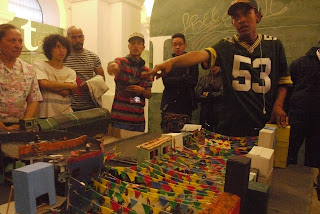
I met Winder in the Museo Nacional, where he was recalling his time in El Bronx to museum guests who came to see a scale model of the street, whose real version was demolished about two years ago.

Recyclers' carts in El Bronx.
Colombia's new conservative President Ivan Duque hopes to reduce illegal drugs' damage by intensifying drug prohibitionism. However, as Linder's story seems to show, harsh punishment might not do much to reduce drug use, but does turn victims like him into criminals. Winder entered and left prison as a drug abuser. It was only afterward, when he 'hit bottom' that desperation motivated him to change his life. In the meantime, society spent a lot of money incarcerating him.

Winder also complained that few of the Bronx's residents recieved support and rehabilitation. A prohibitionist policy which treats drug abuse as a crime instead of a medical condition only makes it more difficult to provide assistance.

On my home from the museum, I passed some police searching a group of young men on a plaza near
´What's that in your pocket?' Cops search young
men on Plaza Santader in central Bogotá.
the Gold Museum. The stop and searches which convert so many youth into criminals don't seem to do much to control drugs, but are a tremendous tool for cops to squeeze bribes out of people.

Later on, I played basketball in a park in La Candelaria where troubled kids called nieros sit in the stands smoking and drinking dubious substances. Drug prohibitionism doesn't seem to have done much to cut off their supplies.

Another ex-Bronx resident, now in rehabilitation.
By Mike Ceaser, of Bogotá Bike Tours

Wednesday, June 6, 2018

Welcome to The 'New' Bronx

Welcome to the New Bronx
 It was called a 'living hell,' with drug addicts of all ages, child prostitutes, torture chambers and illicit cemeteries, located just a few blocks from City Hall and the Presidential Palace, until in May 2016 the city sent in thousands of police and cleared it out, scattering the criminals and addicts all over the city.

Since then, that living hell has been a dead zone: Devastated buildings and vacant streets.

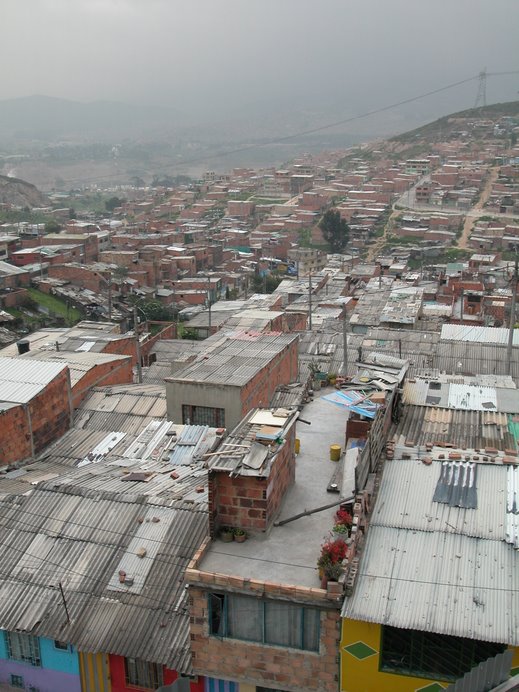
However, the city of Bogotá has big plans for the one-time Bronx (also known as La Ele): It aims to turn the neighborhood into an arts and clothing design district, altho it's also talked about education and housing facilities.

Artists show off work in the military
recruitment complex alongside
the Bronx.
Until Friday, they're holding an odd festival in the ex-Bronx and the neighboring military recruitment center, with art, music and theatre, as well as photos portraying the Bronx's horrific past.

But plans here have a way of not becoming reality, and so far the signs of revitalization in the Bronx are hard to spot. However, the city is making improvements nearby. The historic but notorious Los Martyrs Plaza has been cleaned up, and the adjoining Iglesia del Voto Nacional is being renovated.

Nevertheless, just a few blocks away, addicts who might have once live in El Bronx smoke crack against walls and seated in piles of garbage.


But the old Bronx is still there, just empty.
Visitors to the old, vacant Bronx with its photo exhibit recalling worse times.

No entrance to the old Bronx, even tho there's nothing there.


Empty streets and vacant, bombed-out buildings.

A homeless drug addict sits beside Los Martires Plaza.

The Iglesia del Voto Nacional is under renovation.
Used things, perhaps stolen, for sale on Martires Plaza. This used to go on inside El Bronx.


In the Los Martires you see grand homes of what was once a wealthy neighborhood.


Drug addicts now hang out on the nearby Plaza España.

Smoking dope against a nearby wall.

A few blocks from El Bronx, smoking crack in piles of garbage. 

Welcome to the New Bronx.
By Mike Ceaser, of Bogotá Bike Tours

Wednesday, November 29, 2017

Memories of El Bronx

Chiri, left, and Juan Carlos point to a detail of their model of El Bronx.

Looking out of the window of
a Bronx rented room.
For most Bogotanos, the name 'El Bronx' represents misery, addiction, depravement and addiction. But, for three young men who lived years there as criminals and addicts, the place also represents joys, friendship and pleasure.

The three young men recounted their experiences recently in Bogotá's Museo Nacional, where they also displayed a scale reproduction of the three streets which for nearly 15 years were home for thousands of thieves, drug dealers, crack addicts, prostitutes and myriad other criminals, just a few blocks from City Hall and the Presidential Palace.
Drugs for sale.
The model was complete with a stabbing, lots of bags of drugs and the streets' many other criminal activities, but also normal activities such as a woman preparing food and children playing with a dog.

Juan Carlos, 19, who lived in the Bronx for six years and Chiri, 22, who lived there for a decade, were both addicted to basuco, a cheap, dirty form of crack cocaine, and supported themselves by robbery. Chiri recounted how he belonged to a gang which stole car parts on the neighboring Carrera 10.

"I'd ask the driver for a handout," he said, "and then bang! the rear-view mirror's gone!" He made a motion of ripping the mirror off of the car.

But El Bronx, which was ruled by several criminal kingpins, each of whom controlled a sector of the
A Bronx corner.
streets, had its own organization and rules. For example, thievery was prohibited inside - except when the prize was big and one had permission from one of the kingpins.

"You could come and go safely," one of the young men told me. "Fresco."

"Nobody stole just a few hundred thousand pesos. It had to be millions."

The neighboring small businesses, which sell bedwear and hardware were safe, the men explained, because they paid protection money. In fact, El Bronx's bosses prohibited stealing within a several block radius, as Chiri learned when he stole a bicycle on the neighboring Los Martires Plaza. The bike's owner chased him into El Bronx, where one of the bosses learned of Chiri's misdeed and sentenced him to being hit 25 times with a wooden board. Chiri took it in stride.

A stabbing in the street.
"I just said 'let's get it over with,' Chiri recalled. "I wanted someone who would do it fast."

But he'd gotten off easy. When Mayor Enrique Peñalosa sent in thousands of police to clear out El Bronx a bit more than a year ago, they found cemeteries and torture chambers, used to punish those who didn't pay their drug debts. I asked the young men about the stories that the penalty for failing to pay was death and they shrugged their shoulders.

"Isn't it that way everywhere?" they asked me. "How about your country?"

I told them that this was beyond my personal experience.

Another unpardonable sin in El Bronx was spying - or even giving the appearance of doing so. For
example, outsiders came in to buy drugs or stolen items, but couldn't dilly dally. If they didn't come, buy and leave, they were suspect and could be punished.

"The Bronx wasn't a shopping mall," Juan Carlos said.

Both boys entered El Bronx because of their drug habits. "It's just a short step from (doing drugs on) the corner, to living in the street," they said, and added, "There are no social classes in El Bronx. Everybody's the same, everybody's an addict."

In contrast, young girls and women addicts ended up trading sex for drugs in El Bronx - and many became prisoners. After months of witnessing the Bronx's crimes, the kingpins would not let them leave for fear they'd rat on them.

Children play with a dog, lower left, near scavenged materials to be sold.
Bazuco, or crack, was the ubiquitous drug there, but marijuana, heroin, psychedelics and alchohol were also popular. Juan Carlos recalled multi-day alchohol and heroin binges. "Boy, I was flying," he said.

The entrance to the old Bronx.
Not all the Bronx residents were criminals and addicts. There were also working families, they said, who lived there because it was cheap: a room cost as little as $5,000 pesos per night, and you could pay in cash by the night.

But, amidst the horrors, the boys also experienced solidarity, when other Bronx residents shared food and loaned money to each other.
Quiet and empty: El Bronx today.


Now, they are living in a rehabilitation center, working with other addicts, and have started a hip hop band called 'Free Soul.'

El Bronx replaced the nearby El Cartucho neighborhood, which was bulldozed and replaced by the Tercel Milenio Park in the early 2000s. The ex-Bronx residents agreed that the problems of addiction and crime won't go away, but urged more support for addicts. That wasn't the case with the thousands who had inhabited El Bronx, many of whom ended up on the street. Juan Carlos and Chiri said there are about 150 recovering addicts in their rehabilitation residence.

The young men made one other point: To its residents, their home was not 'El Bronx,' but 'La L,' named for the L shape made by the two original streets invaded by addicts and criminals driven out of El Cartucho. "El Bronx is a place in New York," they pointed out.

Evidently, they think the original Bronx's reputation reflects badly on them. (Little do they know that New York's Bronx is being gentrified.)

As for Bogotá's Bronx, the city has plans to turn the neighborhood into an arts and education district. We'll see whether that ever happens. So far, it's still vacant.

I asked Juan Carlos whether he regretted his years living in El Bronx.

"No," he replied, "if I hadn't been there, then I wouldn't be here today."

This was the last week the event and exhibition were to be held in the Museo Nacional, but it will move on to the Centro de Memoria and IDArtes.

It's worth seeing, even if your Spanish is less than perfect, like mine. I probably understood less than half of what was said, but I comprehended enough to appreciate the tragedy, suffering and humanity of El Bronx, and why it's a good thing that it's gone - until another one appears.

Related:

Battle in El Bronx


By Mike Ceaser, of Bogotá Bike Tours

Wednesday, May 31, 2017

The New Bronx

It was El Bronx. What will it be in ten years?
A year ago, this was a place of frantic activity: Drug dealing, prostitution, even torture and murder. Today, it's quiet, except for a few laborers demolishing the old buildings.

Plenty of drug addicts are still around. 
This was El Bronx, for years Bogotá's most notorious street, until one year ago Mayor Enrique Peñalosa sent in thousands of police to clear it out. Inside, they found torture chambers, cemeteries and child prostitutes and crack addicts.

The treatment of the people they found there was very irregular: some reportedly were bussed to surrounding towns and simply left there, while I'm told that others were dumped on the edge of the polluted Bogotá River. According to the city government, several hundred entered treatment for drug dependency.

The neighborhood's environment has changed. Fewer drug addicts wander about, and the threatening atmosphere is reduced.

One neighboring storeowner had conflicting feelings about the change. On the positive side, some
The entrance to what was El Bronx.
customers are no longer afraid to come to the area, she said. The homeless and drug addicts didn't bother her personally, she said, 'since they were doing their own thing,' but they did stink.

Many of the drug addicts now spend their days lying on the median strips of neighboring avenues.

The city has ambitious plans for the area, including attracting health care, design industries, higher education and building low-income housing. The neighboring Martires Plaza and the Iglesia del Voto Nacional are being refurbished.

But the city's plans feel like a threat for local businesspeople. The store owner said business owners fear the city will use eminent domain to purchase their properties without giving them a fair price.

The neighboring Iglesia del Voto Nacional is being renovated.

And Los Martires Plaza has also been fixed up.

The city is building apartments and shopping in what was the old Cartucho neighborhood.

Los Martires hardware stores.
 The neighborhood is full of small retail businesses.
And bedwear shops.
Once a wealthy neighborhood, some grand old homes remain.
Homeless drug addicts spend their days on La Plaza España.
A few blocks west, La Plaza España has changed little. Perhaps Bronx residents moved here.

Street art on Plaza España.

An old man sits in front of a closed pasta factory on Plaza España.
By Mike Ceaser, of Bogotá Bike Tours

Wednesday, November 2, 2016

Indigentes All Over

Homeless drug addicts pass the hours away on the median of Carrera 10 south of San Victorino.
When thousands of police invaded El Bronx this May, they discovered a place of horrors. Crack addicts, child crack addicts, prostitutes of all ages, torture chambers, and even murder victims, buried and forgotten beneath the buildings.

However, what might have been a new life for the addicts and criminals in the bronx, who are also
Residents of El Bronx. (Photo: Semana)
victims, has not come to pass. According to news reports and people who work with addicts, many Bronx residents were bussed to neighboring towns, where they were just dumped on the street, or dropped off on the banks of the Rio Bogotá.

Of course, many addicts reject assistance, so social workers' jobs aren't easy. But now, complain residents of neighborhoods like San Bernardino, located just south of Tercer Milenio Park, the drug addicts camp on their doorsteps. Businesspeople complain about addicts sleeping and defecating in front of their doorways and have marched in protest to Plaza Bolivar.

Permitting a criminal district in the city's center, just a few blocks from City Hall and the presidential palace was intolerable. But now things may be worse, both for the Bronx residents, who lost their homes and community, and neighbors, who now feel as tho they're living in El Bronx.

The 'good' news? Just as before the Bronx there was El Cartucho, sooner or later the same population will settle someplace new and establish a new 'Bronx.'

By Mike Ceaser, of Bogotá Bike Tours

Thursday, September 5, 2013

Memorializing the Beso in El Bronx


This recent created mural on Calle 26 just west of Carrera Decima is becoming a Bogotá icon.

The mural memorializes a scene from El Bronx, the city's open-air drug alley.

On April 1, while Pres. Santos visited El Bronx, an El Tiempo photographer captured a couple in a passionate embrace amidst the street's vice and misery.

The couple were Hernán and Diana, drug addicts and Bronx denizens who survive by making and selling pipes for smoking dope. Both come from 'good' families, and Hernán even got an outstanding score on the ICFES student performance score. Some days the couple manages to scrape together the 8,000 pesos they need to pay rent for a room, some nights they sleep outdoors.

But they appear to be very much in love.


Bynb vMnike Ceaser, of Bnhh}+¿ogotá Bike Tour6