Showing posts with label crime. Show all posts

Sunday, June 24, 2018

Colombia's Medical Marijuana Hits a Speed Bump

Coca leaf and cannabis cures for sale in a Bogotá market.
Are the two plants really so different?
Colombia is by far the planet's biggest cocaine producer, and the cocaine economy is booming, more than quadrupling over recent years.

Now, Colombia wants to be a world leader in another drug: marijuana.

The country's cannabis strategy is full of ironies, of course. Colombia was a world marijuana leader back in the 1970s and '80s, when Colombian Gold was prized in California high schools like the one I studied in. Of course, today pot is legal in California (although it can't be imported), and California produces lots more high quality pot than Colombia does.

But hot, humid Colombia has lots better growing conditions than do temperate nations like the U.S.,

Canada and Europe, where marijuana is increasingly legal or tolerated. In particular, Colombia has drawn lots of investment from Canada, which is in the process of legalizing recreational cannabis, altho the Canadians are careful to stress that their Colombian investments involve only medicinal marijuana.

Colombia's cocaine industry continues costing the country immense amounts of money to pay for carnage and law enforcement, while its marijuana businesses will soon be paying taxes and creating legal employment, like the tobacco and alcohol industries.

Is there a lesson here about the best way to manage mind-altering substances?

Colombia's cannabis industry suffered a black eye a few weeks ago when a group of Israeli cannabis tourists and their guide were kidnapped after visiting a medicinal marijuana plantation near Cali. The kidnappers, who were apparently dissident FARC guerrillas, released the tourists but killed the guide, after demanding an astronomical ransom from her family. Whether the kidnappers were motivated by money or paranoia about strangers entering their region is not clear. But the tragedy was only marginally related to marijuana, which was what drew the tourists into the troubled region, but did not cause the crime.
Mónica Berenice Blanco Sossa,
m
urdered Argentine-Colombian tourist guide. 

Some have suggested that the tragedy was the fault of the guide and the tourists for pursuing mind-altering substances. That's an interesting sentiment. I'll wait for them to prohibit tourists from consuming alcohol, tobacco and caffeine, as well.

By Mike Ceaser, of Bogotá Bike Tours

Friday, April 6, 2018

More Motorcycles, More Problems

A crowd of motorcyclists roar along an avenue in central Bogotá.
El Tiempo: 'Motorcycles take more
and more passengers from buses
.'
Bogotá is becoming inundated with motorcycles. For their riders, they provide an alternative to having to wait for buses or idle in traffic jams. But for cities they create problems including crime,  traffic chaos and a weakened mass transit system.

Perhaps surprisingly, motorcycles also pollute - a lot, particularly those motorcycles with small two-stroke engines which burn oil and often leave behind a stream of white smoke dense with particulate
A motorcycle belches out white smoke.
matter. Bogotá officials have repeatedly declared they would restrict the two-stroke motorcycles, but instead they are proliferating. (Today, even many 'bicycles' are equipped with dirty, noisy engines - altho they still behave like, and claim to be, bicycles.)

Motorcyclists are also linked to crime. I myself was once mugged by a group of young men on motorcycles. And official concern was so much that several months ago Bogotá banned male motorcyclists from carrying other males as passengers.

A motorcycle club rally in La Candelaria. Most Bogotá motorycles are smaller, newer and more practical.
But perhaps motorcycles' most worrying impact for urban liveability is the way that they drain
Motorcycles lined up in a Bogotá neighborhood
dedicated to repairing motorcycles and selling
morotcycle parts.
passengers from mass transit. If mass transit ridership drops far enough - and that's already happening in Bogotá - it will make mass transit economically inviable, reducing its availability and pushing even more people to cars and motorcycles and worsening Bogotá's terrible traffic.

Motorcycles are involved in a dosproportionate number of accidents and injuries.
By Mike Ceaser, of Bogotá Bike Tours

Saturday, March 3, 2018

How to Wash Money Clean

How to bring them home.
Imagine that you're a successful drug trafficker. Your cocaine cargo arrived safely in some rich nation, where it sold for thousands of times what it cost to buy the coca leaves and chemicals back in Colombia.

But now you have two challenges: You need to bring that money back into Colombia, and you need to disguise it as legal money.

You might take the first stept by having people swallow pills stuffed with hundred dollar bills or tape wads of bills to their bodies. But that's dangerous and means trusting the couriers.

Or, you might try to transfer the money back into Colombia thru the banking system. But the banks are supposed to have ways of flagging large transfers and investigating their origin.

Or, you could use the dirty money to buy stuff like washing machines, running shoes, or bicycles, import them into Colombia and then sell them to recover your profits. Even if you sell the products at a loss, it's still worth it, since the drug profits were so huge.

In the third case, you've not only brought your dirty money into Colombia, but also disguised it as clean money. That's called money laundering.

Think of the FARC guerrillas, and you think of bombings, drug trafficking, child soldiers and other crimes - but probably not supermarkets.

Yet, according to Colombian authorities, a supermarket chain played a fundamental in the guerrillas'
A Supercundi supermarket, allegedly linked
to the FARC guerrillas.
operations by laundering their ill-gotten gains. The Supercundi market chain had grown quickly after being founded in 2006, and, according to authorities, sold some products 90% cheaper than in a normal store. This week, the government shut down the markets, alleging they belonged to a friend of the FARC, who laundered the FARC's illegal income from drugs and illegal mining and then invested the new, clean money in land, luxury cars and new businesses.

The supermarkets also served a second function for the guerrillas - supplying their fighters with food.

Money laundering comes in many forms.

Years ago, a friend's girfriend told us about her job in a language institute which, strangely, taught almost no classes, and those it did have had almost no students. Whenever someone called asking to enroll, the instruction was to tell them that the class was full.

That sounded like a money laundering operation. Someone with an illicit income had set up the 'school' to be able to justify that income, confident that authorities wouldn't look too closely.

Another time, a tourist told me he'd tried to book in a Bogotá hostel, only to be told that it was
completely full. That sounded strange, as it wasn't busy season. Since the hostel had a nice website, I decided to visit it to drop off publicity. The place had no sign, and the woman who answered the door seemed to have no knowledge of a hostel there. Someone had come by once and talked about perhaps opening a hostel there, she said.

That sounded like a small-time money laundering operation.

During the narcos era, many drug traffickers bought sports teams to obtain social status and launder money, since authorities couldn't easily monitor their incomes. The athletes' international travels provided nice opportunities to smuggle drugs.

The Cali drug cartel, ironically, purchased the Rebaja drugstore chain to launder their money. And the San Andresitos stores, known for selling imported clothing and electronics, are also notorious for laundering money.

Money laundering, which affects - and often even benefits - all of us, is yet another economic distortion caused by prohibitionism. Legalize drugs, and this phenomenon, like many others, would simpy disappear.

A La Rebaja pharmacy on Plaza San Victorino, in Bogotá. The chain used to be owned by the Cali Cartel.
By Mike Ceaser, of Bogotá Bike Tours

Thursday, January 25, 2018

End of the Free Motorcyle Ride (for men)

Thousands of motorcyclists protesting the planned law prohibiting male passen.gers
clogged streets in central Bogotá the other day
In most places, the sight of a motorcycle carrying a passenger is probably a bit charming, and demonstrates at least a sort of fuel efficiency.

In Colombia, however, this sort of ride sharing has a brutal history. In the heyday of the narcos,
professional assassins used motorcycles' back seats as work platforms. Today, those sort of killings are much less common. But police say that motorcycle passengers, called parrilleros, commit a huge portion of muggings and other street crimes.
Motorcyclists carry passengers of uncertain gender
in central Bogotá.
The solution? Bogotá plans to prohibit the carrying of passengers on motorcycles with engines larger than 125 cubic centimeters in a huge part of the central city. Not all passengers will be banner, however: Only male ones.

Last night, thousands of motorcyclists jammed Bogotá streets in protest. However, the same rule has been implemented in other Colombian cities with successful results, according to police.

In a politically correct nation such as the U.S., such a rule would likely get tossed out for gender discrimination, or be challenged by same-sex couples who'd complain protest that only heterosexual men could carry their partners with them.

Will the new measure make traffic jams worse?
However, the measure reflects a reality: The overwhelming majority of violent crimes are committed by males. Until women become more ambitious criminally, it's fine to discriminate in their favor.

But this all begs the question of how police will enforce this rule, particularly on cold days when motorcycle riders are bundled up and apparently genderless. Will male passengers take to wearing spiked heels and wigs with long, blond hair flowing out from under their helmets?

By Mike Ceaser, of Bogotá Bike Tours

Thursday, January 18, 2018

Off-Limits Colombia

Stay out of the dark regions!
The U.S. government approves of its citizens visiting Colombia - but not all of it. Four departments, located on the Venezuelan border and Pacific Coast regions, are supposed to be off limits.

While the U.S. directive generated protests from some of the forbidden regions, it actually generated relief from many more Colombians, who were happy that most of the country was in the 'visit with caution' category. That certainly would not have been true a few years ago.

Of course, the reality is much more subtle and complex. Colombia's Pacific Coast does suffer lots of violence, so why are only two of its departments on the no-go list? The region has been attracting growing numbers of tourists in recent years thanks to its fishing, surfing and spectacular whale watching, and nobody's told me of having had any problems there. Why didn't the U.S. State Department instead advise potential travelers to go there only with an agency which knows the area? After all, you can just as easily fall victim to crime in Bogotá by wandering into the wrong neighborhood.

Even more radical are the rules controlling the movements of embassy employees, who are still prohibited from riding buses and from traveling without permission in all but a few parts of Colombia.

Times have changed, and it's high time that the U.S. government changed its attitudes to match.


By Mike Ceaser, of Bogotá Bike Tours

Wednesday, December 6, 2017

Dangerous Art in Egipto

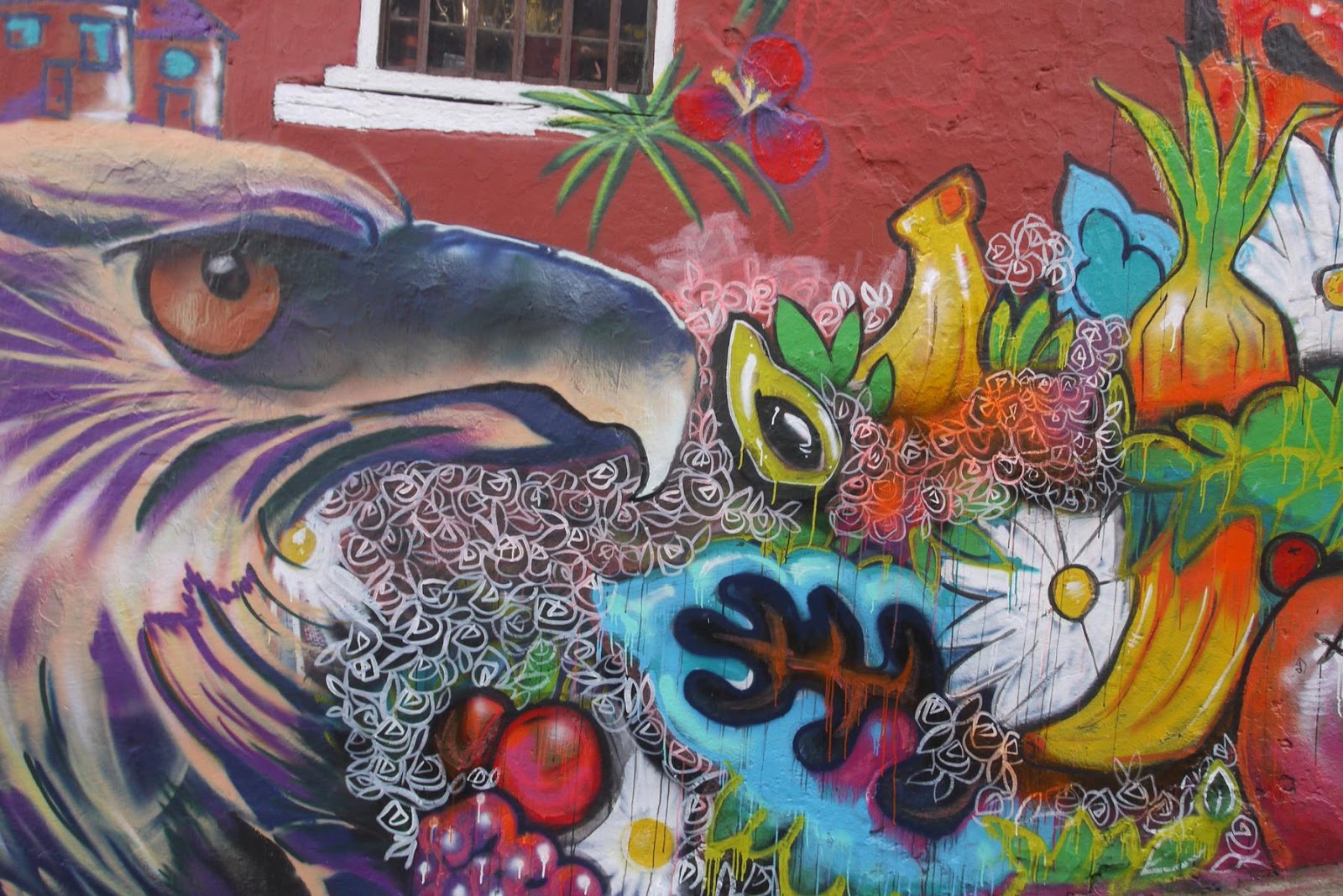
Three Kings, a symbol of Egipto. By K-no. Delix, of Bogotá.
Ark, from Bogotá
Recently, Fundación Colectivo Atempo painted one of the Egipto neighborhood's narrow, winding streets as part of the La Re Pública Cultural Circuit, an annual cultural event. They had painted one house in the neighborhood, which prompted neighbors to ask them to decorate theirs as well.

The works make the neighborhood colorful and evocative. Unfortunately, however, they are out of bounds for most of us, both foreigners and Colombians, because of the neighborhood's violent crime problem. Stories abound of foreigners wandering into Egipto to photograph the view and returning without cameras, money, even their clothing.

A few months ago, a foreigner walked up there and got stabbed and robbed, apparently by the same gang of drug addicts who hung around watching the grafiteros paint their street. The police don't appear to have done anything, as seems to be usually the case.

An old man, by Onírica, from Bogotá
When I went up to photograph the painters working (Bogotá Bike Tours paid for some of the supplies, as did Bogotá Graffiti Tour, which also helped coordinate the event) the local gang gathered around me, the only non-Colombian around, asking me to buy them beer and other goodies. If the grafiteros hadn't been present, no doubt the knives would have come out.

Colectivo Atempo (Bogotá) ft Raw (UK)

The hand of God, by Almiron, from Argentina.

A face, by Feck, from Mexico.

By DJ LU, from Bogotá

Colectivo Atempo (Bogotá) and ft. Raw (UK)

La Wife, from Argentina, with the local gang nearby.
By Mike Ceaser, of Bogotá Bike Tours

Wednesday, November 29, 2017

Memories of El Bronx

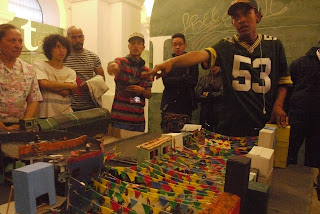
Chiri, left, and Juan Carlos point to a detail of their model of El Bronx.

Looking out of the window of
a Bronx rented room.
For most Bogotanos, the name 'El Bronx' represents misery, addiction, depravement and addiction. But, for three young men who lived years there as criminals and addicts, the place also represents joys, friendship and pleasure.

The three young men recounted their experiences recently in Bogotá's Museo Nacional, where they also displayed a scale reproduction of the three streets which for nearly 15 years were home for thousands of thieves, drug dealers, crack addicts, prostitutes and myriad other criminals, just a few blocks from City Hall and the Presidential Palace.
Drugs for sale.
The model was complete with a stabbing, lots of bags of drugs and the streets' many other criminal activities, but also normal activities such as a woman preparing food and children playing with a dog.

Juan Carlos, 19, who lived in the Bronx for six years and Chiri, 22, who lived there for a decade, were both addicted to basuco, a cheap, dirty form of crack cocaine, and supported themselves by robbery. Chiri recounted how he belonged to a gang which stole car parts on the neighboring Carrera 10.

"I'd ask the driver for a handout," he said, "and then bang! the rear-view mirror's gone!" He made a motion of ripping the mirror off of the car.

But El Bronx, which was ruled by several criminal kingpins, each of whom controlled a sector of the
A Bronx corner.
streets, had its own organization and rules. For example, thievery was prohibited inside - except when the prize was big and one had permission from one of the kingpins.

"You could come and go safely," one of the young men told me. "Fresco."

"Nobody stole just a few hundred thousand pesos. It had to be millions."

The neighboring small businesses, which sell bedwear and hardware were safe, the men explained, because they paid protection money. In fact, El Bronx's bosses prohibited stealing within a several block radius, as Chiri learned when he stole a bicycle on the neighboring Los Martires Plaza. The bike's owner chased him into El Bronx, where one of the bosses learned of Chiri's misdeed and sentenced him to being hit 25 times with a wooden board. Chiri took it in stride.

A stabbing in the street.
"I just said 'let's get it over with,' Chiri recalled. "I wanted someone who would do it fast."

But he'd gotten off easy. When Mayor Enrique Peñalosa sent in thousands of police to clear out El Bronx a bit more than a year ago, they found cemeteries and torture chambers, used to punish those who didn't pay their drug debts. I asked the young men about the stories that the penalty for failing to pay was death and they shrugged their shoulders.

"Isn't it that way everywhere?" they asked me. "How about your country?"

I told them that this was beyond my personal experience.

Another unpardonable sin in El Bronx was spying - or even giving the appearance of doing so. For
example, outsiders came in to buy drugs or stolen items, but couldn't dilly dally. If they didn't come, buy and leave, they were suspect and could be punished.

"The Bronx wasn't a shopping mall," Juan Carlos said.

Both boys entered El Bronx because of their drug habits. "It's just a short step from (doing drugs on) the corner, to living in the street," they said, and added, "There are no social classes in El Bronx. Everybody's the same, everybody's an addict."

In contrast, young girls and women addicts ended up trading sex for drugs in El Bronx - and many became prisoners. After months of witnessing the Bronx's crimes, the kingpins would not let them leave for fear they'd rat on them.

Children play with a dog, lower left, near scavenged materials to be sold.
Bazuco, or crack, was the ubiquitous drug there, but marijuana, heroin, psychedelics and alchohol were also popular. Juan Carlos recalled multi-day alchohol and heroin binges. "Boy, I was flying," he said.

The entrance to the old Bronx.
Not all the Bronx residents were criminals and addicts. There were also working families, they said, who lived there because it was cheap: a room cost as little as $5,000 pesos per night, and you could pay in cash by the night.

But, amidst the horrors, the boys also experienced solidarity, when other Bronx residents shared food and loaned money to each other.
Quiet and empty: El Bronx today.


Now, they are living in a rehabilitation center, working with other addicts, and have started a hip hop band called 'Free Soul.'

El Bronx replaced the nearby El Cartucho neighborhood, which was bulldozed and replaced by the Tercel Milenio Park in the early 2000s. The ex-Bronx residents agreed that the problems of addiction and crime won't go away, but urged more support for addicts. That wasn't the case with the thousands who had inhabited El Bronx, many of whom ended up on the street. Juan Carlos and Chiri said there are about 150 recovering addicts in their rehabilitation residence.

The young men made one other point: To its residents, their home was not 'El Bronx,' but 'La L,' named for the L shape made by the two original streets invaded by addicts and criminals driven out of El Cartucho. "El Bronx is a place in New York," they pointed out.

Evidently, they think the original Bronx's reputation reflects badly on them. (Little do they know that New York's Bronx is being gentrified.)

As for Bogotá's Bronx, the city has plans to turn the neighborhood into an arts and education district. We'll see whether that ever happens. So far, it's still vacant.

I asked Juan Carlos whether he regretted his years living in El Bronx.

"No," he replied, "if I hadn't been there, then I wouldn't be here today."

This was the last week the event and exhibition were to be held in the Museo Nacional, but it will move on to the Centro de Memoria and IDArtes.

It's worth seeing, even if your Spanish is less than perfect, like mine. I probably understood less than half of what was said, but I comprehended enough to appreciate the tragedy, suffering and humanity of El Bronx, and why it's a good thing that it's gone - until another one appears.

Related:

Battle in El Bronx


By Mike Ceaser, of Bogotá Bike Tours

Wednesday, November 15, 2017

When Institutions Don't Work

Are they real, or just virtual?
Case One: For months, our building's sewage system regular crisis. During hard rains, the
wastewater would back up and come flowing up out of the bathroom drain, obliging all of us to grab mops and buckets and clean the mess up.

The landladies, who live upstairs, didn't care - until it happened to them. Then, they hired laborers to clean and rebuild the house's pipes. Then, the only step left was for the city's Acueducto, or Water, department, to hook the house's pipes up to the city sewer line.

That was months ago, and we're still waiting.

One of the landladies, who has physical and psychological problems, has visited Acueducto at least a half dozen times, and come back with promises that they would do the work 'in a few days', 'in a week', 'in a month', etc. They even wrote 'Emergencia!' in big letters on one of the work orders. They've broken all their promises.

To compound the situation's absurdity, the last time the landlady visited Acueducto, they told her she needed to first go get permits from the city's Transit and Public Space departments. And then come back to acueducto.

Shouldn't the water department, rather than the homeowner, have the responsibility of coordinating with the transit department about planned street work? And if they do want the homeowner to do the city employees' job, shouldn't they have told her this the first time she visited, months ago?

Or is all this delay and run-around their way of saying 'You need to grease my palm to get anything done'?
'God and Fatherland.'
And where does the
public service come in?

Case Two: More than two months ago, a foreigner who has lived in Colombia for years was walking down a Candelaria street when a youth stabbed him several times in the back.

The foreigner almost died of blood loss, spent more than a month in the hospital, underwent a half dozen surgeries, lost a piece of one kidney, and is now at home recuperating.

Meanwhile, what have the police done about this attempted murder? The police 'investigador' only interviewed the victim more than two weeks after the attack - and only after we complained to his superiors - and more than two months after the crime he has not talked to the witness. The street has many video cameras which might have captured the attack, but the investigador hasn't looked at the videos. Instead, he gave the victim's teenage son a letter authorizing him to obtain the videos.

"He wants me to do his job," the son says.

A Colombian acquaintance who works in a La Candelaria hotel had a similar experience after being stabbed in an attempted mugging. He went down to the police station and placed the denuncia, but hasn't heard from the cops since.

How many people have these criminals robbed, attacked or even murdered since? But identifying and catching them seems to carry a much lower priority with the cops than, say, shaking down kids for smoking pot or stopping tour guides for working without the benefit of a Sena certification.

And if the public institutions are this apathetic and abusive here, in central Bogotá, in one of the city's more important neighborhoods, the heart of its tourism industry, then what happens when someone needs help in Usme, Kennedy, Ciudad Bolivar or some other barrio popular?

Yet, the really remarkable thing is that Colombian institutions actually work WELL compared to those in many neighboring countries, such as Venezuela and Bolivia. Hundreds of thousands of Venezuelans have sought refuge in Colombia because of the astronomical levels of corruption and criminal violence there (as well as the collapsing economy and hyuperinflation).

In Bolivia, where I lived some 15 years ago, the public institutions seemed designed primarily to squeeze money out of the people they were supposed to serve. There, my landlady's telephone would get cut off periodically, and she'd have to go down to the phone company and pay someone a bribe to get it turned back on. And the police seemed to make a practice of arresting people in order to force them to pay a bribe to be released - a form of institutionalized state kidnapping for ransom.


By Mike Ceaser, of Bogotá Bike Tours

Monday, October 23, 2017

A Gilded Cage for Bacrims

Members of the Usuga clan wanted by police.
The sweet deal and near impunity given to FARC guerrillas was a big reasons why voters rejected the peace deal in last year's referendum.

Yet, now, criminal bands, called bacrims, might receive similar treatment.

Under rules being prepared by the government, such criminal bands, which get rich thru narcotrafficking, extortion and illegal mining, would be able to keep 5% of the dirty money they turn in. And considering the profitability of their illegal operations, that 5% could still be a mountain of money. And we'll never know how much more money those groups have buried underground or hidden in offshore bank accounts.

Not only that, but some of the bacrims' other ill-gotten gains will be spent on...the bacrims themselves, in job training and business development.

Wonder how the victims feel about that.

Unlike the deal with the guerrillas, the bacrims' members are supposed to go to real prisons. We'll see how long they spend there. Even so, they also get a 40% reduction in their sentences.

The proposed rules offer the deal to criminal organizations which have a 'unified command structure,' 'control territory' and 'utilize violence against state forces or the civilian popuation.

The groups must also must carry out cross-border crimes such as trafficking people and weapons.

In other words, the worse you are, the more benefits you get.

The government's urgency to make deals with violent criminal gangs such as the Usuga clan is understandable. After all, defeating them is extremely difficult - and whenever one is destroyed, another pops up.

But how far should the government go in allowing impunity for such groups, a policy which almost amounts to a de-facto legalization of their crimes? And in a nation in which ex-paramilitaries and ex-guerrillas are walking free after little or no punishment, how much impunity can public morality tolerate?

By Mike Ceaser, of Bogotá Bike Tours

Wednesday, July 22, 2015

The Convoluted Case of Álvaro Gómez

Alvaro Gomez Hurtado.
Álvaro Gómez Hurtado was like a comet across Colombian journalism and politics during the 1980s and '90s.

The son of ex-president Laureano Gómez, Alvaro worked for his father's newspaper and other publications as well as serving as Bogotá city councilman, in both houses of Congress and as minister and ambassador in various nations. A leading member of the Conservative Party, he ran three times unsuccessfully for president. In 1998 he was kidnapped by the M-19 Guerrilla group, who were demanding the convening of a Constitutional Convention. The guerrillas achieved their goal, and Gómez Hurtado served in that convention.

Gómez then became an academic, helping to found two universities. But he may have signed his own death warrant by becoming a furious critic of Pres. Ernesto Samper, who was embroiled in a scandal over drug cartel financing of his presidential campaign, known as the Proceso 8000.

"The regime must be overthrown," Gómez said in at least one interview.

In Novemember, 1995, as he left a university, Gómez was gunned down.

His assassination has never been solved. Pres. Samper, guerrilla groups, paramilitaries drug cartels and others have all been suspects in the killing.

Ignacio Londoño Zabala, today an attorney with ties to criminal gang leaders, may have played a role
Ignacio Londoño
in the assassination.

And now, Londoño's assassination may guarantee that the mystery will never be solved.

Londoño, an attorney and local politician in Valle del Cauca with ties to drug cartel leaders, was gunned down the other day in Cartago, Valle del Cauca, where he was a candidate for mayor.

Londoño had given two of his bodyguards the weekend off and sent the third to do a chore in Bogotá. Londoño was in his office when someone shot thru the window, killing him.

Londoño was allegedly linked to the Proceso 8000 as well as various drug cartel leaders. Investigators wanted him to testify about Gómez's killing.

Londoño lying murdered on a Cartogo street.
The Londoño killing is itself the subject of mystery, which will likely never be resolved. Was he killed because of his campaign for mayor? Because of his possible declarations in Gómez's assassination? Because of his links to drug cartel leaders?

The Gómez-Londoño saga is yet another example of the intersection of politics and violence, which so often ends in impunity.

By Mike Ceaser, of Bogotá Bike Tours

Thursday, January 22, 2015

Crime and Punishment


Ignoring the police, pedestrians attack a supposed thief today on Calle 13 and Ave. Caracas.
When a criminal gets caught red handed on Bogotá's streets, he doesn't have only the police to fear: Passers-by also take the law - or, rather, street justice, into their own hands.

The guy WAS guilty. After a few more
kicks, he produced a gold-colored
chain he'd grabbed.
Without justifying lynching, one can still try to understand people's attitude. Reports of many crimes, including muggings and robberies and even homicide, rose last year, El Tiempo reported here and here. That's paradoxical with a growing economy, which presumably would have more people working legitimate jobs. The police suggest that crimes did not rise, but that reporting did. Or, the three-month judicial strike, which left many accused criminals on the street, may also have influenced things.

What is certain is a general anxiety about crime, and a common belief that even when criminals are arrested, they're freed the next day. So, some people try to apply punishment with their own hands. Literally.

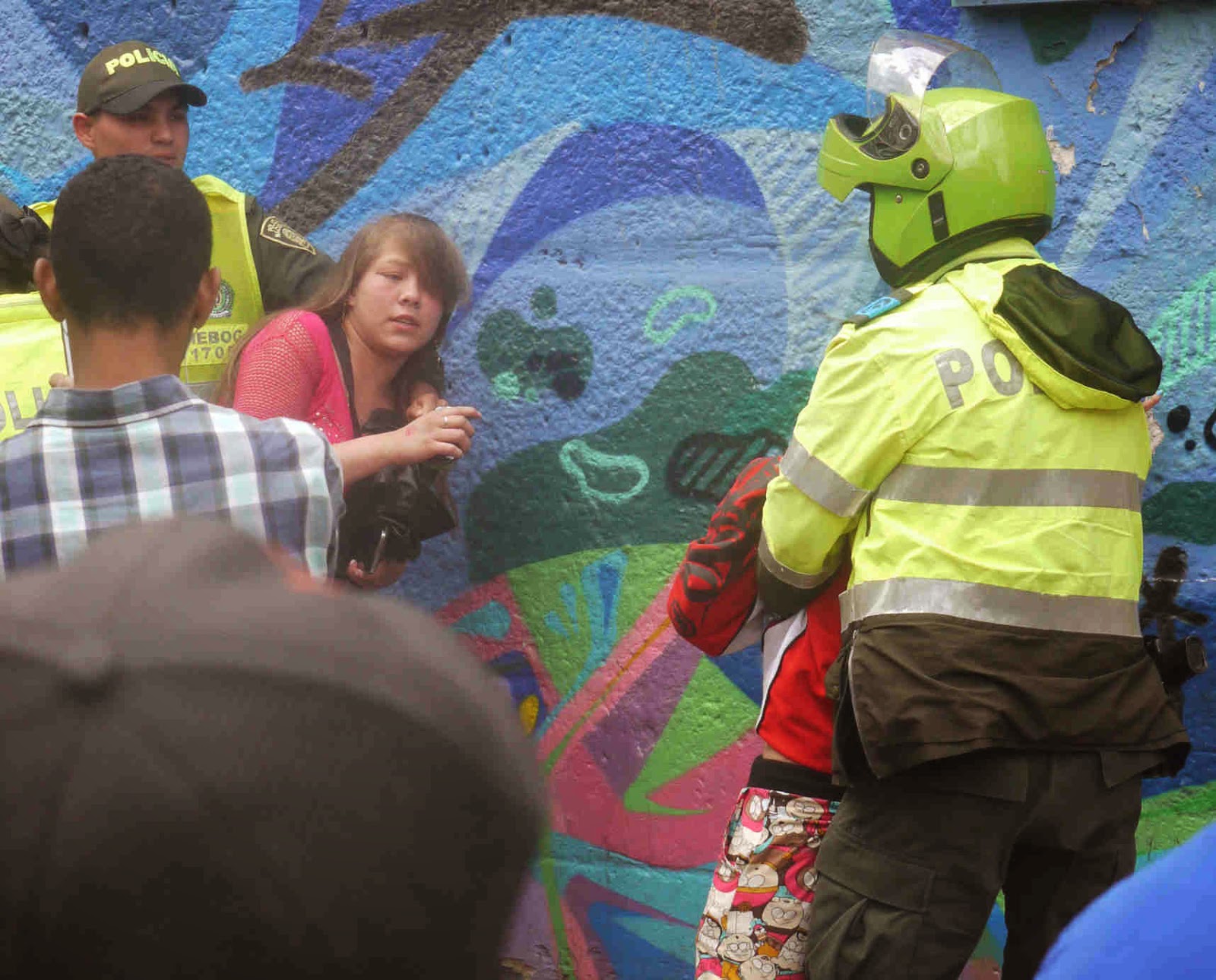
This happened on Carrera Septima the other day. But the police's motives for grabbing the youth weren't clear. One observer thot he'd stolen a bike that was nearby. Others speculated that one or both of the young women present had accused him of attacking her, and then repented.


'Let my man go!'
'He's my man, too!'
But these cops had no intention of freeing the youth.

By Mike Ceaser, of Bogotá Bike Tours