Showing posts with label m-19 guerrillas. Show all posts

Saturday, February 7, 2015

One Less for the Conspiracists?


The grave of Carlos Pizarro in Bogotá's Cementerio Central. His remains were exhumed last November. 
Nearly every prominent killing committed in Colombia has given birth to conspiracy theories:

Was Jorge Eliecer Gaitán killed by the CIA or the KGB rather than a crazy man with a Gaitán
obsession?

Was Luis Carlos Galán's killing planned by the police who were supposed to be protecting him?
Tiles on Pizarro's tomb thank him for favors received.

Was Pablo Escobar shot down by a United States government agent rather than the Colombian search squad usually credited for his killing?

The grim list of possible conspiracies - some of which are probably true - goes on and on.

But it might be one shorter now. Last November, investigators dug up and examined the skeleton of Carlos Pizarro, the M-19 guerrilla-leader-turned-presidential-candidate shot down in 1990 on board a Bogotá-Barranquilla airline flight. According to the official story, the assassin, Gerardo Gutiérrez Uribe alias "Jerry", had hidden a sub-machine gun inside the plane's bathroom, with which he shot Pizarro 15 times. Pizarro's bodyguards immediately shot down the gunman.

Altho fingers first pointed toward Pablo Escobar, confessions and other evidence have since shown that the killing was ordered by right-wing paramilitaries led by Carlos Castaño.

Carlos Pizarro
But suspicions still swirled around the episode. Was the government involved in the murder? Had one of Pizarro's bodyguards actually killed the leftist leader and then shot the supposed gunman as a cover-up?

Mistakes in the investigation fed the conspiracy theories. Experts failed to carry out ballistic tests on Pizarro's corpse. And, a few years ago, police melted down the sub-machine gun during a routine clean-up.

However, examination of Pizarro's exhumed remains, as well as those of the gunman, seem to show that the gunman did in fact shoot Pizarro. On the other hand, a bullet hole located strangely in the back of the gunman's skull supports eyewitness testimony that Pizarro's bodyguards shot the gunman dead as he lay face-down on the plane's floor begging for mercy.

Was the gunman executed to prevent him from talking about possible government involvement in Pizarro's killing? We may never know for certain. Conspiracy theorists - get working!

By Mike Ceaser, of Bogotá Bike Tours

Friday, November 22, 2013

The March for Peace and Everything Else

Peace demonstrators on Plaza Bolivar.
I saw only a small part of today's huge 'March for Peace and Democracy,' organized by Bogotá's City Hall, but enough to realize that it was the usual mix of unions, political groups and even entertainers.

In any case, it's no surprise to find the leftist mayor supporting the controversial peace negotiations between the FARC and Colombian government taking place now in Havana, Cuba. The guerrilla leaders want to go to Congress after any peace agreement is signed. But conservative critics, led by ex-Pres. Alvaro Uribe oppose the talks and say the guerrillas should instead go to prison for their many human rights violations.

Yesterda afternoon, Pres. Santos announced his intention to run for reelection next year, and the peace negotiations are sure to be a central issue of the campaign.

Mayor Petro and other M-19 Guerrilla leaders, of course, created the model which the FARC hope to follow. The guerrilla group demobilized in 1989 and turned into a political party, playing a prominent role in writing Colombia's new Constitution in 1991. Today, Petro is mayor of Bogotá and other ex-M-19 leaders are in Congress.
Giving the peace sign. 
Several marching bands set the beat.
Ex-Telecom employees joined the march. 
A stern policewoman protects - or protects us from - a marching band.
Displaying City Hall's slogan, Humane Bogotá.
'Deceit is also violence.' But who's deceit?
'We women are a generation of peace.' 'No more violence against women.'
By Mike Ceaser, of Bogotá Bike Tours

Monday, June 10, 2013

Gustavo Rojas Pinilla: Political Chameleon

Flowers on dictator Gustavo Rojas Pinilla's tomb in Bogotá's Central Cemetery.
Grl Gustavo Rojas Pinilla.
General Gustavo Rojas Pinilla, who seized power 60 years ago this week, was Colombia's last outright dictator: he shuttered newspapers and massacred university students. But Rojas Pinilla was also a populist hero - and a progressive who gave the vote to women - and even the inspiration for an idealistic leftist guerrilla movement. Today, he retains a sort of progressive aura in the public memory. Go figger.

In 1963, Colombia was hemorraging from La Violencia, a vicious fratricidal war between Liberal and Conservative guerrilla armies. The far-right President Laureano Gómez was too sick to govern. Colombians called for a strong hand to stabilize and pacifize the country.

A memorial on Ave. Septima to the university
students massacred by Rojas Pinilla's
government.
Popular sentiment backed by the military turned to the accomplished general Rojas Pinillas, an engineer who had also directed infrastructure projects and been Colombia's delegate to the United Nations. His June 13 coup was bloodless and Rojas set about mending the country. He pardoned the guerrillas, introduced television and began a series of infrastructure projects financed by strong coffee prices.

But power corrupts, and the benevolent Rojas turned tyrannical. When spectators booed his daughter at an event in the bullfighting stadium, Rojas responded the next week by infiltrating the stadium with toughs, who beat and stabbed to death an undetermined number of government opponents. The newspapers censored by the government ignored the massacre. The very Catholic Rojas also persecuted protestant evangelicals.

The Justice Palace in flames following the
1985 M-19 guerrilla attack.
In 1955, students protesters marching down Ave. Septima were swept by government gunfire, killing some dozen of them. The next year, Rojas closed El Tiempo y El Espectador, Bogotá's two main newspapers (they promptly reopened under new names), and others.

But it was apparently the resurgence of La Violencia which finally turned public opinion and political party leaders against Rojas, forcing him out of power and into exile.

He was replaced by a military junta which oversaw the transition to a quasi democracy (for 15 years the Liberal and Conservative parties simply passed the presidency back and forth).

A plaque in Bogotá's City Hall denouncing
the attack by 'subversives' on the Justice Palace.
But Colombia wasn't done with this savior-turned-tyrant. Rojas returned, now transformed into nationalist populist. At the head of his ANAPO party, in 1970 he ran for president against conservative Misael Pastrana and lost narrowly - according to the official results. Rojas supporters cried fraud, likely with good reason. The election stood, but out of that allege fraud were born the M-19 guerrillas, whose legacy continues in Colombian politics.

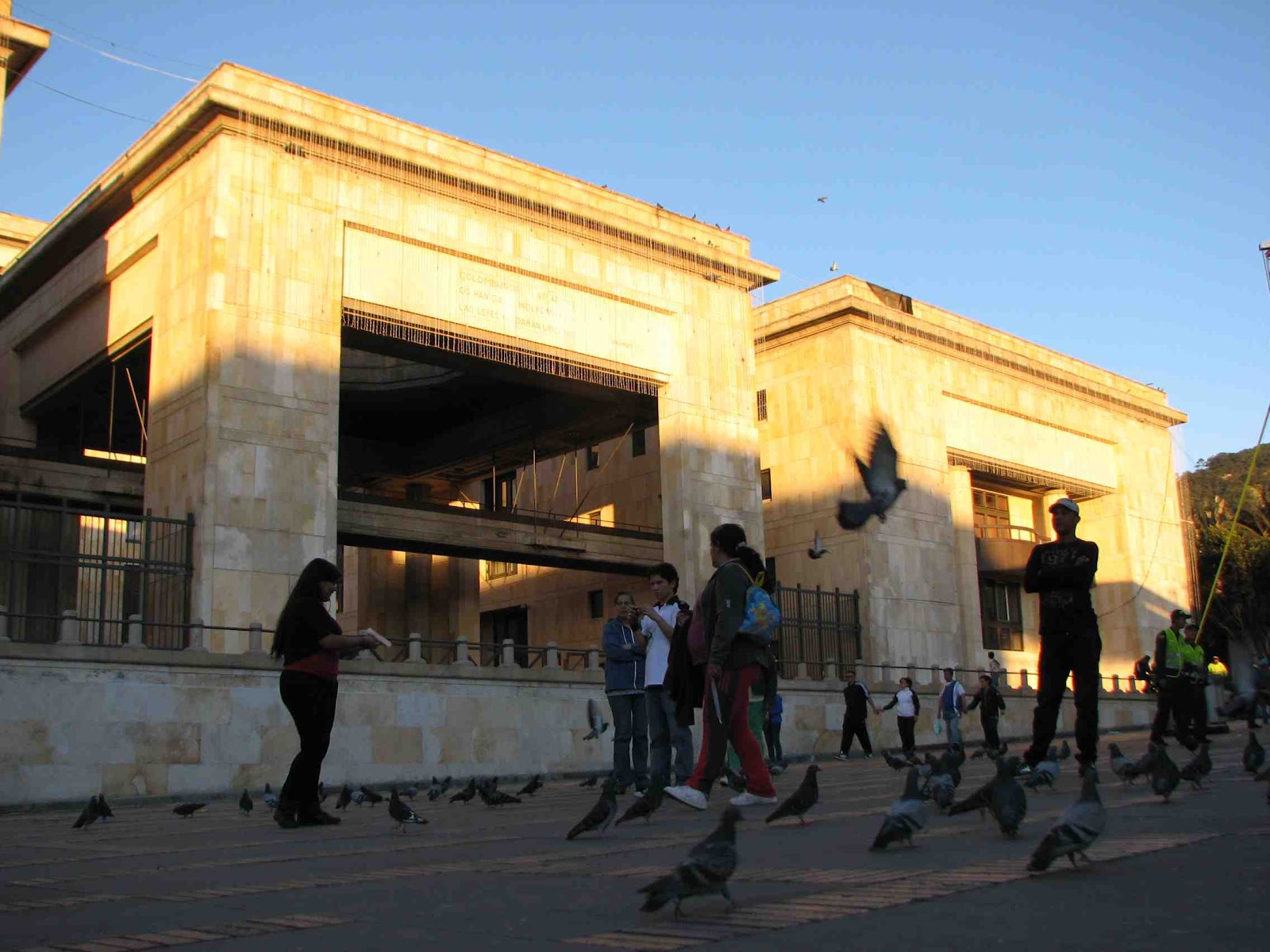
The Justice Palace on Plaza Bolívar in Bogotá was
destroyed in a 1985 M-19 guerrilla  attack and
rebuilt about the year 2000.
The M-19 - young, educated, idealistic and media-savvy, carried out a series of dramatic operations which culminated disastrously with their 1985 attack on the Justice Palace on Plaza Bolívar. After the M-19 took the magistrates hostage, the military counterattacked with tanks fire. The Justice Palace was destroyed and about 100 people were killed, including 11 of the 12 justices. The building was burned and gutted.

A plaque in Bogotá's City Hall memorializes
people disappeared during the Justice Palace
conflict.
A few years later, the M-19 turned in their weapons and became a political party. In 1991, they even played an important role in the writing of Colombia's new Constitution, and can be credited for its progressive features.

Today, some of the ex-M-19 leaders are in Congress, and one, Gustavo Petro, is mayor of Bogotá.

Rojas' legacy has also persisted in more destructive ways. His grandson, Samuel Moreno Rojas, was mayor of Bogotá from 2008 to 2011, and allegedly stuffed his pockets in a huge corruption scheme. Now, Samuel and his brother Ivan, a senator, are in prison awaiting trial. They claim to be innocent.

Ironically, Samuel Moreno is accused of taking kickbacks on contracts for work on Ave. 26 - which his grandfather had constructed.

And Rojas' legacy probably isn't over.

By Mike Ceaser, of Bogotá Bike Tours

Sunday, February 24, 2013

Disappeared or Just Dead?

A tank fires into the Palacio de Justicia on Plaza Bolivar in Nov. 1985. The M-19 guerrillas had taken over the building and were holding the members of the Supreme Court hostage. 
Colombia's defense in an international human rights court has made waves by claiming that nobody was 'disappeared' during the 1985 retaking of the Palacio de Justicia from M-19 guerrillas who had invaded it.

The M-19's November 1985 attack on the Justice Palace and the ensuing retaking by the military remains an open sore in Colombian politics and society. Last year, a court ordered the military to make a Public apology for human rights violations committed by the military. The ruling, which has never been fulfilled, had particular relevance because current Bogotá Mayor Gustavo Petro was a leader of the M-19 guerrillas. Several other one-time M-19 leaders are now in Congress.

More than 100 people died in the episode, including all but one of the guerrillas, many Justice Palace employees, visitors and 11 of the 12 Supreme Court justices. Some simply disappeared without a trace.

Guerrilla Irma Franco and
cafeteria administrator
Carlos Rodriguez. Both
apparently left the
Justice Palace alive but
were never seen again. 
But a number of people from inside the Justice Palace were reported seen alive outside the building or inside the neighboring Casa del Florero, which the military was using as its command post. Some of those apparent survivors were never seen again or were found dead in the burned building, as if killed in the fired which consumed the building.

Court rulings, public opinion and news reports all seem to agree that the military committed human rights violations, including disappearances, during the counterattack. Other high Colombian officials have acknowledged two cases of disappearances: a guerrilla and the administrator of the building's cafeteria, both of whom were reported seen alive outside the building. That's why the Colombian state's argument last week in a case before the Inter-American Court of Justice surprised many, and suggested that the lawyers were defending accused military officers rather than Colombia as a whole.

The government's lawyer argued that the disappeared had all died in the conflagration which destroyed the Justice Palace building. The fire's cause is still debated. According to some sources, cocaine king Pablo Escobar helped finance the M-19's attack in exchange for the guerrillas promising to destroy incriminating legal documents.

Two military officers have been tried, convicted and given prison terms for crimes committing during the retaking. But the military and conservative political parties ask why the M-19, who started it all, have not had to face justice.

Llamas walk past the rebuilt Justice Palace on Plaza Bolivar.
'A tragic sacrifice by forces of subversion,' who
destroyed evidence against narcotraffickers. 
A plaque on the City Hall building lists the
names of 12 people who were allegedly 'disappeared.' 

A plaque in a sidewalk denounces 25
years of impunity in the cases of
 disappeared people. 
Three memorial plaques on Plaza Bolivar, within yards of the rebuilt Justice Palace, show the continuing polarization over the tragedy. One plaque denounces 'impunity' in the cases of the disappeared. Another, on the City Hall building, lists the name of 12 people who "were disappeared" during the violence. And a third, adjoining plaque, memorializes "the tragic sacrifice by forces of subversion of justices of the Supreme Court...defenders of the law. The palace was destroyed by the flames, as were the files, whose destruction was sought by the assailants."

(The reference to the files refers to allegations that drug cartel kingpin Pablo Escobar had financed the attack in order to destroy evidence against him.)


By Mike Ceaser, of Bogotá Bike Tours

Thursday, April 26, 2012

A Celebration for Carlos Pizarro


Party scene: Carlos Pizarro's tomb today. 
Bogotá's Central Cemetery came to life today - but in another era - as llanera music boomed from a corner, where suppporters of Carlos Pizarro celebrated (and that was what it was like) the 22nd anniversary of the M-19 presidential candidate's assassination.

Flowers and photos on Pizarro's tomb. 
Pizarro's assassination in 1990 by paramilitaries rocked the country, which had breathed a sigh of relief when the guerrilla group turned in its arms and converted itself into a political party. Would the M-19 now put their uniforms back on and return to the mountains? (Navarro Wolff, another M-19 veteran, recently revealed that Pizarro had made a secret pact with him to return to the armed struggle in case one of them were assassinated.) Only a few years before, the M-19 had attacked Colombia's Justice Palace on Plaza Bolivar, an episode which ended with nearly 100 dead and the building in flames. But the M-19 continued in the democratic system, several of their members becoming congressmen and governors. Today, ex-M-19 leader Gustavo Petro is mayor of Bogotá.
From Pizarro's tomb, Jose Mercado's
bust is just barely visible. 

A generation of young leftists seems to have idealized the M-19, who were young, colorful and media-friendly - but also committed acts, such as the Justice Palace attack, which look like terrorism today.

The bus on Jose Mercado's tomb looks toward Pizarro's
tomb, which is behind that of Santander. I've always suspected
that whoever buried Mercado did this deliberately. 
And what would Jose Mercado think about all of this? He was an Afro-Colombian union leader whom the M-19 kidnapped in 1976, accusing him of accepting 'imperialist' money and of 'betraying his people.' They held him captive for months, while calling for a 'popular trial' consisting of people writing on buildings' walls whether or not Mercado should be killed. Finally, on the anniversary of the M-19's founding, they murdered Mercado and threw his body onto the street.

The M-19 don't mention Mercado's murder in their tributes to themselves. But Mercado is buried not far away in the Central Cemetery, and his bust seems to look at Pizarro's tomb. What could Mercado be thinking about the celebration taking place there?


Hero? 

By Mike Ceaser, of Bogotá Bike Tours

Friday, April 20, 2012

The M-19 Goes Full Circle

A once-unbelievable seen: The M-19 flag flies before the Justice Palace, which the M-19 guerrillas attacked, disastrously, in 1985.
The M-19's annual auto-hagiography on the Plaza Bolivar has new resonance this year, now that one-time M-19 leader Gustavo Petro is mayor of Bogotá.

The M-19 guerrillas were young, idealistic and media savvy. But they also committed horrendous crimes, including the kidnap-murder of Afro-Colombian union leader Jose Mercado and the 1985 attack on the Justice Palace, which ended with about 100 deaths and the building in flames. (Mayor Petro says he had no knowledge beforehand about the palace attack.)

The M-19, or 19 of April Movement, named themselves after the date of a 1970 presidential election allegedly stolen from dictator-turned-populist politician Gustavo Rojas Pinilla.

A man in a wheelchair reades an exhibit about the M-19. 


The M-19's flag flies before Bogotá's City Hall, now headed by ex-M-19 leader Gustavo Petro. 

Bricks on Plaza Bolivar represent victims of violence. Several military officials are now in prison for human rights violatoins committed during the retaking of the palace. 


A comedian attracts a crowd on Plaza Bolivar. He got lots more attention than did the M-19' exhibit. 

The M-19 demobilized after the disastrous Justice Palace attack and in 1991 participated in the writing of a new Colombian Constitution, which is still in force today. 


'Armed Propaganda.' The M-19 invaded small leftist newspapers, giving them a justification to publish pro-guerrilla propaganda. 


By Mike Ceaser, of Bogotá Bike Tours

Wednesday, February 1, 2012

A Raw Wound Reopens

Soldiers attacking the Justice Palace in 1985.
In a dramatic and incendiary decision, a Bogotá court has ordered Colombia's military to publicly ask forgiveness for human rights violations committed during the retaking of the Justice Palace after a 1985  guerrilla attack.


Bogotá's City Hall: New mayor
Gustavo Petro was a leader of the M-19 guerrillas. 
The M-19 guerrillas had violently invaded the Justice Palace, on Plaza Bolivar, with the apparent assistance of narco Pablo Escobar, and demanded that democratically elected Pres. Belisario Betancur give himself up for a trial by the guerrillas. Instead, the military counterattacked violently. The building went up in flames - the cause is still controversial - and about 100 people died, including 11 of the 12 high court justices. At the time, the military were heroes. But since then evidence has emerged of human rights violations committed by the military, and a consensus has formed that the military used too much violence in the palace's retaking.
The new Justice Palace building. 

Col. Alfonso Plazas Vega, who commanded the counterattack, was convicted of violating human rights, but several other military officers were tried and acquitted.

A plaque in City Hall condemns
the guerrillas' 1985 attack. 
However, the M-19 guerrillas' fate has been very different. A few years after the disasterous attack, the group demobilized and turned into a political party. They participated in the 1991 writing of Colombia's new and quite progressive Constitution, and today several one-time leaders of the M-19 are in government - including Bogotá Mayor Gustavo Petro.

Military officials ask how it is that the guerrillas, who started it all, are getting off scott-free, while the military who retook the palace are being tried and asked to apologize.

Retired military officials have rejected the court's ruling. (The court also ordered ex-Pres. Betancur's role to be presented to the International Criminal Court.)

A plaque on Seventh Ave. commemorating the people who
disappeared during the military counterattack. 
The El Tiempo newspaper criticized the ruling in a strong editorial, and asked why the guerrillas, who staged the attack, should not have to apologize as well.

"Ordering the Army to carry out an act of public contrition for an attack initiated by guerrillas is both humilliating and excessive," El Tiempo wrote.

ordenar al Ejército que haga un acto de contrición pública por una toma de inspiración guerrillera es tanto humillante como excesivo. 

By Mike Ceaser, of Bogotá Bike Tours

Sunday, January 1, 2012

Petro's Political Pedigree


New Mayor Gustavo Petro is the
product of a complex political history.
Today, Gustavo Petro was inaugurated as mayor of Bogotá. He'll now preside in the just-expanded City Hall on the west side of Plaza Bolivar.

Petro was a leader of the M-19 guerrillas, who in 1985 attacked the Justice Palace building, on the right. He's now mayor of Bogota, presiding in City Hall, on the left. In front of the buildings are the tents from today's inauguration. 
But Petro's political past has also involved the Justice Palace on the plaza's north side, and Congress on its south side. His unlikely and remarkable story illustrates both the contradictions and interconnectedness of Colombian politics.

Petro was born in 1960, the son of a schoolteacher, and grew up in the town of Zipaquira, north of Bogotá. Petro early became a leftist, thru the reading of Gabriel Garcia Marquez and friendships with union members.

Tomb of military dictator Gustavo Rojas Pinilla,
whose losing candidacy inspired the  M-19
guerrilla movement.
When Petro was ten, one-time military dictator Gustavo Rojas Pinilla, now recycled as a populist, nationalist candidate, ran for president and lost by a sliver to a conservative. Petro had been overthrown in 1957 for good reason - he had massacred protesters and shut down the nespapers, amongst other crimes. Nevertheless, Rojas Pinilla became the darling of the left, his supporters cried fraud and founded the Movimiento 19 de Abril, or M-19 guerrilla movement.

Almost as soon as he graduated from high school at age 16, Petro joined the M-19 guerrillas and eventually become one of its leaders.

The M-19 started out with dramatic gestures, such as the theft of revolutionary leader Simon Bolívar's sword from one of his statues. "Bolivar's sword returns to battle," the M-19 announced.

The tomb of assassinated M-19
presidential candidate Carlos Pizarro,
perhaps Petro's political inspiration.
Note Bolivar's sword on the tomb.
But the M-19's acts were not always so idealistic. In 1976 they kidnapped and murdered union leader Jose Mercado and discarded his corpse in the street. They also took over the Embassy of the Dominican Republic during a diplomatic party. That attack ended bloodlessly, with the guerrillas carrying out something of a victory parade to the airport, from where they left for Cuba. In 1985, the group invaded the Justice Palace on Plaza Bolivar, took the Supreme Court justices hostage and demanded that Pres. Belisario Betancur submit to a guerrilla trial. Instead, the government counter-attacked, the building was destroyed and 11 of the 12 supreme court justices died, amongst some 100 deaths in total.


Jose Mercado,
union leader kidnapped
and murdered by the M-19 guerrillas.
Close to three decades later, the wounds remain open from what is known as 'The Holocaust of the Justice Palace.' Families still search for relatives who disappeared during the attack and counterattack and the general who commanded the counterattack is in prison for human rights violations.

1985: The Justice Palace in flames
after the M-19 attack. 
The rebuilt Justice Palace today. 
A few years after the attack the M-19 demobilized and turned into a political party. Today, several ex-M-19 leaders are in Congress, one is a governor, and Petro is mayor of the nation's capital city. Petro, of course, claims that he knew nothing about the Justice Palace attack.

After their demobilization, M-19 chose Carlos Pizarro as its presidential candidate. In 1990, Pizarro was assassinated - one of four candidates assassinated during that campaign. Surprisingly, the M-19 did not return to violence and participated in the 1991 convention which rewrote Colombia's constitution.

A plaque on City Hall memorializing the 1985 attack. 
Petro served in Zipaquira's City Council and later in Congress. As a congressman, Petro has been seen as idealistic, independent and non-corrupt. He has, for example, strongly criticized the FARC guerrillas and Venezuelan Pres. Hugo Chavez, despite the leftist revolutionary pretenses of both.

Petro won the election to a great degree because Bogotanos saw him as clean and independent. That made a sharp contrast to his predecessor Samuel Moreno Rojes, who is now in prison on corruption charges. Which brings up yet another irony: Moreno Rojas happens to be the grandson of dictator Rojas Pinilla, whose failed candidacy started Petro on the road to where he is today.

Perhaps the greatest significance of Petro's victory is its signal to the armed guerrilla groups which continue battling to overthrow the Colombian government. Mayor Petro is proof positive that the ballot can be a much more effective changemaker than the bullet. Are you listening, FARC?

A plaque near Plaza Bolivar paying tribute to the people who disappeared during the Justice Palace tragedy. 


An image full of contradictions: the grey plaque on Seventh Ave. memorializes protesting students massacred by dictator Rojas Pinilla in 1954. Beside it is a campaign poster for Petro, whose political career has its roots in Rojas Pinilla's failed presidential campaign. The building is covered with graffiti left by recent student protesters.

Scrawled on a wall along Seventh Ave., apparently by student
protesters: 'Against the Santos dictatorship, the M-19 gets ready.'
But Santos is no dictator,
and the M-19s leaders are in government. 
Petro's first statements as mayor sound positive: he repeated his intention to charge car drivers a congestion fee, which will subsidize public transportation. He also promised to tax the rich - a necessary move try to reduce the city's huge wealth gap. And he also plans to create new public universities. That's good, not only because it'll the city's youth more hope and opportuity, but also because it could reduce the crime rate by putting young people on a constructive track.

He also intends to give the poor a monthly stipend of water for free. The intention is good, but the method is mistaken: giving things away for free just promotes waste. A much better policy would be to provide subsidized water-saving devices like low-flow shower heads and toilets. That would save people money as well as conserving water.

By Mike Ceaser, of Bogotá Bike Tours