Showing posts with label Gustavo Rojas Pinilla. Show all posts

Monday, June 10, 2013

Gustavo Rojas Pinilla: Political Chameleon

Flowers on dictator Gustavo Rojas Pinilla's tomb in Bogotá's Central Cemetery.
Grl Gustavo Rojas Pinilla.
General Gustavo Rojas Pinilla, who seized power 60 years ago this week, was Colombia's last outright dictator: he shuttered newspapers and massacred university students. But Rojas Pinilla was also a populist hero - and a progressive who gave the vote to women - and even the inspiration for an idealistic leftist guerrilla movement. Today, he retains a sort of progressive aura in the public memory. Go figger.

In 1963, Colombia was hemorraging from La Violencia, a vicious fratricidal war between Liberal and Conservative guerrilla armies. The far-right President Laureano Gómez was too sick to govern. Colombians called for a strong hand to stabilize and pacifize the country.

A memorial on Ave. Septima to the university
students massacred by Rojas Pinilla's
government.
Popular sentiment backed by the military turned to the accomplished general Rojas Pinillas, an engineer who had also directed infrastructure projects and been Colombia's delegate to the United Nations. His June 13 coup was bloodless and Rojas set about mending the country. He pardoned the guerrillas, introduced television and began a series of infrastructure projects financed by strong coffee prices.

But power corrupts, and the benevolent Rojas turned tyrannical. When spectators booed his daughter at an event in the bullfighting stadium, Rojas responded the next week by infiltrating the stadium with toughs, who beat and stabbed to death an undetermined number of government opponents. The newspapers censored by the government ignored the massacre. The very Catholic Rojas also persecuted protestant evangelicals.

The Justice Palace in flames following the
1985 M-19 guerrilla attack.
In 1955, students protesters marching down Ave. Septima were swept by government gunfire, killing some dozen of them. The next year, Rojas closed El Tiempo y El Espectador, Bogotá's two main newspapers (they promptly reopened under new names), and others.

But it was apparently the resurgence of La Violencia which finally turned public opinion and political party leaders against Rojas, forcing him out of power and into exile.

He was replaced by a military junta which oversaw the transition to a quasi democracy (for 15 years the Liberal and Conservative parties simply passed the presidency back and forth).

A plaque in Bogotá's City Hall denouncing
the attack by 'subversives' on the Justice Palace.
But Colombia wasn't done with this savior-turned-tyrant. Rojas returned, now transformed into nationalist populist. At the head of his ANAPO party, in 1970 he ran for president against conservative Misael Pastrana and lost narrowly - according to the official results. Rojas supporters cried fraud, likely with good reason. The election stood, but out of that allege fraud were born the M-19 guerrillas, whose legacy continues in Colombian politics.

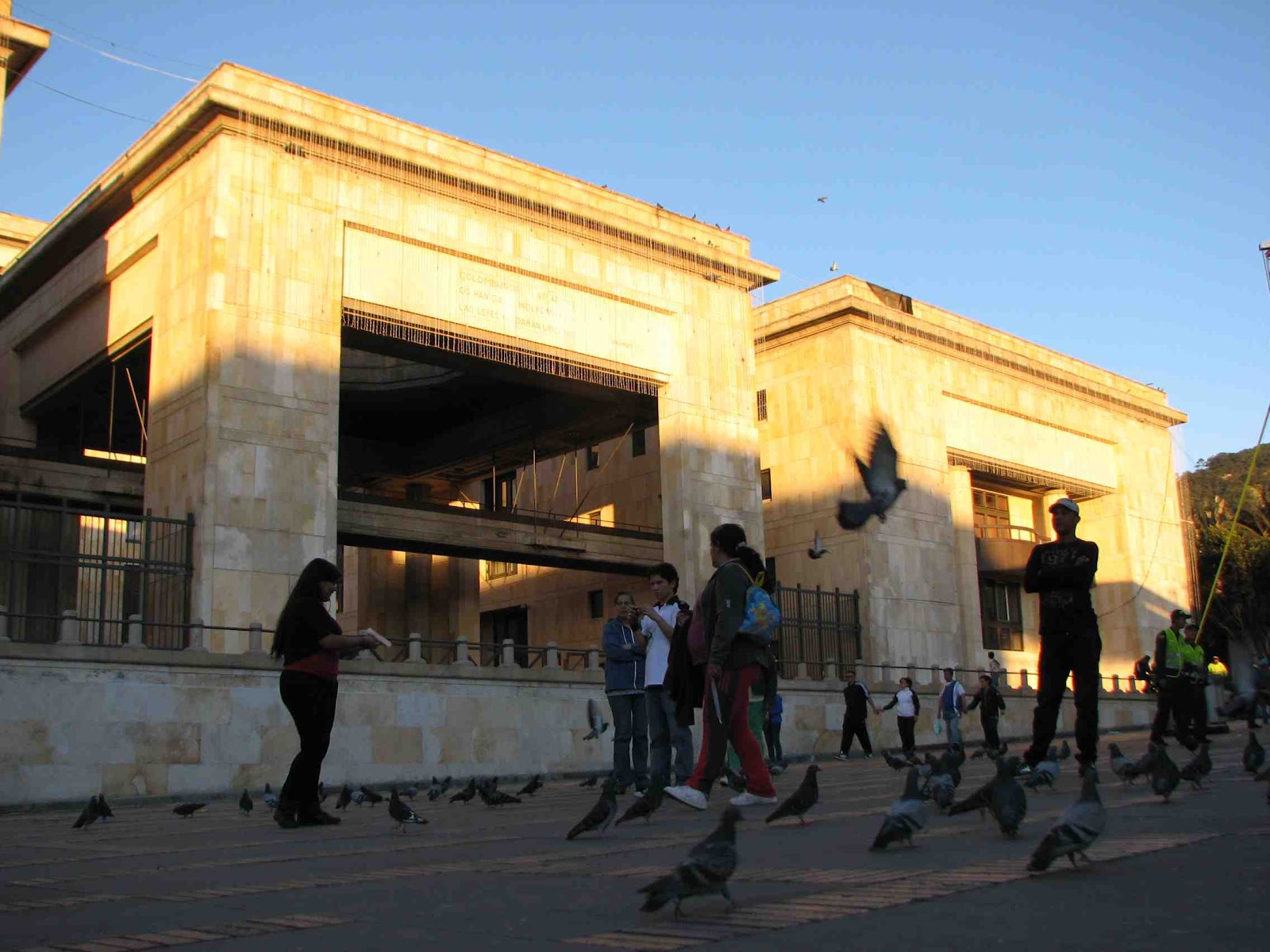
The Justice Palace on Plaza Bolívar in Bogotá was
destroyed in a 1985 M-19 guerrilla  attack and
rebuilt about the year 2000.
The M-19 - young, educated, idealistic and media-savvy, carried out a series of dramatic operations which culminated disastrously with their 1985 attack on the Justice Palace on Plaza Bolívar. After the M-19 took the magistrates hostage, the military counterattacked with tanks fire. The Justice Palace was destroyed and about 100 people were killed, including 11 of the 12 justices. The building was burned and gutted.

A plaque in Bogotá's City Hall memorializes
people disappeared during the Justice Palace
conflict.
A few years later, the M-19 turned in their weapons and became a political party. In 1991, they even played an important role in the writing of Colombia's new Constitution, and can be credited for its progressive features.

Today, some of the ex-M-19 leaders are in Congress, and one, Gustavo Petro, is mayor of Bogotá.

Rojas' legacy has also persisted in more destructive ways. His grandson, Samuel Moreno Rojas, was mayor of Bogotá from 2008 to 2011, and allegedly stuffed his pockets in a huge corruption scheme. Now, Samuel and his brother Ivan, a senator, are in prison awaiting trial. They claim to be innocent.

Ironically, Samuel Moreno is accused of taking kickbacks on contracts for work on Ave. 26 - which his grandfather had constructed.

And Rojas' legacy probably isn't over.

By Mike Ceaser, of Bogotá Bike Tours

Friday, April 20, 2012

The M-19 Goes Full Circle

A once-unbelievable seen: The M-19 flag flies before the Justice Palace, which the M-19 guerrillas attacked, disastrously, in 1985.
The M-19's annual auto-hagiography on the Plaza Bolivar has new resonance this year, now that one-time M-19 leader Gustavo Petro is mayor of Bogotá.

The M-19 guerrillas were young, idealistic and media savvy. But they also committed horrendous crimes, including the kidnap-murder of Afro-Colombian union leader Jose Mercado and the 1985 attack on the Justice Palace, which ended with about 100 deaths and the building in flames. (Mayor Petro says he had no knowledge beforehand about the palace attack.)

The M-19, or 19 of April Movement, named themselves after the date of a 1970 presidential election allegedly stolen from dictator-turned-populist politician Gustavo Rojas Pinilla.

A man in a wheelchair reades an exhibit about the M-19. 


The M-19's flag flies before Bogotá's City Hall, now headed by ex-M-19 leader Gustavo Petro. 

Bricks on Plaza Bolivar represent victims of violence. Several military officials are now in prison for human rights violatoins committed during the retaking of the palace. 


A comedian attracts a crowd on Plaza Bolivar. He got lots more attention than did the M-19' exhibit. 

The M-19 demobilized after the disastrous Justice Palace attack and in 1991 participated in the writing of a new Colombian Constitution, which is still in force today. 


'Armed Propaganda.' The M-19 invaded small leftist newspapers, giving them a justification to publish pro-guerrilla propaganda. 


By Mike Ceaser, of Bogotá Bike Tours

Sunday, January 1, 2012

Petro's Political Pedigree


New Mayor Gustavo Petro is the
product of a complex political history.
Today, Gustavo Petro was inaugurated as mayor of Bogotá. He'll now preside in the just-expanded City Hall on the west side of Plaza Bolivar.

Petro was a leader of the M-19 guerrillas, who in 1985 attacked the Justice Palace building, on the right. He's now mayor of Bogota, presiding in City Hall, on the left. In front of the buildings are the tents from today's inauguration. 
But Petro's political past has also involved the Justice Palace on the plaza's north side, and Congress on its south side. His unlikely and remarkable story illustrates both the contradictions and interconnectedness of Colombian politics.

Petro was born in 1960, the son of a schoolteacher, and grew up in the town of Zipaquira, north of Bogotá. Petro early became a leftist, thru the reading of Gabriel Garcia Marquez and friendships with union members.

Tomb of military dictator Gustavo Rojas Pinilla,
whose losing candidacy inspired the  M-19
guerrilla movement.
When Petro was ten, one-time military dictator Gustavo Rojas Pinilla, now recycled as a populist, nationalist candidate, ran for president and lost by a sliver to a conservative. Petro had been overthrown in 1957 for good reason - he had massacred protesters and shut down the nespapers, amongst other crimes. Nevertheless, Rojas Pinilla became the darling of the left, his supporters cried fraud and founded the Movimiento 19 de Abril, or M-19 guerrilla movement.

Almost as soon as he graduated from high school at age 16, Petro joined the M-19 guerrillas and eventually become one of its leaders.

The M-19 started out with dramatic gestures, such as the theft of revolutionary leader Simon Bolívar's sword from one of his statues. "Bolivar's sword returns to battle," the M-19 announced.

The tomb of assassinated M-19
presidential candidate Carlos Pizarro,
perhaps Petro's political inspiration.
Note Bolivar's sword on the tomb.
But the M-19's acts were not always so idealistic. In 1976 they kidnapped and murdered union leader Jose Mercado and discarded his corpse in the street. They also took over the Embassy of the Dominican Republic during a diplomatic party. That attack ended bloodlessly, with the guerrillas carrying out something of a victory parade to the airport, from where they left for Cuba. In 1985, the group invaded the Justice Palace on Plaza Bolivar, took the Supreme Court justices hostage and demanded that Pres. Belisario Betancur submit to a guerrilla trial. Instead, the government counter-attacked, the building was destroyed and 11 of the 12 supreme court justices died, amongst some 100 deaths in total.


Jose Mercado,
union leader kidnapped
and murdered by the M-19 guerrillas.
Close to three decades later, the wounds remain open from what is known as 'The Holocaust of the Justice Palace.' Families still search for relatives who disappeared during the attack and counterattack and the general who commanded the counterattack is in prison for human rights violations.

1985: The Justice Palace in flames
after the M-19 attack. 
The rebuilt Justice Palace today. 
A few years after the attack the M-19 demobilized and turned into a political party. Today, several ex-M-19 leaders are in Congress, one is a governor, and Petro is mayor of the nation's capital city. Petro, of course, claims that he knew nothing about the Justice Palace attack.

After their demobilization, M-19 chose Carlos Pizarro as its presidential candidate. In 1990, Pizarro was assassinated - one of four candidates assassinated during that campaign. Surprisingly, the M-19 did not return to violence and participated in the 1991 convention which rewrote Colombia's constitution.

A plaque on City Hall memorializing the 1985 attack. 
Petro served in Zipaquira's City Council and later in Congress. As a congressman, Petro has been seen as idealistic, independent and non-corrupt. He has, for example, strongly criticized the FARC guerrillas and Venezuelan Pres. Hugo Chavez, despite the leftist revolutionary pretenses of both.

Petro won the election to a great degree because Bogotanos saw him as clean and independent. That made a sharp contrast to his predecessor Samuel Moreno Rojes, who is now in prison on corruption charges. Which brings up yet another irony: Moreno Rojas happens to be the grandson of dictator Rojas Pinilla, whose failed candidacy started Petro on the road to where he is today.

Perhaps the greatest significance of Petro's victory is its signal to the armed guerrilla groups which continue battling to overthrow the Colombian government. Mayor Petro is proof positive that the ballot can be a much more effective changemaker than the bullet. Are you listening, FARC?

A plaque near Plaza Bolivar paying tribute to the people who disappeared during the Justice Palace tragedy. 


An image full of contradictions: the grey plaque on Seventh Ave. memorializes protesting students massacred by dictator Rojas Pinilla in 1954. Beside it is a campaign poster for Petro, whose political career has its roots in Rojas Pinilla's failed presidential campaign. The building is covered with graffiti left by recent student protesters.

Scrawled on a wall along Seventh Ave., apparently by student
protesters: 'Against the Santos dictatorship, the M-19 gets ready.'
But Santos is no dictator,
and the M-19s leaders are in government. 
Petro's first statements as mayor sound positive: he repeated his intention to charge car drivers a congestion fee, which will subsidize public transportation. He also promised to tax the rich - a necessary move try to reduce the city's huge wealth gap. And he also plans to create new public universities. That's good, not only because it'll the city's youth more hope and opportuity, but also because it could reduce the crime rate by putting young people on a constructive track.

He also intends to give the poor a monthly stipend of water for free. The intention is good, but the method is mistaken: giving things away for free just promotes waste. A much better policy would be to provide subsidized water-saving devices like low-flow shower heads and toilets. That would save people money as well as conserving water.

By Mike Ceaser, of Bogotá Bike Tours

Monday, January 24, 2011

Tribute to a Dictator

Rojas Pinilla's Colorful Tomb
The other day, these women dressed up Colombian dictator Gustavo Rojas Pinilla's tomb in Bogotá's Central Cemetery to commemorate the anniversary of his Jan. 17, 1975 death.

Rojas' five-year reign from 1953 to '57 was Colombia's last all-out dictatorship, although several authoritarian but democratically-elected governments have followed.

Rojas played a contradictory and paradoxical role in Colombian history. A hero from the war against Peru, his dictatorship is remembered quite positively, including naturally by these women, who talked about Rojas' public works projects but dismissed my suggestion that Rojas' government had violated human rights. Of course, context also counts. Rojas took command with a coup amidst a near civil war called La Violencia between the Liberal and Conservative political parties.

Rojas managed to stabilize the country, built great public works projects and gave women the vote, for which he is remembered positively. However, during his government the seeds were planted for Colombia's ongoing guerrilla insurrection.

Plaque on Seventh Ave. in Bogotá
commemorating students massacred by
the government in 1954. 
I had to search hard to find mention of the Rojas dictatorship's dark side: discrimination against non-Catholics, shuttering of newspapers, repression of the country's traditional labor unions, massacres of university students and even of bullfighting fans who had booed his daughter.

After being forced from power in 1957, Rojas fled Colombia - to either Spain or the Dominican Republic, historians aren't certain. But he returned, converted into a leftist populist, and ran for president in 1970. The official results gave Rojas' conservative opponent, Misael Pastrana Borrero, a narrow victory, but Rojas' supporters claimed fraud.

Those fraud claims gave rise to the M-19 guerrillas, who would play a prominent role in Colombia from the 1970s through the '90s.

In yet another strange twist of history, current leftist Bogotá Mayor Samuel Moreno Rojas is Dictator Rojas Pinilla's grandson.

By Mike Ceaser, of Bogotá Bike Tours