Showing posts with label activism. Show all posts

Wednesday, June 10, 2015

Scaring Away More Than Bad Spirits


Perhaps two dozen of these crude scarecrows appeared on the National University campus today, most of them behind the Sociology Dept. building, on the lawn known as the Plaza de Freud.

The 'crows were created by sociology students in a symbolic gesture to scare away right-wing paramilitaries who, a student said, have been sending death threats to leftist student activists. Can scarecrows scare away paramilitaries? We can only hope.


By Mike Ceaser, of Bogotá Bike Tours

Sunday, December 21, 2014

Orlando's Victory Moment


Orlando, Bogotá's best-known pro-Cuba activist, who can be seen every Sunday on La Ciclovia riding his bike bedecked with pro-Cuba, anti-United States placards.

Today, Orlando was celebrating the agreement reestablishing diplomatic relations between the two countries, which was widely seen as a Cuban victory over the planet's sole superpower. By withstanding decades of poverty and deprivation, Cuba outlasted the will of Washington, which finally concluded that the feud was futile and counterproductive for both countries.

"Cuba got its way!" Orlando yelled.

The sudden warming between the two nations also removes a source of irritation for the region. Colombia, for example, will no longer have to apologize for its alliance with the U.S. - at least as far as Cuban politics go.


Orlando and friend on La Ciclovia today.

By Mike Ceaser, of Bogotá Bike Tours

Wednesday, November 26, 2014

Paper Butterflies in La Nacho

Fold it this way.
During a bike tour today, we got a lesson from Alexei in folding paper butterflies, part of Bogotá's week against violence against women.
Look - I made a buttefly!
Participants wrote anti-violence messages on the butterflies' wings and glued them to the wall.

'Down with machismo!'


'Strong ovary!'
By Mike Ceaser, of Bogotá Bike Tours

Monday, May 19, 2014

Abortion's Back in the News


Opponents of abortion marched the other day thru downtown commemorating - and mourning - the eighth anniversary of Colombia's legalization of abortion in a few narrow circumstances: rape, incest, when the woman's life is in danger and when the fetus has a severe deformity.

Abortion law returned to the news early this month when the legislature passed a law expanding abortion to women who are victims of the country's armed conflict. In practical terms, I'm not sure how this expands the right, since these women presumably are victims of sexual violence. Or, perhaps they are not victims of physical violence, but acted under duress and threats.

Abortion opponents say that the procedure both kills babies and harms the mother physically and psychologically. Abortion rights advocates say that many girls and women who have the right to abort are not able to legally because of obstacles from courts and doctors. And, legal or not, abortion will happen anyway, they argue.

According to the Gutmacher Institute, which supports legalized abortion, some 400,000 abortions are performed annually in Colombia, of which only 322, or less than one tenth of one percent, are legal abortions.


By Mike Ceaser, of Bogotá Bike Tours

Sunday, May 18, 2014

Cannabis Carnaval

Take a few. This guy is with Colombiacultiva.org and the Colombian seeds store.
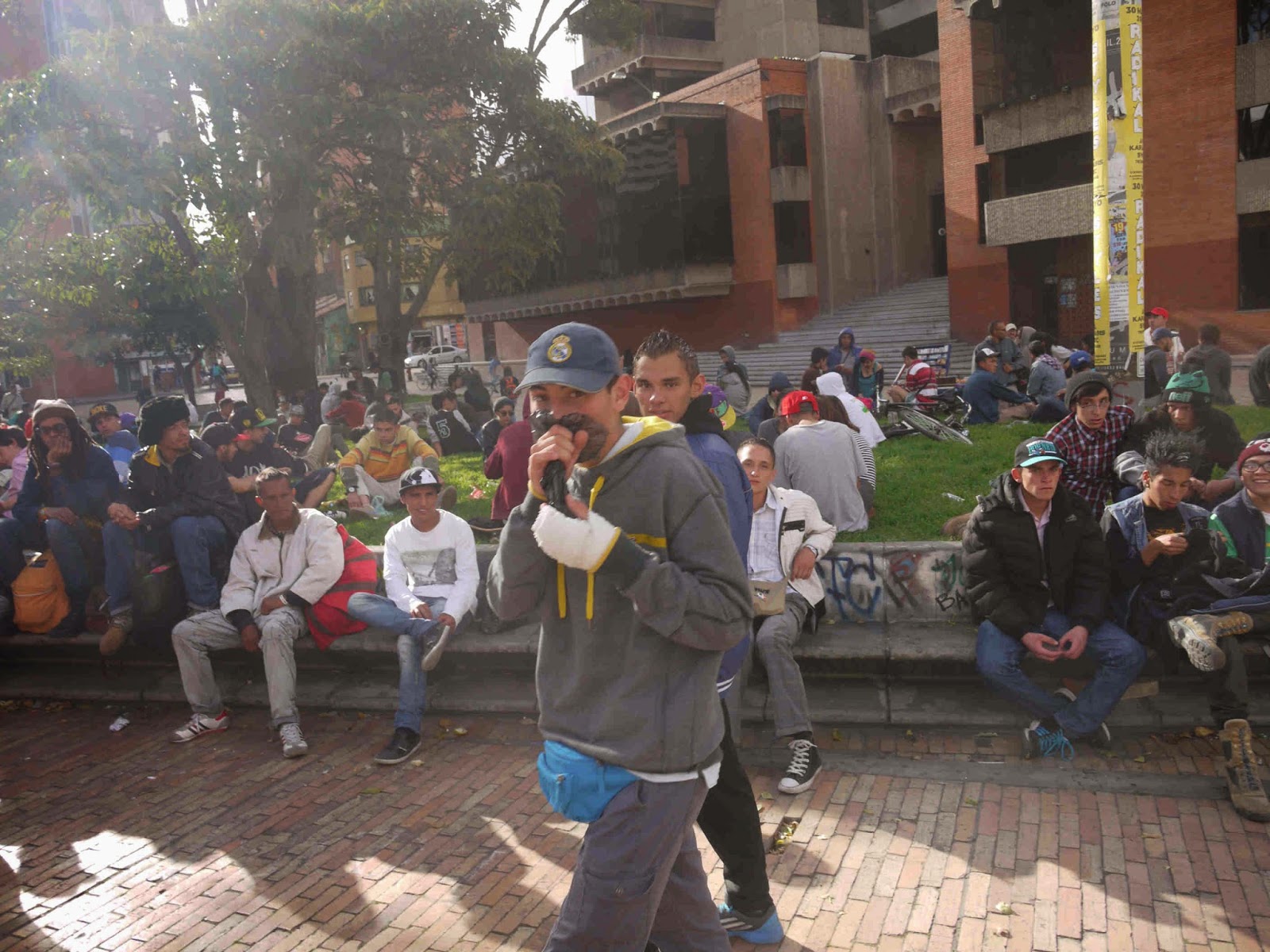
If you passed thru the Parque Nacional or the Plaza del Periodista today, you probably know that today was the annual Cannabis Carnaval, which calls for marijuana legalization, or, at least, the creation of designated 'free smoking areas.' 

By the look of things, for today at least, the Plaza del Periodista was one of those areas. Police stood nearby and just watched the smoke rise from the plaza's patch of grass.

What's that? An adolescent pot plant.
Power to the potheads!
'No to erradication!'
The cops didn't seem to care today. Maybe they can recognize a lost cause.
A girl waves colorful flags for the potheads.

Pipes and other paraphernalia for sale.


Two young guys walk past sniffing glue, a common addiction among young people, especially the homeless.

By Mike Ceaser, of Bogotá Bike Tours

Sunday, May 4, 2014

Demanding Justice for a Murdered Son


In late September 2006, Raul Antonio Carvajal, a 29-year-old army corporal, called his father and told him that his superior officers had ordered him to kill innocent people and turn their bodies over as supposed guerrillas. Carvajal disobeyed the command, his father, also named Raul Carvajal, said, and 18 days later, on October 8, he was murdered himself, his father said.
Raul Carvajal, right, tells a passer-by
the story of his murdered son.

The elder Carvajal has been protesting the last several days with his truck covered with billboards denouncing the Alvaro Uribe administration parked in front of the San Francisco Church at the intersection of Carrera Septima and Ave. Jimenez.

Carvajal says that the courts and government have ignored his demands for justice. He believes that is because of the continuing influence of ex-Pres. Alvaro Uribe, who was recently elected to the Senate, and of current Pres. Santos, who was Uribe's minister of defense. In what became known as the False Positives scandal, thousands of young men, mostly peasants, were murdered by military units and labeled as guerrillas in order to earn bonuses and time off. In the investigations and prosecutions which followed, neither Santos nor Uribe was directly implicated in the crimes. According to United States diplomatic cables released by Wikileaks, Santos wanted the killings investigated at the time.

Carvajal believes that his son was murdered by other members of the military for either refusing to participate in the killings or trying to report them.

"I want the world to know about these killings," Carvajal says. "I want justice done."


By Mike Ceaser, of Bogotá Bike Tours

Saturday, December 29, 2012

Carlos Castaño's Human Rights Campaign

A boy examines photos swinging in the wind. 
Carlos Castaño, el Bueno.

Carlos Castaño, the name of the leader of the United Self-Defense Forces of Colombia, or AUC, is about the most notorious name in Colombian history thanks to the horrific rights abuses he ordered.

But there's another Carlos Castaño, who calls himself 'El Bueno' and hails from the other end of the political spectrum, who is carrying out Bogotá's most prominent one-man human rights campaign.

Alvaro Uribe, dictator?
This Castaño, 50, came from a peasant family in the Antioquia region. At age 22 he joined the EPL guerrilla group, which reached a peace treaty with the government and demobilized in 1991. Castaño blames the EPL's leadership for accepting benefits from the government and selling out their principles. Just before the demobilization, however, Castaño said he had survived a massacre in which 6 peasants were murdered - one of many crimes and injustices which he blames on the Colombian government.

He became a farmer in Tolima. But says that in 2002 he and his family were forced to flee because of violence from right-wing paramilitaries, who may have answered to the other, EVIL Carlos Castaño, who was murdered by other paramilitaries in 2004.

Pedestrians ponder a photo celebrating Che Guevara.
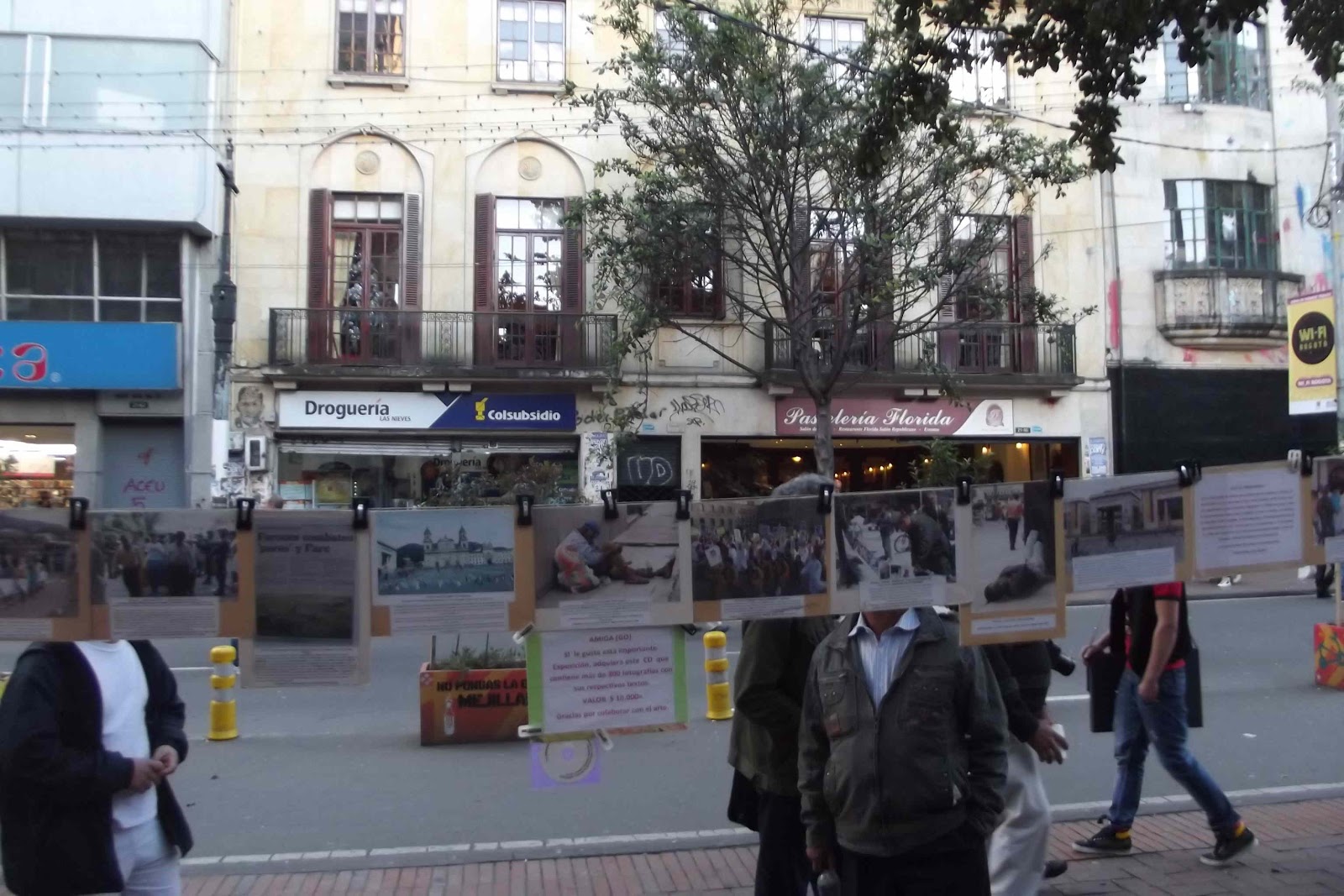
Then, Carlos Castaño, el bueno, fled to Bogotá, where he set began setting up his photo exhibitions. He displays hundreds of photos on long strings strung between trees and posts on the sidewalks. Most of the photos, he says, he took himself.

"I'm just out here giving a bit of truth to the people," Castaño says.

Castaño says he's been harassed by the police, who have confisticated his photos, searched his home and even accused him of being a terrorist. He considers himself only a truth-teller.

"If this is terrorism," he says, motioning to his photos, "then let's have more of it."

He hasn't had trouble recently, he says. The city's decision to ban cars from this stretch of Ave. Septima helped, as does the fact that Mayor Gustavo Petro was once a guerrilla himself - in his case in the M-19 movement.

Castaño's photos are a grab-bag of images, denouncing human rights violations, social injustices, harm to the environment - even technology (altho Castaño is on Facebook).

A man walks past and demands of Castaño: "Where are the photos of the FARC and ELN guerrillas' human rights violations?"

Castaño smiles back at him. "Don't worry," he replies, "the RCN and Caracol television and radio networks are transmitting plenty of that."

Both men correct. Castaño's photos definitely concentrate on denouncing the government and rightist forces, while celebrating socialist icons, particularly Che Guevara. Contradictorily, one image labels Colombia's democratically-elected Pres. Alvaro Uribe as a 'dictator,' while a nearby photo idolizes Guevara, a leader of Cuba's dictatorship.

Colombia's guerrillas and right-wing forces have all committed grevious human rights abuses. But, while virtually nobody defends the paramilitaries, a significant group of self-deceiving idealists, both here and abroad, persist in celebrating the guerrillas, despite all of their crimes against the poor. For an example, see Mariana, the displaced woman begging across the street from Castaño.

A steady stream of passers-by stop and ponder Castaño's images. His low-tech exhibition likely gets many more visits than most websites about Colombian human rights. For Castaño, who travels around Colombia and even internationally displaying his pictures, the exhibition is not only a statement - it's also a living for him.

Police clash with demonstrators. 
"If you like the photos, how about contributing a few coins or a bill," he calls out, offering his collection can.

So, Castaño has joined the ranks of the professional displaced people, whom we see begging on Colombia's sidewalks displaying signs pleading 'Desplazados Por La Violencia. Favor Ayudarnos.' But turning into a lifetime beggar only perpetuates victimization and helplessness. Castaño may be living off of his tragedies, but at least he's also doing something constructive.

The message laments displacement of peasants. 
An idealist, Castaño expresses pessimism on Colombia's prospects for resolving its human rights problems and persistent injustices. In the FARC-government peace negotiations just starting up now in Havana, Cuba, Castaño expects the FARC leadership to sell out just as he accuses the EPL leaders of having done two decades ago.


Carlos, a bit ironically, hangs his photos on one of Bogotá's most commercial avenues. 


Carlos's photo of a policeman photographing Carlos while confisticating his photos.


'Donations please.'


'I fear the day that technology overtakes mankind.' Albert Einstein. 

Marx, Hitler, Einstein and Fidel Castro. A strange crowd at the Last Supper. 

By Mike Ceaser, of Bogotá Bike Tours