Showing posts with label globalization. Show all posts

Friday, January 11, 2013

Colombian Patrimony: Made in China

Boy scouts relaxing in sombrero vueltiao hats today in La Candelaria.
The news that one of Colombia's national symbols, the sombrero vueltiao, is being imported from China, should make Colombian officials reflect on the consequences of its rush to open itself to free trade.

The hat is traditionally made by residents of the Zenú indigenous territory San Andrés de Sotavento. As you can see here, it's a slow, laborious process.

This story in El Tiempo describes the poverty in which many of the traditional hat weavers live, how they may spend a week making a single hat, which they sell for 120,000 pesos, and how that hat gets resold for several times as much in the big city. The article also mentions that some Chinese businesses had approached a traditional hatmaker offering to pay him for his methods. The artisan says he refused - but the Chinese evidently learned, anyway.

That Chinese factories can make sombreros vueltiao faster and cheaper than traditional weavers is no surprise. And Colombia's proposed government measures, such as labeling hats' countries of origin, aren't likely to make much difference. Colombia's only real option for keeping the hat industry at home is to set up its own factories - altho that would put even more pressure on the traditional hatmakers. Even then, we can only hope that Colombian industry can outcompete the Chinese, even with the Chinese' extra costs of shipping their products halfway around the globe.

Sombrero vueltiao hats for sale near El Museo de Oro. I couldn't find a label saying where they'd been made.
This is yet another sad consequence of globalization, which makes meaningless merchandise out of a national symbol and takes away the livelihoods of traditional craftspeople.

A traditional weaver at work.
Perhaps, at least, the Chinese factories are weaving their sombreros out of Colombian-grown fibers. If so, they'll be following the sad pattern that's trapping Latin American countries in underdevelopment - exporting their raw materials to China, which manufactures them into retail products and sells them back to Latin America at a profit.

But don't blame the Chinese, tho, who are just working hard. Blame the countries which allow themselves to be treated this way.


By Mike Ceaser, of Bogotá Bike Tours

Friday, October 12, 2012

Memorializing the Horrors of El Caucho

Chained indigenous rubber workers. 
Rubber king Arana.
A rubber industry workhouse. 
Colombia's indigenous people of the Amazon are commemorating the 100th anniversary of the horrific rubber boom at the beginning of the last century, when tens of thousands of indigenous people were enslaved and worked to death by a Peruvian company exporting its production to English industries in this early example of globalization.

Sir Roger Casemont, an Englishman
who investigated the rubber industry's
horrors.
Today, Pres. Santos sent the indigenous communities a message "asking for forgiveness for your dead, your orphans and your victims" sacrificed "for a supposed 'progress' which didn't understand the importance of safeguarding every person and every indigenous culture."

La Voragine, a classic novel
about the rubber industry's abuses.
(Some would argue that those words could also apply to the development 'locomotives' being promoted by Santos' government today, most of which consist of digging up and exporting the nation's natural resources, at great cost to its biodiversity and indigenous cultures.)

The horrors of the rubber, or caucho, exploitation were immortalized by Colombian writer José Eustasio Rivera in his 1924 novel El Voragine.

Almost all of the rubber production was done in the Putumayo region by a Peruvian company named La Casa Arana, which exported most of its rubber to England, altho the United States' automobile boom also drove the demand for rubber.

A sign today on Plaza Bolivar says that native
peoples have nothing to celebrate.
The English carried out several investigations, led by Irishman Sir. Roger Casemont, which reported the horrors of slavery, torture and mass murder in the rubber production. But the industry only declined after the English exported seeds and planted rubber in Africa and Malaysia, where production and transport were cheaper.

The story has a dramatic postscript. Casemont, who had also investigated atrocities by Belgium in the African Congo, went on to fight for Irish independence - by conspiring with Germany during World War I. However, he was captured by the British and hanged in 1916. Mario Vargas Llosa wrote Casemont's story in his recent historical novel  'The Dream of the Celt.'

An indigenous woman and child begging on a sidewalk in downtown Bogotá. Indigenous people from the Amazon have had a particularly difficult time integrating into western culture. 

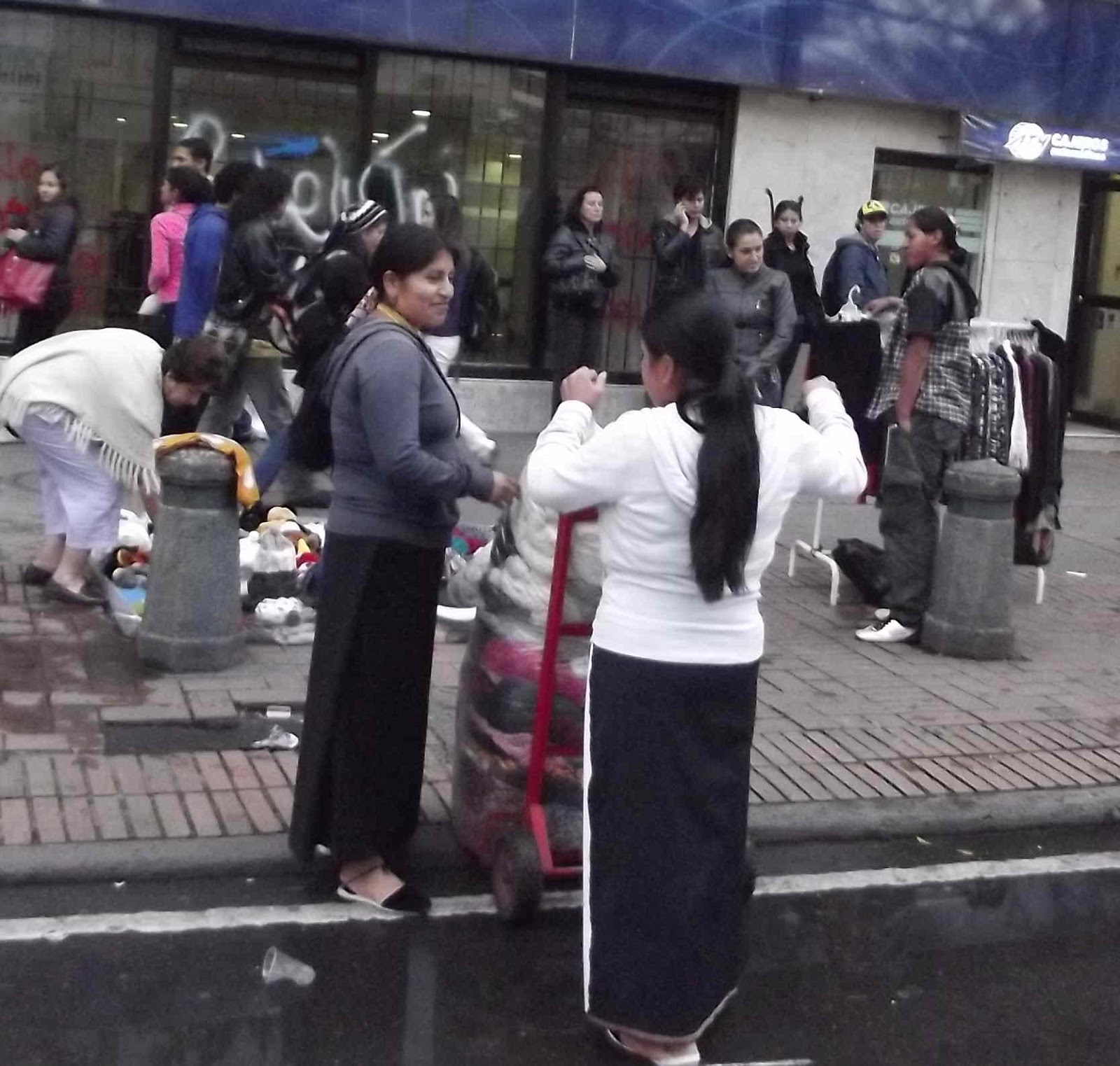
Indigenous women street merchants. Indigenous people from mountain and desert regions, particularly Quechua speakers from Ecuador, seem to succeed relatively well commercially. 

An indigenous woman wheels her wares past a street mural saying 'Mucho Indio.'


By Mike Ceaser, of Bogotá Bike Tours

Friday, September 21, 2012

Millos Goes Global

Millonarios, probably Bogotá's primier football team, has sold 20% of itself to a Spanish investment firm - owned by Americans. And the New York-based investment firm is headed by an Armenian born in Lebanon who studied business in France.

The purchase is of course yet another sign of how money - and sports - is getting globalized.

It also says something about the priorities of Spain, which is near bankruptcy, but one of whose football teams still found the spare millions to contract Falcao, Colombia's best football player.

Futbol, in fact, seems to be about the only thing in which the beleagured Spanish continue excelling, altho most of their teams' stars are foreigners.

Will this cash injection improve Millonarios' performance, especially in international play, where Colombian teams have often disappointed?

Perhaps that will depend on whether the team plays U.S.- or Spanish-style football.

By Mike Ceaser, of Bogotá Bike Tours