Showing posts with label amazon. Show all posts

Thursday, October 10, 2013

Kevin Scott's Great Adventure

Kevin Scott, in the Colombian Amazon,
shortly before wandering off into FARC's hands.
(Photo: El Tiempo)
Kevin Scott, apparently, does not read Wikipedia. If he had, he might have learned that San José del Guaviare, a town deep in Colombia's Amazon, is the historical base of the FARC Guerrillas and not a reccomended tourist destination - particularly for an ex- military man from the United States.

But Scott, a 27-year-old ex-Marine, got it into his head to walk from San José del Guaviare across the Amazon jungle to Brazil, armed only with a machete. It promised to be a great adventure, and turned into an even greater one when the FARC seized Scott on June 18 and began providing him free food and lodging (as well as Marxist ideology) for the duration.

When they initially kidnapped him, the guerrillas accused Scott of being a 'mercenary.' But they seem to have warmed up to him. Recently on their web page the guerrillas called Scott "a good gringo, naive and a daydreamer." That's probably not the way an ex-Marine likes to be described. But his family must be comforted to hear that Scott is alive, and apparently well, if a bit confused.

The guerrillas also described Scott as a hippy, who seems to have added a new dimension to couch surfing. After finishing his tour in Afghanistan, the FARC say, Scott "turned into a folkloric gringo, a gum chewer and marijuana smoker, who with a pack on his back, bluejeans and a few dollars in his pocket, set out to travel and get to know the world, with a very unique conception of life."

The FARC seem to have found in Scott an opportunity to wax poetic. They also hope he will get them some of the attention and legitimacy they perpetually craave. When U.S. civil rights leader Jesse Jackson visited Colombia recently, the FARC seemed willing to release Scott - as long as Jackson showed up for a photo opp at the release.

The Colombian government refused to cooperate. Now, Scott may have to wait until the next media star visits.

Scott, however, may not be impatient to live the jungle and guerrilla hospitality. On their website, the FARC quote Scott as saying that, before he leaves the jungle, he wants to see a tiger.

By Mike Ceaser, of Bogotá Bike Tours

Saturday, February 23, 2013

Leopoldo Richter's Lost World


Leopoldo Richter, a German artist, explorer and entomologist, fled his troubled nation for the Amazon in the 1930s and spent the next years exploring remotes areas of Brazil and Colombia, where he sketched native peoples whose lives had still not been altered by western culture. A small exhibition of Richter's drawing is on display now in Bogotá's Museo Nacional.

Since Richter's time, hunters, loggers, miners and farmers have invaded deeper into the Amazon, forever changing, and often destroying, the lives of native peoples, who often fall victim to new diseases, habitat loss and the temptations of junk food, alchohol and television.

Nevertheless, some uncontacted indigenous people still remain in the Amazon. Recently, Colombia approved Decreto 4633, requiring the government to protect land used by uncontacted peoples. In January, the government announced it would more than double the size of Chiribiquete National Park in the Amazon, from 1.3 million to 3 million hectares, in part to protect uncontacted native peoples.

However, many of the forces threatening these peoples' existence are illegal, and therefore nearly impossible to control.


By Mike Ceaser, of Bogotá Bike Tours

Friday, October 12, 2012

Memorializing the Horrors of El Caucho

Chained indigenous rubber workers. 
Rubber king Arana.
A rubber industry workhouse. 
Colombia's indigenous people of the Amazon are commemorating the 100th anniversary of the horrific rubber boom at the beginning of the last century, when tens of thousands of indigenous people were enslaved and worked to death by a Peruvian company exporting its production to English industries in this early example of globalization.

Sir Roger Casemont, an Englishman
who investigated the rubber industry's
horrors.
Today, Pres. Santos sent the indigenous communities a message "asking for forgiveness for your dead, your orphans and your victims" sacrificed "for a supposed 'progress' which didn't understand the importance of safeguarding every person and every indigenous culture."

La Voragine, a classic novel
about the rubber industry's abuses.
(Some would argue that those words could also apply to the development 'locomotives' being promoted by Santos' government today, most of which consist of digging up and exporting the nation's natural resources, at great cost to its biodiversity and indigenous cultures.)

The horrors of the rubber, or caucho, exploitation were immortalized by Colombian writer José Eustasio Rivera in his 1924 novel El Voragine.

Almost all of the rubber production was done in the Putumayo region by a Peruvian company named La Casa Arana, which exported most of its rubber to England, altho the United States' automobile boom also drove the demand for rubber.

A sign today on Plaza Bolivar says that native
peoples have nothing to celebrate.
The English carried out several investigations, led by Irishman Sir. Roger Casemont, which reported the horrors of slavery, torture and mass murder in the rubber production. But the industry only declined after the English exported seeds and planted rubber in Africa and Malaysia, where production and transport were cheaper.

The story has a dramatic postscript. Casemont, who had also investigated atrocities by Belgium in the African Congo, went on to fight for Irish independence - by conspiring with Germany during World War I. However, he was captured by the British and hanged in 1916. Mario Vargas Llosa wrote Casemont's story in his recent historical novel  'The Dream of the Celt.'

An indigenous woman and child begging on a sidewalk in downtown Bogotá. Indigenous people from the Amazon have had a particularly difficult time integrating into western culture. 

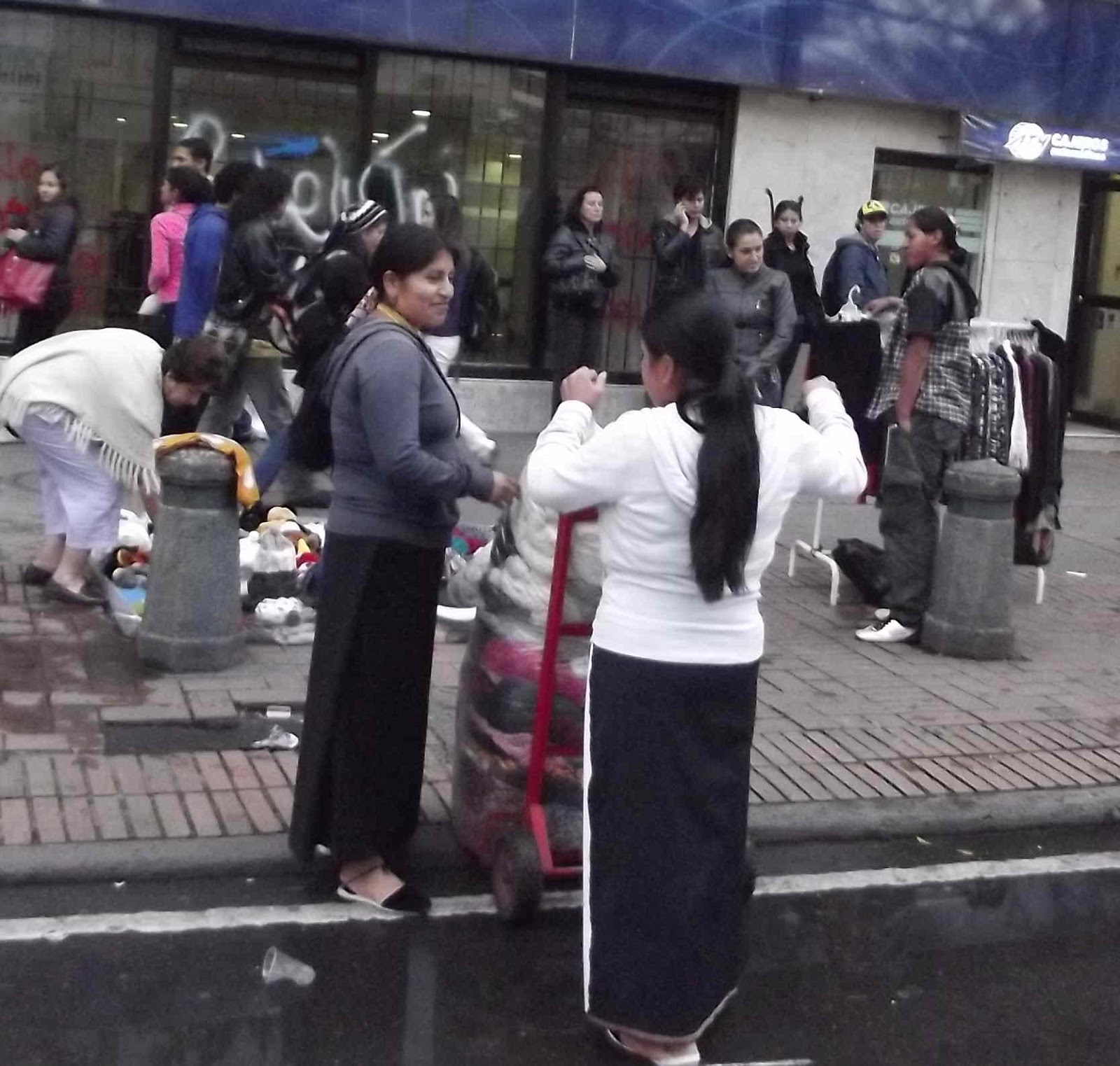
Indigenous women street merchants. Indigenous people from mountain and desert regions, particularly Quechua speakers from Ecuador, seem to succeed relatively well commercially. 

An indigenous woman wheels her wares past a street mural saying 'Mucho Indio.'


By Mike Ceaser, of Bogotá Bike Tours